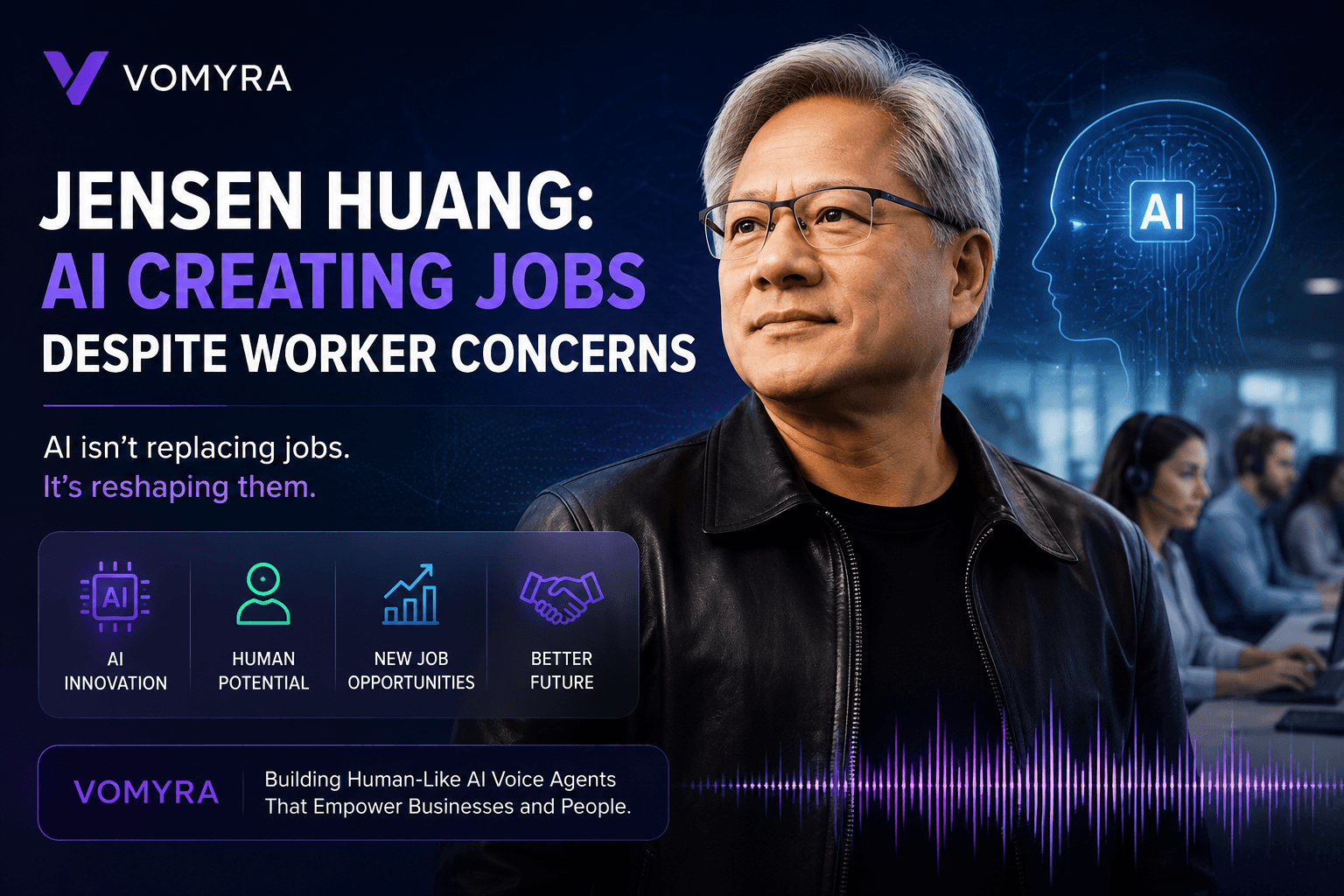
Artificial Intelligence has become one of the most discussed technologies of the decade. While many workers worry that automation could replace millions of jobs, Nvidia CEO Jensen Huang believes the future looks very different. According to Huang, AI is not simply eliminating jobs—it is creating entirely new career opportunities across industries.
His statement that AI is “creating an enormous number of jobs” has sparked conversations among business leaders, employees, economists, and technology experts worldwide. As companies continue investing heavily in AI tools, machine learning systems, and automation platforms, many people are asking the same question:
Will AI replace workers, or will it create more opportunities than it destroys?
The answer appears to be more complex than either extreme. While certain repetitive tasks are becoming automated, AI is also generating demand for new skills, specialized roles, and human expertise that didn’t exist a few years ago.
In this article, we’ll explore Jensen Huang’s perspective, examine how AI is changing employment, identify emerging job opportunities, and discuss how workers can prepare for the AI-powered future.
Why Jensen Huang Believes AI Creates More Jobs Than It Eliminates
Throughout history, major technological breakthroughs have often sparked fears about unemployment.
When factories introduced machines during the Industrial Revolution, many believed manual labor would disappear. When computers entered offices, workers worried administrative jobs would vanish. The rise of the internet raised concerns about traditional retail and media careers.
Yet history shows a different pattern.
Technology typically automates specific tasks while creating entirely new industries and professions. The internet, for example, led to the emergence of careers such as:
- Digital Marketing Specialists
- SEO Experts
- Social Media Managers
- Web Developers
- Cybersecurity Analysts
- E-commerce Consultants
Similarly, AI is creating roles that were virtually nonexistent just a few years ago.
According to Huang, businesses implementing AI systems still require humans to:
- Manage AI workflows
- Monitor outputs
- Ensure quality control
- Handle complex decision-making
- Maintain customer relationships
- Train and optimize AI systems
Instead of replacing every worker, AI is changing how work gets done.
The Evolution of Jobs in the AI Era
Many jobs are not disappearing entirely. Instead, they are evolving into more strategic and value-driven positions.
For example, customer service representatives are increasingly supported by AI chatbots and voice assistants. However, human agents remain essential for handling sensitive situations, escalations, and complex customer concerns.
Likewise, AI can analyze large datasets in seconds, but businesses still need professionals to interpret findings and make informed decisions.
This shift is creating a new category of jobs focused on collaboration between humans and AI systems.
What Types of Jobs Is AI Creating Right Now?
The AI economy is already generating thousands of new opportunities worldwide.
1. AI Trainers
AI systems require human guidance to learn industry-specific knowledge and improve accuracy. AI trainers help teach systems how to respond correctly in different scenarios.
2. Prompt Engineers
As generative AI tools become more common, companies need professionals who understand how to create effective prompts that generate useful and accurate outputs.
3. AI Operations Specialists
Organizations require experts who can monitor AI systems, troubleshoot issues, and optimize performance.
4. Data Quality Analysts
AI models are only as good as the data they receive. Data quality specialists ensure information remains accurate, consistent, and relevant.
5. AI Ethics and Compliance Officers
As regulations surrounding AI continue to evolve, businesses need professionals who can ensure ethical and legal AI implementation.
6. Human-AI Collaboration Managers
Many companies are creating roles focused on improving workflows between employees and AI systems.
Traditional Jobs vs. Emerging AI Roles
| Traditional Role | AI-Era Position |
| Call Center Agent | AI Conversation Supervisor |
| Cold Caller | AI Lead Qualification Specialist |
| Data Analyst | AI Insights Manager |
| Quality Inspector | Predictive Maintenance Coordinator |
| Customer Support Agent | AI Escalation Specialist |
| Research Assistant | AI Research Strategist |
| Diagnostic Technician | AI-Assisted Diagnostic Analyst |
This transition demonstrates that AI often changes job responsibilities rather than eliminating entire professions.
How Indian Businesses Are Adapting to AI
India has become one of the fastest-growing AI markets globally. Organizations across sectors are rapidly adopting automation, machine learning, and conversational AI technologies.
Technology hubs like Bangalore, Hyderabad, Pune, and Gurgaon are seeing increasing demand for professionals who can combine technical expertise with business knowledge.
Companies implementing AI solutions often discover that human oversight remains essential.
For example, businesses using AI-powered customer support tools still need professionals to:
- Handle complex customer issues
- Build long-term relationships
- Monitor AI conversations
- Ensure customer satisfaction
- Maintain brand reputation
This trend is particularly visible in the voice automation sector. Businesses using advanced voice AI platforms such as Vomyra can automate repetitive customer interactions while allowing human teams to focus on higher-value conversations, sales opportunities, and strategic customer engagement.
Why Human Skills Are Becoming More Valuable
One of the biggest misconceptions about AI is that technical skills alone will determine future success.
In reality, many uniquely human capabilities are becoming increasingly important.
Emotional Intelligence
AI can process data, but it struggles to genuinely understand human emotions, empathy, and relationship dynamics.
Critical Thinking
Businesses need employees who can evaluate AI-generated outputs and make informed decisions based on context.
Creativity
While AI can generate content and ideas, human creativity remains essential for innovation, storytelling, branding, and strategic planning.
Leadership
Organizations still require leaders who can inspire teams, manage change, and navigate uncertainty.
Ethical Decision-Making
As AI becomes more integrated into society, ethical judgment will become increasingly valuable.
The Biggest Challenge: Workforce Reskilling
Although AI creates opportunities, the transition is not always easy.
Workers whose roles involve repetitive or predictable tasks may need to develop new skills to remain competitive.
The most successful professionals are focusing on:
- AI literacy
- Digital skills
- Data interpretation
- Problem-solving
- Communication
- Project management
- Customer relationship management
Businesses are also investing heavily in employee training programs to help teams adapt to AI-powered workflows.
Those who embrace continuous learning are likely to benefit most from the changing job market.
AI and the Future of Work: Opportunity or Threat?
The future of employment is unlikely to be a simple story of job losses or job gains.
Instead, we’re witnessing a transformation in how work is performed.
Some routine tasks will become automated. However, new responsibilities, industries, and professions will emerge alongside these changes.
Organizations adopting AI often realize that technology works best when paired with human expertise. Whether it’s healthcare, finance, education, manufacturing, sales, or customer support, AI performs most effectively when people remain actively involved.
Businesses leveraging AI-powered communication tools, automation platforms, and voice agents—including solutions from Vomyra AI Voice Platform—are finding that automation increases efficiency while creating opportunities for employees to focus on higher-value work.
This balance between human intelligence and artificial intelligence may ultimately define the next generation of employment.
Conclusion
Jensen Huang’s claim that AI is creating more jobs than it eliminates reflects a broader historical pattern seen during previous technological revolutions. While automation will undoubtedly reshape many industries, it is also generating entirely new career paths and business opportunities.
The workers who thrive in this environment will be those who adapt, learn continuously, and develop skills that complement AI rather than compete directly with it.
Instead of asking whether AI will replace humans, a better question may be:
How can humans and AI work together to create more value than either could alone?
As we move deeper into the AI era, that collaboration will likely become the foundation of future careers and economic growth.
Frequently Asked Questions (FAQs)
1. Is AI creating more jobs than it eliminates?
Many experts believe AI will create significant new job opportunities, although some traditional roles may be reduced or transformed. Historical technology shifts suggest long-term job creation often outweighs job displacement.
2. What are the fastest-growing AI-related jobs in 2026?
AI trainers, prompt engineers, AI operations specialists, data quality analysts, AI compliance officers, and machine learning consultants are among the fastest-growing roles.
3. Which industries are hiring the most AI professionals?
Technology, healthcare, finance, customer service, manufacturing, logistics, and e-commerce are leading AI-related hiring efforts globally.
4. What skills should workers learn to stay relevant in the AI age?
Workers should focus on AI literacy, communication, problem-solving, emotional intelligence, creativity, data interpretation, and leadership skills.
5. Will AI completely replace customer service jobs?
No. AI can automate routine interactions, but human agents remain essential for handling complex issues, emotional situations, relationship-building, and strategic customer engagement.