The Question Every Voice AI Builder Is Asking
In 2025, speech-to-speech AI models arrived with demos that changed what developers expected from voice technology. A single model taking audio in and returning audio out, with no text intermediary, achieving conversational latency that made the three-stage pipeline feel architecturally clumsy by comparison.
The question that entered every voice AI architecture discussion from early 2026 onward is whether that demonstration performance translates into the production deployments that actual businesses run on actual customer calls.
The answer, as of mid-2026, is more specific than most architecture posts acknowledge: cascaded pipelines remain the production standard for enterprise telephony deployments, speech-to-speech models are winning in specific consumer-facing and web-based use cases, and a hybrid architecture is emerging as the pattern that most serious builders are converging on for complex commercial applications.
Vomyra AI Voice Agent is built on the cascaded pipeline architecture with streaming optimisations that push its Indian telephony latency to under 500 milliseconds. Understanding why that choice was made for the Indian market requires understanding what the architecture debate is actually about.
Architecture One: The Traditional Cascaded Pipeline
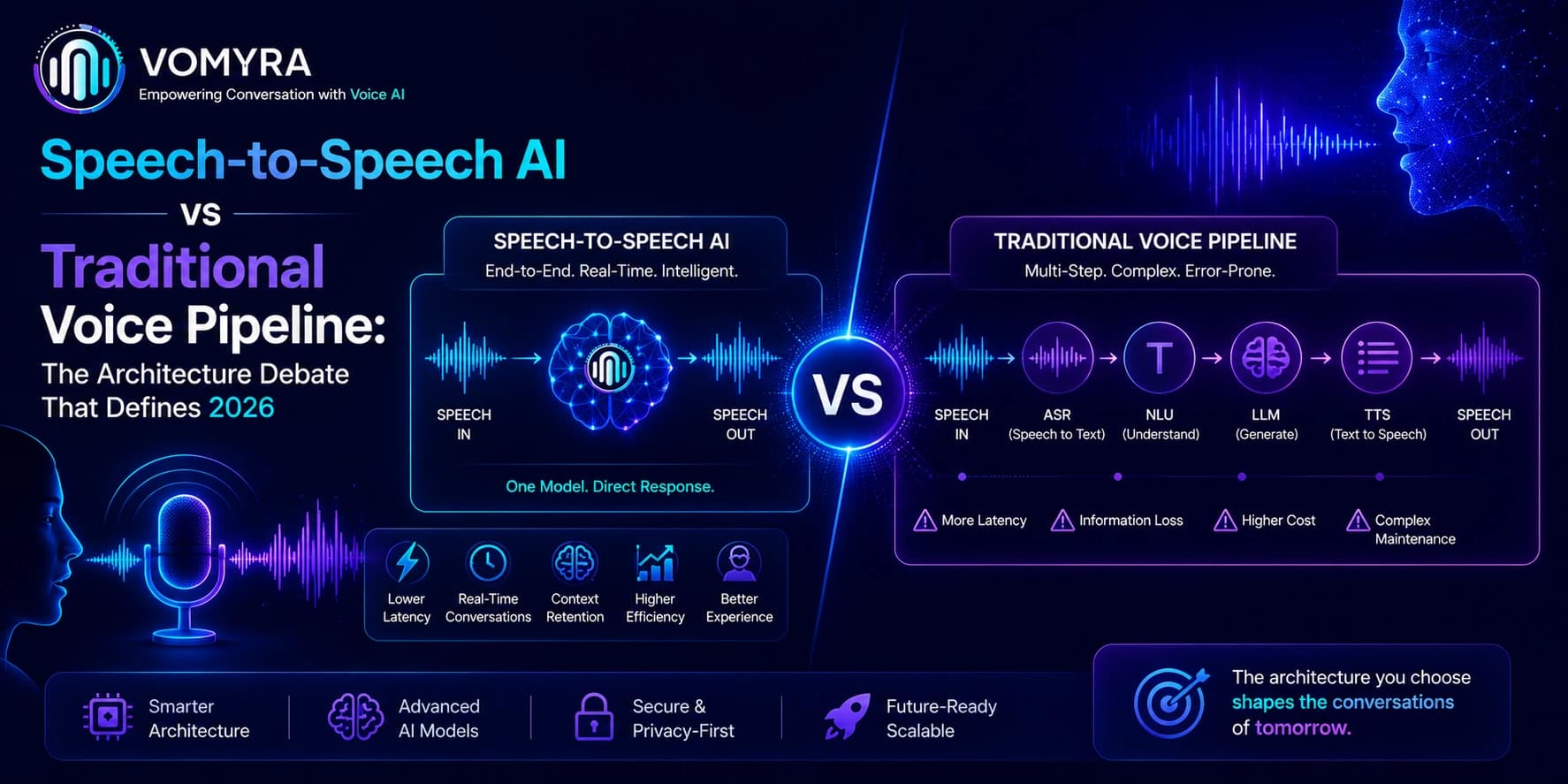
The cascaded pipeline has been the foundation of commercial voice AI for the past decade. It processes a voice interaction through three sequential stages, each handled by a separate model or service.
Stage one is speech-to-text. The incoming audio from the phone call is captured and converted to text by an automatic speech recognition model. The ASR model handles audio format conversion, compression artifact correction, noise filtering, and language identification before outputting a text transcript of what the caller said. In a streaming configuration, partial transcripts are sent downstream before the full utterance is complete, reducing the wait time before the LLM begins processing.
Stage two is language model reasoning. The text transcript from the ASR stage is processed by a large language model that determines intent, accesses external tools (CRM, calendar, inventory, eligibility systems), generates an appropriate response, and decides what action the conversation should take next. This is where the actual intelligence of the voice agent lives: the qualification logic, the objection handling, the escalation rules, and the tool calls that retrieve live data during the call.
Stage three is text-to-speech. The LLM’s text response is converted to audio by a voice synthesis model. In a streaming configuration, the TTS layer begins generating audio as the first tokens of the LLM response arrive, rather than waiting for the complete response text. This streaming overlap is where most of the latency gains in modern cascaded pipelines come from.
Latency profile. A well-optimised cascaded pipeline in 2026 delivers 800 to 1,500 milliseconds of total end-to-end latency from the moment a user stops speaking to the moment they hear the first syllable of the response. A highly tuned streaming implementation on dedicated infrastructure can push this down to 500 to 700 milliseconds. The minimum latency floor for a three-stage sequential architecture is approximately 500 milliseconds regardless of how well each stage is optimised, because the stages must complete in order.
What cascaded does well. The modular structure of a cascaded pipeline is also its greatest practical strength. Each stage can be independently optimised, swapped, or upgraded without affecting the others. The text layer between the ASR and LLM stages creates a natural audit point: every conversation is automatically transcribed, producing a structured record that compliance, quality assurance, and CRM integration all depend on.
Tool calling, the mechanism by which the LLM checks live inventory, retrieves customer records, or books an appointment during the call, works natively and reliably in the text domain. And debugging a cascaded pipeline is straightforward: when something goes wrong, the transcript shows exactly what happened at each stage.
Architecture Two: Speech-to-Speech Models
Speech-to-speech models collapse the three-stage pipeline into a single multimodal model that takes audio input directly and produces audio output directly, with no text representation of the conversation at any point in the processing chain.
The theoretical advantages of this architecture are significant. Without a text intermediary, the model retains the full acoustic signal throughout processing: tone, pace, emotional inflection, hesitation patterns, and prosody are preserved from input to output rather than being stripped by the ASR transcription step and approximated back by the TTS synthesis step.
A speaker’s uncertainty, their emotional state, their accented pronunciation of a term, and the rising intonation that signals a question versus a statement all survive in the audio signal that the S2S model processes natively.
The latency advantage is equally significant. S2S models achieve 200 to 300 milliseconds of response time in benchmark conditions, representing an 85 percent reduction compared to cascaded pipelines in controlled tests. In production deployments, realistic S2S latency runs from 400 to 800 milliseconds depending on model size, infrastructure, and audio quality.
This is still meaningfully faster than most cascaded implementations, and the subjective experience of the difference in a natural conversation is noticeable.
Interruption handling improves substantially in S2S architectures. Because the model processes audio as a continuous stream rather than waiting for discrete utterance boundaries, it can detect when a caller begins speaking mid-response and stop generating without the turn detection latency that cascaded systems carry.
Where S2S models currently fall short. The production reality of S2S in 2026 is more constrained than the benchmark numbers suggest. Tool calling, the ability to make a function call to an external system during a conversation and incorporate the result, is significantly more challenging in S2S models than in text-based LLMs.
The text intermediary in a cascaded pipeline is where JSON function calls are naturally formatted, validated, and routed. S2S models are still maturing on reliable tool use, which means applications requiring real-time CRM access, live inventory checks, or calendar integrations face reliability challenges that cascaded pipelines do not.
Compliance and auditability present a structural problem for S2S deployments. Without a text transcript, there is no natural audit trail of what was said and what the AI responded. Regulatory frameworks in financial services, healthcare, and any Indian NBFC or insurance company operating under RBI and IRDAI guidelines require documented interaction records.
Generating these from an S2S model requires adding a separate transcription step on top of the audio-in-audio-out model, which partially undermines the latency advantage.
Debugging an S2S system when something goes wrong is substantially harder than debugging a cascaded pipeline. The intermediate representations that make a cascaded pipeline’s failure points visible do not exist in S2S.
The model produces an output but the developer cannot inspect what internal audio representation drove the output. Evaluation tooling for S2S is still significantly less mature than for text-based pipeline evaluation.
The India-Specific Factor That Changes the Calculus
Most architecture comparisons are written for high-quality audio environments: WebRTC browser connections on broadband, or clean studio recordings used for benchmark evaluation. The Indian telephone market presents a substantially different technical reality that shifts the architecture trade-off.
Standard Indian telephony audio is sampled at 8 kHz over PSTN or compressed mobile networks, versus the 16 kHz or higher sample rates that voice AI models are typically trained and evaluated on. This compression removes approximately half of the audio frequency content that vocal nuance and emotional expression depend on.
The prosody, tone, and emotional signal that S2S models specifically preserve by avoiding text intermediation are partially destroyed by the telephony codec before the model even receives the audio.
Research on S2S model performance with 8 kHz PSTN audio shows meaningfully higher error rates compared to broadband audio. The cascaded pipeline’s ASR stage can be specifically tuned for telephony audio quality with noise robustness training that is tailored for 8 kHz input. S2S models trained on high-quality audio show less graceful degradation on telephony audio than ASR models specifically optimised for the telephony acoustic environment.
For Indian voice AI deployments specifically, this means the latency advantage of S2S shrinks in practice because the model’s input quality is degraded by the telephony layer, and the conversational naturalness advantage shrinks because the emotional signal the model is designed to preserve has already been compressed out of the audio before the model receives it.
The Hinglish factor compounds this. S2S models achieving high scores on multilingual benchmarks are typically evaluated on clean audio. Mid-sentence code-switching between Hindi and English, combined with regional accents and 8 kHz mobile audio, represents a more difficult input distribution than any current S2S benchmark covers.
Cascaded pipelines with ASR models specifically fine-tuned on Indian telephony Hinglish audio outperform general S2S models on this distribution in 2026.
The Emerging Hybrid Architecture
The architecture that most experienced builders are converging on in 2026 is neither pure cascaded nor pure S2S. It is a hybrid that uses S2S-style streaming and audio signal processing at the conversation layer while retaining the text domain for reasoning, tool calling, and compliance logging.
The pattern, sometimes described as a half-cascade or supervisor architecture, works as follows: audio is processed with a streaming ASR layer that sends partial transcripts to the LLM before the utterance is complete. The LLM generates a response while audio is still arriving, and begins streaming the response to a TTS layer before the full response is generated.
The text layer is preserved for tool calls, compliance logging, and CRM updates. An audio-layer interruption detector monitors the input stream and can halt TTS generation when the caller begins speaking again, providing the barge-in responsiveness that pure cascaded systems handle poorly.
This hybrid achieves latency in the 400 to 600 millisecond range on well-optimised infrastructure, provides reliable tool calling from the text LLM layer, maintains an automatic transcript for compliance and CRM purposes, and handles interruptions more gracefully than a sequential cascaded pipeline.
It represents the current production best practice for enterprise telephony voice AI, and it is where the most capable Indian market voice AI deployments are operating.
Why the Cascaded Architecture Still Wins for Indian Business Voice AI

For the specific use cases that Indian businesses deploy voice AI for in 2026, the cascaded pipeline with streaming optimisations remains the correct architectural choice.
Lead qualification calls for real estate and fintech require the LLM to make tool calls: checking portal lead data, updating CRM records, verifying loan eligibility criteria, booking site visit slots into a calendar. These operations happen in the text domain, and their reliability on a cascaded pipeline with a mature text LLM is substantially higher than on current S2S implementations.
Regulatory compliance for NBFC, insurance, and healthcare voice AI in India requires call transcripts. The cascaded pipeline produces these automatically as a structural output of the ASR stage. S2S deployments require adding a transcription step to produce the same record.
Multilingual support across Hindi, Hinglish, Tamil, Telugu, Marathi, Gujarati, Bengali, Punjabi, and Assamese is better served by specialised ASR and TTS models trained on Indian telephony audio than by a general-purpose S2S model primarily trained on Western language audio at higher quality.
Vomyra AI Voice Agent implements the streaming cascaded architecture with Indian telephony optimisations, achieving sub-500 millisecond response latency on Indian mobile network audio across all supported languages, with automatic transcript generation, real-time CRM integration through MCP, and built-in TRAI and DPDP compliance controls.
The architecture choices are specifically calibrated to what performs reliably at production scale on Indian telephone infrastructure.
When to Consider Speech-to-Speech for Your Voice Application
S2S architecture is the right choice for specific application profiles that are different from the primary Indian business voice AI use cases described above.
Consumer-facing voice assistants on web or mobile applications, where audio quality is high (browser WebRTC on broadband) and the primary metric is conversational naturalness rather than tool calling complexity or compliance documentation, are the clearest current fit for S2S.
High-empathy use cases such as mental health check-ins, premium customer experience interactions, or coaching conversations where emotional resonance is the primary value deliver better results on S2S than on cascaded pipelines.
Applications where the conversational turn speed matters more than tool calling depth, such as voice-controlled navigation or simple FAQ assistants, can use S2S’s latency advantage effectively.
The H2 2026 prediction from most architecture researchers is that production-grade S2S models with reliable tool calling and compliance logging will emerge, at which point the trade-off shifts for more complex enterprise use cases.
Building on a platform that can integrate new model architectures as they mature is more important than committing to a specific architecture today as permanent.
Getting Started Without the Architecture Decision
For most Indian businesses deploying voice AI in 2026, the architecture decision is already made by the platform they choose. The streaming cascaded architecture with Indian telephony optimisations is the default for purpose-built Indian voice AI platforms, and it is the right starting point.
A free trial of Vomyra AI Voice Agent provides 500 monthly credits covering full deployment on the streaming cascaded architecture: Indian +91 numbers, Hinglish and 32-plus Indian language support, sub-500 millisecond response latency on Indian mobile networks, real-time CRM integration, Petpooja POS connectivity, and TRAI and DPDP compliance controls.
The first workflow, whether inbound lead qualification, outbound calling campaigns, or appointment booking, goes live in days without any architecture decisions or infrastructure configuration.
Frequently Asked Questions
Is speech-to-speech faster than traditional voice pipelines?
In benchmark conditions, yes. S2S models achieve 200 to 300 milliseconds versus 800 to 1,500 milliseconds for cascaded pipelines. In production on 8 kHz Indian telephony audio, the gap narrows because S2S models degrade more on compressed audio than ASR models specifically tuned for telephony input quality.
Which architecture is better for Indian language voice AI?
The cascaded pipeline with India-specific ASR models trained on Indian telephony audio outperforms general-purpose S2S models for Hinglish and regional Indian languages on real call quality in 2026. The specific audio environment of Indian mobile networks reduces the naturalness advantage that makes S2S compelling on high-quality audio.
Can speech-to-speech models make tool calls during a voice conversation?
Tool calling in S2S models is still maturing in 2026. Complex tool use such as live CRM reads, calendar booking, and eligibility checks is more reliable on cascaded pipelines where the text LLM layer handles function calling natively. This is the primary practical reason enterprise voice AI deployments remain on cascaded architectures.
Does Vomyra AI Voice Agent use speech-to-speech or a cascaded pipeline?
Vomyra AI Voice Agent uses a streaming cascaded pipeline optimised for Indian telephony conditions, achieving sub-500 millisecond response latency on Indian mobile network audio across Hindi, Hinglish, Tamil, Telugu, and other Indian languages, with automatic transcript generation and real-time CRM integration.
Will speech-to-speech replace cascaded pipelines in the future?
Most researchers predict production-grade S2S with reliable tool calling and compliance logging will emerge in 2027. The current recommendation is to use the streaming cascaded architecture for complex enterprise telephony applications and monitor S2S maturity for applications where conversational naturalness is the primary metric.