The Number That Stopped Every Fintech Founder Mid-Scroll
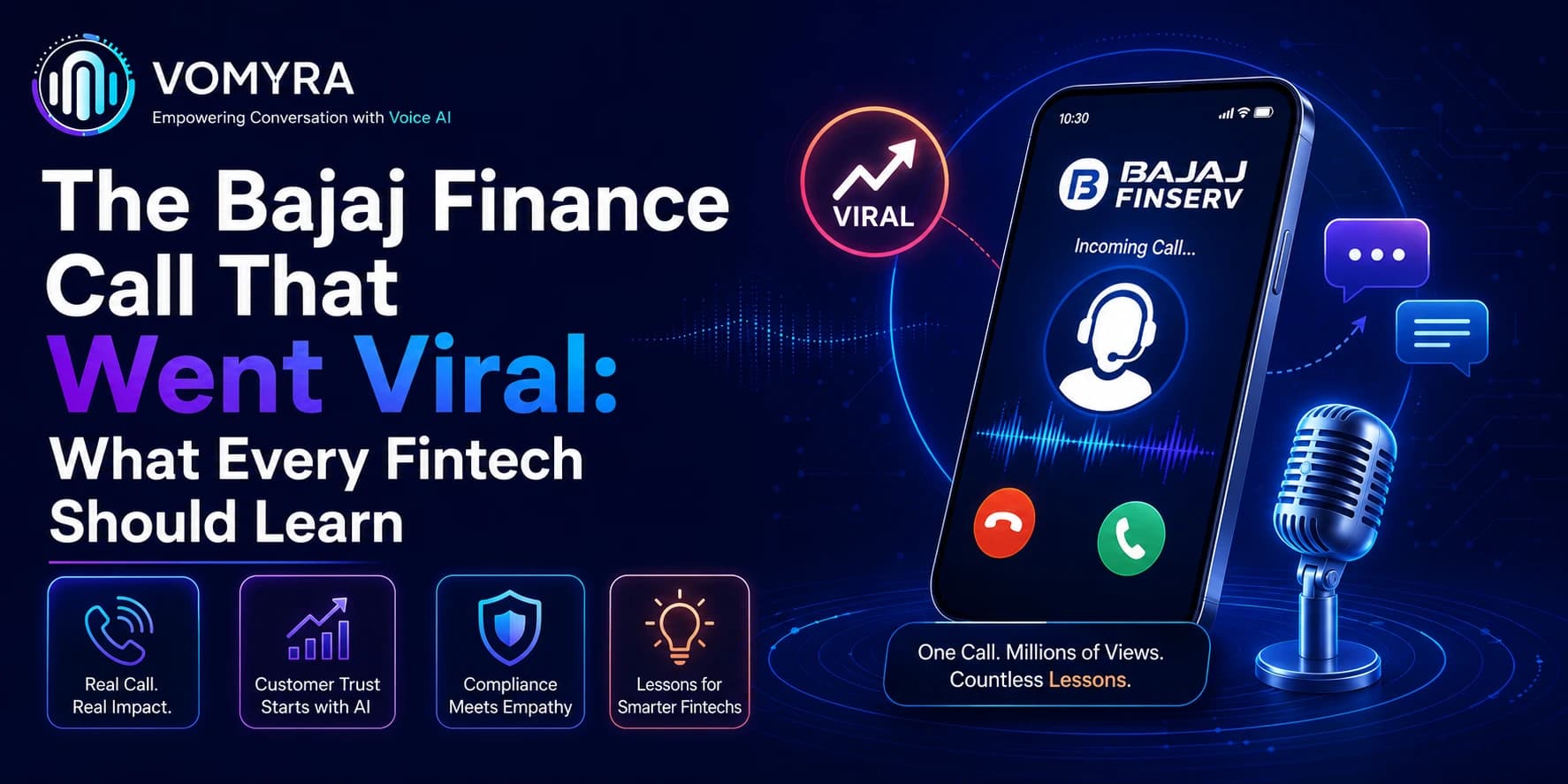
During Bajaj Finance’s Q3 FY26 earnings call, Managing Director Rajeev Jain shared a statistic that made its way through every fintech WhatsApp group, startup Slack channel, and investor newsletter in India within 48 hours.
AI analysed 2 crore customer calls. From those calls, the system generated Rs 1,600 crore in loan disbursals, roughly 10 percent of Bajaj Finance’s entire Q3 volume. It also created over 100,000 personalised loan offers. All without a single human picking up the phone first.
That announcement went viral not because the technology was exotic. It went viral because of what it revealed about where value actually sits in a financial services business, and because the gap between what Bajaj Finance did and what most Indian NBFCs and fintechs are currently doing with their customer call data is so large that it was uncomfortable to confront.
Vomyra AI Voice Agent is built for the businesses that read that story and asked: how do we get there? This post unpacks what Bajaj Finance actually did, why it worked, and what the specific lessons are for Indian fintech companies, NBFCs, and lending startups that cannot spend Rs 50 crore annually on AI infrastructure but still need the same result.
What Bajaj Finance Actually Did
The viral headline was about the money. The story underneath it was about a decision Bajaj Finance made 18 months before the Q3 announcement: to treat its call centre not as a cost centre to be minimised, but as a data asset to be mined.
For years, Bajaj Finance ran one of India’s largest outbound calling operations. The calls were notorious. “Bajaj Finance calling” became shorthand in middle-class WhatsApp groups for corporate persistence bordering on irritation. Pre-approved loan offers arrived at inconvenient times. Upsells came at irrelevant moments. The call centre felt like a legacy liability.
What changed was not the call centre. What changed was what Bajaj Finance started doing with the recordings.
Every inbound and outbound call contains signals that a human reviewer either misses or cannot process at scale. Hesitation about interest rates. Curiosity about a specific product. Mention of a life event, a wedding, a renovation, a school admission. Frustration about eligibility criteria that indicates the caller might qualify for a different product. These signals existed in Bajaj Finance’s call recordings for years before AI came into the picture. The recordings sat on servers, largely unanalysed.
Starting in late 2024, Bajaj Finance began running AI over every recorded call. The process was not frontier technology. It was speech-to-text conversion, keyword and intent extraction, and rule-based triggers built on top of that structured data.
The AI converted voice into text, text into structured data points, and structured data into actionable credit intelligence. From 2 crore calls, it surfaced 100,000 customers who showed specific signals of product readiness, created personalised offers for each of them, and generated Rs 1,600 crore in disbursals from those offers.
The magic was not the model sophistication. It was the discipline to connect every customer call into a single data pipeline and the organisational commitment to act on what the data revealed.
The Four Lessons Every Indian Fintech Should Take From This
Lesson 1: Your Existing Call Data Is Already a Revenue Asset
Most Indian fintech companies and NBFCs record customer calls for compliance and quality monitoring. Those recordings sit in storage systems, reviewed only when a complaint is raised or a random QA sample is pulled.
Bajaj Finance’s Q3 result is a demonstration of what happens when you run AI across all of that data systematically instead of sampling it. The calls already happened. The customer conversations already contained intent signals.
The cost of generating those calls was already paid in the form of telecaller salaries, telephony infrastructure, and customer acquisition spend. The AI layer on top of existing recordings is incremental cost against already-sunk investment.
For an Indian NBFC or fintech running 50,000 calls per month, this represents a significant untapped resource. Calls where a prospect asked about home loans but was pitched a personal loan. Calls where a customer mentioned a business need but was not followed up on.
Calls where the intent signal was present but the human telecaller did not capture it in the CRM. AI running across those recordings surfaces what was missed.
Lesson 2: Personalization at Scale Is Not a Feature, It Is the Mechanism
The 100,000 personalised offers Bajaj Finance generated were not batch-processed templates with name fields. They were offers calibrated to individual customer contexts extracted from actual conversations: the specific product the customer had expressed interest in, the life event they had mentioned, the EMI range they had indicated was comfortable, the objection they had raised on a previous call.
Personalisation of this kind produces a fundamentally different customer response than a generic pre-approved offer. Customers do not hate calls. They hate irrelevance. When an offer arrives because AI inferred a genuine need from a previous conversation, the same phone call that previously felt like spam begins to feel like service.
For Indian fintech companies competing for the same customer base as large NBFCs with far larger marketing budgets, personalization at the individual level is the clearest route to better conversion rates without higher customer acquisition cost. AI voice agents that record, analyse, and feed conversation data back into offer generation create the same mechanism Bajaj Finance used, at a fraction of the infrastructure cost.
Lesson 3: The Call Centre Is the Moat, Not the Liability
The industry assumption before Bajaj Finance’s Q3 disclosure was that digital-native fintechs had the structural advantage in India’s AI era. No call centre overhead, no legacy systems, no expensive outbound operations. Pure digital acquisition and servicing.
Bajaj Finance inverted that assumption. The call centre was not the liability. It was the data source. Eighteen months of running AI over voice data built a customer intelligence layer that digital-only acquisition channels cannot replicate because the voice call captures signals that a web form, an app interaction, or a digital credit assessment simply does not surface.
The specific insight for Indian fintech companies is that phone calls remain the primary customer interaction channel for the majority of India’s credit-seeking population, particularly in Tier 2 and Tier 3 cities, among first-time borrowers, and across segments where digital literacy varies.
A fintech that treats its voice channel as a cost to minimise is discarding the richest customer signal it generates. A fintech that treats it as a data asset and deploys AI to extract that signal builds a compounding advantage with every call.
Lesson 4: The Technology Is Accessible. The Discipline Is the Barrier.
Bajaj Finance reportedly allocates over Rs 50 crore annually to AI and employs 200-plus engineers dedicated to these systems. The numbers are significant. The underlying technology, however, is not proprietary.
Speech-to-text conversion, intent classification, and structured data extraction from call recordings are capabilities available to Indian businesses at a fraction of that cost through AI voice agent platforms designed for deployment without infrastructure investment.
The models behind Bajaj Finance’s call analysis system are the same class of models that power current Indian voice AI platforms. The difference is not technical. It is organisational.
Bajaj Finance committed to treating every customer call as a data point and built the pipeline to act on that data systematically.
Most Indian businesses have not made that commitment, not because the technology was unavailable, but because the organisational discipline to capture, process, and act on voice data at scale requires a deliberate decision to do so.
What 800 Autonomous AI Agents Tells You About Where This Is Going

Beyond the call analysis story, Bajaj Finance’s Q3 announcement included a detail that received less attention but carries equal weight for the fintech industry: the company is deploying 800-plus autonomous AI agents across Sales, HR, IT, and Risk functions, and all 26 Bajaj Finance products will have conversational AI interfaces by May 2026.
The number 800 is significant not because of its absolute size but because of what it implies about the organisational model. Bajaj Finance is not treating AI as a department or a project. It is treating AI as a capability layer that replaces or augments the human process across every function simultaneously.
For a lending company, the specific AI agent categories that matter most are the ones closest to revenue: agents that handle outbound loan qualification calls, agents that analyse inbound service calls for cross-sell signals, agents that follow up on loan applications that stalled in the process, and agents that manage EMI reminder campaigns at scale in the customer’s preferred language.
These are not experimental use cases. They are the workflows that Bajaj Finance has been running at scale since late 2024 and that any Indian NBFC or fintech can begin deploying today through AI voice agent platforms without building the infrastructure from scratch.
The Specific Gap Between Bajaj Finance and Most Indian Fintechs Right Now
The gap is not primarily technical. It is data pipeline and speed of action.
Bajaj Finance processes every call and acts on signals from that call within the same customer interaction cycle. A customer who mentioned a home renovation need on an inbound service call in January receives a relevant offer in February based on what the AI extracted from that conversation.
Most Indian fintechs process a sample of calls for QA, log a manual CRM note if the telecaller remembers, and send a generic marketing push two weeks later that has no connection to what the customer actually said on the call.
The infrastructure required to close this gap does not need to be built from scratch. AI voice agent platforms that record calls, extract structured qualification data, push it to a CRM in real time, and trigger personalised follow-up sequences are deployable today for Indian fintech companies across the full spectrum from early-stage startups to mid-market NBFCs.
The AI lead qualification voice bot India businesses deploy today runs the same core process at a lower call volume and lower infrastructure cost. Record the call. Extract the signals. Act on the data faster than the customer expects.
How Indian Fintechs Can Apply This Without a Rs 50 Crore AI Budget
The Bajaj Finance playbook, stripped of the scale and the infrastructure spend, comes down to three operational decisions that any Indian fintech can implement.
First: treat every customer call as a structured data source. Every call that goes unrecorded or unanalysed is a signal lost. AI voice agents that record, transcribe, and extract qualification data from every interaction build the same intelligence layer Bajaj Finance built, starting from the first call.
Second: connect call outcomes directly to offer generation. The gap between “customer expressed interest in a higher loan amount” and “customer receives a personalised offer reflecting that amount” should be measured in hours, not weeks. AI voice agent platforms that push structured call data to CRMs in real time create the pipeline for that connection without manual data entry from telecallers.
Third: deploy AI on the outbound side as well as the inbound side. Bajaj Finance’s AI outbound calling India operation does not wait for customers to call in. It identifies customers whose past call data indicates readiness, initiates outbound contact in their preferred language, and presents a relevant offer based on their history.
An AI voice sales agent running outbound qualification campaigns for an Indian fintech operates on the same logic at a cost per contact that makes the economics viable from day one.
Vomyra AI Voice Agent is built for exactly this workflow. The no-code AI voice agent platform India fintechs and NBFCs deploy covers inbound qualification, outbound campaigns, multilingual support across Hindi, Tamil, Telugu, Marathi, Gujarati, Bengali, and every other major Indian language, real-time CRM integration, and full call transcript and qualification data capture. The starting point is a free tier with 500 monthly credits that renew every month at no cost.
The Uncomfortable Question the Bajaj Finance Story Raises
If a traditional NBFC with a 20-year-old call centre operation, no tech startup DNA, and no digital-native acquisition infrastructure became India’s clearest AI success story in financial services, the question every fintech founder should sit with is simple.
What signals are sitting in your current call recordings that you are not acting on?
For most Indian fintech companies, the answer is significant. Calls where customers indicated product interest that was not captured. Calls where objections were raised that never made it into a CRM record. Calls where the right offer was not presented because the telecaller did not have the customer’s full history visible during the conversation.
Bajaj Finance’s Rs 1,600 crore came from mining signals that were already present in calls that had already happened. The technology to do that is not behind a Rs 50 crore investment. It is behind a free trial.
A free trial of Vomyra AI Voice Agent covers full deployment including call recording, transcript extraction, qualification scoring, multilingual support across Indian languages, and real-time CRM integration. The 500 monthly free credits renew every month. The first campaign can go live within a week.
Frequently Asked Questions
What was the Bajaj Finance viral call story about?
During the Q3 FY26 earnings call, Bajaj Finance MD Rajeev Jain revealed that AI had analysed 2 crore (20 million) customer calls, generated Rs 1,600 crore in loan disbursals from AI-identified opportunities, and created over 100,000 personalised loan offers. The announcement circulated widely because of the scale of the result and the simplicity of the underlying technology.
What technology did Bajaj Finance use to analyse 2 crore calls?
The stack was primarily speech-to-text conversion, keyword and intent extraction, and rule-based triggers. It was not frontier generative AI. The lesson for Indian fintechs is that the technology is accessible. The discipline to process every call systematically and act on the data is the actual barrier.
Can a small Indian fintech or NBFC replicate the Bajaj Finance AI approach?
Yes, at a proportional scale. AI voice agent platforms available in 2026 provide call recording, structured data extraction, CRM integration, and multilingual outbound campaigns without the infrastructure investment Bajaj Finance made. The process is the same. The volume scales with the business.
What languages do AI voice agent platforms support for Indian fintech use cases?
Hindi, Hinglish, Tamil, Telugu, Marathi, Gujarati, Bengali, Punjabi, Assamese, and other major Indian languages. For a lending business serving customers across multiple Indian states, multilingual AI calling is the equivalent of Bajaj Finance’s pan-India personalisation capability.
How quickly can an Indian fintech deploy an AI voice agent for lead qualification?
On a no-code platform, a single workflow covering inbound qualification or outbound campaign calling can go live within three to five working days. No engineering resources are required.