Why Indian Developers Are Building Their Own Voice Agents in 2026
The cost of running a voice agent on a closed-source API has a ceiling problem. At low call volumes, paying per API token is perfectly reasonable. At 50,000 calls per month, the arithmetic changes. Self-hosted open-source LLMs running on your own GPU infrastructure cost 5 to 8 times less per token than closed-source APIs at equivalent volumes.
For an Indian fintech qualifying thousands of loan leads daily, or a real estate platform handling portal inquiries across five states in multiple languages, that cost difference is the difference between a viable and non-viable unit economics model.
At the same time, open-source voice models have crossed a production-readiness threshold in 2026 that they had not reached before. Vomyra AI Voice Agent gives teams an alternative path that skips the infrastructure build entirely.
This guide covers both: what the open-source stack looks like for developers who want full control, and where a purpose-built platform makes more sense for teams that want production results without the engineering investment.
The Open-Source Voice Agent Stack in 2026
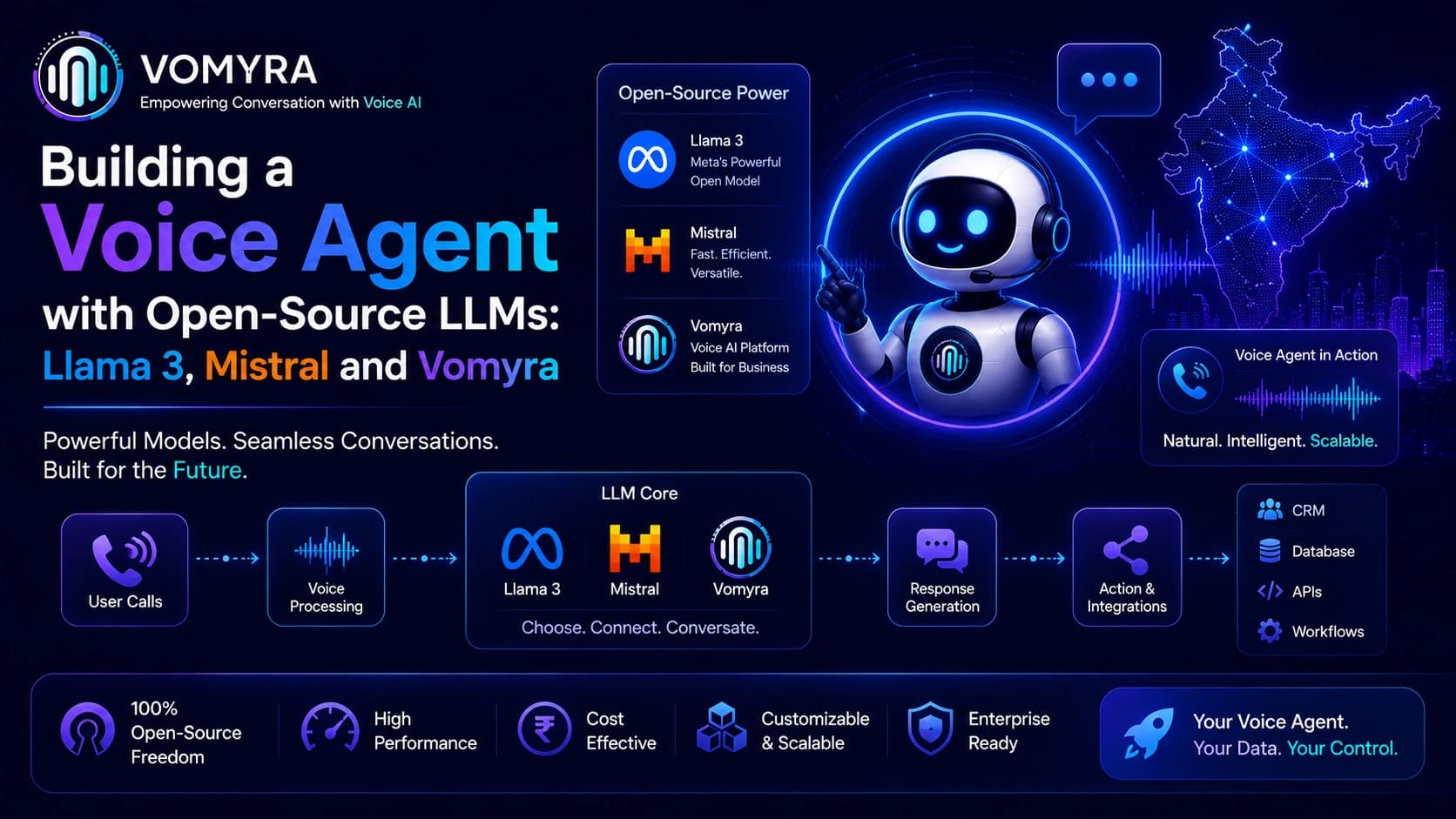
A voice agent built on open-source components in 2026 requires four layers working together in a pipeline with strict latency requirements. Each layer has well-established open-source options, and the overall pipeline is now genuinely production-capable for the right use cases.
Layer 1: Speech Recognition (ASR)
The first layer converts incoming audio from a phone call into text. OpenAI’s Whisper remains the most widely deployed open-source ASR model in 2026, available in multiple sizes from tiny (39M parameters) to large-v3 (1.5B parameters). Whisper large-v3 achieves competitive word error rates on standard English benchmarks and has improving but still inconsistent performance on Indian languages, particularly over mobile phone audio with background noise.
For Indian-market voice agents, the ASR layer is the most consequential design decision. A customer calling from a Tier 2 city on a 4G connection with kitchen noise and a regional accent presents a very different audio quality profile than a studio-recorded test sample.
Whisper performs well on clean audio and degrades measurably in realistic Indian telephony conditions. Teams building for Indian markets should evaluate ASR performance specifically on actual call recordings from their target customer base, not on benchmark datasets recorded in controlled conditions.
Faster-Whisper, a reimplementation using CTranslate2, delivers roughly 4x speedup over the original Whisper implementation with equivalent accuracy. This matters for real-time voice agents where the ASR step needs to complete in under 300 milliseconds to keep total end-to-end latency within the natural conversational range.
Layer 2: Language Understanding and Reasoning (LLM)
Once the caller’s speech is converted to text, a language model processes the content, determines intent, generates a response, and decides whether to access external tools, escalate to a human, or continue the conversation.
Llama 4 Scout is the current default for open-source agentic work in 2026. Its 10-million-token context window means it can hold the full history of a long qualification call and access extensive knowledge base content simultaneously.
Its instruction-following capability and tool-calling reliability are strong enough for production multi-step voice workflows. For teams running self-hosted inference, Llama 4 Scout on a well-configured vLLM deployment handles concurrent calls efficiently.
Mistral Large 3 is the strongest choice for multilingual enterprise applications. At 675 billion parameters in a mixture-of-experts architecture with 256K context and an Apache 2.0 licence, it delivers frontier-class performance on reasoning tasks while being fully self-hostable with no usage restrictions.
For Indian voice agents requiring fluent Hindi, Tamil, Telugu, Marathi, Gujarati, and Bengali understanding, Mistral’s multilingual depth makes it the better LLM choice over Llama for language-critical applications.
Mistral Small 4 offers a more hardware-efficient alternative at 119 billion total parameters with 6 billion active parameters, combining multimodal input and a 256K context window. For teams running inference on smaller GPU budgets, Small 4 on a single A100 produces competitive quality at a fraction of the compute cost of Large 3.
For tool calling specifically, which is how the LLM accesses a CRM, a calendar, a property database, or a loan eligibility system during a live call, all three models support structured JSON function calling that integrates with standard agentic frameworks like LangGraph and CrewAI.
Layer 3: Text-to-Speech (TTS)
Mistral released Voxtral TTS in March 2026, a fully open-source speech synthesis model based on Ministral 3B that supports nine languages including Hindi. Voxtral achieves a time-to-first-audio of 90 milliseconds for a 500-character input and a real-time factor of 6x, meaning it renders 10 seconds of audio in approximately 1.6 seconds.
It clones a custom voice from under five seconds of reference audio, capturing accent, inflection, and speech rhythm. The model runs on edge hardware as small as a smartphone.
For Indian voice agents specifically, Voxtral’s Hindi support and voice cloning capability are significant. A business can clone the voice of a senior sales executive or a customer service representative and have the AI agent speak in that voice across every call, maintaining brand voice consistency at a scale no human team can match.
Other strong TTS options for open-source pipelines include Kokoro (82M parameters, runs on CPU, extremely fast for short utterances), Chatterbox from Resemble AI (voice cloning from 5 seconds of audio with emotion control across 23 languages), and Orpheus from Canopy Labs (built on Llama architecture, 150M to 3B parameter variants, optimised for low-latency streaming where speech starts playing before generation completes).
Layer 4: Telephony and Call Handling
The fourth layer connects the AI pipeline to an actual phone call. This is where Indian-market builds face their most significant infrastructure challenge.
Traditional telephony infrastructure routes audio over PSTN or SIP with compression codecs (G.711, G.729) optimised for human voice quality, not for AI model input. AI voice agents require the audio to be converted from telephony format to a form the ASR model can process, and the synthesised response to be converted back to telephony format, within the total latency budget of the conversation.
For Indian deployments, this requires either a Twilio or Exotel account (adds USD-denominated cost and a separate billing layer), a custom SIP trunk implementation (requires significant telephony engineering), or integration with a platform that handles the telephony layer natively.
Indian regulatory requirements add another layer: TRAI’s DLT registration for outbound commercial calls, DND registry scrubbing, 9 AM to 9 PM calling window enforcement, and DPDP consent logging all need to be implemented at this layer.
The Latency Budget: Why Sub-500ms Matters
A natural human conversational pause lasts 200 to 500 milliseconds. A voice agent response that arrives in under 500 milliseconds feels like a normal conversation. A response that takes 1.2 seconds or more registers as the call dropping or the system freezing.
The total latency budget for a real-time voice agent breaks down across the pipeline layers:
ASR processing: 150 to 300 milliseconds for a 5-second utterance on Faster-Whisper with a well-sized GPU.
LLM inference: 200 to 600 milliseconds for first-token generation on a quantized 8B model, or 400 to 900 milliseconds on a 70B model, depending on GPU configuration and batch size.
TTS generation: 90 to 200 milliseconds for first-audio on Voxtral or Kokoro.
Network and telephony conversion: 50 to 150 milliseconds each direction.
Total: 490 to 1,150 milliseconds in best-case to realistic-case ranges on well-optimised infrastructure.
Achieving consistent sub-500ms end-to-end latency on a self-hosted stack in India requires GPU instances with low-latency connections to Indian telephony infrastructure. The infrastructure that makes this reliable at scale is not trivial to build or maintain, and the performance degradation under concurrent call load requires careful capacity planning.
Hinglish: The Open-Source Stack’s Biggest Indian Market Challenge
The most significant gap between open-source voice agent performance on benchmark datasets and real Indian customer call performance is Hinglish code-switching.
Approximately 57 percent of urban Indian business conversations mix Hindi and English within the same sentence. A prospect might say “haan, property dekhni hai, but site visit ka time flexible chahiye” in a single breath without signalling a language switch. Standard ASR models trained on monolingual datasets treat this as a noise event or produce fragmented transcriptions that break the downstream LLM’s ability to understand intent.
Whisper handles some Hinglish because its training data includes mixed-language audio, but its performance on realistic Indian telephony Hinglish is inconsistent and degrades significantly on fast speech, strong regional accents, or background noise.
Building a reliable Hinglish-capable ASR layer typically requires fine-tuning Whisper on Indian call data, which requires access to a substantial annotated Hinglish call dataset, which most teams do not have.
Mistral Large 3’s multilingual reasoning layer handles Hinglish well at the comprehension level once transcription is accurate. The bottleneck is transcription quality, not LLM understanding.
This means Hinglish quality is primarily an ASR problem, not an LLM problem, and the ASR problem is the harder one to solve without India-specific training data.
The India-Specific Regulatory Implementation Layer
Any production voice agent making outbound commercial calls in India must implement:
TRAI TCCCPR compliance: DLT telemarketer registration, DND registry scrubbing before every outbound campaign, and a hard restriction to 9 AM to 9 PM IST calling window. These are not optional.
Calling a DND-registered number for commercial purposes exposes the business to TRAI penalties regardless of whether the call was placed by a human or an AI system.
DPDP Act compliance: Documented consent for recording and processing voice data, clear data purpose limitation, and audit trails for every AI interaction with customer data. For fintech and lending use cases, RBI’s Fair Practices Code adds identity disclosure requirements and grievance redressal documentation on top of this.
Implementing these controls on a self-built open-source stack means building the DND scrubbing integration, the calling-hour scheduler, the consent logging system, and the audit trail infrastructure yourself. Each of these is a non-trivial engineering task that needs ongoing maintenance as regulations evolve.
Build vs Use: Honest Decision Framework

The decision between building an open-source voice agent stack and using a purpose-built platform is not primarily a technical question. It is an economic and strategic question about where engineering time should be spent.
Build on open-source when:
You have an existing data science or ML infrastructure team and GPU compute budget. Your use case has specific compliance, data sovereignty, or customisation requirements that cannot be met by a SaaS platform.
Your call volume is large enough that the infrastructure cost savings from self-hosted inference justify the engineering investment. You are building voice AI as a product to sell rather than as an operational tool for your business.
Use Vomyra AI Voice Agent when:
You need a working AI voice agent in production within a week, not a quarter. Your team does not have ML infrastructure experience or available GPU budget. You need Indian +91 numbers, Hinglish support, Petpooja AI integration voice capability, and TRAI compliance out of the box without engineering those features separately.
The call volume is in the range where a per-minute platform cost is more economical than dedicated GPU instances plus engineering overhead. Your use case is a business operation, such as AI voice agent for real estate India lead qualification, AI voice agent for restaurants India order taking, AI voice agent for fintech India EMI reminders, or AI recruitment calling bot India candidate screening, rather than a product you are building to sell.
Vomyra AI Voice Agent starts free with 500 monthly credits that renew every month, supports 32-plus Indian languages including Hinglish and AI voice agent in Assamese language, connects to Petpooja POS and standard CRMs without custom integration code, and provides Indian +91 numbers, TRAI compliance controls, and DPDP consent logging built into the platform.
For a business that wants the capability of a voice AI without the infrastructure build, this is the path that gets a working system live in days rather than months.
Running the Open-Source Stack: Practical Starting Configuration
For developers who decide the open-source build is the right path, the following configuration delivers the best performance-to-cost ratio for Indian market voice agents in 2026.
ASR layer: Faster-Whisper large-v3 with a CUDA-enabled GPU instance. Fine-tune on Indian call data using LoRA if budget allows. Evaluate word error rate specifically on Hinglish test samples from your actual customer call recordings before going to production.
LLM layer: Mistral Large 3 for multilingual-heavy applications, Llama 4 Scout for agentic workflows requiring long context and tool use. Deploy on vLLM for production serving with standard REST API endpoints. Use quantised 4-bit or 8-bit checkpoints to fit larger models on available GPU memory.
TTS layer: Voxtral TTS for Hindi-primary applications where voice naturalness matters. Kokoro for CPU-deployable applications where GPU costs are a constraint. Orpheus for streaming applications where first-audio latency is the primary optimisation target.
Telephony layer: Exotel for Indian SIP trunk integration with regulatory compliance. Configure calling-hour enforcement, DND scrubbing, and consent logging at the Exotel integration layer. Build a webhook handler that converts Exotel audio events to the Whisper-compatible format and converts Voxtral TTS output back to telephony audio format.
Orchestration: LangGraph for stateful multi-turn conversation management. Tool calling configured for real-time CRM reads and writes during the call. Escalation logic defined as a state transition in the conversation graph that triggers a SIP transfer to a human agent when specific conditions are met.
Getting Started With Either Path
For developers exploring the open-source path, the starting point is running Faster-Whisper and a quantised Mistral Small 4 on a local GPU and testing the full pipeline on five to ten recorded calls from the target customer segment.
The latency profile and Hinglish accuracy on real calls will determine whether the self-hosted stack is viable before any production infrastructure investment is made.
For businesses that need a working AI voice agent without the infrastructure build, a free trial of Vomyra AI Voice Agent covers 500 monthly credits with full platform access, Indian +91 numbers, multilingual support including Hinglish, CRM integration, Petpooja connectivity, and TRAI compliance. The first workflow goes live in days rather than months.
Frequently Asked Questions
1. Which open-source LLM is best for building an Indian voice agent in 2026?
For multilingual voice agents, Mistral Large 3 is a strong option because it supports Indian languages such as Hindi, Tamil, Telugu, and Marathi under the Apache 2.0 license. If your project needs long-context conversations, advanced tool use, and agent workflows, Llama 4 Scout is another excellent choice thanks to its large context window and reliable function calling.
2. Does Mistral’s Voxtral TTS support Hindi?
Yes. Voxtral TTS supports Hindi along with several other languages. It offers fast speech generation, can create a custom voice from just a few seconds of reference audio, and is optimized to run on edge devices like smartphones and laptops.
3. What is the biggest challenge when building a voice agent for India?
One of the biggest challenges is handling Hinglish (Hindi-English code-switching). While many speech recognition models perform well with clean, single-language audio, accuracy often drops when users mix languages, have regional accents, or speak in noisy environments. Fine-tuning models with Indian call data is usually necessary for reliable performance.
4. Is an open-source voice agent cheaper than using a platform like Vomyra?
It depends on your call volume. For smaller deployments, using a managed platform is often more cost-effective because it eliminates infrastructure, maintenance, and engineering overhead. For businesses handling very high call volumes and with an experienced ML team, a self-hosted open-source solution can reduce long-term costs.
5. Can Vomyra AI Voice Agent handle the same use cases as a custom open-source solution?
Yes, for most business needs. Vomyra can manage lead qualification, customer support, appointment scheduling, outbound campaigns, multilingual conversations, CRM integrations, and compliance requirements. However, organizations that require extensive model customization or strict data sovereignty may benefit from building and hosting their own open-source solution.