Artificial Intelligence (AI) has seen remarkable breakthroughs over the past decade. From chatbots handling customer queries to Vomyra AI Voice Assistants transforming human-computer interaction, large language models (LLMs) like GPT-3, GPT-4, and now GPT-5 have pushed the boundaries of what machines can understand and generate.
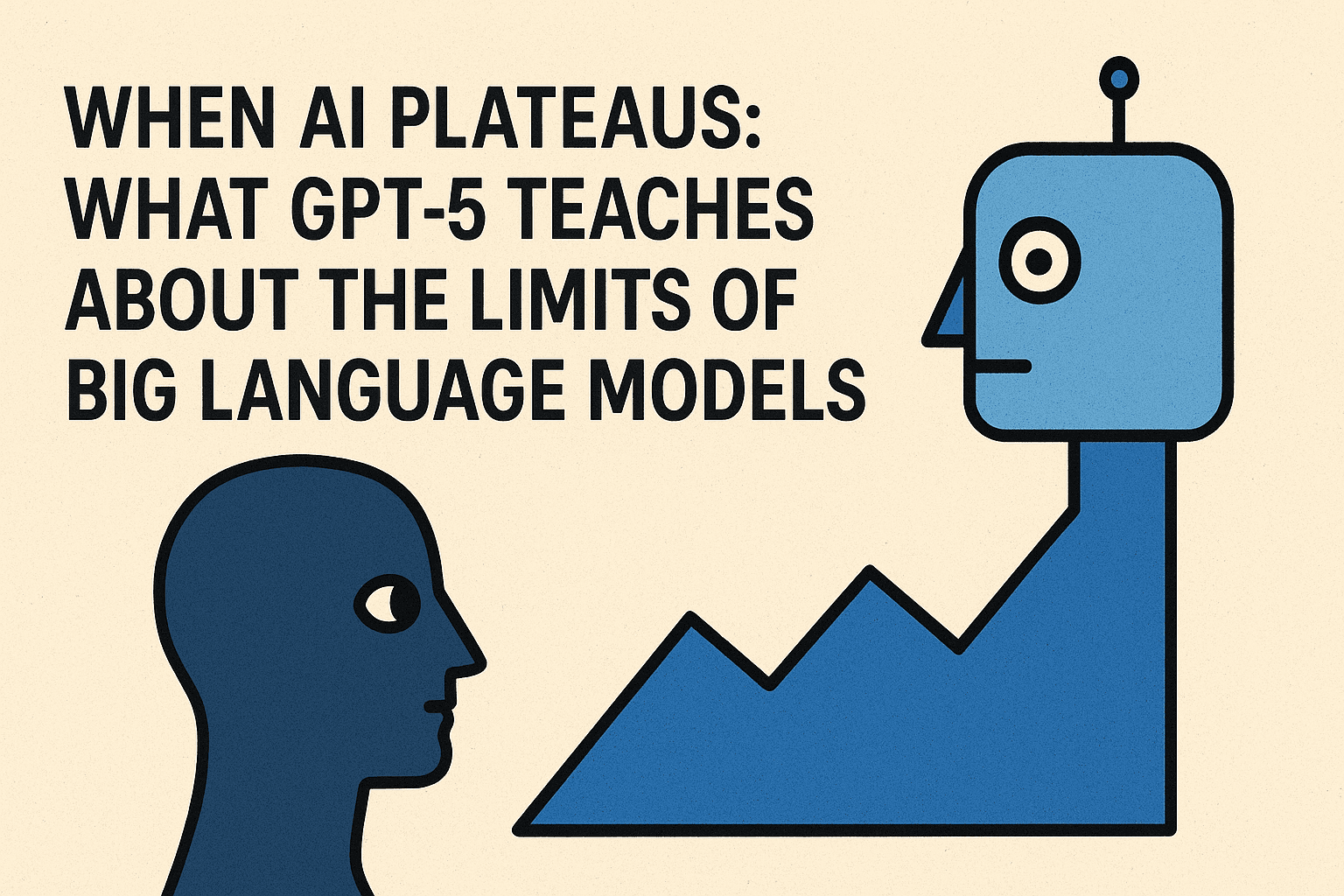
However, with every leap forward, a critical question arises: Is there a limit to how much bigger and brighter these models can become? GPT-5 is powerful, but it also exposes the limits of scaling AI. This blog explores what GPT-5 teaches us about those boundaries and how the future of AI Agents may evolve beyond sheer size.
The Rise of Big Language Models
From GPT-2 to GPT-5
Each iteration of GPT brought bigger training datasets, more parameters, and increasingly human-like performance. GPT-2 amazed us with coherent text generation, GPT-3 shook industries with its versatility, and GPT-4 demonstrated reasoning abilities far beyond expectations.
GPT-5 builds on this legacy—but its advances aren’t solely about size. Instead, it focuses on optimization, efficiency, and smarter alignment with human values.
Why Bigger Doesn’t Always Mean Better
Scaling models have diminishing returns. For example:
- GPT-3’s jump from GPT-2 was dramatic.
- GPT-4 showed improvement, but not a revolutionary one.
- GPT-5 pushes further, yet its progress highlights that language models alone may not be sufficient to achieve accurate human-level intelligence.
What GPT-5 Reveals About AI’s Plateau
1. The Data Bottleneck
LLMs thrive on massive datasets. However, the internet doesn’t have an infinite supply of high-quality text. GPT-5 demonstrates that simply feeding models more data won’t guarantee more intelligent reasoning. At some point, models tend to memorize patterns rather than understand the underlying context.
2. Energy and Cost Limits
Training GPT-5 required enormous computational resources. This raises sustainability concerns:
- The energy consumption of large AI models contributes to carbon footprints.
- The costs of building bigger models limit accessibility for smaller organizations.
3. Reasoning vs. Understanding
GPT-5 is excellent at simulating reasoning, but it doesn’t truly understand. It can generate legal documents, write code, or hold a conversation, but it lacks genuine comprehension and common-sense reasoning. This gap reminds us of AI’s inherent plateau.

Beyond GPT-5: The Future of AI Agents
The Rise of Specialized AI Agents
Instead of just scaling models, innovation is moving toward AI Agents—specialized tools that can reason, act, and interact in dynamic environments. For instance:
- Free Voice AI Agents like Vomyra are redefining customer engagement by combining language models with real-time speech capabilities.
- Task-focused AI Agents can handle scheduling, automate workflows, or even execute transactions independently.
Why Vomyra AI Voice Assistants Matter
Vomyra represents the shift from “just bigger models” to “smarter, more empathetic AI.” Unlike generic chatbots, Vomyra AI Voice Assistants are:
- Conversational: Able to mimic natural human tones.
- Task-oriented: Designed to solve real problems quickly.
- Empathetic: Built to respond in ways that feel human, not robotic.
This reflects a broader trend: AI is no longer just about scale—it’s about usability, personalization, and efficiency.
Lessons from GPT-5 About AI’s Limits
1. Bigger Isn’t Always Sustainable
The industry can’t keep building endlessly larger models without hitting resource constraints. The focus must shift to efficiency.
2. Integration Beats Expansion
Pairing LLMs with AI Agents provides more practical value than making them bigger. A smaller, well-integrated model can outperform a giant one in real-world scenarios.
3. Human-Centric Design Matters
AI must evolve to meet human needs, not just technical benchmarks. Voice-driven tools like Vomyra embody this principle by bridging the gap between technology and empathy.
Conclusion: Redefining Progress Beyond Size
GPT-5 is a milestone, but also a mirror reflecting the boundaries of AI growth. It teaches us that scaling alone won’t unlock accurate intelligence. The future lies in AI Agents like Vomyra AI Voice Assistants and Free Voice AI Agents that combine advanced reasoning with accessibility and empathy.
As AI reaches its limits in terms of size, it opens doors to innovation in specialization, sustainability, and human-centered design. The next wave of progress isn’t about making AI larger—it’s about making it more intelligent, more connected, and deeply human.
FAQs
What does GPT-5 reveal about the limits of AI?
GPT-5 demonstrates that larger models encounter bottlenecks in data, energy, and reasoning capabilities. Progress now depends on efficiency and more innovative design, not just size.
How are AI Agents different from large models like GPT-5?
LLMs like GPT-5 generate language, while AI Agents are action-oriented, capable of decision-making, executing tasks, and integrating into workflows.
Why are Vomyra AI Voice Assistants important?
They represent a human-centric evolution of AI, offering conversational, empathetic, and task-driven interactions that move beyond traditional text-based models.
Are Free Voice AI Agents as powerful as paid ones?
Free Voice AI Agents offer excellent accessibility and functionality, although premium options may provide advanced customization, integrations, and analytics.
What’s the future after GPT-5?
The future lies in specialization—AI Agents that can combine reasoning with real-world actions, creating systems that are more usable, empathetic, and sustainable.