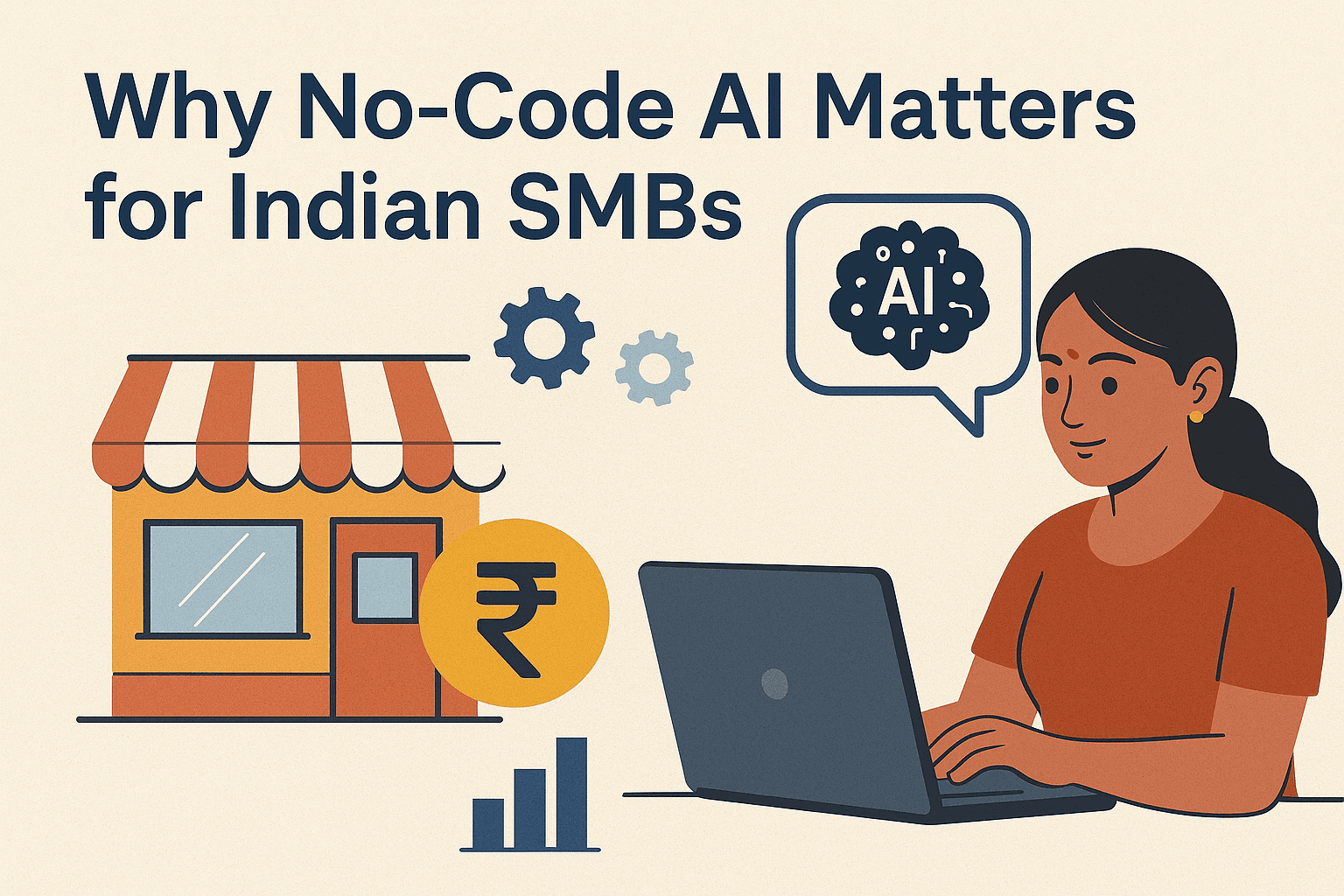
Artificial intelligence (AI) no longer exists only in the domain of large technology companies and research labs. In India, small‑ and medium‑sized businesses (SMBs) are increasingly embracing AI to automate tasks, reach customers in new ways, and compete more effectively against larger players. However, many business owners and developers still believe AI requires massive budgets, technical teams, and deep data sets. This misconception has kept some Indian SMBs from reaping AI’s benefits. No‑code AI and low‑code platforms are rapidly changing that reality. These tools allow business users to build AI‑powered solutions without writing complex code, making SMB AI adoption both affordable and practical.
Table of Contents
- Introduction – Why No‑Code AI Matters for Indian SMBs
- AI Adoption in Indian SMBs – Trends, Challenges, and Opportunities
- What Is No‑Code AI? – Definition and Key Differences
- Benefits for SMBs – Cost, Speed, Innovation, and Localization
- Success Stories – Indian SMBs Leveraging No‑Code AI
- Tools and Platforms – Essential No‑Code AI Solutions
- Building a Strategy – Steps for SMB AI Adoption
- Future Outlook – Market Trends and Emerging Technologies
- Conclusion – Transformative Impact of No‑Code AI
- FAQs – Common Questions Answered
This article dives into why no‑code AI matters for Indian SMBs in 2025. It examines adoption statistics, demystifies no‑code platforms, highlights benefits and challenges, provides real success stories from Indian companies, lists recommended tools, outlines a strategy for adoption, and looks ahead to the future. Throughout this piece.
Understanding AI Adoption in Indian SMBs
A surge in AI adoption and revenue impact
Indian SMBs are embracing AI at an impressive pace. According to Salesforce’s 2024 SMB Trends Report, 78% of Indian SMBs are already using or experimenting with AI, and their top use cases include automated customer service chatbots, marketing campaign optimization, and AI‑generated content. The same study found that 93% of Indian SMBs using AI believe it boosts revenue. Another survey by CPA Australia and ASSOCHAM (Business Technology Report 2024) notes that 23% of Indian businesses have implemented AI and 73% plan to expand AI usage in 2025, far above the global average. These figures suggest that AI is no longer an experimental technology—it is a growth engine.
The optimism around AI adoption extends beyond small businesses. Microsoft’s 2025 Work Trend Index reports that 93% of Indian business leaders intend to use AI agents within 12–18 months, and 59% are already deploying voice ai agents with Indian phone number to automate workstreams. This wave of enthusiasm shows that India’s leadership sees AI as an essential productivity tool, which filters down to SMBs looking to stay competitive.
Perceived obstacles and cultural misconceptions
Despite these encouraging statistics, many SMB owners and developers still hesitate. A common belief is that AI demands huge data sets and extensive programming skills. AI consultants note that pre‑trained AI models such as ChatGPT, Jasper, or Writesonic can deliver powerful results without any data from the user. Off‑the‑shelf tools—voice synthesis, video creation, workflow automation, chatbots, and market research tools—allow even micro‑enterprises to deploy AI quickly. Businesses are advised to start small by automating a single task and choose tools requiring minimal setup rather than collecting vast amounts of data.
Cost and complexity are other concerns. Traditional AI projects often involve data scientists, machine learning engineers, and expensive computing infrastructure. Reports acknowledge that 41% of SMB leaders worry they might fall behind in AI adoption, and 60% find it challenging to keep up with technological change. Security, compliance, and customer trust remain top worries. These barriers explain why accessible solutions like no code platforms are crucial.
Why Indian SMBs are uniquely positioned for AI
India’s entrepreneurial landscape offers several advantages for adopting AI. Entrepreneurs possess a “jugaad” mentality—an ability to achieve maximum output with minimal resources—and a strong focus on return on investment. English proficiency also gives many business owners an edge in using AI tools that rely on natural language prompts. Meanwhile, multiple regional languages and diverse cultural traditions create a vibrant market for localized AI applications, which makes regional language support especially valuable.
What Is No‑Code AI and Why Does It Matter?
Defining no‑code AI and low‑code platforms
A no code platform is a software environment that lets users build applications, workflows, or AI models through visual interfaces, drag‑and‑drop components, and pre‑built templates. Low‑code platforms work similarly but allow limited coding for customization. Democratized AI brings “drag‑and‑drop AI components” to business users, enabling marketers and HR managers to build recommendation engines and chatbots without programming. These platforms handle the heavy lifting—data preparation, model training, and deployment—behind the scenes.
Key differences from traditional AI development

Traditional AI requires specialized skills—data wrangling, model selection, parameter tuning, and deployment. It often demands a dedicated team, long development cycles, and substantial budgets. In contrast, no‑code AI offers:
- Ease of use: Visual dashboards replace code. Users configure models using simple menus, making AI accessible to non‑technical staff.
- Rapid prototyping and deployment: Projects can be built and tested in days instead of months, accelerating innovation.
- Lower costs: Subscription pricing and pay‑as‑you‑go models eliminate heavy capital expenditure.
- Pre‑trained models: Tools come with build voicebots that can be tailored with minimal data, avoiding the need for massive datasets.
By reducing complexity, no‑code AI unlocks SMB AI adoption. Even developers and IT managers benefit—they can build proof‑of‑concepts quickly or free up time for more strategic tasks.
Benefits of No‑Code AI for Indian SMBs
- Cost savings and improved ROI
Traditional AI initiatives can be prohibitively expensive, often involving custom software, data infrastructure, and specialized talent. By contrast, no‑code tools are subscription-based and scale according to usage. SMBs using AI report measurable revenue growth, and small investments in AI can yield substantial returns, making no-code platforms financially viable for resource-constrained businesses. - Empowering non‑technical employees and fostering innovation
Top No‑code platforms allow employees who understand customer needs to design solutions themselves. This shortens the feedback loop between idea and execution, creates “citizen developers,” and frees IT staff to focus on complex tasks. Applications built with no-code tools are significantly more affordable and faster than traditional coding. - Faster time to market and adaptability
Speed is critical in India’s fast-changing markets. No‑code AI tools enable rapid prototyping and real-time adjustments, helping SMBs pivot quickly. Regional language support and cultural customization allow businesses to target different geographic and demographic segments without extensive development work. - Scalability and flexible integration
No‑code AI platforms integrate with commonly used software—CRM, ERP, email, payment gateways, and analytics—allowing SMBs to scale operations without complex re-engineering. Many SMBs double their ROI within months of adoption by automating repetitive tasks and creating an “AI flywheel” that compounds growth. - Localization and multilingual support
India’s linguistic diversity poses challenges for digital tools. No‑code AI platforms increasingly offer regional language support, allowing small businesses to personalize communications for different states and festivals, improving customer engagement without hiring multilingual teams. - Aligning with government and industry trends
Government policies and industry momentum support SMB AI adoption. India leads the world in AI-driven leadership transformation, and businesses embedding AI into daily work can leverage speed and precision to remain competitive.
Real Success Stories: Indian SMBs Using No‑Code AI
- Amrutam and Avimee Herbal: Optimized marketing and customer engagement using AI-powered content creation and social media automation.
- Learnbay: Automated content creation and lead nurturing, improving customer engagement and lead generation.
- Ravi’s Food Delivery Empire (Pune): Used AI tools to grow from 50 to 500 daily orders and increase revenue substantially with minimal monthly investment.
- TechStart Solutions (Bengaluru): Reduced project completion time by 50% and expanded their client base eightfold using AI-driven development tools.
- The Sari Story (Kolkata): Tripled revenue in 10 months through AI-enhanced photography and multilingual customer support.
- EduTech Revolution (Indore): Used AI tools to increase student enrollment and revenue dramatically.
- Priya Mehra (Jaipur jewelry brand): Grew revenue fivefold by stacking three AI tools for content creation, workflow automation, and analytics.
These examples illustrate how small, strategic investments in AI can yield exponential returns.
Tools and Platforms: Building Blocks for SMB AI
Essential no-code AI tools for business functions:
- ChatGPT & Jasper: Language models for content creation and customer support.
- Canva AI: Design templates and generative AI for marketing materials.
- WhatsApp Business API: Automated customer support and order management.
- Zapier & Make: Workflow automation platforms.
- GitHub Copilot: AI code assistant for IT teams.
- Figma AI & Notion AI: Rapid prototyping, design, and project management.
- SemRush, Scalenut & Writesonic: SEO and marketing automation.
- ManyChat & Chatbase: Chatbot builders for messaging platforms.
- Google Looker Studio & Power BI: Analytics platforms with predictive insights.
- Regional solutions: Startups offering localized no-code AI with vernacular language support.
Choosing the right platform involves evaluating ease of use, cost, integration, community support, and language features. Start with the most time-consuming processes and scale gradually. Avoid common pitfalls such as overstated AI claims, lack of ROI metrics, and shadow IT.
Building a No‑Code AI Strategy for Your SMB

- Identify high-impact use cases – Map processes and start small with tasks that save time or improve accuracy.
- Evaluate tools and platforms – Align tool selection with business needs and regional language requirements.
- Train your team and encourage experimentation – Empower citizen developers and promote internal workshops.
- Measure impact and iterate – Track time saved, leads generated, conversion rates, and revenue growth; iterate based on results.
- Address data governance and compliance – Ensure data privacy, encryption, access controls, and vendor reliability.
- Plan for scalability and integration – Integrate multiple tools into cohesive workflows; consider low-code extensions if needed.
Future Outlook: The No‑Code AI Market in India
The no‑code AI platform market in India is projected to grow rapidly, reflecting demand across industries. Regional adoption patterns differ: manufacturing hubs focus on supply chain optimization, tech ecosystems emphasize code generation, and businesses in other states seek market analysis and quality control AI.
The next wave of agentic AI—autonomous AI programs—promises greater automation and decision-making capabilities. Indian startups report a significant share of new customers from SMBs using low-code or no-code agentic platforms. Developers and IT managers continue to play a critical role in integration, scalability, and security.
Policy initiatives and ethical considerations—including AI bias, data privacy, and responsible practices—will shape adoption. SMBs must select platforms that uphold ethical standards and comply with regulations.
Conclusion: Why No‑Code AI Is Transformative for Indian SMBs
AI in India is no longer futuristic hype; it delivers practical, measurable results. No code platforms democratize AI, making it accessible for entrepreneurs, developers, and employees without specialized skills. Adoption enables cost reduction, faster development cycles, innovation by non-technical staff, localized engagement, and seamless scalability.
Success stories from multiple Indian SMBs show that small investments can lead to exponential growth. The coming years promise autonomous agents, deeper generative AI integration, and stronger regulation. To seize the opportunity, Indian SMBs should start experimenting with no‑code AI today.
Frequently Asked Questions (FAQs)
What is a no‑code platform?
A no‑code platform allows users to build applications, workflows, or AI models through visual interfaces without coding. These platforms handle data processing, model training, and deployment, enabling non-technical users to create AI solutions quickly.
Why should Indian SMBs care about SMB AI?
AI adoption leads to measurable growth. No‑code tools lower barriers to entry, allowing SMBs to automate tasks, personalize marketing, and improve customer service without large investments.
Do I need large amounts of data to use AI?
No. Many pre‑trained AI models work effectively with little or no proprietary data. Some predictive analytics tools require historical data, but no‑code platforms often provide built-in datasets and templates.
Are no‑code AI tools expensive?
Not necessarily. Many tools offer free or low-cost tiers. Small businesses report investing between ₹2,800 and ₹5,200 per month, achieving double ROI in under six months.
How quickly can I see results?
Many SMBs report improvements within weeks, with revenue growth and customer expansion observable within six to eight months.
Are no‑code AI tools secure and compliant?
Security varies by vendor. Use reputable platforms that comply with India’s data protection laws and industry regulations. Always encrypt sensitive data and set proper user permissions.
Will no‑code AI replace developers and IT managers?
No. It empowers non-technical users but does not eliminate the need for technical expertise. Developers and IT managers remain essential for integration, scalability, and complex projects.
What are the risks of adopting no‑code AI?
Risks include overstated AI capabilities, privacy concerns, limited customization, and lack of training. Mitigate these by setting clear goals, monitoring ROI, and involving technical experts.
How do I choose the right tool?
Consider your use case, data requirements, integration needs, pricing, and language support. Start with one tool addressing a core pain point, then scale as results demonstrate value.