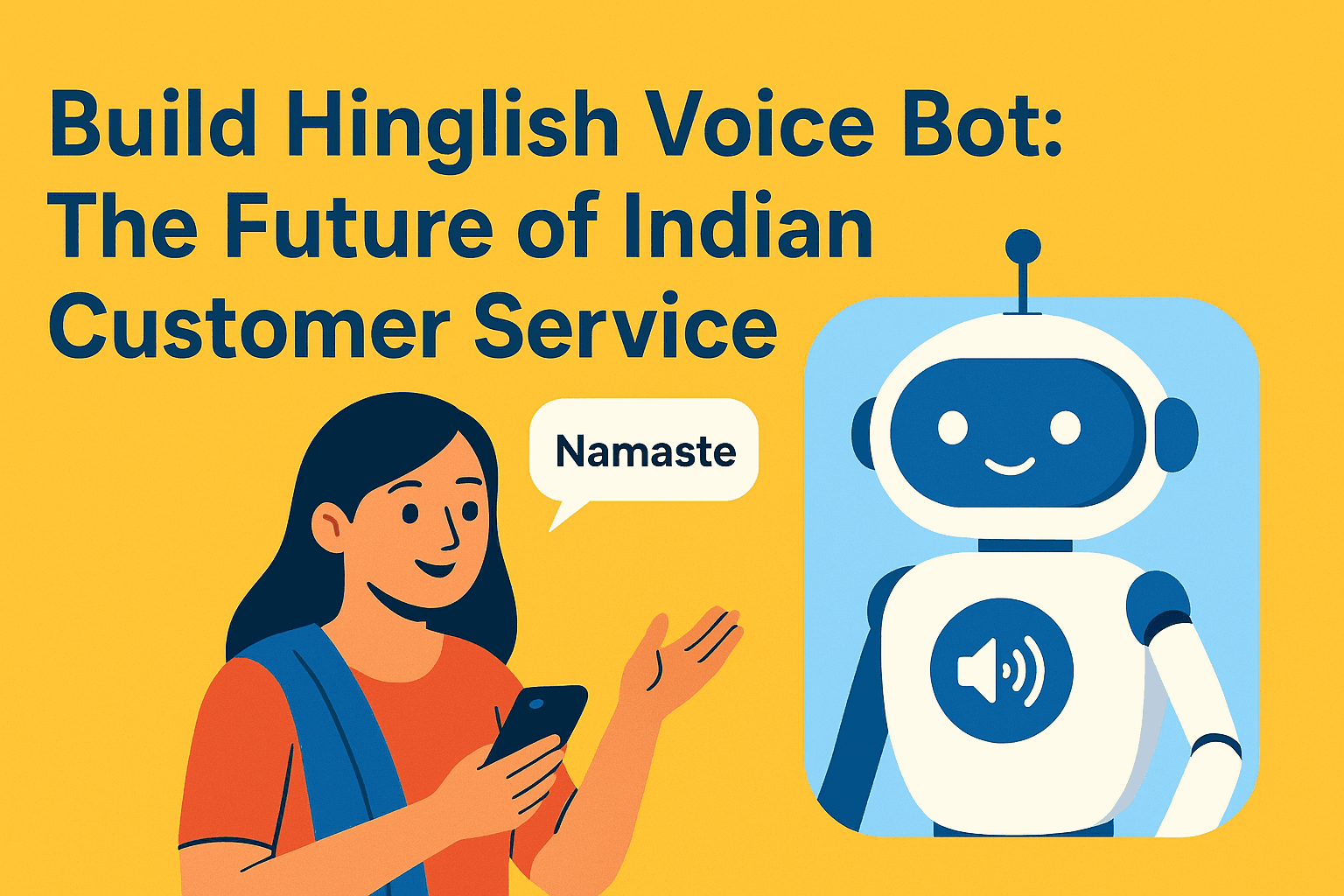
The Indian customer service landscape stands at a linguistic crossroads. While businesses chase English-speaking markets, they overlook a massive opportunity: the 350 million urban Indians who communicate primarily in Hinglish voice bot language—a natural blend of Hindi and English. This hybrid language isn’t just a trend; it’s become the authentic voice of modern India, reshaping how businesses connect with customers across tier-2 and tier-3 cities.
Multilingual AI calling agent India solutions addressing this gap are witnessing explosive growth, with the voice AI market projected to reach USD 1.82 billion by 2030. Companies deploying Hinglish-capable voice bots report 10% higher customer satisfaction scores and 76% increases in inquiries from previously underserved regional markets.
Understanding the Hinglish Voice Bot Phenomenon in India
Urban India has quietly developed its own linguistic ecosystem. Research reveals that approximately 60% of people in tier-2 and tier-3 cities encounter Hinglish regularly, with 19% engaging with it continuously throughout their daily communications. This isn’t accidental—Hinglish fills a critical gap between aspiration and accessibility.
The evolution follows a predictable pattern. Hindi monolinguals learning English don’t become pure bilinguals; they become Hinglish speakers. Studies tracking this shift demonstrate that Hinglish populations grew at an annualized rate of 1.2% between 2014 and 2022, with projections suggesting acceleration to 2.98% growth beyond 2023. More significantly, researchers found that interviewed participants claiming Indian language voice agent platform bilingualism actually used 18.5% English words within supposedly “Hindi-only” conversations—they genuinely cannot speak monolingual Hindi anymore.
Code-Switching Creates Technical Complexity
Academic analysis of Hindi-English conversations reveals fascinating patterns. Student interview recordings showed roughly 67% Hindi words mixed with 33% English words on average, with intra-sentential code-switching (switching within sentences) as the dominant form. Speakers naturally insert English words into Hindi grammatical structures, creating phrases like “Mera recharge balance check karna hai please”.
This code-switching follows specific linguistic rules. Within noun phrases, speakers either keep all constituents in one language or switch the head noun to English while maintaining Hindi modifiers (e.g., “mera hometown,” “apane friends”). Compound verbs particularly show English integration: “integrate karana haim,” “recommend karunga tumhe,” “surfing karata haim”. These patterns aren’t random—they represent systematic grammatical structures that AI systems must comprehend.
The technical challenges multiply when considering dialectal variations. A word in Uttar Pradesh doesn’t always carry identical meaning in Bihar. Pronunciation patterns shift dramatically across regions, with accent recognition becoming critical for accurate interpretation. Traditional NLP systems designed for monolingual content struggle with this linguistic fluidity.
Why Hinglish Voice Bot Technology Matters for Business Growth
The business case for Hinglish voice automation extends far beyond simple translation. When customers hear support in their natural communication style, psychological barriers dissolve. Banking customers in Jaipur exhibit measurably higher trust levels when AI switches from English to Hindi, transforming hesitation into relief during critical financial transactions.
E-commerce platforms deploying regional language support experience 3x higher conversion rates in tier-2 and tier-3 cities. Real estate agencies implementing Tamil voice AI reported 76% inquiry increases from rural areas and 44% improvements in customer trust scores. A Bangalore proptech startup serving relocating IT professionals used multilingual voicebots to handle inquiries from Tamil Nadu and Andhra Pradesh employees, demonstrating practical cross-regional applications.

The revenue implications prove substantial. Businesses using multilingual voice AI report 40% higher lead engagement rates specifically because prospects communicate in preferred languages. A Mumbai restaurant chain implementing trilingual voice AI (Hindi, Marathi, English) achieved 90% call automation rates with zero missed calls during peak hours, directly increasing order volume. These aren’t marginal improvements—they represent fundamental shifts in market accessibility.
Market Penetration Across Demographics
Language preference data reveals critical market segmentation. The New York Times reports that over 350 million urban Indians use Hinglish regularly, with social media usage showing 2% year-over-year growth between 2022 and 2024. More tellingly, 90% of Indians prefer native language interactions over English for important communications. This preference creates a massive addressable market gap.
Customer acquisition costs drop dramatically with language alignment. Studies show that language barriers increase acquisition costs by 3-5x, while 67% of customer journeys are abandoned when support isn’t available in preferred languages. Sales conversions drop by 40% when communication remains limited to English. The State Bank of India’s multilingual voicebot handles over 100,000 customer queries daily across 11 Indian languages, demonstrating scalability possibilities.
Voice search adoption patterns reinforce these trends. Google India indicates voice search usage grows 270% year-over-year in India, significantly outpacing global averages. This behavioral shift toward voice interfaces creates natural adoption pathways for Hinglish voice bot solutions. Urban professionals aged 25-45 demonstrate highest comfort levels, while older demographics and rural users show increasing receptiveness as interfaces become more intuitive.
How Vomyra Handles Hinglish Voice Bot Conversations Naturally
Platform architecture determines success in handling code-switched languages. Vomyra positions itself as India’s first free no-code voice AI platform specifically engineered for Indian businesses. The platform supports 32+ Indian languages with native Hinglish capabilities, recognizing that code-switching isn’t an error but the standard communication mode.

Technical implementation requires sophisticated NLP pipelines addressing unique Hinglish characteristics. Preprocessing includes script standardization (managing both Roman and Devanagari scripts), language identification within mixed sentences, and specialized tokenization handling code-switch boundaries. Advanced models employ LSTM and BERT architectures trained on Hindi-English mixed datasets, outperforming generic monolingual systems on classification tasks.
Real Conversation Examples
Practical deployment reveals how natural language processing handles authentic interactions. At a Tech Alumni Summit, Vomyra’s live demonstration answered random questions from 200+ business owners without pre-programmed responses, showcasing robust real-time processing capabilities. The system managed interruptions intelligently, distinguishing between casual affirmations like “yes,” “ji,” or “okay” and genuine interruptions requiring response changes.
Meesho’s implementation provides concrete performance metrics. Their multilingual Gen AI-powered voice bot manages approximately 60,000 calls daily, achieving 10% higher customer satisfaction scores compared to previous systems. The bot performs efficiently on basic smartphones and noisy environments—critical factors given that 80% of Meesho’s users come from tier-2 cities and beyond.
Banking sector applications demonstrate handling of sensitive information. ICICI Bank’s voice AI implementation increased call resolution rates by 50% while lowering operational costs by 30%. The system manages collections and customer service calls while maintaining compliance with financial regulations. Central Bank of India’s voice AI boosted repayment rates while reducing operational complexity through multilingual support.

Platform Integration Capabilities
Deployment success depends on seamless integration with existing business systems. Vomyra offers integrations with Google Sheets, Gmail, Google Calendar, and restaurant systems like Petpooja. This connectivity allows voice agents to access real-time data, update CRM systems, coordinate scheduling, and trigger automated workflows without manual intervention.
The platform provides 500 free credits monthly with Indian number integration, enabling businesses to make and receive calls using local numbers. Pay-per-use pricing at ₹5 per minute makes enterprise-grade AI accessible even to startups and small businesses. This pricing model eliminates large upfront investments, allowing companies to scale gradually based on actual usage.
Technical setup requires no coding skills. Users access a drag-and-drop interface to design conversation flows, set triggers, and define responses. The platform’s No‑code AI and low‑code approach democratizes voice AI, previously accessible only to large enterprises with dedicated development teams. Live testing environments allow businesses to refine agent behavior before public deployment.
Technical Architecture Behind Multilingual AI Calling Agent India Solutions
Building robust speech models for Indian languages requires sophisticated technical frameworks. Modern systems leverage transformer-based models and recurrent neural networks processing intricate phonetic patterns characteristic of Indian languages. Hybrid architectures combine Hidden Markov Models with deep neural networks, creating systems capable of handling acoustic variability in multilingual environments.
Feature engineering for Indian languages demands specialized approaches to phoneme extraction. Tamil, Telugu, and Malayalam contain complex consonant clusters and vowel modifications requiring unique preprocessing techniques. Advanced methods include spectral subtraction for noise reduction, cepstral mean normalization for channel compensation, and dynamic time warping for temporal alignment. These preprocessing steps maintain model accuracy across diverse recording conditions, from high-quality studio environments to noisy street-side interactions typical of Indian mobile usage.
Overcoming Code-Switching Challenges
Code-switching presents unprecedented challenges requiring innovative technical solutions. Speech models must incorporate multilingual processing capabilities that seamlessly transition between different phonetic systems, grammatical structures, and vocabulary sets without losing conversational context. Advanced systems employ hierarchical clustering techniques grouping similar dialectal patterns while maintaining sensitivity to regional variations carrying semantic significance.
Acoustic modeling employs adaptation techniques dynamically adjusting to speaker-specific characteristics including regional accents, speaking rates, and prosodic patterns. These adaptation mechanisms enable speech recognition systems to maintain high accuracy levels across diverse user populations without requiring separate models for each dialectal variation.
Training data scarcity compounds technical difficulties. Hindi qualifies as a low-resource language with limited labeled audio compared to English. The Common Voice project released merely 11 validated hours for Hindi versus 2,186 for English. Training robust supervised ASR models typically requires several thousand hours of labeled audio, creating real challenges for Indian language implementations.
Natural Language Understanding
Moving beyond speech recognition to genuine understanding requires sophisticated NLP architectures. Hinglish’s unpredictable structure, combined Roman and Devanagari scripts, and lack of standardized grammar challenge traditional language processing systems. Specialized pipelines implement support vector machines, Naive Bayes classifiers, and deep learning methods using LSTM and BERT models specifically trained on code-mixed datasets.
Sentiment analysis for code-mixed data remains largely unexplored despite social media platforms containing extensive Hinglish content. Novel approaches combine translation (using LoRA weights of fine-tuned Gemma-2B models), meta embeddings (GloVe, Word2Vec, TF-IDF, fastText), and stacking classifier ensembles. Experimental results show the TF-W2V-FST combination achieving 91.53% accuracy with 0.96 AUC scores.
Sample-efficient language models address computational constraints. Fine-tuning smaller architectures like Qwen2.5-3B with parameter-efficient methods (LoRA) shows remarkable results. Hinglish fluency improvements reached 41.4% over base models, with coherence increasing 42.4%. These gains demonstrate that targeted fine-tuning on code-mixed conversational data enables compact models to handle Hinglish naturally without requiring massive computational resources.
Business Benefits and ROI of Hinglish Voice Bot Deployment

Cost analysis reveals compelling economics. Traditional call centers cost ₹38,500 per agent monthly (including salary, benefits, infrastructure, training, and supervision). A 50-agent center requires ₹19.25 lakhs monthly or ₹2.31 crores annually. Comparable Qcall.ai implementation handling 100,000 minutes monthly costs ₹6 lakhs monthly or ₹72 lakhs annually—a 69% cost reduction saving ₹1.59 crores annually.
Beyond direct cost savings, AI voice agents provide 24/7 availability (human agents work 8 hours), zero sick days or attrition, instant scalability during peak periods, consistent service quality, and multilingual support without additional hiring. These operational advantages compound over time as systems learn from interactions and handle increasingly complex scenarios independently.
Performance Metrics
Quantifiable improvements validate investments. Companies report 60% increases in sales-qualified leads and 50% reductions in operational errors after implementing conversational AI. Customer satisfaction scores improve 15-20% with natural Hinglish voice bots compared to robotic English-only systems. First-call resolution rates increase 30% when AI handles routine queries accurately on initial interactions.
Average handle time reductions prove substantial. AI-addressed routine queries drop call times from 3-4 minutes to under 45 seconds. This efficiency allows human agents to focus entirely on complex issues requiring nuanced judgment and empathy. Studies show 100% automation of routine tasks enables 300% efficiency gains while maintaining quality standards.
Revenue enhancement often exceeds cost savings. Lead engagement rates increase 40% when prospects communicate in preferred languages. A Bangalore fashion retailer saw 35% increases in customer satisfaction scores after implementing multilingual support. E-commerce platforms report conversion rate improvements of 3x in tier-2 and tier-3 cities with regional language capabilities.
Market expansion opportunities prove transformative. Businesses serving only English-speaking customers access perhaps 10-15% of India’s population. Adding Hindi support expands reach to 40-50%. Supporting major regional languages opens access to 80-90% of the market. This dramatic expansion in addressable market size justifies voice AI investment even before considering operational efficiencies.
Future Trends in Multilingual AI Calling Agent India Technology
Predictive modeling suggests continued acceleration. AI adoption in Indian customer service expects to reach 80% across industries by 2025. The conversational AI market alone projects to near USD 5 billion by 2033 in India. Integration of AI with business systems in India is projected to increase by 40% by 2025, reflecting growing recognition that AI customer service systems must seamlessly connect with existing CRM, ERP, and marketing automation platforms.
Emerging use cases expand beyond basic customer service. Document processing capabilities will handle insurance claims, loan applications, and compliance documents with minimal human oversight. AI systems will process verification, complex analysis, and cross-referencing tasks, dramatically reducing processing times while improving accuracy.

Voice Commerce Integration
The fusion of voice and commerce accelerates. Voice-activated prompts merged with hyper-personalized video content create deeper brand connections. The global market for AI voice personalization platforms projects to exceed USD 61 billion by 2032, with India positioned to lead in vernacular adoption. Deeper integration with fintech solutions like Buy Now Pay Later and UPI creates seamless “voice-to-cart” experiences.
Hyper-personalization extends beyond names and locations. Advanced AI models anticipate user needs and proactively offer solutions. Contextual understanding tracks conversation topics and patterns, suggesting relevant products or services at optimal moments. This behavioral intelligence transforms voice interfaces from reactive responders to proactive assistants.
Channel expansion creates new touchpoints. While smartphones remain dominant, rapid growth occurs in voice interactions through in-car assistants and wearables. These devices offer hands-free engagement opportunities particularly valuable for on-the-go interactions. The proliferation of IoT devices embeds voice capabilities throughout physical environments, from smart homes to retail spaces.
Frequently Asked Questions
Can Hinglish voice bots understand regional Hindi dialects?
Modern platforms employ hierarchical clustering techniques and acoustic adaptation to handle regional variations. Systems trained on diverse datasets recognize pronunciation differences across states while maintaining semantic understanding. Real-world deployments show successful operation across multiple Hindi dialects.
How accurate are Hinglish voice bots compared to English-only systems?
Platforms specifically designed for Indian languages achieve comparable accuracy to English systems. Meesho’s implementation demonstrates 10% higher customer satisfaction scores with multilingual capabilities. Training on code-mixed datasets enables proper handling of language switching that confuses English-only systems.
What industries benefit most from Hinglish voice bots?
E-commerce, banking, healthcare, education, and travel sectors show highest adoption. Any business serving tier-2 and tier-3 city customers gains substantial advantages. Real estate agencies report 76% inquiry increases, while restaurants achieve 90% call automation rates.
How long does implementation typically take?
No-code platforms like Vomyra enable setup in minutes rather than months. Users design conversation flows, test responses, and deploy agents without technical teams. Traditional development requiring coding might take weeks to months depending on complexity.
What is the typical ROI timeline for Hinglish voice bot investments?
Most businesses report positive ROI within 3-6 months. Cost savings from reduced staffing needs, combined with increased conversion rates from better language support, generate rapid returns. Companies see 60-80% cost reductions while improving customer satisfaction.
Do voice bots replace human customer service agents entirely?
Voice bots automate routine queries, allowing human agents to focus on complex issues requiring empathy and judgment. The optimal model combines AI handling repetitive tasks with human escalation for nuanced situations. This hybrid approach delivers cost savings while maintaining service quality.
Conclusion: Embracing India’s Linguistic Future
The data tells an unambiguous story: Hinglish isn’t a transitional phase but rather the authentic voice of modern urban India. Businesses deploying Hinglish voice bot solutions access 350 million speakers currently underserved by English-only systems. The technology has matured beyond experimental stages into production-ready platforms delivering measurable business results.
Vomyra democratize access to sophisticated voice AI, removing technical barriers that previously limited implementations to large enterprises. With no-code interfaces, free starting tiers, and pay-per-use pricing, businesses of all sizes can deploy multilingual voice agents handling customer interactions 24/7.
The competitive landscape shifts rapidly. Early adopters already report substantial advantages through improved efficiency, expanded market reach, and enhanced customer satisfaction. Companies delaying implementation risk falling behind as customer expectations for instant, native-language support become standard. The question isn’t whether to deploy multilingual AI calling agent India solutions but how quickly businesses can adapt to leverage this transformative capability while maintaining the human touch that customers value most.