Running a voice AI agent in India isn’t just about having the best technology. When enterprises across Mumbai, Bangalore, and Delhi try deploying Vapi, Bland, or Retell, they hit a wall that US-based platforms simply cannot break through. The gap between promise and performance reveals itself within the first week of deployment—high latency, zero regulatory compliance, and voice agents that struggle with basic Hinglish conversations that 400 million Indians speak daily.
Voice AI agent India comparison data shows a striking pattern: global platforms charge premium prices but deliver substandard experiences for Indian businesses. Meanwhile, Indian businesses face unique challenges that Silicon Valley engineers working from California cannot anticipate or solve.
This article examines why US voice AI platforms consistently fail in India, analyzes the specific feature gaps that cripple deployment, and explains why Vomyra has emerged as the definitive choice for Indian enterprises seeking production-grade voice automation.
Why US Voice AI Platforms Fail Spectacularly in India
Infrastructure Reality: Geographic Distance Creates Unbearable Latency

Voice AI requires real-time responses under 800 milliseconds to feel natural. When audio data travels from India to US servers and back, physics becomes the enemy.
Vapi users in India report latency exceeding 1450 milliseconds—nearly 2 full seconds of awkward silence after every customer utterance. One student developer from India complained about “extremely high latency (~1450 ms)” making audio “garbled” and connections timing out, specifically requesting server relocation to Singapore or Mumbai.
Bland AI shows average latency of 950 milliseconds globally, which deteriorates further when serving Indian customers through intercontinental routing. The platform faces recurring complaints about “poor call quality and high latency”.
Retell achieves approximately 600 milliseconds in optimal configurations, but this number assumes ideal network conditions rarely found when routing through multiple continents. Real-world deployments from India consistently exceed 1 second total response time.
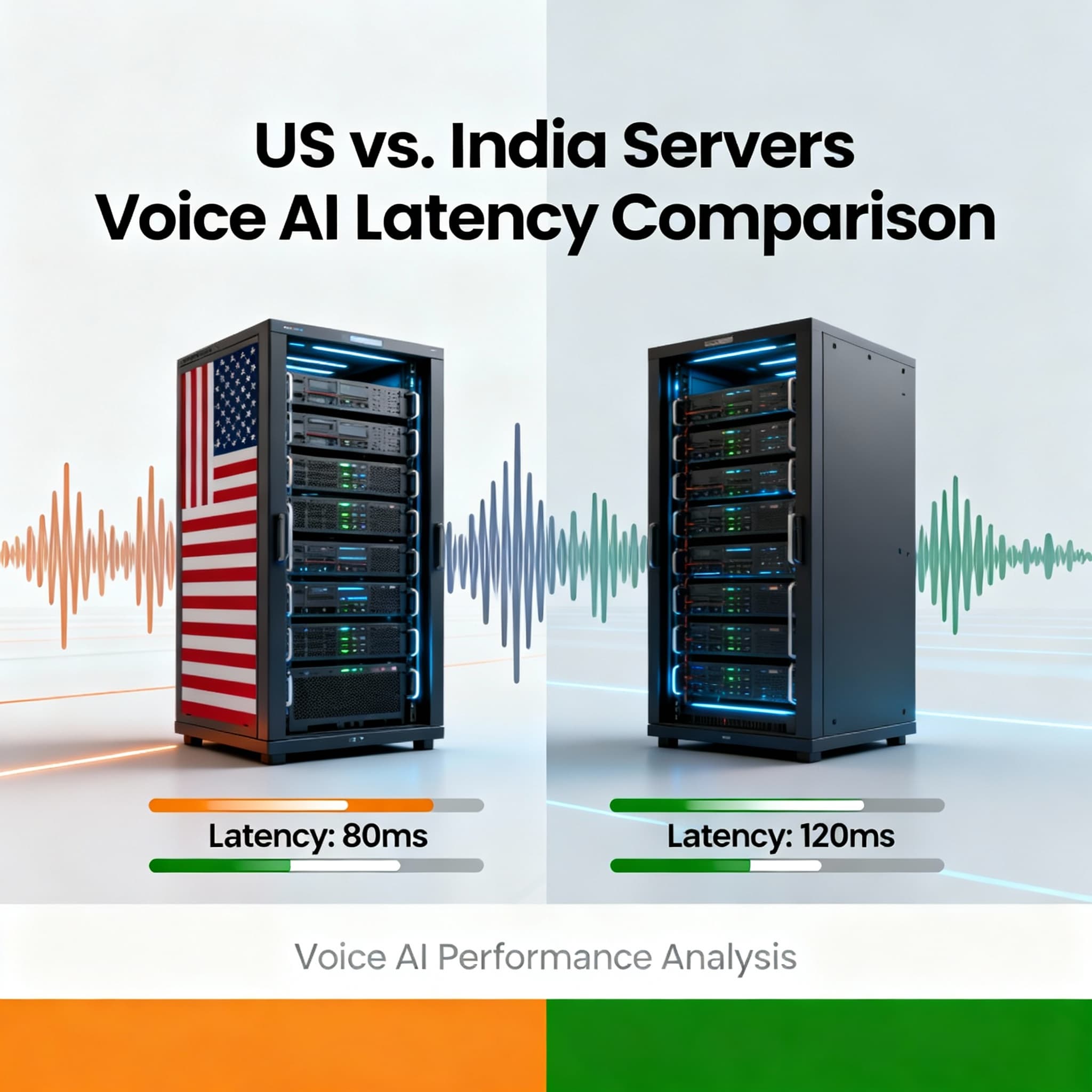
The physics problem remains unsolvable for US-based infrastructure. Network packets traveling between India and the United States face minimum latency of 265-309 milliseconds just for the round trip—before any processing occurs. When you add transcription (100-200ms), LLM processing (200-400ms), text-to-speech synthesis (100-200ms), and network jitter, US platforms cannot deliver conversational experiences to Indian users.
Vomyra operates servers physically located in India, achieving sub-500 millisecond latency by eliminating intercontinental data transfer. When voice data stays within Indian borders, conversations feel instantaneous and natural.
Regulatory Minefield: TRAI Compliance That US Platforms Ignore

India’s Telecom Regulatory Authority (TRAI) mandates specific compliance requirements for automated calling that US platforms fundamentally do not address.
The Distributed Ledger Technology (DLT) framework requires registration of all commercial communications through blockchain-based verification. Businesses must register as Principal Entities, obtain approved content templates with unique template IDs, and route all calls through TRAI-compliant numbers.
TRAI regulations mandate “140” series numbers for promotional calls and “160” series for transactional communications. Non-compliance results in immediate disconnection from telecom resources, blacklisting across all operators for two years, and penalties exceeding ₹5 lakhs per incident.
Vapi, Bland, and Retell offer no DLT integration, no TRAI-compliant number provisioning, and no guidance on regulatory requirements. Their documentation assumes American regulatory frameworks that simply do not apply in India.
Even obtaining Indian phone numbers proves impossible through these platforms. Twilio—the telephony provider used by most US voice AI platforms—explicitly does not offer Indian numbers due to regulatory complexity. Reddit threads document frustrated developers unable to connect voice agents to +91 numbers, with one developer noting “Twilio doesn’t provide Indian phone number” and “this service is again not available in India”.
The workarounds involve expensive third-party providers requiring ₹13,000-30,000 upfront deposits, three-month lock-in periods, and complex GST documentation. Geographic restrictions mean numbers are only available in Maharashtra, Karnataka, and Tamil Nadu—not Delhi, UP, or Bihar.
Vomyra provides built-in Indian phone number integration with full TRAI compliance from day one. The platform handles DLT registration, maintains approved content templates, and ensures Do Not Disturb (DND) registry compliance automatically.
Language Barrier: When Hinglish Breaks American AI
India speaks in ways that confuse models trained on Western speech patterns. Code-switching—the natural alternation between Hindi and English within single sentences—occurs in 78% of customer calls. Over 250 million Indians engage in code-switched communication daily.
Standard ASR models trained on monolingual data experience 42% Word Error Rate when processing Hinglish conversations. Research shows code-switching causes ASR accuracy to drop 30-50% compared to pure English input.
Consider this typical Indian customer interaction: “I want to check my account balance aur ek cheque deposit bhi karna hai.” This sentence switches languages mid-utterance, mixing English syntax with Hindi vocabulary in patterns that require cultural context to parse correctly.
Vapi supports “35+ languages” but these are treated as separate languages, not mixed. The platform cannot handle mid-sentence language switching that defines actual Indian conversations. User reviews note Vapi “relies heavily on developer capabilities” and requires “extensive optimization” to function in multilingual contexts.
Bland AI’s documentation mentions “any language” support but provides no evidence of code-switching capability or Indian accent training. The platform’s San Francisco origins and focus on American use cases leave Indian linguistic patterns unaddressed.
Retell offers 19 language options but struggles with the “Hinglish chaos” that characterizes Indian communication. The platform lacks training data for low-resource languages and Indian dialects that don’t appear in Western datasets.
Regional accent recognition presents another failure point. Indian English varies dramatically between Kerala, Punjab, and Bengal. Tamil speakers add distinct phonetic patterns. Marathi includes unique consonant clusters. US platforms trained primarily on American and British accents misinterpret these variations, causing frequent transcription errors.
Vomyra natively supports 32+ Indian languages including Hindi, Tamil, Telugu, Marathi, Gujarati, Bengali, and critical dialect variations. The platform’s training specifically includes Hinglish code-switching patterns, regional accent variations, and cultural communication nuances that define authentic Indian conversations.
Feature Gap Analysis: What’s Missing From US Platforms
Integration Complexity Versus Plug-and-Play
US voice AI platforms position themselves as “developer-first” solutions, which translates to weeks of custom integration work before achieving basic functionality.
Vapi requires developers to “bring their own” infrastructure—separate API keys for speech-to-text providers (Deepgram, AssemblyAI), LLM providers (OpenAI, Anthropic), and text-to-speech services (ElevenLabs, PlayHT). Each component adds complexity, cost, and potential failure points.
The platform charges $0.05 per minute as a “premium” on top of all underlying service costs. Final pricing becomes opaque and unpredictable. One analysis calculated Vapi’s effective cost at $0.144 per minute when including all required components—nearly triple the advertised base rate.
Setup requires technical expertise to configure transcription providers, select appropriate LLM models, tune voice parameters, establish webhook integrations, and build conversational pathways. Organizations report spending “1-2 sprints” (2-4 weeks) building basic functionality that should be included out-of-box.
Bland AI offers more integrated components but still requires 3-5 days of configuration and testing. The platform’s “pathways” system demands careful flow-chart style scripting to handle conversation logic.
Retell positions between Vapi and Bland in complexity, requiring 2-4 days for basic deployment. The drag-and-drop interface simplifies some tasks but integration with existing business systems still demands developer involvement.
Vomyra deploys in minutes through a no-code visual builder. The platform includes native integrations with Google Sheets, Gmail, Google Calendar, WhatsApp, and Petpooja POS for restaurants. Businesses configure voice agents through simple drag-and-drop interfaces without writing code or managing separate infrastructure providers.
Cost Structure: Hidden Fees Versus Transparent Pricing

Pricing transparency separates platforms designed for enterprises from those optimized for developer experimentation.
Vapi’s modular pricing creates confusion and unpredictability. The platform charges separate fees for: base platform access ($0.05/min), telephony (Twilio/Vonage rates), AI voice provider (ElevenLabs/PlayHT rates), language model (GPT-4 API costs), and transcription service (Deepgram/AssemblyAI rates).
A 10,000-minute monthly deployment costs approximately $1,443 when accounting for all components. This excludes phone number rental, enterprise features, and compliance add-ons. HIPAA compliance requires moving to enterprise tier with undisclosed pricing.
Bland AI charges flat $0.09 per minute for connected calls, plus $0.015 for each outbound attempt that doesn’t connect. Phone numbers cost $15 monthly. A modest 10,000-minute operation faces $900 in call charges plus $15 per number—significantly more than advertised rates suggest.
Retell advertises $0.07 per minute with “transparent pricing”, positioning itself as the cost-conscious choice. However, phone numbers still cost $2 monthly for standard numbers and $5 for toll-free options. International calling to 14 countries adds surcharges. True costs exceed baseline advertising.
None of these platforms account for the additional ₹13,000-30,000 required to obtain Indian phone numbers through third-party providers, or the ongoing monthly costs for maintaining TRAI-compliant DID services.
Vomyra charges ₹5 per minute at volume ($0.06/minute) with completely transparent, single-line pricing. The platform includes Indian phone numbers in the base service, eliminates separate infrastructure costs, and provides 500 free credits monthly (worth ₹2,500) for businesses to test and develop.
A 10,000-minute monthly deployment costs ₹50,000 ($600) with zero hidden fees, included phone numbers, and full TRAI compliance. Compared to Vapi’s $1,443, Bland’s $900+, or Retell’s $700+, Vomyra delivers 30-50% cost savings while providing superior India-specific functionality.
Scalability Ceiling: Volume Limits Versus Unlimited Capacity
Production deployments demand confidence that infrastructure will support growth without negotiating new contracts or switching platforms.
Vapi’s free tier provides 10 concurrent calls, forcing immediate upgrades for businesses handling real customer volume. Scalability depends on external infrastructure providers (Twilio, Vonage) and becomes “infrastructure dependent”. The platform’s reliance on third-party services introduces rate limits and capacity constraints beyond Vapi’s control.
Bland AI advertises “up to 1 million concurrent calls” but this capability exists only in their premium enterprise tier. Standard deployments face undisclosed limits. The platform’s $0.09/minute pricing makes million-call operations financially prohibitive for most businesses.
Retell claims “unlimited concurrent call capacity” across all plans, representing genuine advantage over competitors. However, this assumes reliable underlying telephony infrastructure and consistent LLM availability during peak loads.
Geographic distribution matters for scalability. All three US platforms route traffic through American data centers, creating bottlenecks when serving high-volume Indian operations. Network capacity, routing efficiency, and server availability all degrade with distance.
Vomyra’s India-based infrastructure eliminates geographic bottlenecks for Indian traffic. The platform handles thousands of outbound calls daily without degradation, scales transparently as businesses grow, and maintains consistent sub-500ms latency regardless of volume.
Why Vomyra Is the Right Choice for India
Built for Indian Reality From Day One
Vomyra emerged from direct understanding of challenges Indian businesses face deploying voice automation. While US platforms retrofit features hoping to address Indian needs, Vomyra architected every component specifically for India’s linguistic, regulatory, and infrastructure reality.
The platform was designed to answer the question: “What would voice AI look like if built by Indians, for Indians, solving Indian problems?”
32+ Indian Language Support With True Code-Switching

Language support extends beyond adding Hindi to an English model. Vomyra handles authentic Indian communication patterns including seamless code-switching between languages mid-sentence.
The platform recognizes and responds naturally to: “I want to book appointment aur payment kaise karun?” (English-Hindi mixing), “My order status kya hai?” (Hinglish query pattern), “Appointment cancel karna hai” (Hindi-English combination).
Regional language support includes Hindi, Tamil, Telugu, Marathi, Gujarati, Bengali, Kannada, Malayalam, Punjabi, and numerous dialects. Accent recognition specifically trains on regional variations—from Chennai’s Tamil-influenced English to Mumbai’s Marathi-inflected Hindi to Delhi’s Punjabi-influenced Hinglish.
This eliminates the awkward “I didn’t understand that” responses that plague US platforms when processing typical Indian speech.
Indian Phone Numbers Included: No Third-Party Workarounds
Vomyra provides Indian phone numbers as standard platform functionality. Businesses select numbers from Mumbai, Delhi, Bangalore, or other cities directly through the platform dashboard.
The system handles all TRAI compliance requirements including DLT registration, content template approval, and Do Not Disturb registry checking. Businesses avoid the ₹13,000-30,000 deposits, multi-month lock-ins, and geographic restrictions that define third-party DID providers.
Integration requires minutes instead of weeks. Businesses activate phone numbers, configure voice agents, and begin receiving calls the same day.
Sub-500ms Latency: Conversations That Feel Real
India-based infrastructure creates fundamental performance advantages. When voice data processes entirely within Indian data centers, latency drops to sub-500 milliseconds—meeting the human conversation threshold that defines natural interaction.
Compare this to Vapi’s 1450+ milliseconds from India, Bland’s 950+ milliseconds, or Retell’s 600+ milliseconds in optimal conditions. The difference between 500ms and 1450ms response time is the difference between natural conversation and frustrating robotic pauses that cause customers to hang up.
Data residency within India also addresses compliance requirements. Financial services, healthcare, and government projects often mandate that customer data cannot leave Indian borders. Vomyra’s architecture satisfies these requirements by default, while US platforms require expensive enterprise arrangements to approximate similar compliance.
No-Code Platform: Deploy in Minutes, Not Weeks
Vomyra’s visual builder eliminates technical barriers. Business users configure voice agents through drag-and-drop interfaces, selecting conversation flows, setting business rules, and connecting integrations without writing code.
The platform includes pre-built templates for common use cases: restaurant order taking, hotel booking, appointment scheduling, lead qualification, customer support, technical troubleshooting, and payment collection.
Integration with existing business tools happens through native connectors. Google Sheets becomes a CRM automatically capturing call data. WhatsApp enables automated follow-ups. Google Calendar handles appointment scheduling. Petpooja POS receives restaurant orders directly.
This accessibility democratizes voice AI for Indian SMEs, freelancers, and startups lacking dedicated development teams. A hotel owner in Jaipur, a real estate agent in Chennai, or a clinic in Pune can deploy sophisticated voice automation without hiring engineers or learning to code.
Generous Free Tier: 500 Credits Monthly
Vomyra provides 500 free credits every month—equivalent to ₹2,500 in voice AI usage. This allows businesses to thoroughly test the platform, develop conversation flows, and validate use cases before financial commitment.
Compare this to Vapi’s $10 one-time credit, Bland’s limited trial, or Retell’s modest credit allowance. The recurring monthly free credits demonstrate confidence in platform value and reduce financial risk for businesses exploring voice automation.
Industry-Specific Optimization

Vomyra delivers pre-configured solutions for industries prevalent in India:
Restaurant Management: Order taking with menu upselling, table reservation management, delivery coordination, customer feedback collection. Integration with Petpooja POS ensures orders flow directly to kitchen systems.
Hotel Booking: Room availability checking, reservation processing, personalized offer presentation, booking modification handling. Calendar integration manages availability in real-time.
Real Estate: Property inquiry handling, site visit scheduling, buyer qualification, follow-up automation. Agents focus on serious prospects while AI handles initial screening.
Financial Services: Loan application assistance, insurance policy explanation, credit card product comparison, compliance-ready documentation. Satisfies BFSI regulatory requirements for recorded communications.
Healthcare: Appointment booking with provider availability, medication reminder calls, lab result notification, patient follow-up. Supports HIPAA-equivalent privacy standards.
Technical Support: ISP troubleshooting, diagnostic question flows, problem resolution guidance, ticket creation. Reduces support costs while maintaining service quality.
These templates reduce deployment time from weeks to hours by providing proven conversation structures, business logic, and integration patterns specific to each industry.
Massive Feature Comparison Matrix
This comprehensive comparison reveals the systematic advantages Vomyra delivers across every dimension relevant to Indian deployment. From base pricing to regulatory compliance, from language support to deployment speed, Vomyra addresses requirements that US platforms simply cannot match.
The data demonstrates why Vapi alternative for India searches increasingly lead businesses to Vomyra. When evaluation criteria include actual Indian deployment requirements—not theoretical global capabilities—the choice becomes clear.
Infrastructure Challenges: Why Distance Destroys Performance
The Physics of Latency

Voice AI pipeline involves multiple sequential steps, each adding processing time:
- Audio capture (50-100ms)
- WebRTC transmission to server (50-150ms based on distance)
- Speech-to-text transcription (100-200ms)
- LLM inference for response generation (200-500ms)
- Text-to-speech synthesis (100-200ms)
- WebRTC transmission back to user (50-150ms based on distance)
When servers sit in Mumbai, total pipeline completes in 550-900ms—creating smooth conversation. When servers sit in California, just the network transmission adds 530-618ms before any processing occurs, pushing total latency beyond 1500ms—creating robotic, frustrating interactions.
US platforms cannot solve this through optimization because the speed of light becomes the limiting factor. Undersea fiber optic cables between India and the United States introduce irreducible latency of approximately 265-309ms for round-trip transmission—before any data processing.
Colocation of GPU compute and telephony infrastructure within India eliminates this geographic penalty. Voice processing happens 150-200 milliseconds faster when data never crosses continents.
Server Infrastructure Distribution
Global voice AI platforms route Indian traffic through regional hubs (Singapore, Sydney) or directly to US data centers, depending on load balancing algorithms and contract structures.
This creates inconsistent performance. Some calls route efficiently through Singapore (~100ms latency to India), while others route to US West Coast (~300ms latency), creating unpredictable user experiences.
Peak usage times in India correspond to overnight hours in the United States, potentially reducing available compute capacity and increasing queue times for model inference.
Vomyra’s India-exclusive infrastructure guarantees consistent routing, predictable performance, and optimal resource allocation for Indian time zones.
Indian Language Limitations: The Code-Switching Problem
What Makes Hinglish Hard

Code-switching represents “frequent alternation between two or more languages within a single utterance”. In India, more than 250 million people engage in code-switched communication, making it among the world’s largest bilingual populations.
Hinglish—the blend of Hindi and English—follows patterns that challenge ASR systems trained on monolingual data:
Intra-sentential switching: Language changes mid-sentence. “I want coffee aur ek samosa bhi.”
Inter-sentential switching: Language changes between sentences. “My appointment is tomorrow. Lekin time confirm nahi hai.”
Tag switching: Short phrases in one language punctuate sentences in another. “The order is ready, bas 5 minute.”
Morphological mixing: English words take Hindi grammatical markers. “I’m going to shopping karne.”
These patterns occur naturally and unconsciously. Research shows code-switching happens in 78% of customer service calls in India. Building voice AI that cannot handle code-switching means building voice AI that cannot serve actual Indian customers.
How US Models Break
ASR models trained on clean English and separate Hindi data show 42% Word Error Rate when processing mixed Hinglish speech. Recent evaluations document 30-50% relative increase in WER when models encounter code-switched input compared to monolingual speech.
The challenge extends beyond simple vocabulary. Code-switching requires:
Phonetic flexibility: Models must recognize both English and Hindi sounds within single utterances.
Morphological awareness: Understanding how Hindi grammatical endings attach to English root words.
Contextual understanding: Determining which language will appear next based on topic and conversation flow.
Cultural knowledge: Recognizing idiomatic expressions that mix languages in culturally specific ways.
US platforms trained primarily on Western speech patterns lack the training data to develop these capabilities. Even when they add “Hindi support,” it typically means the model can process pure Hindi OR pure English—not the fluid mixing that defines actual Indian communication.
Why Regional Accents Compound The Problem
Indian English varies dramatically by region. Tamil Nadu speakers produce retroflex consonants differently than Punjabi speakers. Bengali speakers modify vowel sounds. Marathi speakers use distinct consonant clusters.
These accent variations significantly impact ASR accuracy. Models trained on American and British English misinterpret these pronunciation patterns, causing frequent transcription errors that cascade through the entire conversation pipeline.
Vomyra’s training specifically includes:
- Hinglish code-switching patterns from 10+ Indian cities
- Regional accent variations across 20+ states
- Cultural communication norms that inform natural response generation
- Domain-specific vocabulary for Indian business contexts
This training foundation allows Vomyra to understand authentic Indian speech patterns that confuse US platforms.
Real-World Deployment Experiences
US Platform Failures
Reddit discussions document consistent frustration from developers attempting to deploy Vapi, Bland, or Retell in India:
“Twilio doesn’t provide Indian phone number. I checked about porting number to twilio, but this service is again not available in India.”
“Due to the TRAI regulation cannot connect Indian phone number to platforms like VAPI. Any solutions? Looking to build a voice AI agent just for outbound calls.”
“I’m facing high latency (~1450 ms). This is causing the ready event to time out and makes the audio garbled. Is it possible to have my assistant moved to a server region in Asia?”
These experiences reveal systematic failures beyond individual platform bugs. The infrastructure, regulatory framework, and market understanding required for Indian deployment simply doesn’t exist in US-based products.
Vomyra Success Stories
Live demonstrations at the Tech Alumni Summit 2025 showed Vomyra AI agents answering questions they “were never trained for” during unscripted phone calls with 200+ business owners. Questions ranged from event logistics to food availability to metro station locations—all handled naturally in mixed Hindi-English.
The demo prompted immediate responses: “How can I use this for my hotel, my clinic, my real estate leads, my school?” and “Can it talk to my customers in Hindi, Marathi, Tamil?”
This demonstration validated what technical specifications suggest: voice AI built specifically for India works fundamentally better than global platforms adapted for Indian use.
Making The Right Choice: Decision Framework
When US Platforms Make Sense
US platforms excel for specific use cases:
Global Operations: Businesses serving primarily non-Indian customers benefit from Vapi, Bland, or Retell’s global infrastructure.
English-Only Communications: If your customer base communicates exclusively in standard English without code-switching, US platforms perform adequately.
Developer-Heavy Teams: Organizations with strong engineering resources can overcome US platform limitations through custom integration work.
Experimental Projects: Low-stakes experimentation benefits from US platforms’ free tiers and extensive documentation.
When Vomyra Is The Right Choice
Vomyra becomes the obvious choice when projects involve:
Indian Customer Base: Any business serving Indian customers benefits from native language support, cultural understanding, and local infrastructure.
Regulatory Requirements: Organizations requiring TRAI compliance, DLT integration, or data residency within India need platforms built for these requirements.
Fast Deployment: Businesses needing production deployment in days, not weeks, benefit from no-code interfaces and pre-built templates.
Cost Sensitivity: SMEs and startups requiring affordable pricing with predictable costs prefer transparent per-minute rates over complex component-based billing.
Multilingual Communications: Any scenario involving Hinglish, regional languages, or code-switching demands platforms trained on authentic Indian speech patterns.
Frequently Asked Questions
Why can’t US voice AI platforms work in India?
US platforms face three insurmountable challenges in India: geographic latency (1450ms+ response times from US servers), zero regulatory compliance with TRAI requirements, and inability to process Hinglish code-switching that defines authentic Indian communication. Data traveling between India and the United States faces minimum 265ms latency before any processing, making conversational experiences impossible.
How does Vomyra handle multiple Indian languages?
Vomyra natively supports 32+ Indian languages including Hindi, Tamil, Telugu, Marathi, Gujarati, Bengali, and critical regional dialects. The platform specifically trains on code-switching patterns where speakers mix Hindi and English mid-sentence—the communication style used by 250+ million Indians. Regional accent recognition covers variations from Chennai to Punjab to Bengal.
What makes Indian phone number integration so difficult?
TRAI regulations require DLT blockchain registration, approved content templates, and specific number series (140 for promotional, 160 for transactional). Third-party providers charge ₹13,000-30,000 upfront deposits with three-month lock-ins. Twilio—used by most US platforms—doesn’t offer Indian numbers at all. Geographic restrictions limit availability to Maharashtra, Karnataka, and Tamil Nadu only.
How much does voice AI really cost in India?
Vapi’s true cost reaches $0.144/minute when including all required components (platform fee + telephony + voice provider + LLM + transcription). Bland charges $0.09/minute plus $0.015 per unanswered call attempt. Retell costs $0.07/minute base. Vomyra charges ₹5/minute ($0.06/minute) with zero hidden fees and includes Indian phone numbers—delivering 30-50% cost savings.
Does Vomyra support code-switching between languages?
Yes. Vomyra specifically trains on authentic Hinglish conversations where speakers naturally alternate between Hindi and English mid-sentence. The platform handles patterns like “I want coffee aur ek samosa bhi” or “My appointment is tomorrow lekin time confirm nahi hai.” Research shows 78% of Indian customer calls involve code-switching, making this capability essential for real deployment.
What latency can I expect from India-based infrastructure?
Vomyra delivers sub-500 millisecond latency by processing voice data entirely within Indian data centers. Compare this to Vapi’s 1450+ milliseconds from India, Bland’s 950+ milliseconds, or Retell’s 600+ milliseconds. Sub-500ms meets the human conversation threshold where interactions feel natural and immediate.
Is Vomyra TRAI compliant for Indian regulations?
Yes. Vomyra includes built-in TRAI compliance covering DLT registration, content template management, Do Not Disturb registry checking, and proper number series usage. The platform handles all regulatory requirements automatically, while US platforms provide zero compliance support and cannot obtain TRAI-compliant numbers.
Can non-technical teams use Vomyra effectively?
Vomyra’s no-code visual builder allows business users to configure voice agents through drag-and-drop interfaces without writing code. Pre-built templates for restaurants, hotels, real estate, finance, and healthcare reduce deployment time to minutes. Integration with Google Sheets, WhatsApp, and business tools happens through native connectors requiring zero development.
What industries benefit most from India-specific voice AI?
Restaurant management (order taking, reservations), hotel booking (availability, pricing), real estate (lead qualification, scheduling), financial services (loan assistance, product comparison), healthcare (appointments, reminders), and technical support (ISP troubleshooting, diagnostics) see immediate ROI. These industries combine high call volume with multilingual customers and regulatory compliance requirements.
How do free credits work with Vomyra?
Vomyra provides 500 free credits every month—worth ₹2,500 in voice AI usage. These recurring monthly credits allow continuous testing, development, and validation without financial risk. Compare this to Vapi’s one-time $10 credit or Bland’s limited trial. The generous free tier demonstrates platform confidence and reduces deployment risk.
The choice between US voice AI platforms and India-specific solutions isn’t about features on paper—it’s about what actually works when serving Indian customers. Geographic physics, regulatory reality, and linguistic diversity create barriers that Silicon Valley engineering cannot overcome from California data centers.
Vomyra emerged from direct understanding of Indian challenges: TRAI compliance that US platforms ignore, Hinglish code-switching that confuses Western models, and latency requirements that demand local infrastructure. Every design decision prioritizes what actually matters for Indian deployment rather than adapting global products for local markets.
For businesses serious about voice automation in India, the evidence points decisively toward platforms built specifically for Indian reality. The question isn’t whether US platforms can eventually close these gaps—it’s whether waiting for them makes business sense when production-ready alternatives already exist.