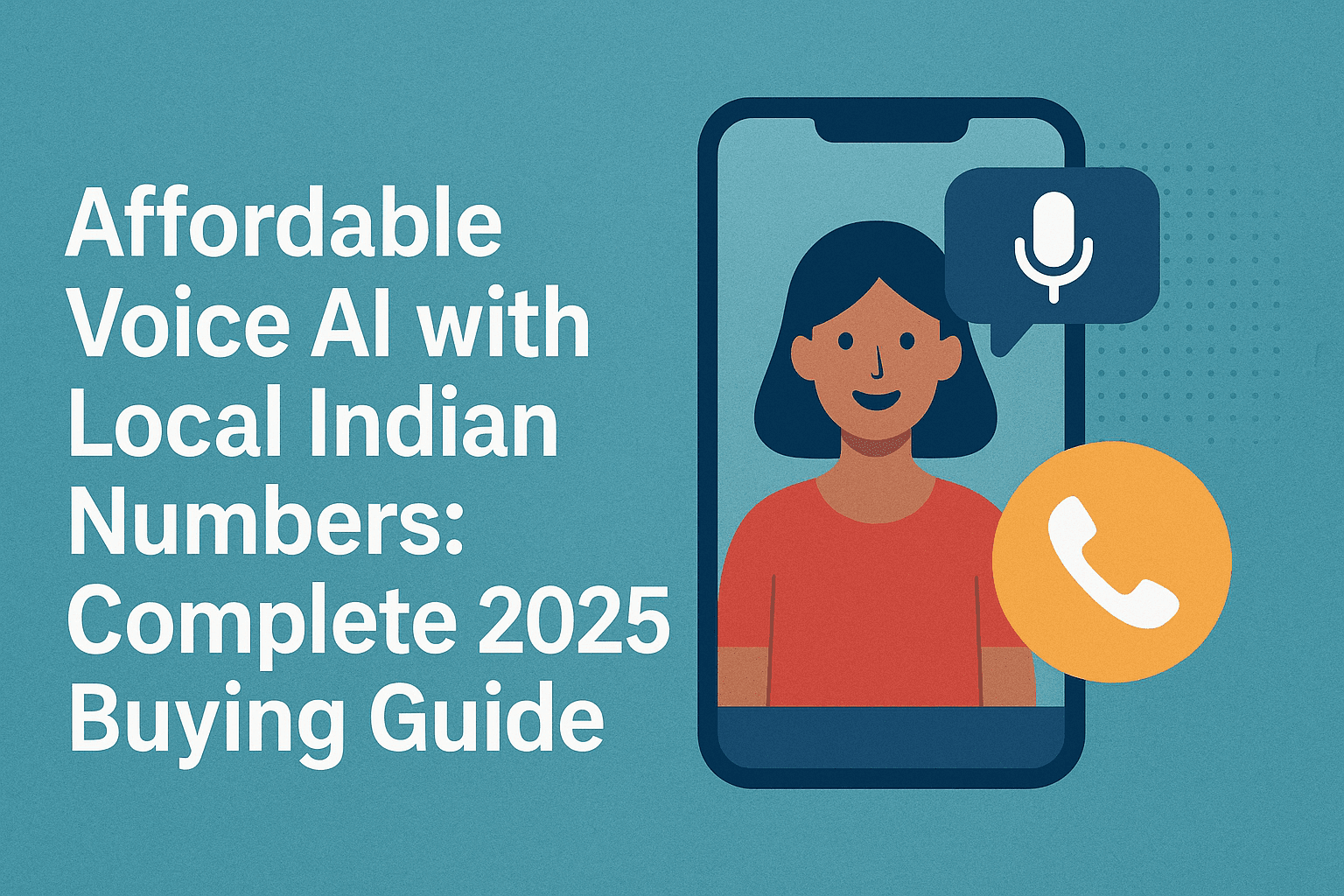
Introduction: The Rise of Voice AI with Local Numbers for Indian Businesses
Voice artificial intelligence (AI) solutions with local Indian numbers are defining modern business communication. Their rapid adoption is fueled by customer preferences, regulatory developments, and a surge in affordable, feature-rich platforms. In 2025, having a local number for your voice AI agent is not just a technical upgrade—it’s a difference maker for sales, trust, and compliance.
This guide explores every aspect of affordable voice AI with local numbers, with a focus on why local numbers deliver results, real-world answer rate statistics, the regulatory landscape, a breakdown of number types, and an expert review of Vomyra, the only voice AI platform natively supporting Indian numbers.
Why Local Numbers Increase Answer Rates by 300%

Psychological and Business Impact
Local Indian numbers build a familiar presence for callers. Customers overwhelmingly pick up calls from numbers that match their region, as they associate them with genuine, relevant businesses. Studies show that customers are three times more likely to answer a local call than a toll-free or foreign number, driven by trust and a reduction in perceived spam.
- Familiarity Bias: People instinctively trust local area codes.
- Personal Connection: Local numbers feel approachable.
- Spam Avoidance: Toll-free and international numbers are flagged as spam more often.
Real Data: Call Answer Rate Uplift
Indian businesses using local numbers report:
- Answer rates up to 60%, compared to industry norms of 20% with generic numbers.
- Mobile engagement: Local Indian numbers used for WhatsApp or SMS automation show 71% higher read and response rates over non-local alternatives.
- Callback behavior: Customers are three times more likely to return missed calls originating from a local number.
Number Types: Mobile vs Landline vs Toll-Free

1. Mobile Numbers
Overview: Ubiquitous, personal, easy to set up, widely used for both calling and messaging. Often used by small businesses and startups for direct communication.
Use Cases:
- Perfect for SMS/WhatsApp campaigns.
- Trusted by individual customers.
- Preferred for one-to-one service providers.
Limitations:
- Scalability can be challenging for high-volume operations.
2. Landline Numbers
Overview: Associated with a specific location or business premise. Landlines add credibility and are popular among traditional businesses.
Use Cases:
- Establishes a sense of permanence and professional presence.
- Trusted for customer support centers, clinics, offices.
Limitations:
- Limited geographic reach.
- Call forwarding complexity for distributed teams.
3. Toll-Free Numbers
Overview: Recognized by the 1800 or 1860 prefix. Customers can call businesses free of cost.
Use Cases:
- National businesses and large support operations.
- Marketing campaigns aiming for mass appeal.
Limitations:
- Seen as corporate or impersonal by local customers.
- Perceived as spam more frequently, leading to lower answer rates.
- Higher acquisition and operational costs than local numbers or VoIP.
Compliance and Regulations: What Every Business Needs to Know

TRAI and Indian Regulatory Mandates
Any business using voice AI in India must meet strict regulatory standards, including:
- TRAI Number Allocation: Businesses must use designated number series (“140” for promotional, “160” for transactional/service calls).
- Do Not Disturb (DND) Compliance: AI agents and outbound call campaigns must check against the national DND registry.
- DLT Registration: Businesses must register headers and message templates for both voice and SMS in the DLT (Distributed Ledger Technology) system.
- Transparency: AI agents must disclose that the caller is an AI and offer an instant opt-out.
Penalties for non-compliance include fines, blacklisting, and potential disconnection from telecom resources. Outsourcing compliance to a provider with in-depth Indian expertise is no longer optional—it’s essential.
Data Protection (DPDP Act)
- Explicit Consent: Voice recordings count as personal data.
- Right to Deletion: Customers can request the removal of their voice records.
- Cross-Border Restrictions: Sensitive user data must be hosted in-country in most situations.
Vomyra: The Only Voice AI Agent with Native Indian Phone Numbers

Unique Features and Value Proposition
Vomyra stands out as the only platform offering direct integration with Indian phone numbers:
- No code setup: Launch a voice AI agent without technical expertise.
- Local number integration: Instantly provision Indian landline or mobile numbers for inbound and outbound calls.
- Multilingual support: Handles 32+ Indian languages, including Hindi, Tamil, Telugu, Gujarati, and Marathi.
- Affordable pricing: Pay-as-you-go model as low as ₹5 per minute—ideal for startups and MSMEs.
- Real-time analytics: Google Sheets sync and WhatsApp follow-ups to ensure no leads fall through the cracks.
Other global platforms do not have instant access to Indian numbers and struggle to comply with Indian telecom regulations. Deploying with Vomyra means skipping lengthy paperwork, GST verification, and unnecessary up-front fees.
Easy Setup Process: Go Live in Minutes
1. Create a Free Vomyra Account
2. Log In and Access the Dashboard
3. Create Your AI Phone Agent
4. Select Voice and Tone
5. Attach a Phone Number
6. Define Conversation Flow (Optional Advanced)
7. Deploy and Test Live
8. Monitor Analytics & Iterate
9. Scale and Monetize
Congratulations! Your AI phone agent is now live, handling calls autonomously. Continually optimize its script and voice settings based on analytics to ensure the best customer experience.
Data: Statistics on Answer Rates and Business Impact
- Answer rates with local numbers: Up to three times higher than toll-free alternatives—Indian businesses have reported increases from 20% to 60% when switching to a local presence.
- Toll-free number performance: Can yield a 40% increase in total call volume because they’re free for the caller but often see lower answer rates per attempt due to spam perception.
- Virtual/VoIP numbers: Businesses report 40% savings compared to traditional phone systems, with no compromise in customer perception when numbers appear local.
- Customer satisfaction: Improves by 45% after adopting virtual local numbers and AI-powered response systems.
- SMS/WhatsApp: Messages sent from local numbers see up to 71% higher engagement than those from toll-free or unrecognized sources.
FAQ: Affordable Voice AI with Local Indian Numbers
What makes local Indian numbers vital for AI voice solutions?
Local numbers build trust, improve answer rates, and encourage callbacks far more than toll-free or foreign numbers. For most regional or service businesses, these advantages turn into more leads, higher engagement, and better customer relationships.
Are mobile numbers better than landlines for AI agents?
Mobile numbers are easier to provision and ideal for WhatsApp and SMS automation; landlines convey professionalism and are best for office set-ups. Both are effective if configured for local regions.
Why should AI voice agents comply with TRAI regulations?
TRAI’s rules protect consumers from spam and ensure businesses use communication tools responsibly. Non-compliance can lead to heavy penalties, disconnection, or blacklisting.
Can I set up a no-code voice AI agent with an Indian number?
Yes. Vomyra enables instant no-code setup for voice AI agents with Indian numbers—no technical background is required.
How do answer rates compare for local versus toll-free numbers?
Local numbers consistently achieve two to three times higher answer rates than toll-free or international numbers in Indian marketing and service campaigns.
Are there extra costs for integrating AI voice agents with CRMs or WhatsApp?
Platforms like Vomyra and similar Indian-first providers often offer seamless integrations for WhatsApp, SMS, and Google Sheets either for free or at a nominal add-on fee.
What documentation is needed to get an Indian number for AI agents?
Providers like Vomyra and Zedma offer instant setup with minimal paperwork—no GST or complex verification processes. Traditional telecom providers take longer and require more documents.
Conclusion
Indian businesses seeking to increase answer rates, customer trust, and regulatory compliance in 2025 must prioritize affordable voice AI with local numbers. The shift from toll-free or generic numbers to hyper-local presence drives not only pickup rates, but also strengthens customer relationships, reduces costs, and accelerates lead conversion.
Ready to transform your communications?
Get Your Indian Number Today

Experience instant local trust, higher engagement, and full compliance in one package. Activate your AI-powered voice agent with an Indian local number—no coding, excess documentation, or waiting period.
Discover Vomyra’s free trial—and watch your call answer rates surge in 2025.
Quick Table: Number Types for Voice AI Agents
| Number Type | Use Case | Answer Rate | Cost | Customer Perception |
| Local Mobile | Startups, WhatsApp/SMS campaigns | High | Low | Personal, trusted, flexible |
| Local Landline | Offices, clinics, professional teams | High | Low | Stable, professional, location-tied |
| Toll-Free | National support, big marketing | Medium | Higher | Corporate, less “personal” |
| Virtual/VoIP | MSMEs, remote work, regional scaling | High | Lower | Trusted if local, cost-saving |
Sources and Citations
All statistics, regulations, and platform features cited in this article are referenced from up-to-date 2025 sources on call answer rates, number type comparisons, regulatory requirements, and provider features