A quotation sent is not a deal won – it’s a deal paused, waiting on a follow-up that determines whether it moves forward or quietly dies. In manufacturing, trading, wholesale, B2B services and countless other businesses that run on quotes, this follow-up stage is where a meaningful share of otherwise-winnable deals are lost, not because the price was wrong, but because nobody called back at the right time.
Sales and business development teams know this, yet quotation follow-up is one of the most commonly neglected steps in the sales process. It’s repetitive, doesn’t feel urgent compared to closing an active deal, and is easy to deprioritise the moment the team gets busy – which is exactly when a large batch of quotes has usually just gone out.
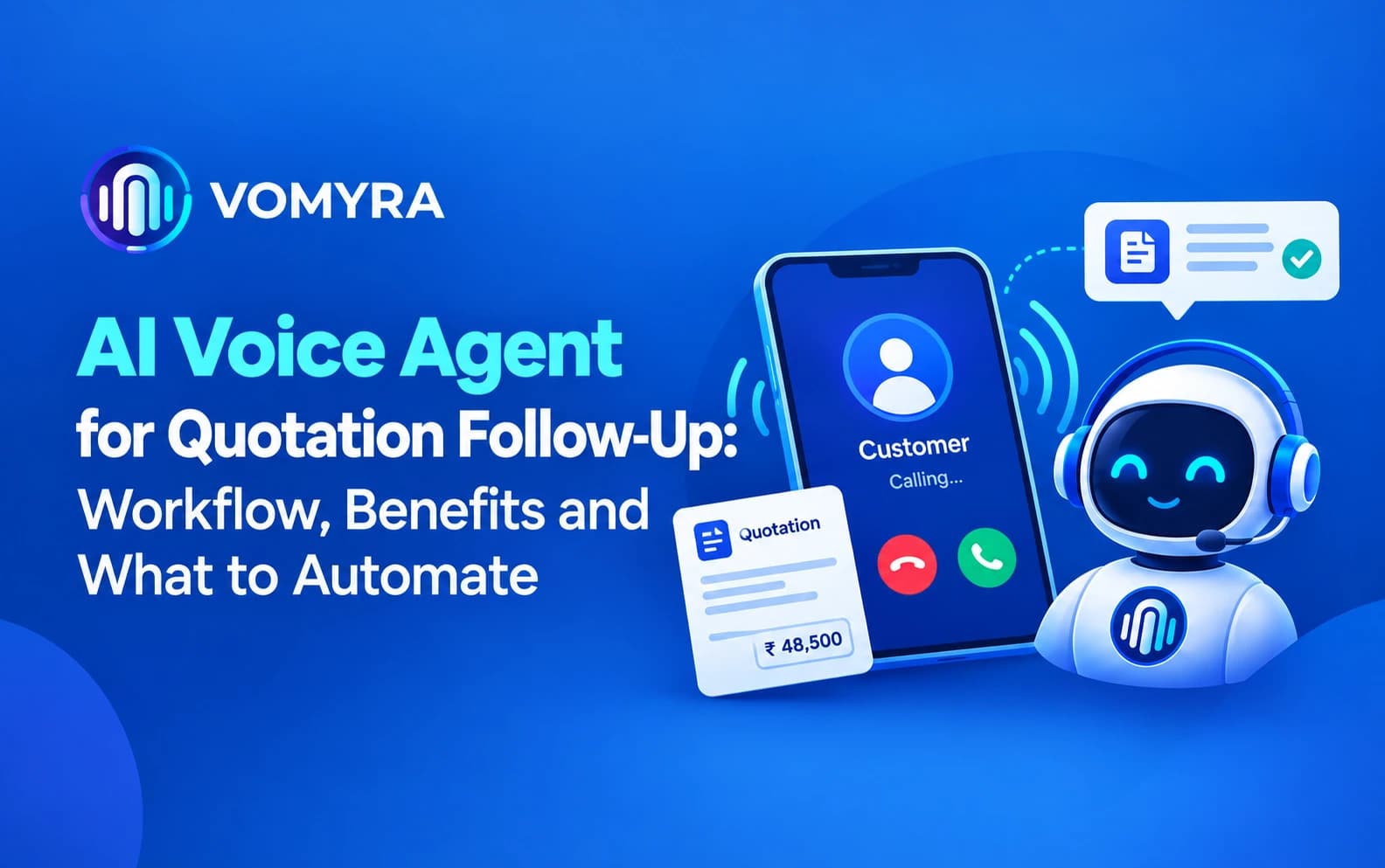
An AI voice agent for quotation follow-up solves this by calling every prospect who received a quote, at defined intervals, without depending on a salesperson remembering to circle back.
This guide covers how AI voice agents handle quotation follow-up, the workflow behind it, the benefits over manual follow-up, and what to automate first.
What Is an AI Voice Agent for Quotation Follow-Up?
An AI voice agent for quotation follow-up is a voice AI system that automatically calls prospects after a quote or proposal has been sent, checking whether they’ve reviewed it, answering questions about pricing or terms, addressing common objections, and moving the conversation toward a decision or a handoff to a human rep for negotiation.
Unlike a generic reminder email, it holds an actual conversation – asking why a quote hasn’t been accepted, clarifying details the prospect may be unsure about, and capturing information that would otherwise be lost if the prospect simply doesn’t respond at all.
Why Quotation Follow-Up Gets Neglected
The pattern is familiar across almost every business that sends quotes regularly:
- It competes with more urgent work. A quote already sent feels like a completed task, so it naturally loses priority to live negotiations and new enquiries.
- There’s no natural trigger to follow up. Unlike an inbound call, a sent quotation requires someone to proactively remember to check back – and remembering doesn’t scale across a growing number of open quotes.
- Follow-up timing is inconsistent. Some prospects get called back within a day, others wait weeks, with no clear reason for the difference beyond whoever happened to have time.
- Silence gets misread as disinterest. A prospect who hasn’t responded is often assumed to be uninterested, when in reality they may simply be busy, waiting on internal approval, or unsure about one specific detail that was never clarified.
- There’s no consistent record of why quotes are lost. Without a structured follow-up process, businesses rarely capture whether a quote was lost to price, a competitor, timing, or something addressable.
None of this reflects a lack of effort – it reflects the difficulty of running a disciplined, well-timed follow-up process by hand across a growing number of open quotations.
The AI Voice Agent Quotation Follow-Up Workflow
- Quotation sent trigger – A quote or proposal is issued to a prospect, either through a CRM, quoting tool, or manual process logged into the system.
- Scheduled follow-up call – The AI voice agent calls at a defined interval after the quote was sent, referencing the specific quotation rather than opening cold.
- Status check and clarification – The agent asks whether the quote has been reviewed, and answers common questions about pricing, terms, delivery, or specifications.
- Objection handling – The agent responds to predictable objections – price concerns, comparison with other quotes, timing issues – using defined, consistent responses.
- Outcome routing – Prospects ready to proceed are handed to a sales rep for closing. Prospects needing more time are scheduled for the next follow-up in the sequence. Prospects who’ve gone with a competitor or lost interest are logged with the reason.
- CRM update – Every call outcome, objection raised, and next step is logged automatically against the quotation record.
- Sequence completion – After a defined number of follow-up attempts, unresponsive quotes are flagged for review or moved to a longer-term nurture cycle rather than being followed up indefinitely.
This structure ensures every quote sent actually gets followed up, rather than only the ones a salesperson had time to revisit.
Manual Quotation Follow-Up vs AI Voice Agent Follow-Up
| Factor | Manual Quotation Follow-Up | AI Voice Agent Follow-Up |
| Follow-up consistency | Depends on rep memory and workload | Same defined cadence for every quote |
| Quotes never followed up | Common, especially at higher volume | Rare – every quote stays in the sequence |
| Reason-for-loss data | Rarely captured systematically | Gathered on every call |
| Objection handling consistency | Varies by rep | Same clear, consistent response every time |
| Cost per follow-up call | High (rep time across a growing list of quotes) | Significantly lower at scale |
| Speed of response to prospect readiness | Depends on rep availability | Immediate |
| Reporting on quote conversion | Manual, inconsistent | Structured data across every quote |
| Language coverage | Limited to rep’s languages | Multiple languages, including regional Indian languages |
Read Also: AI Voice Agent for Customer Support: Workflow, Benefits and What to Automate
Key Benefits of Automating Quotation Follow-Up
Higher quote-to-close conversion Since follow-up timing and consistency directly affect whether a quote converts, a systematic process alone often lifts conversion without needing more quotes sent at all.
No quote falls through the cracks Every sent quotation gets followed up on a defined schedule, regardless of how busy the sales team is at any given moment.
Better understanding of why quotes are lost Structured follow-up calls capture reasons – price, timing, competitor, missing information – that are otherwise rarely recorded consistently.
Sales reps focus on active negotiation Instead of spending time chasing status updates, reps step in only once a prospect is engaged and ready for real negotiation.
Faster movement on ready-to-close deals Prospects who are ready to proceed are identified and routed immediately, rather than waiting for a rep to happen to check in.
Lower cost of maintaining a full quote pipeline Following up consistently across a large volume of open quotations becomes far cheaper than the equivalent manual effort.
What to Automate First
A staged rollout works well for quotation follow-up automation:
- First follow-up call after a defined interval – automate the initial check-in a few days after a quote is sent, which is often the single most impactful touchpoint.
- Status and clarification calls – automate simple, predictable questions about the quote itself.
- Common objection responses – automate handling for the small set of objections your team already sees repeatedly.
- Reason-for-loss capture – even for quotes that don’t convert, capturing why is valuable data worth automating from the start.
- CRM logging of quote status – ensure every follow-up call updates the quotation record automatically.
More advanced steps – dynamic follow-up timing based on quote value or prospect engagement, or multi-touch sequences combining calls with messages – can be layered in once the core process is running reliably.
Best Practices for AI Voice Agent Quotation Follow-Up
Time the first follow-up deliberately Following up too soon can feel pushy; waiting too long lets momentum fade. Testing the right interval for your sales cycle matters as much as the call itself.
Reference the specific quotation Opening with the quote details – what was quoted, when it was sent – makes the call feel relevant and considered, rather than a generic check-in.
Keep objection responses accurate and current Since pricing, terms and availability can change, objection-handling logic needs to stay aligned with what’s actually being offered at any given time.
Escalate negotiation-stage conversations quickly Once a prospect is ready to discuss terms in more depth, minimise the delay before a human rep steps in – the agent’s job is to find the right moment, not to negotiate the final terms.
Capture lost-quote reasons even on “no” outcomes A follow-up call that doesn’t convert still has value if it captures why – this data should feed back into pricing, positioning or process decisions over time.

Build an AI Team for Quotation Follow-Up
Many businesses don’t lose deals because their pricing was wrong – they lose them because nobody followed up consistently after the quote went out. Fixing this doesn’t require sending better quotes; it requires making sure every quote actually gets followed up.
Vomyra is India’s Agentic Voice AI Platform, built to run complete AI sales workflows – with a dedicated Follow-Up Agent working alongside Research, Outreach, Qualification and Closing agents. Vomyra AI voice agents follow up on every quotation on a consistent, context-aware cadence, using real Indian mobile numbers and human-like conversations in multiple languages.
If you’re evaluating how to recover more value from quotes already sent, before spending more on new leads, Vomyra is built specifically for this – with unlimited calling plans and no coding required to get started.
FAQs
How soon after sending a quote should the first follow-up call happen?
This varies by industry and typical decision timelines, but the key principle is having a defined, consistent interval rather than an inconsistent, ad hoc follow-up – testing and refining this interval for your specific sales cycle matters more than any universal rule.
Can an AI voice agent negotiate quote terms directly?
Generally not for the final terms – quotation follow-up automation is best used to check status, clarify details, and identify when a prospect is ready, with actual negotiation handed to a human rep at that point.
Will prospects find repeated follow-up calls about a quote annoying?
This depends on cadence and relevance. A well-timed, defined sequence that respects a prospect’s response tends to perform better than either no follow-up at all or generic, overly frequent outreach.
Can quotation follow-up calls be handled in regional Indian languages?
Yes. Platforms built for Indian businesses support multiple languages, so follow-up calls can happen in the language the prospect is most comfortable with.