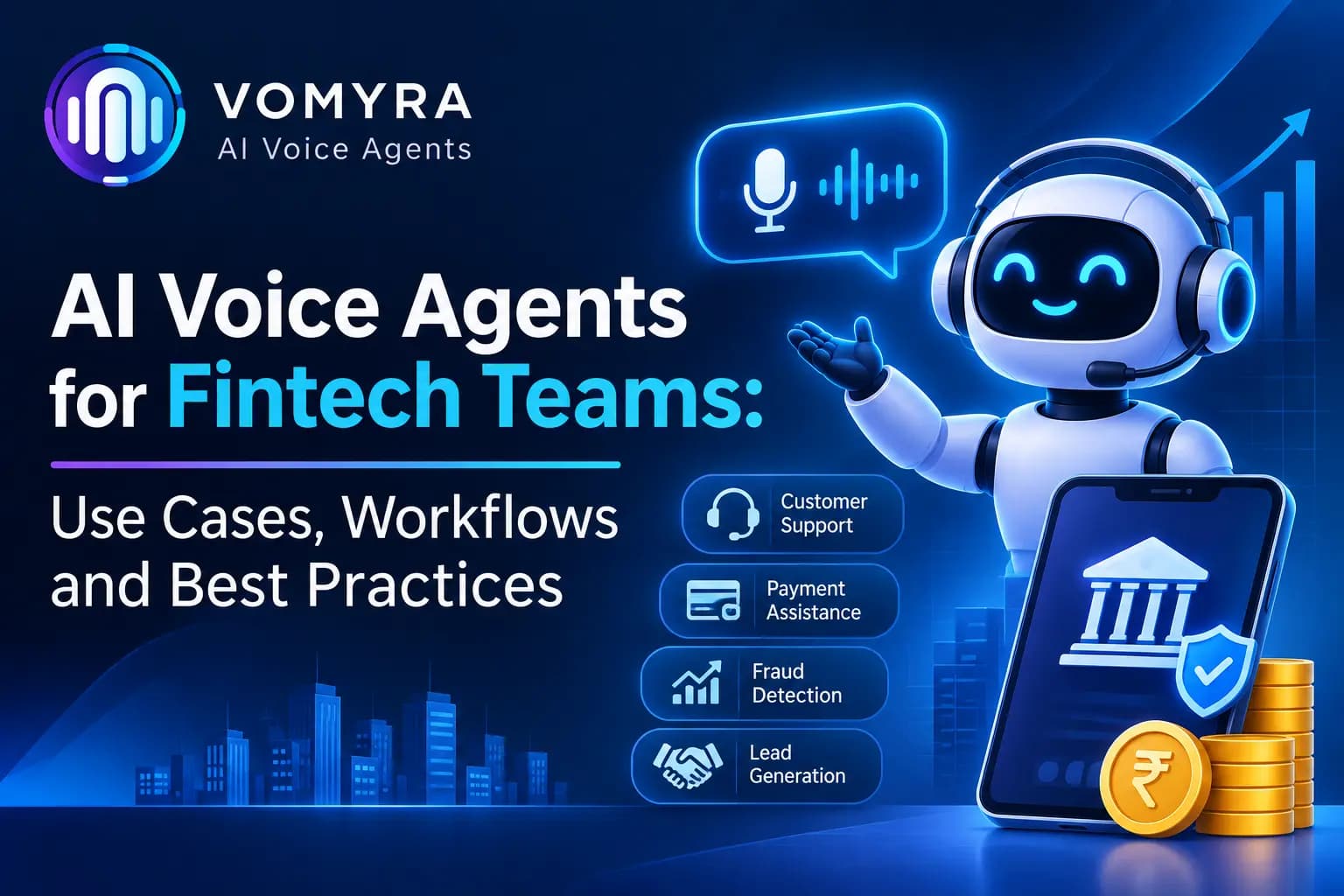
Fintech companies handle a large number of customer conversations every day. From loan application updates and payment reminders to KYC follow-ups, transaction queries and customer support, many important processes still depend on phone calls. As customer volumes grow, managing these conversations through manual calling teams can become time-consuming, expensive and difficult to scale.
AI voice agents for fintech teams offer a way to automate routine voice interactions while keeping customer conversations responsive and consistent. These AI-powered systems can understand spoken questions, follow predefined workflows, retrieve information from connected platforms and take approved actions during a call. When a request needs human attention, they can transfer the conversation to the right team.
For fintech businesses, the goal is not simply to make more calls. It is to improve customer communication, support and follow-ups without compromising security, transparency or regulatory responsibilities.
This guide explains the key fintech use cases for voice AI, how these workflows operate and what businesses should consider before implementing them.
What Are AI Voice Agents for Fintech?
AI voice agents are software-based calling assistants that use speech recognition, language models and text-to-speech technology to communicate with customers over phone calls. Unlike traditional IVR systems that rely on fixed menus and keypad inputs, conversational AI voice agents can understand natural language and respond according to the context of a conversation.
In fintech, these agents can support workflows such as:
- Loan application and document follow-ups
- EMI and payment reminders
- KYC and onboarding assistance
- Transaction and account-related queries
- Customer verification workflows
- Fraud and suspicious-activity notifications
- Insurance and investment service reminders
- Customer support and call routing
A fintech voice agent can also connect with CRM platforms, loan management systems, payment tools and customer support software. This allows it to do more than provide information. It can retrieve approved records, update call outcomes, schedule follow-ups or initiate the next step in a workflow.
Key Use Cases of AI Voice Agents in Fintech
1. Loan Application Follow-Ups
Digital lending platforms often receive applications that remain incomplete because customers have not uploaded documents, finished verification or responded to a request for additional information.
An AI voice agent for loan follow-ups can contact applicants, explain which step is pending and guide them on what to do next. It can also record the customer’s response and update the application status in the connected CRM or loan management system.
Example workflow:
- A customer submits a loan application.
- The system identifies missing information or documents.
- The AI agent calls the applicant with a clear explanation.
- The customer confirms whether they can complete the pending step.
- The system records the response and schedules a follow-up if required.
This helps lending teams reduce manual follow-up work and keep applications moving.
2. EMI Reminders and Payment Follow-Ups
Missed payments can affect repayment performance and increase the workload of collections teams. Fintech lenders can use AI calling agents to send timely EMI reminders before or around the due date.
The agent can share approved payment information, remind customers of the due date and explain available payment channels. If a customer says they have already paid, the system can record the response and trigger a payment-status check instead of repeatedly calling them.
For overdue accounts, the agent can capture the reason for delay and route sensitive cases to a human collections representative.
3. KYC and Customer Onboarding
KYC is an important part of onboarding for lending platforms, payment companies, investment apps and other financial services. Delays often occur when customers do not complete verification or submit the required information.
A conversational AI agent can make onboarding calls to explain pending steps, remind customers about document submission and answer basic process-related questions. It can also help customers understand where to continue their application.
However, identity verification and approval decisions should follow the fintech company’s approved KYC process. A voice agent should not independently approve a customer or bypass required verification checks.
4. Transaction Alerts and Fraud Verification
Customers expect quick updates when unusual activity is detected on their accounts. In such situations, AI voice agents can support fraud-response workflows by contacting customers through approved communication channels.
For example, when a transaction is flagged by a fraud monitoring system, the voice agent can notify the customer and ask them to follow the company’s approved verification process. It can record the customer’s response and escalate suspicious or unresolved cases to the fraud team.
Important security consideration: A voice agent should never ask customers to reveal their PIN, password, CVV or one-time password over a call. High-risk actions, such as blocking an account or disputing a transaction, should follow secure authentication and confirmation procedures.
5. Payment Status and Transaction Support
Payment-related queries are common in fintech customer support. Customers may want to know whether a transfer was successful, why a refund is delayed or whether a payment has been received.
When connected to authorised payment or transaction systems, an AI voice agent can retrieve permitted status information and explain it in simple language. If the transaction is pending, failed or disputed, it can create a support request or transfer the customer to the relevant team.
This reduces the need for customers to wait in a support queue for routine updates.
6. Credit Card and Financial Product Support
Fintech companies offering credit cards, digital accounts, investment services or other financial products can use AI calling agents to handle basic customer queries and service reminders.
The agent can explain approved product information, guide customers through service requests, share application updates and route complex questions to a trained representative. It can also qualify customer interest in a new product before transferring the call to a sales or relationship team.
Product recommendations and financial explanations should use approved information rather than unverified or personalised claims.
7. Customer Retention and Re-engagement
Customers may stop using a fintech application because of onboarding difficulties, unresolved support requests or a lack of engagement. AI voice agents can help businesses reconnect with these users through permitted and relevant follow-ups.
For example, an agent can contact a customer who started an application but did not complete it, ask whether they faced a problem and record the reason. The customer can then be directed to the right support or onboarding team.
This gives fintech businesses useful feedback while making customer communication more timely.
How an AI Voice Agent Workflow Works in a Fintech Business
An effective fintech voice automation workflow connects customer data, calling systems and business applications. The exact setup depends on the use case, but a typical process follows these steps.
Step 1: Trigger the Call
A call begins when a defined event occurs in a connected system. This could be an upcoming EMI date, an incomplete loan application, a pending KYC step, a customer support request or a flagged transaction.
Step 2: Retrieve the Required Information
The system retrieves only the information needed for that specific workflow. For example, a payment reminder may require the customer’s approved contact details, due date and permitted payment information.
Step 3: Verify the Customer
Before discussing account-specific details, the agent follows the organisation’s approved identity verification process. The level of verification should match the sensitivity of the information or action involved.
Step 4: Conduct the Conversation
The AI voice agent speaks with the customer, understands their response and follows the configured conversation flow. It can answer approved questions, capture information and explain the next step.
Step 5: Take an Approved Action
Depending on its permissions, the agent may update a CRM record, create a support ticket, record a payment commitment or schedule another follow-up. Sensitive financial actions should require the appropriate authentication and confirmation.
Step 6: Escalate When Required
If the customer reports fraud, raises a dispute, requests human assistance or describes a complex problem, the call should be transferred to the relevant team.
Step 7: Record the Outcome
The system logs the call result, customer response and next action in the connected platform. This gives fintech teams a consistent record for follow-ups, reporting and quality checks.
Read Also: AI Voice Agent for Webinar Leads: Workflow, Benefits and What to Automate
Benefits of AI Voice Agents for Fintech Teams
Better Handling of High Call Volumes
Fintech businesses often experience sudden increases in call volume around EMI dates, payment deadlines, onboarding campaigns and transaction issues. AI-powered voice agents can handle multiple routine conversations at the same time, reducing pressure on human calling teams.
Faster Customer Communication
Automated calls can be triggered by specific events instead of waiting for an employee to manually check a list and start calling. This helps teams contact customers at the right stage of a process.
Consistent Customer Conversations
A configured AI agent follows approved conversation flows and disclosures. This helps reduce differences in how routine information is communicated across different calling agents.
Reduced Manual Work
Routine reminders, application follow-ups and basic support queries can be handled automatically. Human employees can then focus on complex cases, customer disputes and tasks that require judgement.
Improved Customer Experience
Customers can explain their questions in natural language instead of navigating long IVR menus. When the agent is connected to the right business systems, it can provide relevant information and guide customers towards the next step.
Better Call Records and Reporting
Call outcomes, customer responses and follow-up requirements can be recorded in connected systems. This makes it easier for operations teams to review conversations, identify common issues and measure workflow performance.
Best Practices for Implementing AI Voice Agents in Fintech
Fintech communication involves financial information, personal data and customer trust. Automation should therefore be designed around security and responsible customer interaction.
1. Start With a Clearly Defined Use Case
Avoid automating every calling process at once. Start with a structured, repetitive workflow such as EMI reminders, application follow-ups or basic payment-status queries.
Define what the agent can say, what information it can access and which actions it is allowed to perform. Expand the workflow only after reviewing its performance.
2. Protect Customer Data
AI voice agents may interact with sensitive customer information. Businesses should apply access controls, encryption, data minimisation and appropriate retention policies.
Only the information required for a specific task should be made available to the agent. Call recordings and transcripts should also follow the organisation’s privacy, security and retention requirements.
For digital lending businesses in India, the RBI’s Digital Lending Directions, 2025 cover areas such as customer consent, data collection, storage, privacy and the responsibilities of regulated entities working with lending service providers.
3. Follow Calling and Consent Requirements
Automated calling campaigns should follow applicable telecom rules, customer preferences and consent requirements. Businesses should distinguish between transactional or service communication and promotional outreach instead of treating every call in the same way.
In India, TRAI provides requirements and guidance for commercial communication, including sender and telemarketer registration, consent and registered communication processes. Fintech teams should review the rules that apply to their specific call type and deployment.
4. Never Collect Sensitive Authentication Details Through Conversation
A voice agent should not ask customers to share passwords, PINs, CVVs or OTPs. Payment workflows must be designed so that sensitive authentication data is not captured in call recordings.
The PCI Security Standards Council states that card verification codes must not be stored after authorisation, including in digital audio recordings. Where such data may be entered during a call, appropriate recording suppression or redaction controls should be used.
5. Keep Human Escalation Available
Not every customer issue should be resolved by automation. Disputes, suspected fraud, complaints, financial hardship and complex account problems may require trained employees.
Set clear escalation conditions so the AI agent can transfer the call with relevant context. Customers should also have a clear way to request human assistance.
6. Connect the Agent With Approved Business Systems
A voice agent becomes more useful when it can work with the systems that fintech teams already use. Depending on the organisation’s architecture, integrations may include:
- Customer relationship management (CRM) platforms
- Loan management systems (LMS)
- Payment and transaction platforms
- Customer support and ticketing tools
- KYC and onboarding systems
- Reporting and analytics dashboards
Use secure APIs and role-based permissions to control which information the agent can retrieve and which actions it can perform.
7. Test Conversations Before Going Live
Test the agent with different customer responses, accents, background noise, interruptions and unexpected questions. Check whether it can understand the customer’s intent, provide accurate information and follow the correct escalation process.
Review failed calls and customer feedback regularly. Update conversation flows when products, policies or compliance requirements change.
How to Measure the Performance of Fintech Voice AI
Implementing an AI voice agent is only the first step. Fintech teams should track performance to understand whether automation is improving customer communication and operational efficiency.
| Performance Metric | What It Measures |
| Call connection rate | How many calls successfully reach customers |
| Task completion rate | How many conversations achieve their intended outcome |
| First-call resolution | How often queries are resolved without another contact |
| Escalation rate | How many calls need human assistance |
| Promise-to-pay rate | How often customers confirm a repayment commitment |
| Average handling time | Average duration of a customer conversation |
| Customer satisfaction | Customer feedback after the interaction |
| Cost per completed interaction | Operational cost of achieving a successful outcome |
These metrics should be reviewed together. For example, a high task completion rate is not useful if customers receive incorrect information or cannot reach a human representative when needed.
Read Also: MCP Client vs MCP Server: Understanding Their Differences
How Vomyra Can Support Fintech Calling Workflows

Fintech teams need voice automation that can fit into existing business processes rather than operate as a separate calling tool. Vomyra AI voice agents can be considered for structured workflows such as customer follow-ups, payment reminders, onboarding communication and routine support interactions.
By connecting voice agents with relevant business systems, organisations can design workflows in which calls are triggered by events, customer responses are captured and outcomes are passed to the next step. This can help operations teams manage repetitive communication while keeping human employees available for cases that require attention.
The right implementation depends on the fintech company’s use case, technology stack, data policies and compliance requirements. Before deployment, teams should define the agent’s permissions, test the conversation flow and establish clear escalation rules.
Common Mistakes to Avoid When Deploying Fintech Voice AI
Even a capable AI voice agent can create problems if the workflow is poorly planned. Some common mistakes include:
- Automating sensitive financial decisions without proper human review.
- Using outdated customer or transaction information.
- Making repeated calls without checking customer preferences and applicable rules.
- Allowing the agent to access more customer data than its task requires.
- Failing to provide a clear route to human support.
- Measuring call volume instead of successful task completion.
- Launching without testing different customer responses and edge cases.
Avoiding these mistakes helps businesses build voice automation that is useful, reliable and easier to manage.
Conclusion
AI voice agents can help fintech teams manage repetitive customer communication across lending, payments, onboarding, transaction support and customer service. They can reduce manual calling work, improve response times and make routine workflows easier to scale.
However, successful implementation requires more than conversational technology. Businesses must combine accurate system integrations with data protection, consent management, secure authentication and human escalation.
The most effective approach is to start with a well-defined workflow, measure its results and expand automation gradually. With the right controls, AI voice agents for fintech teams can become a practical part of customer operations while keeping trust and responsible communication at the centre.
Frequently Asked Questions
1. What are AI voice agents used for in fintech?
AI voice agents are used for loan follow-ups, EMI reminders, KYC assistance, payment updates, customer support, fraud verification workflows and other routine customer conversations. They can also connect with business systems to record responses and trigger approved actions.
2. Can AI voice agents automate loan collection calls?
Yes. They can support payment reminders and early-stage collection workflows by sharing approved payment information, capturing reasons for delayed payments and recording repayment commitments. Sensitive cases, disputes and financial hardship should be escalated to trained human representatives.
3. Are AI voice agents safe for financial services?
They can be used in financial services when deployed with appropriate security and compliance controls. Businesses should restrict data access, follow approved identity verification processes, protect call recordings and avoid collecting sensitive authentication details through conversation.
4. Can fintech voice agents integrate with CRM and payment systems?
Yes, depending on the voice platform and available integrations. Through secure APIs, an AI voice agent may retrieve permitted customer or payment information, update CRM records, create support tickets and schedule follow-ups.
5. How can fintech companies measure AI voice agent performance?
Fintech teams can measure call connection rate, task completion rate, first-call resolution, escalation rate, customer satisfaction and cost per completed interaction. These metrics help identify workflow issues and evaluate the business impact of automation.