Credit card sales in India still run largely through the phone call. A bank or NBFC’s telesales team dials hundreds of prospects a day, explains card benefits, checks basic eligibility, and tries to get a callback or an application started before the prospect loses interest.
The volume is high, the script is repetitive, and the margin for error, both in pitch quality and regulatory compliance, is thin.
AI voice technology is now applied to a meaningful share of this workflow, not to replace telesales outright, but to handle the repetitive opening layer with more consistency than a large outbound calling floor typically manages.
This guide looks at where AI fits into credit card sales calling in India, what it can and cannot do well, and what the regulatory boundaries around outbound calling mean for any business considering it.
Why Credit Card Sales Still Depend on Calls
Digital application funnels exist for nearly every major card in India, yet outbound calling remains a primary acquisition channel, particularly for co-branded cards, pre-approved offers, and cross-sell to an existing banking customer base.
A phone conversation does something a banner ad or email cannot: it lets a prospect ask a specific question, like whether a particular spend category earns extra reward points, and get an answer immediately, which shortens the gap between interest and application.
The challenge is scale. A bank or card-issuing NBFC working through a pre-approved list of several hundred thousand customers cannot realistically have human agents call every name within a useful window, and a list that sits untouched for weeks loses relevance as customer circumstances and competing offers change.
What AI Actually Does in This Workflow
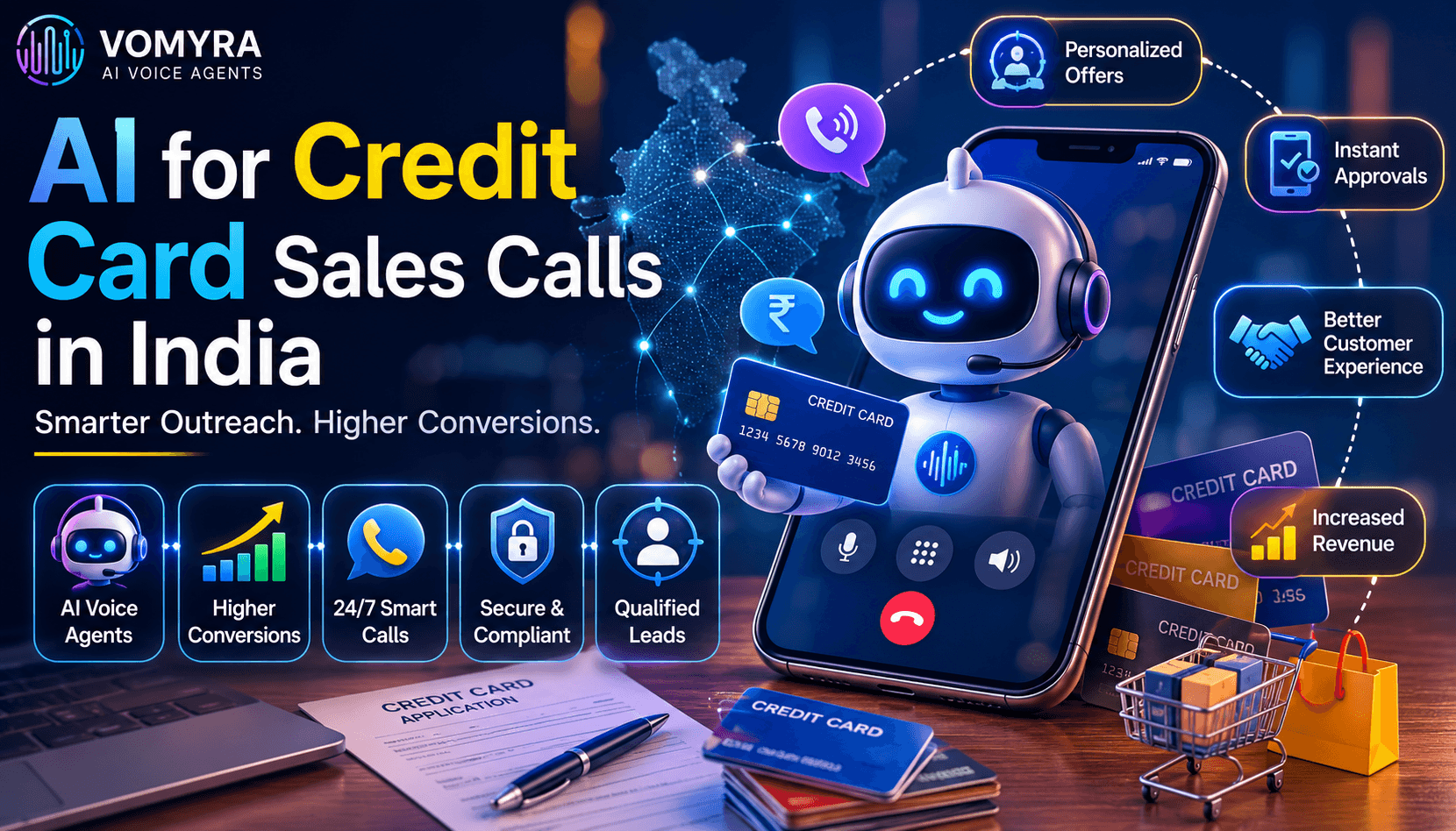
An AI voice agent used for credit card sales calling typically handles the early stage of the conversation rather than the entire sales cycle. It can place the initial outbound call to a pre-approved or marketing-consumed list, introduce the card offer, explain core benefits such as annual fees, joining bonuses, and reward structure, and gauge interest through a short set of questions.
Where the prospect is engaged and eligible, the AI can collect basic details and either initiate the digital application flow or schedule a callback with a human agent for the parts of the conversation, such as detailed underwriting questions or objection handling, that genuinely benefit from a person.
On the inbound side, the same kind of system can answer calls from prospects responding to a marketing campaign, a website inquiry, or a missed-call trigger, answering routine questions about eligibility, fees, and documentation without making the caller wait in a queue.
This matters more than it might initially seem, since a prospect who calls in with active interest and reaches a slow or unavailable line is a prospect who may simply call a competing issuer next.
Where AI Adds Real Value Over a Manual Calling Floor

The most measurable advantage is consistency at volume. A large outbound calling team inevitably produces variation in pitch quality across agents and shifts; an AI system delivers the same accurate explanation of fees and benefits on every call, which matters in a category where a misquoted fee becomes a complaint later. Call coverage is the second advantage.
An AI system can work through a much larger portion of a pre-approved list within a given week than a fixed-size human team, surfacing genuinely interested prospects faster so human agents spend time on conversations actually moving toward a sale.
Multilingual capability is a specific advantage in the Indian market. A pre-approved list spanning multiple cities will include customers more comfortable in Hindi, Tamil, Telugu, Marathi, or Bengali than in English, and a system that holds the actual sales conversation in that language, rather than switching to English mid-call, tends to keep prospects engaged longer.
Follow-up consistency is the final piece: many credit card leads go cold simply because nobody calls back at the right time, and an AI system can be configured to retry an interested-but-unavailable prospect automatically, which a manually managed list often fails to do reliably.
What Still Needs a Human
Underwriting decisions, income verification judgment calls, and any conversation where a prospect raises a complaint, a dispute, or genuine financial hardship should move to a human agent, not stay with the AI. The same applies to negotiation on terms or fee waivers, which typically sit outside what an AI agent is authorized to offer.
A properly configured deployment treats the AI as the layer that handles volume and routine qualification, with a clear and fast handoff to a person whenever the conversation moves past that.
The Regulatory Boundary Most Vendors Don’t Mention
Outbound credit card sales calls in India fall squarely under TRAI’s Telecom Commercial Communications Customer Preference Regulations, commonly referred to as TCCCPR.
Any business making promotional outbound calls, including credit card sales calls to a list that hasn’t already opted into that specific communication, needs telemarketer registration on TRAI’s Distributed Ledger Technology platform, must scrub call lists against the National Customer Preference Register (the DND registry), and is restricted to calling between 9 AM and 9 PM.
Calling a DND-registered number for a promotional pitch, even with an AI system placing the call, exposes the business to the same penalties a human telemarketer would face.
A distinction worth understanding here: a call to an existing cardholder about their own account, such as a payment reminder, is generally treated as transactional rather than promotional.
The moment that same call pivots into selling a different product, such as a credit limit increase tied to a new card variant, it shifts into promotional territory and the DND and calling-hour rules apply in full.
Any AI deployment used for credit card sales should be built with this distinction in mind from the start, since the compliance obligation sits with the issuer or NBFC regardless of whether a human or an AI placed the call.
What to Look for in a Platform for This Use Case
A platform suited to credit card sales calling should be evaluated on a few practical points. Conversation quality matters first, since a script that sounds rigid or repeats itself loses prospects within seconds.
List management and DND scrubbing should be built into the workflow rather than left to the business to handle separately, given how directly that affects compliance exposure. CRM and card management system integration determines whether qualified leads actually reach the sales team’s existing pipeline instead of sitting in a disconnected dashboard.
Multilingual coverage should be checked against the specific languages relevant to the target customer base, and a fast, well-defined handoff to a human agent should be standard for any prospect whose conversation moves beyond routine qualification.
Businesses exploring this for the first time often start with Vomyra AI Voice Agent, a no-code platform that can be configured for a single campaign, such as a pre-approved card list, without requiring engineering resources, making it easier to measure actual conversion impact before expanding to a larger calling program.
Measuring Whether It’s Working
The useful metrics for this use case are fairly specific: the percentage of a calling list actually reached within a set window, the rate at which engaged prospects move to a completed or in-progress application, and the average time between first contact and application start.
A deployment that improves reach and speed without moving the application conversion rate is solving the wrong problem, since the point of automating this layer is to get more genuinely interested prospects in front of the parts of the process, application and underwriting, that determine whether the sale closes.
Testing against a defined slice of a calling list, rather than the entire portfolio at once, makes it easier to see whether the qualification logic and language handling actually work before scaling further. A Vomyra AI Voice Agent free trial is generally the lowest-risk way to run that initial test.
Where This Is Headed
Credit card acquisition in India is shifting toward faster, more automated qualification ahead of the application stage, partly because customer expectations around immediate response have moved faster than manual calling floors can keep up with, and partly because the regulatory environment around outbound calling keeps tightening in ways that favor systems with compliance built in from the start rather than bolted on afterward.
AI is unlikely to take over the full sales conversation for higher-value cards or complex eligibility cases anytime soon, but for the repetitive opening layer of outbound and inbound credit card sales calling, platforms like Vomyra AI Voice Agent are already doing measurable work for the businesses that have deployed them carefully.
Frequently Asked Questions
Is it legal to use AI for outbound credit card sales calls in India?
Yes, provided the calling business is registered as a telemarketer under TRAI’s TCCCPR framework, scrubs call lists against the DND registry before calling, and restricts calls to the 9 AM to 9 PM window. These obligations apply regardless of whether the call is placed by a human agent or an AI system.
Can AI handle the entire credit card sales process from call to approval?
No. AI typically manages the outbound pitch, basic qualification, and initial interest capture, while underwriting decisions, complex eligibility questions, and complaint handling remain with human agents and existing approval systems.
Does cross-selling a new card to an existing customer count as a promotional call?
Generally, yes. A call about a customer’s existing account is usually treated as transactional, but the moment it shifts into selling a different product, it becomes promotional and falls under DND and calling-hour restrictions.
Can an AI voice agent sell credit cards in Hindi and regional languages?
Most platforms built for the Indian market support Hindi and major regional languages such as Tamil, Telugu, Marathi, and Bengali, which matters for engagement across a geographically diverse calling list.
How is the success of an AI credit card sales deployment usually measured?
Through list reach within a set window, the rate at which engaged prospects move to an application, and the time between first contact and application start, rather than call volume alone.