Why Interruption Handling Is the Real Differentiator
Most voice agent demos sound natural. The agent speaks clearly, the caller responds, the agent processes and replies. Clean, sequential, impressive in a controlled setting.
Real calls do not work like that.
A prospect says “yeah” halfway through the agent’s opening sentence because they already know what they want. A customer on a loan inquiry call interrupts to correct their income figure before the agent has finished asking the question. A restaurant caller cuts in mid-confirmation to change their order. A patient calls about an appointment and speaks over the agent the moment they hear the clinic name because they have called before and already know what comes next.
This is barge-in. And how a voice agent handles it determines whether callers experience a natural conversation or an infuriating loop of talking-over-and-stopping.
Vomyra AI Voice Agent is built with interruption handling as a core architecture decision rather than an afterthought. This guide explains what barge-in actually involves technically, how to configure it correctly, what the specific challenges are for Indian calling environments, and what the production tuning targets look like in 2026.
What Barge-In Actually Is (And What It Is Not)
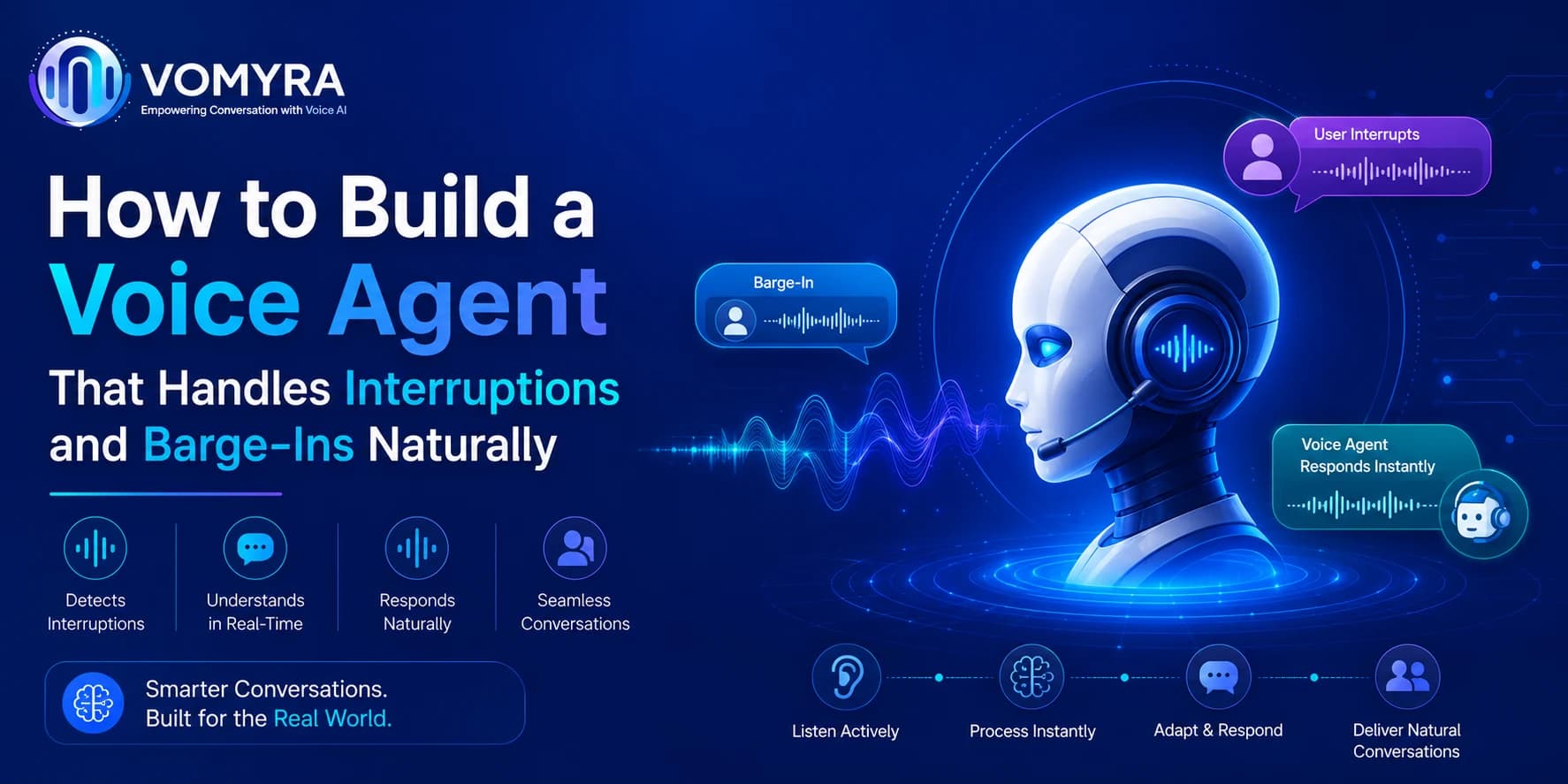
Barge-in is the ability of a voice agent to stop speaking immediately when the caller begins talking, switch from speaking mode to listening mode, and respond to what the caller said rather than continuing the original scripted response.
This sounds simple. The implementation is not.
The reason is that audio is continuous. While the agent is playing its text-to-speech response, the same audio channel is receiving input from the caller’s microphone. The system needs to distinguish between three very different types of incoming audio that all arrive in the same stream:
A true interruption is when the caller genuinely wants to take the conversational floor. They have something to say, they are not waiting for the agent to finish, and the agent needs to stop, listen, and respond to the new input. Failing to detect this makes the agent feel robotic and unresponsive.
A backchannel signal is when the caller says something like “uh-huh,” “okay,” “haan,” or “theek hai” while the agent is speaking. This is not an attempt to take the floor. It is an acknowledgment that the caller is following along. If the agent stops and responds to every “haan,” the conversation becomes fragmented and the caller receives an incomplete response.
Echo and acoustic feedback is when the agent’s own TTS audio bleeds back through the microphone and the system detects it as incoming speech. This creates phantom interruption events on every agent utterance if acoustic echo cancellation is not properly implemented at the telephony layer.
Getting barge-in right means correctly classifying all three of these with low latency, consistently, under real call conditions. The 2026 production standard for this is a turn-taking gap of 200 to 400 milliseconds, a false barge-in rate below 2 percent, and a TTS flush time below 60 milliseconds.
The Five Technical Components of Working Barge-In
1. Voice Activity Detection
Voice activity detection, commonly abbreviated as VAD, is the first layer of the interruption detection pipeline. It continuously analyses the incoming audio stream while the agent is speaking and determines whether human speech is present.
VAD operates at a very short time window, typically 10 to 30 milliseconds per frame, and outputs a confidence score. When the score exceeds a threshold for a defined minimum duration, the system flags incoming speech as a potential barge-in event.
The minimum duration threshold is the most important tuning variable in VAD for Indian calling environments. Set it too short and every backchannel sound triggers a false interruption. Set it too long and genuine interruptions are missed because the caller’s intent signal has already passed before the system reacts.
For Hinglish conversations specifically, the backchannel vocabulary is different from English. Callers frequently use sounds and short phrases (“haan,” “accha,” “theek hai,” “okay”) that are acoustically longer than the English equivalents (“uh-huh,” “mm”) but still function as backchannels rather than turn-taking attempts. VAD tuning that works for English-language calls will often produce excessive false barge-ins on Hinglish calls without recalibration.
2. Barge-In Trigger Logic
Once VAD signals potential speech, the barge-in trigger decides whether to act on it. This decision involves several inputs beyond the raw VAD score:
The duration of the detected speech above the VAD threshold. Short detections, under 200 milliseconds, are more likely to be backchannels or acoustic artifacts. Longer detections are more likely to be genuine turn-taking attempts.
The timing within the agent’s current utterance. An interruption that arrives in the first 500 milliseconds of the agent speaking is more likely to be a true interruption than one that arrives in the final syllables of a long sentence, which may be the caller starting to respond naturally at a perceived turn boundary.
The lexical content if the STT layer has already produced a partial transcript for the incoming audio. A partial transcript containing a question, a correction, or topic-shift content is a strong signal of a genuine interruption. A partial transcript containing only “okay” or “haan” is a strong signal of a backchannel.
3. TTS Flush
When a barge-in is triggered, the agent needs to stop its current text-to-speech output immediately. This means discarding any queued audio that has not yet been played and halting the audio stream the caller is hearing.
The flush needs to happen in under 60 milliseconds to feel natural. A longer flush produces an audible tail where the caller is already speaking but the agent’s voice is still audible for a fraction of a second, which creates a cross-talk effect even after the interruption has been correctly detected.
4. Context Preservation Across the Interruption
When barge-in occurs, the agent must not lose the conversational context it has built up. The question it had asked, the qualification criteria it had been working through, the lead data it had already collected: all of this needs to be preserved so that after the caller finishes their interrupted statement, the agent responds coherently to both what the caller said and where the conversation was before the interruption.
Losing context on barge-in is one of the most disruptive failure modes in voice agent design. A caller who interrupts to correct a figure and then hears the agent repeat the question as if the correction never happened will experience this as the agent not listening, which is more damaging to the interaction than the interruption itself would have been.
5. Graceful Recovery
Not every barge-in is a complete topic shift. Sometimes the caller interrupts to add information, confirm something early, or correct a detail. The agent’s response to a barge-in should not reset the conversation to the beginning of the current conversational segment. It should acknowledge what the caller said and continue from the most logical point given what was just added or corrected.
Recovery phrases that acknowledge the interruption without over-explaining it, such as “Got it” or “Okay, noted” in English, or “Theek hai” or “Bilkul” in Hindi contexts, help the conversation resume naturally without drawing attention to the fact that an interruption handling system just executed.

India-Specific Challenges in Barge-In Handling
The technical components described above are relatively well-documented for English-language voice AI. The Indian calling environment introduces several additional variables that require specific attention.
8 kHz PSTN Audio Quality
Standard Indian telephony transmits audio at 8 kilohertz, compared to the 16 kilohertz or higher sample rates at which most voice AI models are trained and evaluated. This compression removes the upper half of the audio frequency spectrum, which affects the acoustic features that VAD classifiers use to distinguish speech from background noise.
VAD models trained on high-quality audio at 16 kHz will have higher false negative rates on 8 kHz Indian PSTN audio, meaning they miss genuine interruptions more often. This needs to be compensated either by lowering the VAD threshold (which increases false barge-in risk) or by using a VAD model specifically trained on 8 kHz telephony audio.
Hinglish Backchannel Vocabulary
As described in the VAD section, Indian callers use a different backchannel vocabulary than English-language callers. The challenge is compounded in Hinglish because the same word can function as either a backchannel or a genuine conversational contribution depending on context and prosody.
“Haan” said quickly with falling intonation is almost always a backchannel. “Haan?” said with rising intonation is likely a question or clarification request. “Haan, lekin” followed by additional words is the beginning of a genuine interruption with a counter-statement.
Distinguishing these reliably requires both VAD duration analysis and STT partial transcript analysis. Systems that rely on VAD alone without lexical verification produce substantially higher false barge-in rates on Hinglish calls.
Background Noise in Indian Calling Environments
Calls from Indian mobile users frequently contain background noise: vehicle sounds, household activity, street ambient noise, and in commercial settings, other people speaking. Background noise at frequencies overlapping with human speech can trigger VAD detection even when no speech is present.
Effective noise handling for Indian calling environments requires acoustic echo cancellation tuned for mobile network audio quality, energy threshold calibration for typical Indian ambient noise levels, and a noise gate that suppresses audio below a floor that is higher than the quiet-room baseline used in standard VAD configurations.
Configuring Barge-In on Vomyra AI Voice Agent
Vomyra AI Voice Agent handles the technical pipeline described above as a platform-level capability. The configuration available to operators covers the business logic layer that sits on top of the technical detection:
Interruption sensitivity controls the balance between detecting genuine interruptions and ignoring backchannels. For conversational qualification calls where natural dialogue is the goal, a higher sensitivity is appropriate. For calls where the agent needs to deliver specific disclosures or confirmations in full before the caller responds, a lower sensitivity prevents accidental interruption of legally required statements.
Minimum speech duration before barge-in triggers can be configured per agent. For Indian market deployments handling Hinglish calls, this threshold is typically set higher than the default for English calls, reducing false barge-in rates from backchannel signals while maintaining responsiveness to genuine interruptions.
Protected utterance segments allow specific portions of the agent’s script to be marked as non-interruptible. Regulatory disclosure statements, consent language, and pricing confirmations are common candidates. The agent completes these segments in full before barge-in detection resumes.
Recovery script configuration defines what the agent says after successfully processing a barge-in. Different recovery approaches can be configured for different interruption types: short acknowledgments for additive information, confirmation echoes for corrections, and topic reset responses for complete redirection.
Vomyra AI Voice Agent applies these configurations through the no-code dashboard, making barge-in tuning accessible to operations teams without requiring engineering involvement in the underlying detection pipeline.
Testing Barge-In Before Going Live
Barge-in quality only reveals itself under conditions that resemble real calls. Testing against a quiet recording with a clear English speaker will produce very different results from testing against actual Indian mobile call audio with Hinglish speech and ambient background noise.
An effective pre-launch barge-in test matrix covers at minimum:
Interruption at the beginning of an agent utterance, in the middle of a long sentence, and at the natural end of a sentence to check how timing affects detection accuracy.
Backchannel signals including “uh-huh,” “okay,” “haan,” “accha,” and “theek hai” while the agent is speaking to measure the false barge-in rate on the actual backchannel vocabulary your callers use.
Background noise conditions representative of where your callers are most likely to call from, such as vehicle interiors, offices, and households with ambient sound.
Simultaneous speech where both the caller and agent are speaking at the same time for more than one second, to verify that the agent yields correctly rather than attempting to continue over the caller.
Corrections where the caller interrupts to change a figure or detail and the agent needs to incorporate the correction rather than continuing with the original response.
Each of these scenarios should be tested in every language the agent will handle in production, since the barge-in characteristics of a Tamil caller will differ from a Hinglish caller and both will differ from an English caller.
When to Escalate Instead of Continuing
Even a well-tuned barge-in system will encounter calls where the conversation is breaking down beyond what the automated pipeline can recover. Research consistently shows that most callers accept AI voice agents for routine interactions but strongly prefer human contact when the interaction starts feeling unreliable.
The correct response to a call where barge-in detection has failed multiple times, where the same information has been requested more than twice, or where the caller has explicitly asked to speak to a person is not to keep trying. It is to transfer to a human agent with full call context so the caller does not have to repeat themselves.
Configuring a maximum retry limit and an escalation path that preserves conversation context is as important as the barge-in detection itself. A fast, well-contextualised human handoff when automation is failing protects the caller relationship far better than additional retry attempts.
A free trial of Vomyra AI Voice Agent covers barge-in configuration, multilingual support including Hinglish and regional Indian languages, Indian +91 numbers, and the full escalation and human handoff infrastructure before any payment is required.
Frequently Asked Questions
What is barge-in in a voice agent?
Barge-in is the ability of a voice agent to stop speaking immediately when the caller begins talking, switch to listening mode, and respond to what the caller said rather than completing its scripted response.
What causes false barge-ins in AI voice calls?
False barge-ins are caused by backchannel signals like “uh-huh” or “haan,” acoustic echo from the agent’s own TTS audio bleeding into the microphone, and background noise triggering voice activity detection incorrectly.
Why is barge-in harder for Indian calling environments?
Indian PSTN audio is compressed to 8 kHz which reduces VAD accuracy, Hinglish backchannel vocabulary is longer and more speech-like than English equivalents, and Indian calling environments typically have higher ambient background noise.
What is the production standard for barge-in latency in 2026?
The 2026 production standard is a turn-taking gap of 200 to 400 milliseconds, a false barge-in rate below 2 percent, and a TTS flush time below 60 milliseconds.
Does Vomyra AI Voice Agent support barge-in configuration without coding?
Yes. Barge-in sensitivity, minimum speech duration, protected utterance segments, and recovery script configuration are all accessible through the no-code Vomyra dashboard without engineering involvement.