The Call That Gets Missed Every Friday Evening
Picture a resort somewhere in Coorg. Beautiful property. Thirty-two rooms. A small front-desk team of three, two of whom go off shift by 7 PM because that is when the actual guests need attention over dinner. The phone starts ringing around 8 PM from families in Bangalore and Chennai and Hyderabad who have finally sat down after work, opened their browsers, and decided this is the weekend they plan the family trip.
Some of those calls get answered. Some do not. The ones that do not, those families go back to MakeMyTrip and book through an OTA. The resort pays 18 to 22 percent commission on a booking it would have had for free if someone had just picked up the phone.
This is not a staffing problem. You cannot justify hiring a full-time reservations agent specifically to answer calls between 7 PM and 10 PM every weekday. The numbers do not work. But the missed bookings are real, and they add up.
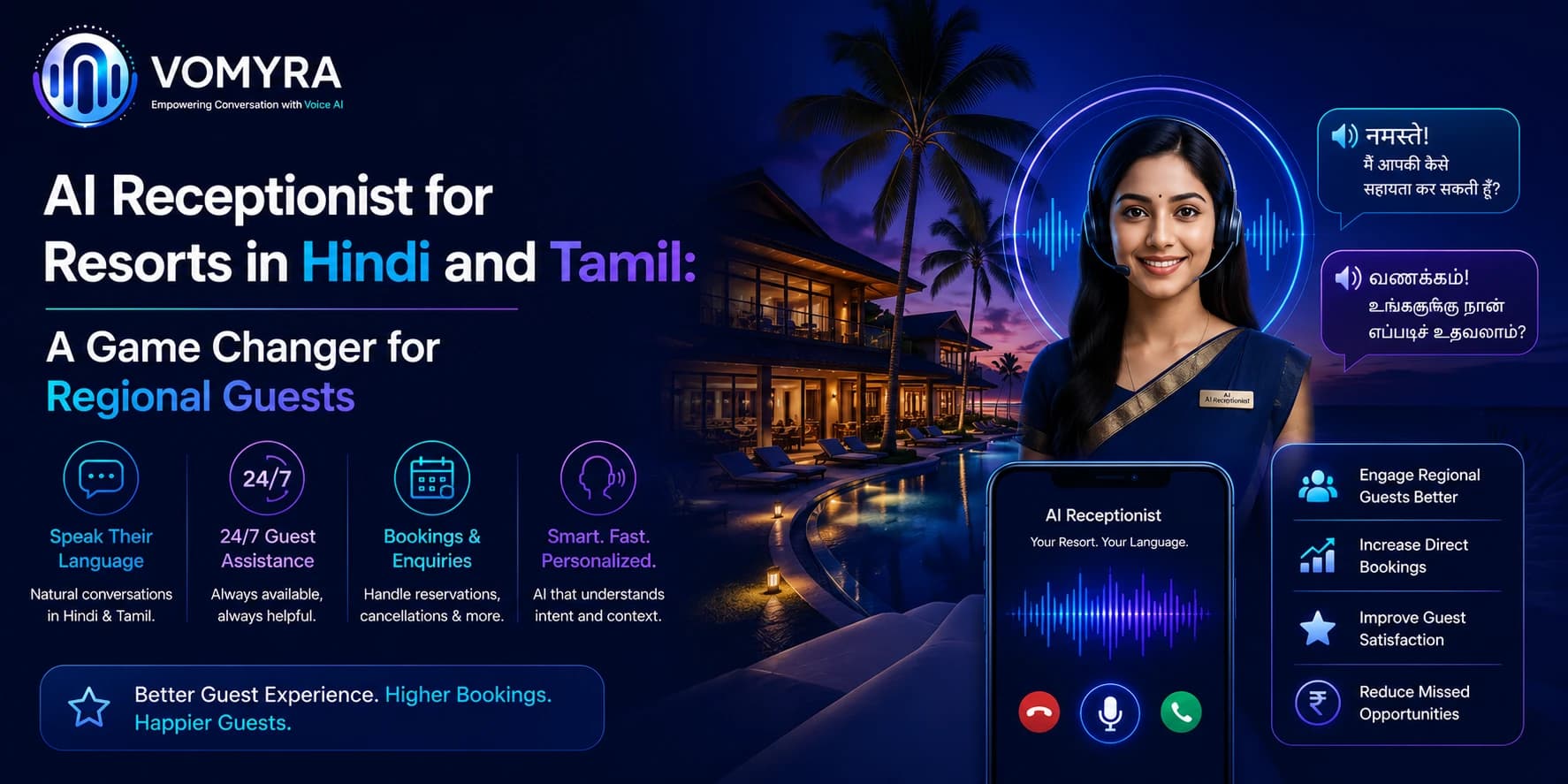
This is exactly the gap that Vomyra AI Voice Agent was built for, an AI receptionist that speaks to your guests in Hindi or Tamil or Kannada or Marathi, answers every call regardless of the hour, and either completes the booking or passes a qualified inquiry to your team the following morning with everything they need to close it.
Why Domestic Indian Resort Guests Have a Specific Language Problem
Here is something the hospitality tech industry mostly ignores. The conversation about multilingual AI for hotels tends to be framed around international guests, French speakers at a Delhi hotel, Japanese tourists in Rajasthan. That is a real problem, but it is not the biggest one for most Indian resorts.
The bigger issue is domestic. India had over 60 crore domestic tourist visits in 2025. Most of those trips were planned by families who speak Hindi, Tamil, Telugu, Kannada, Marathi, Gujarati, or Bengali as their primary language. And a significant share of those families feel noticeably more comfortable when they can ask questions about a resort in their own language, not in formal English.
Think about what a typical inquiry call for a family resort actually involves. They want to know if the resort has a swimming pool and what hours it is open. Whether the food is vegetarian. What the room configuration is for a family of five.
Whether there is a kids’ activity programme. What the cancellation policy is if the grandmother’s health becomes uncertain. Whether early check-in is possible on a Saturday because they are driving from Madurai and want to arrive by noon.
These are not complicated questions. But they are questions that feel more natural to ask in Tamil or Hindi than in English. And when the person who picks up the phone switches immediately to English, or when no one picks up at all, that family either books somewhere else or goes through an OTA where the UI is in their language even if the property staff is not.
An AI receptionist that speaks Tamil naturally and can answer all of these questions in the first two minutes of a call is not a luxury feature for an Indian resort. For resorts targeting domestic travellers from South India or North India specifically, it is a direct revenue tool.

What an AI Resort Receptionist Actually Handles (In Real Terms)
There is a version of the AI receptionist pitch that makes it sound like magic. And there is the reality of what it actually does well in a production deployment. Both are worth understanding.
What it genuinely does well. Every single call that comes in during non-staffed hours gets answered. Every availability inquiry gets a real answer based on your live room inventory if the system is connected to your PMS. Every question about check-in timing, pool hours, restaurant menu categories, parking, pet policy, and nearby attractions gets answered accurately based on your configured knowledge base.
Every booking inquiry where the caller is ready to make a decision gets completed without requiring a human in the loop.
For a resort that receives 40 to 80 calls on a typical Friday and Saturday, a meaningful number of those arrive when front desk capacity is limited. The AI handles all of them, simultaneously, with no hold times and no queue.
What it needs human backup for. A caller who is unhappy with their previous stay and wants to discuss compensation before they rebook. A group inquiry for a corporate offsite where the sales process involves negotiation.
A guest with a very specific disability accommodation requirement that requires direct confirmation from the property manager. A complaint that needs empathy and judgment. These escalate to your team, with full context from the AI call, so no one has to explain themselves twice.
The division is cleaner than people expect. The AI is genuinely good at volume and information. Humans are genuinely good at empathy and judgment. You need both, and the right implementation lets each do what it is actually good at.
Hindi-Speaking Resort Guests: What the Conversation Looks Like
Let’s be specific about this because the abstract argument for multilingual AI only becomes convincing when you can see what the actual interaction looks like.
A family from Lucknow calls a resort in Manali on a Thursday evening. Nobody on shift speaks fluent Hindi beyond pleasantries. Previously, this call either resulted in a halting English conversation where the family could not get their actual questions answered, or the call ended with “I’ll have someone call you back”, which sometimes happened and sometimes did not.
With an AI receptionist configured for Hindi and Hinglish, that conversation goes completely differently. The caller opens in Hindi. The AI responds in Hindi. They ask about room options for a family of four, do ek double bed wali room mil sakti hai ya family suite better rahega? The AI explains both options, their rates for the requested dates, what is included in each.
They ask about the restaurant, kya khana vegetarian bhi milta hai ya sirf non-veg? The AI confirms the vegetarian menu and gives the meal timing. They ask about a weekend pickup, kya resort ki taraf se cab arrange hoti hai Manali bus stand se? The AI confirms the pickup service and its cost.
All of this takes maybe four minutes. The family either books on the call or they say they will discuss and call back. Either way, the conversation was completed. Their questions were answered. The resort made a genuine impression.
Without the AI, that conversation probably ended after ninety seconds of friction.
Tamil-Speaking Resort Guests: A Different Conversation Pattern
Tamil guests at South Indian leisure properties, hill stations in the Nilgiris, beach resorts in ECR, heritage properties in Chettinad, represent a large, high-spending domestic tourism segment that most resorts serve imperfectly from a language standpoint.
Tamil is not just a different language from Hindi. It has a different conversational rhythm. Questions come with more context. Guests are often asking on behalf of extended family groups, which means they need to understand options in more detail before committing.
The communication style tends to be more relationship-oriented before transaction-oriented, meaning the first two minutes of a call often feel more like an introduction than a direct inquiry.
An AI receptionist configured for Tamil needs to match this. The opening needs to feel warm and contextualised, not transactional. The pacing of responses needs to allow the caller to process before the AI moves to the next point.
And the AI needs to be genuinely fluent in business Tamil, not a translated English script that sounds like it came from Google Translate, because Tamil speakers immediately recognise and disengage from unnatural phrasing.
Vomyra AI Voice Agent’s Tamil support is trained on production Tamil call data, not studio recordings of standardised Tamil. This matters specifically for resort inquiry calls, which tend to involve questions about amenities, food, and family-specific requirements where the vocabulary is distinctly regional rather than formal or textbook.
The Direct Booking Economics: Why This Pays for Itself Quickly
Every resort owner understands the OTA commission calculation. But it is worth making it concrete.
Suppose a resort has an average room rate of ₹6,000 per night. A two-night family booking is ₹12,000. On an OTA at 20 percent commission, the resort nets ₹9,600 from that booking. On a direct booking, it nets the full ₹12,000.
The difference is ₹2,400 on a single booking.
If the AI receptionist recovers five direct bookings per month that would otherwise have been OTA bookings, not new bookings, just redirected ones, that is ₹12,000 per month in commission savings. Against a platform cost that is a small fraction of that. The payback is measured in weeks, not months.
That is just the commission saving. It does not count the missed calls that never resulted in any booking at all, calls that came in at 9 PM on a Friday when no one was on the desk, that went unanswered, that resulted in the family booking a competitor resort. Those calls have a higher value than the commission savings because they represent revenue that was entirely lost rather than partially retained.
Beyond Room Bookings: What Else the AI Handles at a Resort
Booking inquiries are the headline use case. But a resort has a lot more call types than just reservations.
Guests who are already checked in call the front desk constantly. Pool hours. Restaurant last order time. Spa appointment scheduling. Request for extra towels. Question about the shuttle to the local market. Checkout time if they want to stay a little longer. All of these are routine calls that take a trained front desk person out of a face-to-face guest interaction.
An AI receptionist handles the routine ones. Your team handles the guest who is standing at the desk.
For resorts with restaurants, the Petpooja AI integration voice connection means phone calls to the in-house restaurant also go through the AI layer. Meal reservation calls, table bookings for dinner, questions about today’s specials, all handled automatically with the outcome pushed into the Petpooja system without anyone typing it in manually.
This is where the AI receptionist stops being a call-answering tool and starts being an operational efficiency layer. Fewer interruptions for the front desk team. Cleaner data in the booking and restaurant systems. More attention available for the guests who are physically present.
Setting This Up Without a Technology Project
Most resort owners, honestly, do not want to manage a technology implementation. The reason AI tools do not get deployed in mid-market Indian resorts is not that nobody wants them. It is that the setup process usually involves an IT team, a systems integration, weeks of configuration, and a significant upfront cost before the first call is handled.
Vomyra AI Voice Agent is built to work differently. The knowledge base, your resort’s room types, amenities, pricing, policies, restaurant information, local activity options, is loaded through a plain-language interface, not a technical setup process. The AI is assigned an Indian +91 number. The language is configured for Hindi or Tamil or both. The integration to your CRM or booking system is a connection step rather than a development project.
A resort operations manager, not a developer, can complete this. That is the actual design intent.
And for a resort that wants to test this before committing to it properly, a free trial of Vomyra AI Voice Agent includes 500 monthly credits that renew every month, enough to handle a meaningful volume of real calls in Hindi and Tamil and see what the actual caller experience looks like before any payment is required.
Frequently Asked Questions
Can the AI receptionist handle room availability and booking in Hindi or Tamil?
Yes. When connected to your property management system, the AI checks live availability, quotes rates for the requested dates, and can complete a booking directly. If PMS integration is not configured, it captures the inquiry details and passes them to your team with a full call summary.
What happens to calls that come in after the AI is deployed but the guest needs a human?
The AI transfers the call to the appropriate team member with full call context. The guest does not need to repeat their question. The team member picks up already knowing what was asked, what language was used, and what information the guest already received.
Does the AI sound natural in Tamil, or does it sound like a translated script?
Vomyra AI Voice Agent’s Tamil support is trained on production Tamil call audio rather than translated text. The speech patterns, pacing, and phrasing reflect natural Tamil conversation rather than a formal or textbook register.
Can one AI receptionist handle calls in both Hindi and Tamil?
Yes. Language detection is automatic from the caller’s opening. A Hindi-speaking caller from Lucknow and a Tamil-speaking caller from Coimbatore can both call the same resort number and each will receive the response in their own language without any menu selection or configuration change per call.
What is the cost of an AI receptionist for a mid-sized resort?
Vomyra AI Voice Agent is priced at a transparent per-minute rate in INR with no minimum commitment. The free tier includes 500 monthly credits that renew every month, which covers a meaningful number of test calls before any payment decision is required.