Outbound calling is one of the most resource-intensive activities in any business that relies on it – sales outreach, payment reminders, appointment confirmations, customer check-ins. It demands consistent volume, disciplined follow-up, and enough calling capacity to actually reach the people on the list before the opportunity passes.
Most teams can’t sustain this manually at the scale they need. Call lists sit partially worked, follow-up falls off under pressure, and outbound calling capacity ends up being whatever’s left over after everything else the team has to do.
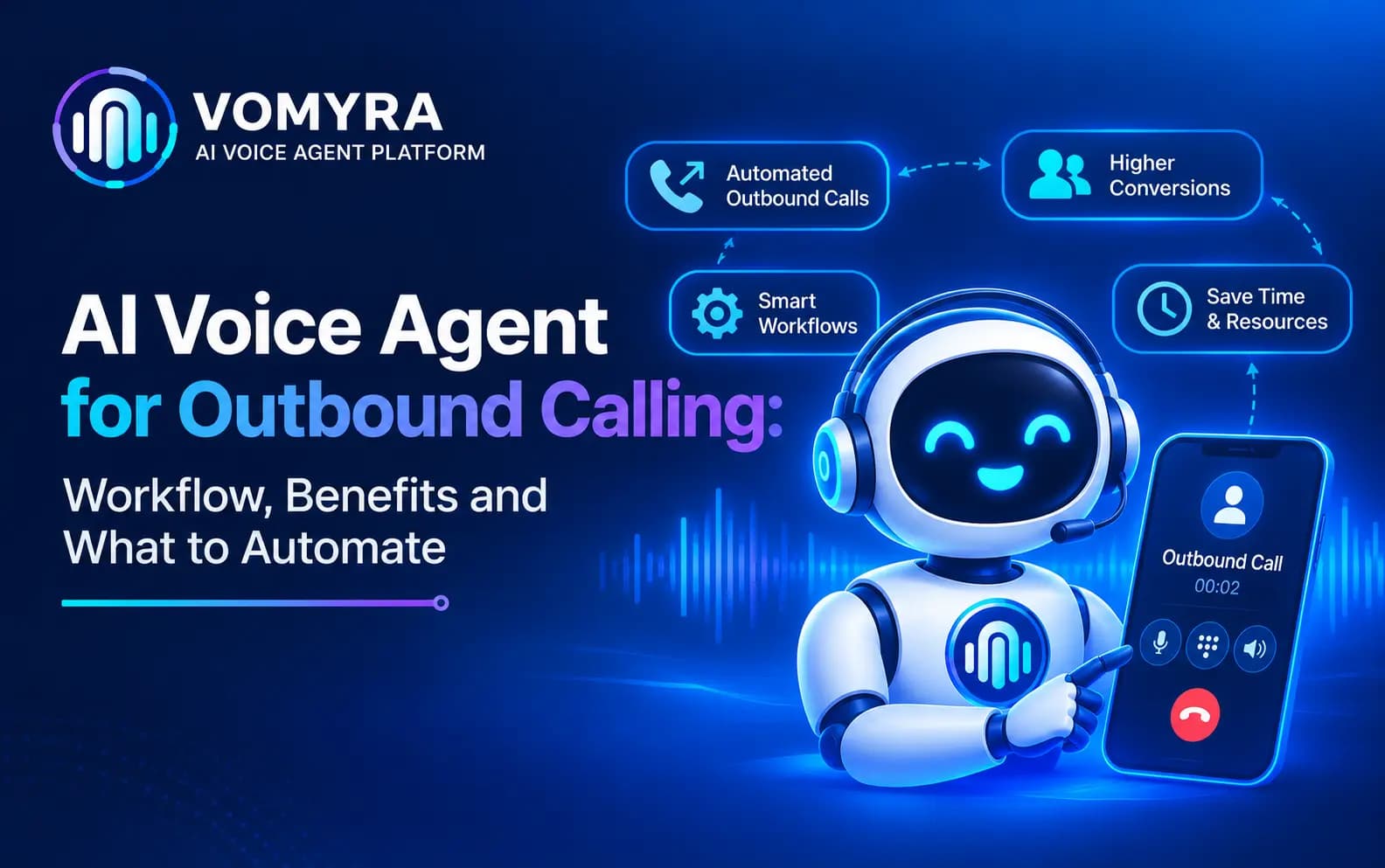
An AI voice agent for outbound calling removes this capacity constraint – placing calls automatically, holding natural conversations, and working through a list consistently, without depending on how much spare time a team has on a given day.
This guide covers how AI voice agents handle outbound calling, the workflow behind it, the benefits over manual dialling, and what to automate first.
What Is an AI Voice Agent for Outbound Calling?
An AI voice agent for outbound calling is a voice AI system that proactively places calls – to leads, customers, or any defined list – and carries the conversation itself: introducing the reason for the call, asking questions, handling responses, and routing the outcome appropriately, all without a human dialling or speaking on the call.
This applies across a wide range of outbound use cases – sales outreach, payment or appointment reminders, satisfaction check-ins, re-engagement campaigns – anywhere a business needs to proactively reach people by phone rather than wait for them to call in.
Why Manual Outbound Calling Struggles to Scale
Outbound calling has a few structural constraints that limit it regardless of team effort:
- Calling capacity is fixed. A team can only make so many calls in a working day, regardless of how large the list is.
- Lists don’t get worked evenly. The first few contacts on a list often get called promptly; later ones may sit for days or never get reached at all.
- Follow-up discipline breaks down under pressure. When other priorities compete for attention, outbound calling is often the first thing that slips.
- Time zones and calling windows limit reach. People outside a team’s working hours are simply missed, regardless of intent to reach them.
- Consistency varies by caller. Script adherence, tone, and thoroughness differ from person to person and day to day.
An AI voice agent removes each of these constraints – working through a full list consistently, at scale, without the capacity ceiling a human team inevitably runs into.
The AI Voice Agent Outbound Calling Workflow
A typical outbound calling workflow runs through these stages:
- List upload and segmentation – Contacts are pulled from a CRM, spreadsheet, or campaign source and segmented by relevant criteria.
- Automated dialling – The AI voice agent places calls using a real mobile number, at configured times and pacing.
- Conversation handling – The agent delivers the call’s purpose – a pitch, a reminder, a check-in – and responds naturally based on what the person says.
- Response and objection handling – Common questions and objections are handled conversationally, without sounding scripted or robotic.
- Outcome capture – Each call’s result is logged – interested, not interested, callback requested, no answer – with a full transcript.
- Automated follow-up – No-answers and requested callbacks are automatically re-attempted at appropriate times, without manual tracking.
- Reporting and CRM sync – Every call outcome updates the CRM or relevant system in real time, giving full visibility into campaign performance.
This structure means every contact on a list actually gets called, and called again if needed, without depending on spare team capacity.
Manual Outbound Calling vs AI Voice Agent Outbound Calling
| Factor | Manual Outbound Calling | AI Voice Agent Outbound Calling |
| List coverage | Partial, especially on longer lists | Full list worked consistently |
| Daily call capacity | Limited by team size and hours | Hundreds of simultaneous calls |
| Follow-up consistency | Often inconsistent under workload | Automated, systematic cadence |
| Cost per call at scale | High (staff time, overheads) | Significantly lower at scale |
| Calling hours | Limited to team’s working hours | Can run across extended hours |
| Consistency of delivery | Varies by caller and day | Same quality conversation every call |
| Language coverage | Limited to team’s languages | Multiple languages, including regional Indian languages |
| Reporting and data capture | Manual notes, often incomplete | Full transcripts and structured outcome data |
Read Also: AI Voice Agent for Customer Support: Workflow, Benefits and What to Automate
Key Benefits of Automating Outbound Calling
Full list coverage, every time Every contact gets called, rather than only the ones a team had capacity to reach before time or priorities ran out.
Higher outbound volume without more headcount Campaign volume can scale up for a launch or peak period without needing to hire or reassign staff temporarily.
Consistent messaging and tone Every call delivers the same quality conversation, removing the variability that comes from different callers, moods, or fatigue late in a shift.
Faster follow-through on responses Interested contacts are identified and routed immediately, rather than waiting for a caller to circle back to their notes later.
Lower cost per contacted lead or customer Outbound campaigns become significantly cheaper to run at volume compared to staffing an equivalent manual calling effort.
Full visibility into what’s working Every call is transcribed and logged, giving clear data on which messaging, timing, and segments perform best.
What to Automate First
A staged rollout works well for outbound calling automation:
- Initial list outreach – automate the first call across a new list, rather than working through it manually one contact at a time.
- No-answer follow-up – automate re-attempts for contacts who didn’t answer the first call.
- Simple confirmation or reminder calls – appointment reminders, payment confirmations, or check-ins that follow a predictable structure.
- Basic response handling – common, predictable questions and objections that don’t require judgement.
- CRM logging – ensure every call outcome updates the relevant system automatically, without manual entry.
More advanced steps – live transfer to a human mid-call, complex multi-stage outbound sequences, or campaigns requiring nuanced negotiation – can be layered in once the core outbound flow is proven and reliable.
Best Practices for AI Voice Agent Outbound Calling
Segment lists before calling Well-segmented lists let the agent tailor its opening and questions appropriately, rather than using one generic script for everyone.
Time calls thoughtfully Calling at appropriate hours, and spacing follow-up attempts sensibly, protects both response rates and the recipient’s experience.
Keep opening lines clear and direct People decide quickly whether to keep listening. A clear, honest opening about who’s calling and why performs better than an evasive or overly scripted one.
Design clean handoff points When a contact is ready for a deeper conversation or negotiation, the transition to a human rep should be immediate and carry full context.
Monitor call outcomes regularly Review transcripts and outcome data regularly to catch response patterns, common objections, or messaging that isn’t landing well.
Respect opt-outs and calling regulations Outbound calling is subject to consent and regulatory requirements that vary by use case and region – these need to be built into the calling workflow from the start, not treated as an afterthought.

Build an AI Team for Outbound Calling
Manual outbound calling will always be capped by how many calls a team can physically make in a day. An AI voice agent removes that ceiling, working through your full list consistently rather than whatever a team has spare capacity for.
Vomyra is India’s Agentic Voice AI Platform, built to run complete AI outbound workflows – with Outreach, Qualification, Closing and Follow-Up agents working together, not a single standalone dialling tool. Vomyra AI voice agents place outbound calls using real Indian mobile numbers and hold human-like conversations in multiple languages, working through your full contact list consistently.
If you’re evaluating how to scale outbound calling without scaling headcount, Vomyra is built specifically for this – with unlimited calling plans and no coding required to get started.
FAQs
Is AI voice agent outbound calling the same as a predictive dialler?
No. A predictive dialler connects a human rep to the next answered call. An AI voice agent carries the entire conversation itself – no human is on the line until the contact is ready for one, if at all.
Can outbound AI voice agents handle cold calling as well as warm follow-up?
Yes, both are common use cases, though cold outreach typically needs more careful script design and objection handling than warm follow-up to a known contact.
Will people know they’re speaking with an AI on an outbound call?
Transparency expectations and requirements vary by use case and jurisdiction – it’s worth defining a clear disclosure approach appropriate to your calling context before launching.
Can an AI voice agent make outbound calls in regional Indian languages?
Yes. Platforms built for Indian businesses support multiple languages, so outbound calls can happen in the language the contact is most comfortable with.