Large businesses manage thousands of customer conversations across sales, customer support, appointments and service enquiries. As operations expand, handling every call manually can increase costs, create delays and make it difficult to maintain consistent communication.
AI voice agents for enterprise teams offer a way to automate routine conversations while allowing employees to focus on tasks that require human judgement. These systems can answer questions, qualify leads, collect information and support follow-up activities based on predefined business rules.
For enterprises operating across multiple departments or locations, the key is not simply automating calls. It is building reliable workflows that connect conversations with the right business processes.
Why Enterprise Teams Need AI Voice Automation
Traditional call handling depends heavily on employee availability. During busy periods, teams may struggle to answer every enquiry, contact every lead or provide timely updates to existing customers.
Enterprise AI voice agents can help manage repetitive interactions without requiring employees to handle every conversation manually. Their effectiveness depends on the quality of the system, available integrations and the complexity of the task.
Managing High Call Volumes
Sales campaigns, product launches and seasonal demand can generate more calls than a team can comfortably manage. Missed calls and delayed responses may affect customer satisfaction and sales opportunities.
Enterprise voice automation can help handle routine conversations during peak periods. Businesses must still confirm that their telephony setup and platform can support the expected number of concurrent calls.
Reducing Repetitive Tasks
Employees often spend considerable time answering common questions, confirming appointments and collecting customer details. These activities can take time away from more complex work.
AI-powered customer communication can reduce repetitive workloads by handling approved enquiries and recording relevant information. Employees can then focus on negotiations, complaints and situations requiring personal attention.
Practical AI Voice Agent Use Cases for Enterprises
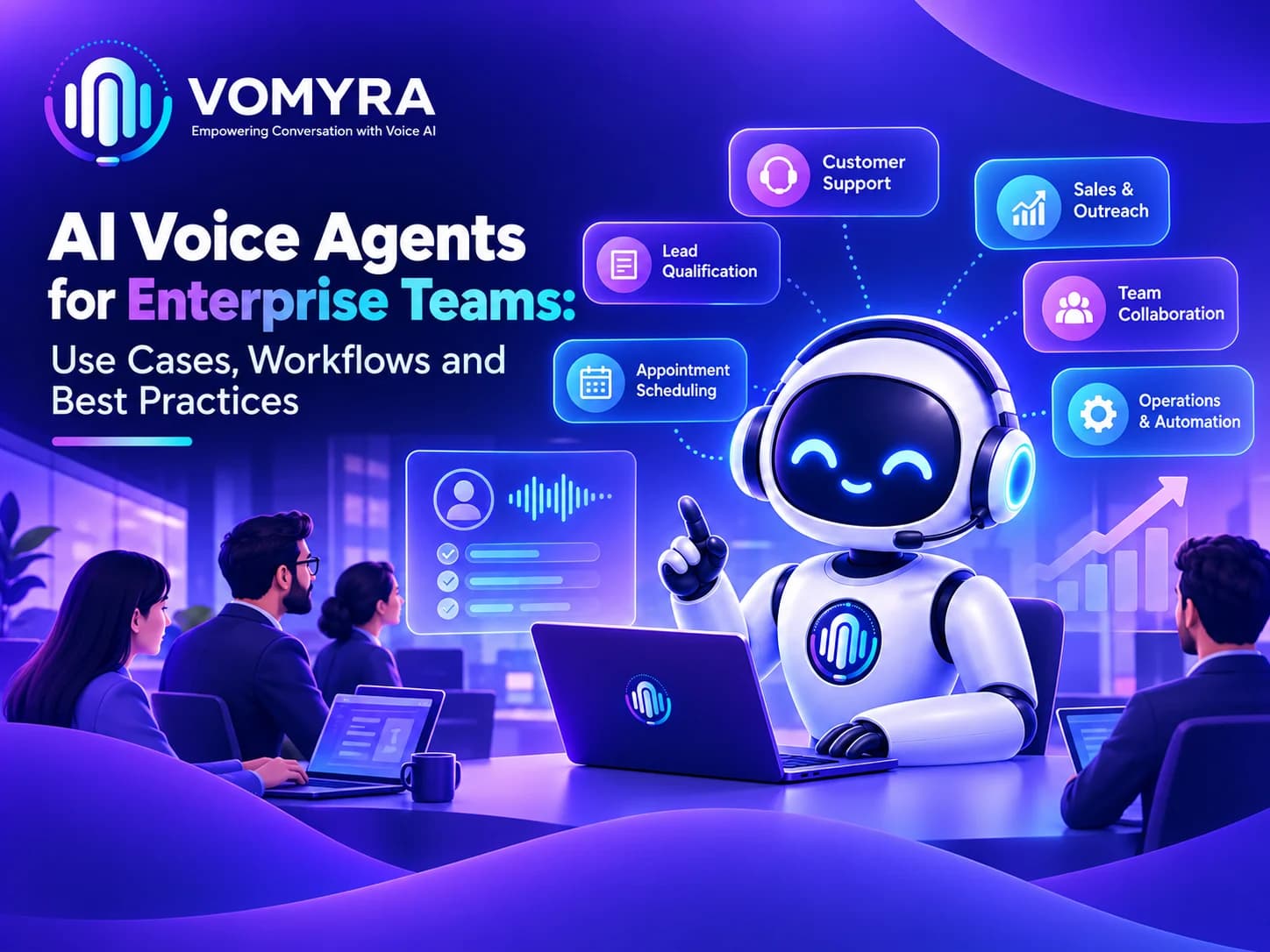
The right application depends on the department, customer requirements and existing business systems. The following AI voice agent use cases demonstrate how enterprises can apply voice automation across different operations.
1. Sales and Lead Qualification
Sales teams frequently receive enquiries from customers with different budgets, requirements and purchase timelines. An AI voice agent can ask relevant questions, collect responses and identify leads that meet predefined qualification criteria.
AI voice agents for sales teams can also support initial outreach and follow-up activities where appropriate permissions are available. Qualified prospects can be directed to sales representatives with useful context from previous conversations.
2. Customer Support and Service Enquiries
Support departments handle recurring questions about services, account information, appointments and order updates. Voice AI for customer support can answer approved questions and guide callers towards the appropriate next step.
When a problem requires investigation or specialist knowledge, the agent should transfer the conversation or create a support request. This keeps automation useful without forcing customers through unsuitable automated responses.
3. Appointment Scheduling and Reminders
Healthcare administration, consulting firms and service businesses often manage appointment bookings, confirmations and reminders. An AI agent can collect preferred dates, check availability through supported integrations and record booking requests.
These AI voice agent use cases can help reduce manual coordination. However, the workflow must confirm successful bookings instead of assuming that a request has been completed.
4. Internal Enterprise Communication
Large organisations also need to coordinate communication between departments, offices and employees. Voice agents can support routine internal enquiries, meeting reminders and requests for operational information.
Enterprise call automation can make these processes more consistent when connected to approved internal systems. Access permissions should ensure that employees receive only the information they are authorised to view.
How AI Voice Agent Workflows Operate
A successful implementation requires more than a conversational interface. AI voice agent workflows should connect the conversation with the business systems and actions needed to complete a task.
Step 1: Identify the Business Requirement
Start by selecting one clear problem, such as missed sales enquiries, repetitive support calls or appointment reminders. Define the expected outcome before introducing automation.
Step 2: Prepare Accurate Information
Create an approved knowledge base containing service details, frequently asked questions, business policies and escalation instructions. Regular updates help prevent incorrect responses.
Step 3: Connect Business Systems
AI voice agent integration may involve a CRM, scheduling platform, helpdesk or order management system. The integration should allow the agent to access permitted information and record relevant outcomes.
Step 4: Define Human Handoffs
Establish rules for transferring calls when customers request human assistance, raise complaints or ask questions the agent cannot answer confidently.
Step 5: Test and Improve
Begin with a limited group of conversations. Review response accuracy, task completion, customer feedback and integration errors before expanding the workflow.
AI Voice Agents vs Traditional Call Handling
Traditional call handling relies on employees for most conversations and follow-up tasks. AI voice agents can automate suitable interactions, although the results depend on system configuration and business requirements.
| Feature | Traditional Call Handling | AI Voice Agents |
| Call answering | Depends on staff availability | Can answer automatically when configured |
| Routine enquiries | Mainly handled by employees | Can handle approved questions |
| Lead qualification | Employees ask and record questions | Can collect and classify lead information |
| Appointment reminders | Often require manual coordination | Can automate supported reminder workflows |
| CRM updates | Frequently entered manually | Can update supported fields through integrations |
| Complex issues | Employees manage the conversation | Can escalate to human employees |
| Scaling capacity | Often requires additional staff | Depends on platform and telephony capacity |
AI voice agents for businesses are not a complete replacement for human teams. Their main value is handling suitable repetitive tasks while employees remain available for complex conversations and decisions.
Best Practices for Enterprise Voice Automation
Enterprises should establish clear operational standards before deploying voice automation across departments.
- Start with a defined use case: Choose a repetitive process with measurable outcomes.
- Protect customer information: Apply suitable access controls, retention policies and privacy requirements.
- Maintain accurate records: Verify that summaries, customer details and call outcomes are recorded correctly.
- Set escalation rules: Make human assistance available for sensitive or complicated situations.
- Monitor performance: Review completion rates, customer feedback and failed actions.
- Check system capacity: Test integrations and concurrent calling limits before increasing volume.
AI voice agents for enterprise teams should be evaluated using actual business results rather than the number of automated calls alone. Enterprises should also confirm applicable consent, recording and outbound-calling requirements before deployment.

How Vomyra Supports Enterprise Voice Workflows
Vomyra provides AI voice agents for business conversations, including workflows involving lead qualification, outreach and follow-up. These capabilities can help businesses explore how voice automation fits into their existing customer communication processes.
When evaluating a solution, enterprise teams should examine supported integrations, call capacity, reporting options and the ability to transfer conversations to employees. The final setup should match the organisation’s actual requirements rather than relying on features that have not been verified.
Conclusion
AI voice agents for enterprise teams can help organisations manage routine calls, qualify leads, support customers and coordinate follow-up activities. The strongest implementations combine clear workflows, reliable integrations, accurate information and human oversight.
Businesses should begin with a practical use case, measure its results and expand automation only when the process performs reliably. With the right planning, enterprise voice automation can reduce repetitive work and help teams direct their time towards higher-value activities.
FAQs
1. What are AI voice agents for enterprise teams?
They are AI-powered systems that handle business phone conversations, answer approved questions, collect information and perform supported actions according to configured workflows.
2. Which departments can use enterprise AI voice agents?
Sales, customer support, appointment management and internal operations can benefit from suitable voice automation workflows.
3. Can AI voice agents integrate with enterprise CRM systems?
Yes, when the platform supports the required integration. Businesses should verify permissions, data accuracy and error-handling capabilities before deployment.
4. Can AI voice agents handle complex customer problems?
They can identify certain issues and collect relevant information, but complex, sensitive or unusual problems should be escalated to qualified employees.
5. How should enterprises measure voice automation performance?
Useful metrics include response time, qualified leads, successful bookings, task completion, customer satisfaction and integration failures. These measures help determine whether automation is delivering practical business value.