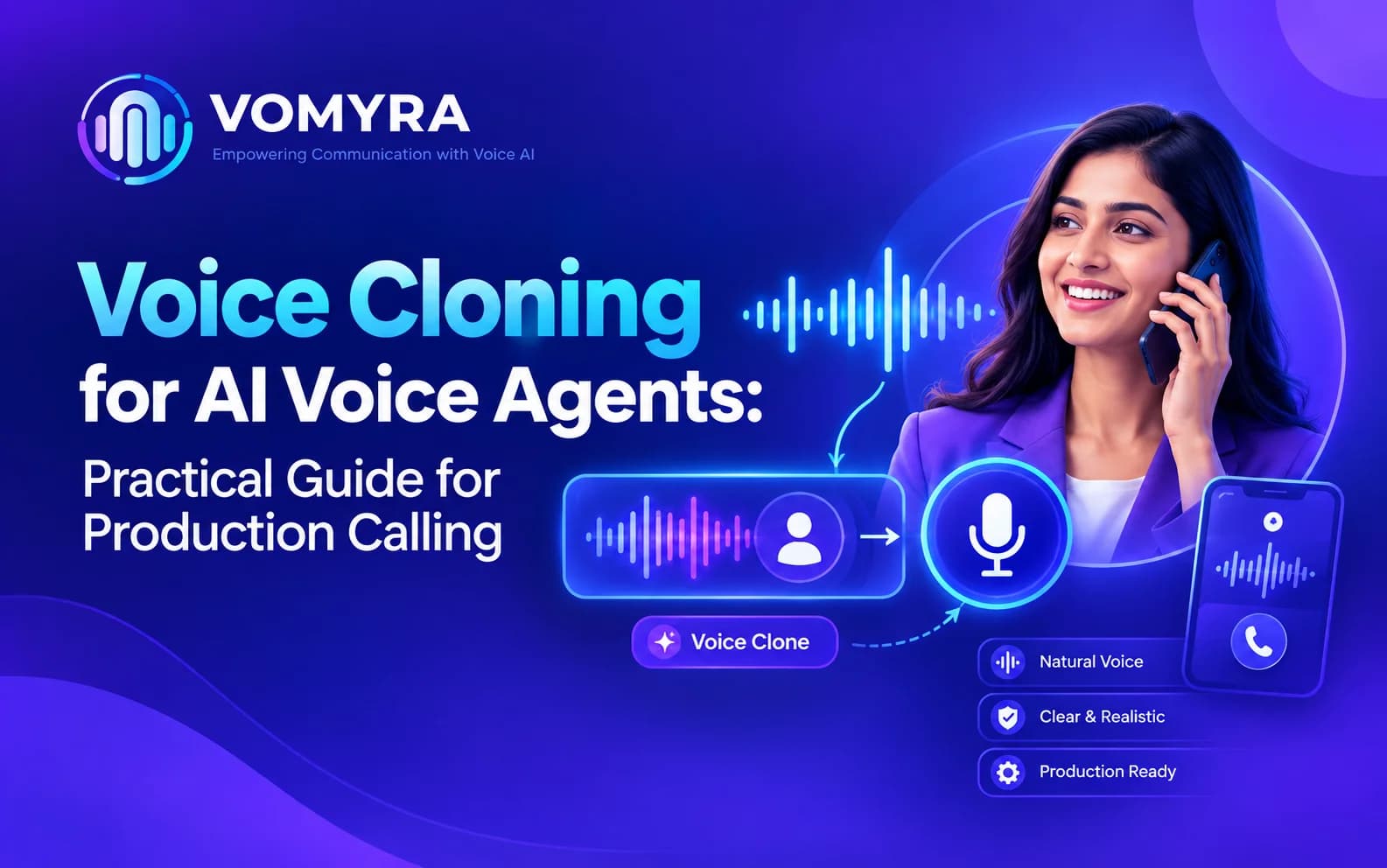
Ask a business owner what they want from an AI voice agent and a surprising number say the same thing: “Can it sound like me?” Or like our best sales rep. Or like the brand voice we use in our ads.
That is the appeal of voice cloning. It also raises real questions about consent, quality, cost and trust, and many of them only show up once calls go live.
This guide explains how voice cloning works in AI voice agents, when it is worth using, what can go wrong, and how to choose a voice that works on real phone calls.
What Is Voice Cloning in an AI Voice Agent?
Voice cloning means creating a synthetic voice that closely resembles a specific real person, using recordings of that person speaking. The cloned voice is then used by the text-to-speech layer of an AI voice agent to speak its replies.
It is different from a standard AI voice. Standard voices are pre-built options you pick from a list. A cloned voice is built to sound like one particular speaker.
In a typical voice agent, the pipeline is speech-to-text, a language model that decides what to say, and text-to-speech that speaks it. Voice cloning only changes the last step: how the reply sounds. It does not change what the agent knows or how well it handles a conversation.
When Voice Cloning Helps
Brand consistency. If a company already has a recognisable voice in ads, IVR and videos, a matching voice on calls can feel more coherent.
Founder or expert-led outreach. Some businesses want calls that sound like a known person, for example a clinic’s doctor confirming an appointment, with that person’s agreement.
Familiarity and trust. A consistent, friendly voice can make reminders and follow-ups feel more personal than a generic one.
Local feel. A voice with a natural regional accent can feel more relatable to callers in a particular market.
Read Also : How to Reach 10,000 Leads in 10 Minutes with AI Voice Calling
When It Is Not Worth It
When the conversation is the problem. A cloned voice will not fix slow replies, poor interruption handling or wrong answers. Latency, knowledge base quality and prompt design affect results far more.
When quality is uneven. Cloned voices can sound excellent in a clean demo and drift on long calls, in other languages, or with unusual names and numbers.
When consent is unclear. Using anyone’s voice without clear, documented permission is a legal and reputational risk.
When a good standard voice does the job. For many use cases, such as lead qualification, order confirmation and reminders, a clear, natural standard voice performs just as well.
Consent, Law and Trust
This is the part that deserves the most care.
- Get explicit written consent from the person whose voice is cloned, covering where it will be used, for how long and for what purposes. Decide what happens if that person leaves the company.
- Treat voice recordings as personal data. Data protection rules, including India’s Digital Personal Data Protection Act, apply to how recordings are collected, stored and used. Check with your legal team.
- Never imitate someone without permission. Cloning a customer’s, a public figure’s or a competitor’s voice is off limits. Impersonation can also fall under fraud and deepfake rules.
- Be transparent with callers. Follow disclosure norms and any rules on automated or AI-generated calls in your sector, and make it easy to reach a human.
- Secure the voice model. A cloned voice is an asset that can be misused. Limit access and keep records of who can create or use it.
What Makes a Voice Work on Real Calls
Voice quality on a phone line is different from quality in a studio. A few things matter more than whether the voice is cloned:
| Factor | Why it matters on calls |
| Latency | The voice has to start speaking quickly, ideally by streaming audio as it is generated |
| Clarity over 8 kHz phone audio | Phone networks compress audio, so a voice that sounds rich in a demo can sound thin on a call |
| Pacing and pauses | Natural rhythm makes the agent sound like it is listening, not reading |
| Pronunciation | Names, brands, numbers and addresses must be spoken correctly |
| Language and accent | Hindi, English and regional languages, including mixed speech, need to sound native, not transliterated |
| Consistency over long calls | The voice should not change tone or pace halfway through |
| Emotional range | Warm for support, brisk for confirmations, calm for sensitive topics |
Voice Cloning vs Standard Voices
| Aspect | Cloned Voice | Standard Voice |
| Setup time | Needs recordings, training and testing | Ready to use |
| Brand match | High, if done well | Moderate |
| Consent and legal work | Required | Minimal |
| Multilingual consistency | Can vary across languages | Usually tuned per language |
| Risk | Misuse, quality drift | Low |
| Cost | Often higher | Lower |
| Best for | Brand-led or personality-led calling | High-volume, task-focused calling |
A Practical Approach for Production
- Start with a strong standard voice. Launch, measure pickup rate, call completion and conversion.
- Test cloning only if there is a clear reason, such as brand recall or a named spokesperson.
- Use a small test group and compare against the standard voice on real metrics.
- Listen to real call recordings, not only samples. Check long calls, numbers, names and every language you serve.
- Document consent and access before going wide.
- Review regularly. Check for drift and for customer complaints.

A Voice That Works, Not Just One That Impresses
The best voice for an AI voice agent is the one callers understand, trust and stay on the line with. For most businesses that comes from fast, natural conversation, accurate answers and the right number on caller ID, with cloning as an optional extra.
Vomyra is India’s Agentic Voice AI Platform. It gives businesses a complete AI voice team (Research, Outreach, Qualification, Closing and Follow-Up agents) with human-like conversations in multiple languages, real Indian mobile numbers, no-code setup and unlimited calling plans.
If you are weighing voice options for your calls, test them on your own use case and your own audience, and judge by results.
FAQs
What is voice cloning for AI voice agents?
It is the use of a synthetic voice modelled on a specific real person as the agent’s speaking voice. The agent’s knowledge and conversation skills stay the same; only how it sounds changes.
Does a cloned voice make an AI voice agent perform better?
Not by itself. Conversion and resolution depend more on latency, accuracy, interruption handling and a good knowledge base. A cloned voice can help with brand fit and familiarity, but it will not fix a weak conversation.
Is it legal to clone someone’s voice?
It depends on consent and on local law. You should have clear written permission from the person, comply with data protection rules and avoid any use that could mislead callers or imitate someone without authority. Take legal advice for your situation.
How much audio is needed to clone a voice?
It varies by technology, from short clips to several hours of clean recordings. More clean audio generally gives better results, and quality of recording matters more than quantity.
Can a cloned voice speak Hindi and regional languages well?
Sometimes, but quality often differs between languages and with mixed Hindi-English speech. Test on real calls in every language you plan to use.
Do callers need to be told they are speaking to an AI?
Transparency is good practice and is increasingly expected. Follow the rules for your industry and region, and always offer a route to a human.
What matters more than voice cloning?
Low latency, natural interruption handling, accurate knowledge, clear scope and