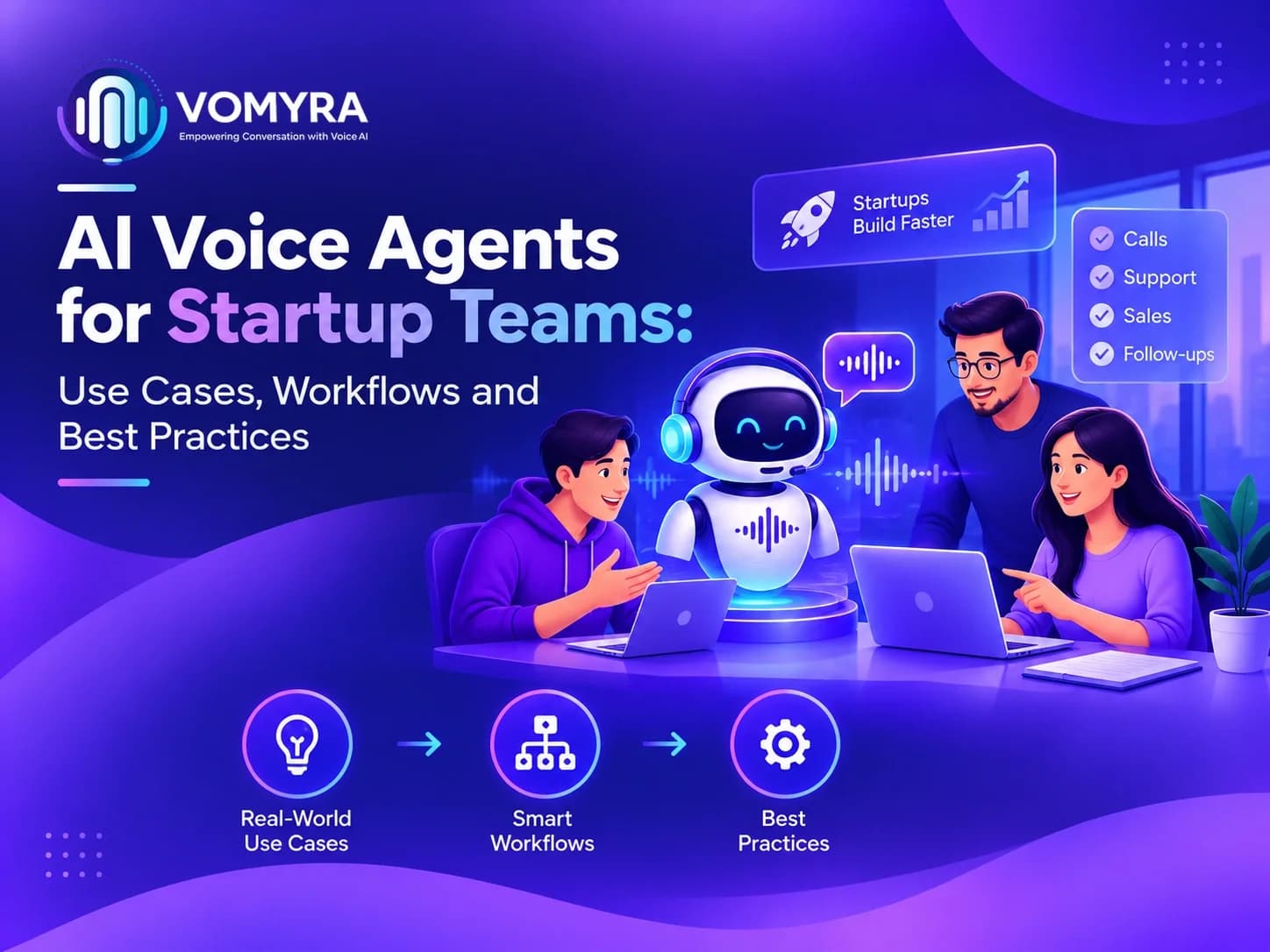
A startup team of ten rarely has ten people for the phone. Sales is two people. Support is whoever is free. Operations is one person with a spreadsheet. Hiring happens in the gaps.
Yet the work involves a lot of calls: following up with leads, confirming orders, onboarding new users, chasing payments, scheduling interviews. Each call is small. Together they eat hours that the team needs for building and selling.
AI voice agents give small teams a way to handle these calls without hiring a full calling team. This guide covers where voice AI fits across a startup, the workflows worth setting up first, and the practices that keep it reliable as you grow.
Why Startup Teams Are a Good Fit for AI Voice Agents
- Every hour counts. Founders and early hires cannot spend a day on repetitive calls.
- Speed wins deals. Early customers and leads respond best to fast, personal contact.
- Volume is uneven. A product launch or campaign can bring a rush of enquiries that a small team cannot cover.
- Hiring ahead of revenue is risky. Automation lets you handle more conversations before you know which roles you need.
- Customers are spread out. Different cities, time zones and languages are hard to cover with a small team.
- Data is already in tools. Forms, CRMs, payment tools and product events give clear triggers for calls.
Key Use Cases for Startup Teams
1. Instant Lead Response and Qualification
When a lead fills a form or requests a demo, an AI voice agent calls within minutes, asks a few qualifying questions and books a meeting. The sales team talks only to people who fit.
2. Demo and Meeting Booking
The agent offers available slots, books into the calendar and sends a confirmation. A reminder call before the meeting helps reduce no-shows.
3. User Onboarding and Activation
For products with sign-ups, an agent can call users who have not completed key steps, find out what is blocking them and book a short walkthrough.
4. First-Line Customer Support
An AI customer service agent can answer common questions, check order or account status, log tickets for the rest and pass urgent issues to a person with context.
5. Order and COD Confirmation
For consumer and D2C startups, confirmation calls reduce wrong addresses, fake orders and returns.
6. Payment and Renewal Reminders
Polite calls about overdue invoices or upcoming renewals often recover revenue that emails miss.
7. Feedback and Customer Research
Short voice surveys after onboarding, delivery or a feature launch give richer answers than forms, and transcripts reveal recurring themes.
8. Candidate Screening and Interview Scheduling
For roles with many applicants, an agent can run a short first call to confirm interest, location and availability, then schedule interviews.
9. Community, Event and Webinar Follow-Up
Registrant reminder calls and post-event follow-ups help improve attendance and keep the pipeline warm.
A Practical Workflow for a Startup Team
- Trigger from your tools: form, sign-up, inactivity, order, payment status or calendar entry.
- Instant call from the AI voice agent, with a script written for that stage.
- Conversation: qualify, answer questions, confirm details or collect feedback.
- Action: book a meeting, send a payment link, update an order or create a ticket.
- Record the outcome in your CRM or sheet with transcript and next step.
- Hand over hot leads, upset customers and complex cases to the right person with a summary.
- Review weekly: read a sample of transcripts, update scripts and track the numbers.
Small Team Without vs With AI Voice Agents
| Area | Small team without voice AI | With AI voice agents |
| Lead response time | Hours, depends on who is free | Minutes |
| Qualification | Inconsistent, rep-dependent | Same questions on every call |
| Onboarding outreach | Rarely done | Triggered by user behaviour |
| Support first response | Limited to working hours and staff | Routine queries covered |
| Payment reminders | Ad hoc | Scheduled and consistent |
| Customer research | A few calls per month | Many short calls with transcripts |
| Language coverage | Limited to the team | Multiple Indian languages |
| Cost as volume grows | Rises with each hire | Scales without matching hires |
Benefits for Startup Teams
More meetings from the same traffic. Fast response and steady follow-up lift the share of leads that turn into conversations.
Time back for the team. People spend time on product, key customers and closing, not on routine calls.
Better activation and retention. Calling stuck users and at-risk customers recovers some who would have quietly left.
Revenue protection. Payment and renewal reminders reduce avoidable losses.
Customer insight at scale. Transcripts show objections, feature requests and confusing moments you would otherwise miss.
Flexible growth. You can scale conversations first, and hire later for the roles that truly need people.
Read More: Best AI Voice Agent for Startups in India 2026
Best Practices for Startup Teams
Start with one workflow. Pick a clear, high-intent trigger such as demo requests or order confirmation, and measure it before adding more.
Write short, honest scripts. Say who is calling and why, ask two or three focused questions and offer a clear next step.
Keep product knowledge accurate. Feed the agent your website, help docs and pricing, and update it whenever things change.
Define when a human steps in. Set rules for big deals, angry customers, security or legal questions and anything outside scope.
Respect consent and calling rules. Call only people who have reason to expect it, follow calling-hour rules and honour opt-outs.
Measure outcomes, not calls. Track meetings booked, activation rate, confirmed orders and recovered payments.
Review transcripts regularly. Weekly reviews in the first month catch issues early and improve results quickly.
Plan for growth. Choose a platform that works with your CRM and tools, so workflows can expand as the team does.

Build an AI Team for Your Startup
Small teams win by being fast and consistent in every conversation. AI voice agents help you do both without adding headcount too early.
Vomyra is India’s Agentic Voice AI Platform. It gives startups a complete AI voice team (Research, Outreach, Qualification, Closing and Follow-Up agents), real Indian mobile numbers, human-like conversations in multiple languages and no-code setup, with unlimited calling plans.
If you want to cover leads, onboarding, reminders and follow-ups without growing the team, test Vomyra on one workflow and measure the result.
FAQs
How can startup teams use AI voice agents?
They can use them for lead qualification, demo booking, user onboarding, first-line support, order confirmation, payment reminders, customer feedback and candidate screening.
Will AI voice agents replace our sales or support team?
They take over repetitive first calls, reminders and routine questions. People still run demos, handle complex issues, negotiate and manage key relationships.
Is this affordable for an early-stage startup?
The main value for early teams is covering conversations you cannot staff. Start with one workflow, measure the result and expand if it works. Check pricing and calling limits before you commit.
Do we need engineers to set it up?
Not on a no-code platform. Agents can be launched from your website, knowledge base or documents. Engineering help is only needed for deeper integrations.
Can an AI voice agent speak Hindi and regional languages?
Yes, on platforms built for India. Vomyra supports multiple languages, including natural Hindi-English code-switching, which helps when your customers are spread across cities and states.
What if the agent cannot answer a question?
It should say so politely, offer a callback or pass the call to a person with a summary. Set these rules before launch.
How do we know it is working?
Compare response time, meeting-booking rate, activation, confirmed orders and recovered payments before and after launch, and read call transcripts for quality.