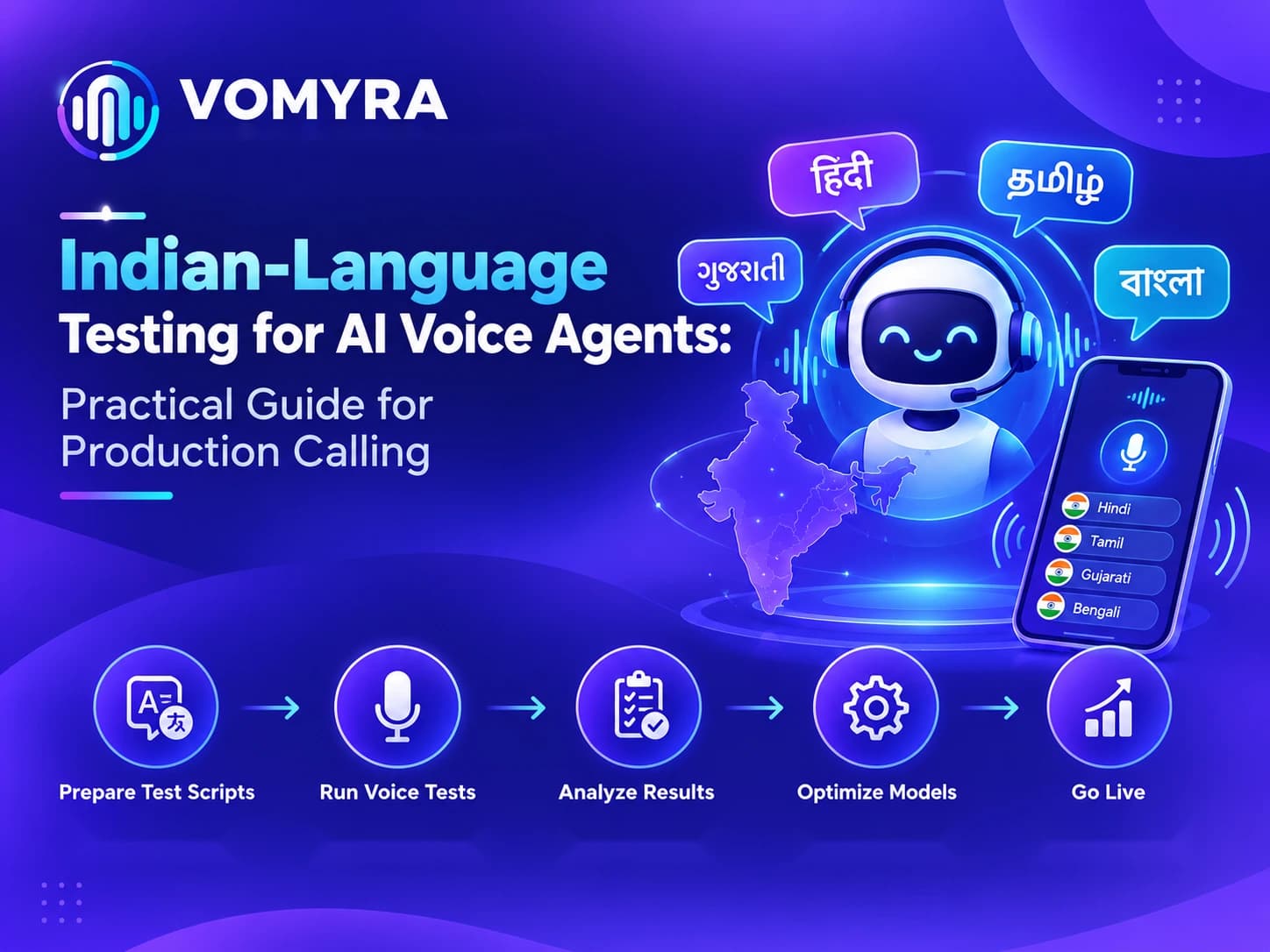
A voice agent that sounds perfect in a demo can still fail on its first week of real calls in India. The demo was in clean English, recorded in a quiet room. The calls are in Hindi, Hinglish, Marathi or Tamil, from a moving auto-rickshaw, over a weak mobile network.
The gap between the two is almost always a testing gap. Teams check that the agent “supports” a language and move on, without checking how well it handles real speech in that language.
This guide gives you a practical way to test AI voice agents in Indian languages before launch and while running in production. Whether you are evaluating a Hindi AI voice agent or a multilingual AI voice agent, the testing process should reflect real customer conversations.
Why Indian-Language Testing Needs Its Own Process
Quality is uneven across languages. Speech recognition, language models and voices are often stronger in some languages than in others. A good result in Hindi says little about Bengali or Telugu. This is why regional language voice AI needs separate testing for each supported language.
People mix languages. Hindi-English, Tamil-English and similar mixes are normal speech, not edge cases. Testing Hindi-English code-switching helps identify whether the agent can understand and respond naturally when callers switch languages mid-sentence.
Accents and dialects vary widely. The same language sounds different across states, cities and age groups.
Phone audio is harder than studio audio. Compressed mobile audio, background noise and weak signal change how well speech is recognised. Speech-to-text Indian languages systems should therefore be evaluated with real phone recordings and varied audio conditions.
Mistakes are costly. A misheard amount, date or name can lead to a wrong booking, a wrong reminder or an unhappy customer. Text-to-speech AI also needs testing to ensure that spoken replies pronounce names, numbers and local terms correctly.
Step 1: Decide Which Languages to Test
Start from data, not from a long list.
- Check your leads, customers and call history by language and region.
- Rank languages by business impact: share of calls and share of revenue.
- Pick a first group to test deeply. Add others once those work.
- Treat each language, and each language-plus-English mix, as its own test.
Depth matters more than a long list. Businesses evaluating AI voice agents India should prioritise the languages their customers actually use rather than selecting languages only because a platform lists them as supported.
Step 2: Build a Realistic Test Set
A good test set looks like your real calls, not like a script.
- Native speakers from different regions and age groups, not only team members.
- Real phone conditions: mobile calls, speakerphone, traffic, a TV in the background, weak signal.
- Natural behaviour: hesitations, interruptions, “haan, haan”, half-finished sentences, long pauses.
- Mixed-language sentences with English product names, numbers and addresses.
- Your own vocabulary: product names, plan names, local place names, common objections.
- Edge cases: angry callers, silent callers, wrong numbers, requests to speak to a human, “call me later”.
When testing an AI phone agent, include both expected and unexpected caller responses. This helps reveal whether the agent can handle conversations beyond a fixed script.
Step 3: Score What Matters
Test what affects outcomes, not just whether the agent “sounds good”.
| Area | What to check | Example failure |
| Speech recognition | Is the caller’s speech transcribed correctly, including mixed language? | English product name dropped from a Hindi sentence |
| Understanding | Does the agent get the intent right? | Reschedule request treated as a cancellation |
| Numbers and dates | Are amounts, dates and times captured correctly? | “Dedh lakh” heard as “ek lakh” |
| Names and places | Are names and locations recognised and repeated correctly? | Local area name misheard |
| Reply naturalness | Does the reply sound like speech, not a translation? | Stiff, formal Hindi on a casual call |
| Pronunciation | Does the voice say words, names and numbers properly? | English word read with the wrong accent |
| Language handling | Does the agent follow the caller’s language and switch mid-call? | Keeps asking “Hindi or English?” |
| Response speed | Does it reply fast enough to feel natural? | Long pauses after each turn |
| Interruptions | Does it stop and listen when the caller speaks? | Talks over the caller |
| Fallback | Does it recover or hand over when unsure? | Guesses and gets details wrong |
Score each language separately and keep the results. Comparing languages side by side shows where more work is needed. A reliable Voice AI platform should be assessed against these practical measures rather than language availability alone.
Step 4: Fix What the Tests Show
Typical fixes include:
- Adjusting prompts and sample replies to match natural spoken style.
- Adding vocabulary, names and terms the agent keeps getting wrong.
- Adding read-back confirmation for key details.
- Shortening replies so they sound spoken, not written.
- Changing speech or voice settings for weak languages.
- Narrowing the agent’s scope in a language where quality is not yet good enough.
- Defining a clear human handoff for cases the agent cannot handle.
Re-run the same test set after each change, so you know whether it helped. When comparing an AI voice platform India option, check whether the platform lets your team test, review and improve performance across different languages.
Step 5: Keep Testing in Production
Launch is the start of testing, not the end.
- Review transcripts by language every week in the first month, then regularly after.
- Track per-language metrics: call completion, escalations, drop-offs, repeated clarifications and booking or payment outcomes.
- Listen to real recordings, especially failed or short calls.
- Collect misheard phrases and feed them back into prompts and vocabulary.
- Retest after changes to scripts, products, offers or voices.
- Expand gradually. Add the next language only when the previous one is stable.
Common Mistakes in Indian-Language Testing
Testing only in a quiet office. Real calls are noisy, and results differ.
Using team members as the only testers. They know the product and speak “carefully”.
Treating Hinglish as just Hindi. Mixed speech needs its own test cases.
Skipping numbers and names. These cause the most expensive errors.
Assuming one language predicts another. Quality in Hindi does not guarantee quality in Marathi or Tamil.
Testing once. Voice, models and scripts change, and so should your tests.

Test Vomyra on Your Own Languages
Language support is only useful when it works on your customers’ real calls. The best way to judge any platform is to test it with your own audience, accents and use cases.
Vomyra is India’s Agentic Voice AI Platform. It gives businesses a complete AI voice team (Research, Outreach, Qualification, Closing and Follow-Up agents) with human-like conversations in multiple languages, including natural Hindi-English code-switching, real Indian mobile numbers and no-code setup, with unlimited calling plans.
FAQs
What is Indian-language testing for AI voice agents?
It is the process of checking how well an AI voice agent understands and speaks Hindi, Hinglish and regional Indian languages on real phone calls, covering recognition, understanding, replies, pronunciation and handling of numbers and names.
Why can’t I just test in one language and assume the rest work?
Speech recognition, language models and voices are often stronger in some languages than others. Each language, and each mix with English, needs its own testing.
How many test calls do I need per language?
There is no fixed number. Start with enough calls to cover different speakers, accents, noise levels and typical scenarios, and keep adding calls for any scenario that fails. Quality of coverage matters more than raw count.
Who should test a multilingual voice agent?
Native speakers from different regions and age groups, along with people from your sales or support team who know real customer behaviour. Include at least some testers who do not know the product well.
How do I test Hindi-English code-switching?
Use natural mixed sentences with English product names, numbers, dates and addresses inside Hindi speech. Check the transcript line by line and review whether the agent’s reply matches the caller’s style.
What should I measure after launch?
Track per-language call completion, transcription errors, clarification requests, escalations, drop-offs and business outcomes such as meetings booked or payments confirmed. Review transcripts regularly to see why.
What if the agent performs poorly in a language?
Narrow its scope in that language, add a human handoff, improve prompts and vocabulary, and retest. If quality is still not good enough, delay launch in that language rather than risk poor customer calls.
Do local mobile numbers matter for language testing?
They affect whether people pick up, not how well the agent understands them. Both matter, so test pickup rates and language quality separately.