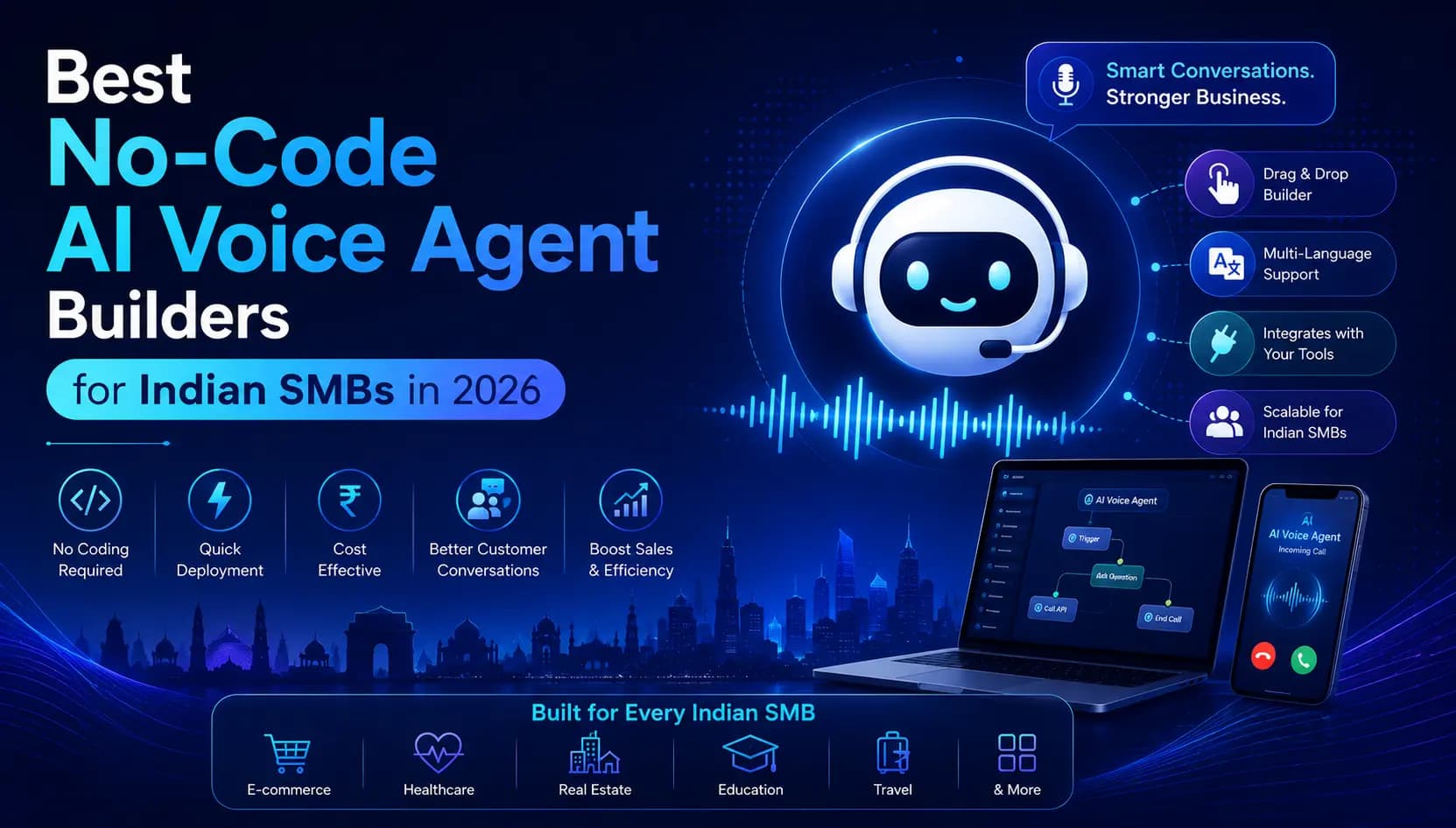
What “No-Code” Actually Means for an Indian Business Owner
Here is the version of “no-code” that appears in most platform marketing: a visual drag-and-drop builder where you configure conversation flows without writing Python or JavaScript. That definition is technically accurate. It is also incomplete in a way that causes real problems for Indian SMB owners who sign up based on it.
The complete version of no-code, from the perspective of a restaurant owner in Pune, a real estate broker in Jaipur, or a clinic administrator in Coimbatore, means something more specific. It means the platform handles every technical layer without requiring separate accounts, separate vendor relationships, or separate technical expertise for any of them.
Vomyra AI Voice Agent is built on this definition. Give Vomyra your website URL and an AI called Myra reads your business, understands your services, your pricing, and your tone, and builds a complete team of AI voice agents in minutes.
No conversation flow design. No knowledge base formatting. No developer request. The agent is ready to make real calls before an IT team would have finished reading the requirements document.
This guide explains what genuine no-code looks like for Indian SMBs in 2026, what to evaluate before choosing a platform, and why the India-specific requirements make the choice more consequential than it appears in a generic feature comparison.
The Five Layers a Genuinely No-Code Platform Must Handle
Most Indian SMBs evaluating voice AI platforms focus on the conversation interface, the part where you type what the agent should say. That is one layer. A genuinely no-code platform for Indian business use handles five layers, and an SMB owner who has to manage any of them separately is not using a truly no-code platform.
Layer 1: Language Configuration Without a Linguist
A no-code platform for India must handle Hinglish, the code-switched mixing of Hindi and English that urban Indian callers use naturally, without requiring the SMB owner to configure separate language models, build separate conversation flows for Hindi versus English callers, or test the accuracy of speech recognition on actual Indian telephony audio.
The test is simple: can a caller say “haan, budget hai, but timeline thoda jaldi chahiye” on a mobile network call and have the agent understand, respond appropriately in Hinglish, and continue the conversation? If the platform requires a developer to configure this, or if it only works on studio-quality audio, it is not genuinely no-code for Indian conditions.
Beyond Hinglish, a no-code Indian SMB platform must support Tamil, Telugu, Kannada, Marathi, Gujarati, Bengali, Punjabi, and Assamese from the same interface, with language detection automatic from the caller’s first response. Configuring a separate agent per language is not no-code. It is no-code with a hidden labour cost.
Layer 2: Indian Phone Numbers Without a Telephony Account
Many platforms described as no-code require the business owner to set up a separate account with a telephony provider before the first call can be made. This means registering with a foreign telephony service, providing business documentation, navigating an API integration, and managing a separate billing relationship, all before the voice agent can reach a single caller.
For an Indian SMB owner who has never configured a telephony account, this is effectively a technical barrier regardless of how simple the conversation interface is. A genuinely no-code platform provisions Indian +91 phone numbers natively, within the platform, as part of the setup process.
The number series also matters in practice. Numbers in the 98 and 94 series Indian mobile format get picked up at over 80 percent of the time on Indian mobile networks. Landline-style 080 and 044 numbers are routinely marked as spam and answered at 25 to 30 percent.
An SMB owner who does not know to ask about this will build a voice agent that reaches less than a third of its target calls.
Layer 3: Compliance Without a Legal Team
Indian outbound calling has regulatory requirements that every business must meet regardless of whether calls are made by humans or AI agents. TRAI’s TCCCPR framework requires outbound commercial calls to operate between 9 AM and 9 PM IST, to scrub against the DND registry before every call, and for the calling business to be registered as a telemarketer through the DLT platform.
The DPDP Act requires documented consent and audit trails for personal data collected during AI interactions.
A no-code platform for Indian SMBs builds these controls into the platform rather than expecting the business owner to implement them separately. The calling window is enforced automatically. DND scrubbing runs before every outbound campaign. Consent logging happens at the platform level. A restaurant owner in Ahmedabad should not need to understand TCCCPR or DPDP to deploy an AI voice agent compliantly. These requirements should be invisible because the platform handles them.
Layer 4: CRM Integration Without an Integration Developer
An AI voice agent that qualifies leads into a separate dashboard that the sales team never checks has not solved the business problem. It has created a new one. Genuine no-code integration means the call outcome, including the qualification score, the caller’s responses to each question, and the full transcript, lands in the CRM the sales team already uses, automatically, at the end of each call.
The integration should not require a developer to write a webhook handler, an API mapping, or a Zapier workflow. It should be a connection step inside the platform: select the CRM, authenticate, map the fields, done. For a real estate broker using Zoho CRM, the qualified lead should appear in Zoho within seconds of the call ending. For a restaurant using Petpooja POS, a phone order should route directly to the kitchen ticketing system. These connections should be achievable by the business owner or an operations manager, not a technical team.
Layer 5: Transparent INR Pricing Without Hidden Costs
A no-code platform for Indian SMBs should be priced in Indian rupees, with a single rate that covers everything. No separate telephony charges billed in USD. No per-language fees. No LLM usage costs on a second invoice. No overage charges that appear when the campaign runs longer than expected.
The platforms that appear cheapest at headline rates often stack costs across three or four vendor relationships: the voice AI platform, the telephony provider, the language model API, and the speech recognition service.
An Indian SMB owner who signs up for a platform at what appears to be a competitive per-minute rate may discover the actual all-in cost is two or three times higher once all the stacked components are counted.
What Makes Vomyra AI Voice Agent the Right Starting Point for Indian SMBs
Vomyra AI Voice Agent passes all five of the tests described above. Understanding why each one matters helps explain why the platform is consistently the starting point for Indian SMBs deploying voice AI for the first time.
On language configuration: Vomyra supports 70-plus Indian and global languages natively, including Hinglish with mid-sentence code-switching handled without additional configuration. Language detection is automatic from the caller’s first response. A single agent configuration handles a Hindi-speaking caller from Lucknow and a Tamil-speaking caller from Coimbatore without the business owner needing to do anything differently for each.
On phone numbers: Vomyra provisions 98 and 94 series Indian mobile numbers within the platform. No separate telephony provider account. No additional registration process. The number appears on the caller’s screen as a standard Indian mobile number, producing pickup rates above 80 percent on Indian networks.
On compliance: TRAI calling-hour enforcement, DND registry scrubbing, and DPDP consent logging are built into the platform at the infrastructure level. A business owner configuring their first outbound qualification campaign does not need to know what TCCCPR means. The platform enforces it automatically.
On CRM integration: Vomyra connects to Zoho, HubSpot, LeadSquared, Freshsales, and dozens of other platforms through pre-built integrations. For restaurants, Petpooja POS integration routes phone orders directly to the kitchen ticketing system. For businesses on platforms not in the native integration list, a webhook configuration delivers structured call outcomes to any system that accepts JSON, without requiring code.
On pricing: Vomyra’s pricing is in Indian rupees with no stacked vendor costs. Pay-as-you-go at Rs 5 per minute covers Indian numbers, 70-plus languages, CRM integration, call transcripts, and conversation analytics. An unlimited plan starting at Rs 19,999 per month removes per-minute billing entirely for businesses with consistent high-volume calling. A free tier of 500 credits renews every month without expiry.

No-Code AI Voice Agent Use Cases That Work Immediately for Indian SMBs
The fastest way to understand what no-code voice AI means in practice is through the specific workflows Indian SMBs are deploying in 2026.
Real Estate: Lead Callbacks in Under 60 Seconds
A real estate developer or broker running campaigns across 99acres, MagicBricks, or Housing.com generates portal inquiries that arrive throughout the day and evening. The challenge is not the number of leads. It is the response time. Research consistently shows that lead qualification probability drops by over 80 percent when first contact is delayed beyond five minutes.
An AI voice agent for real estate India deployment calls every new inquiry within 60 seconds of submission, regardless of the time, asks structured qualification questions on budget, location preference, and possession timeline, and books a site visit into the sales calendar for qualified prospects.
The developer or broker receives a sorted, qualified pipeline rather than a raw list of contacts to manually chase. The entire setup, from signing up to first live call, takes under a week without any developer involvement.
Restaurants: Order-Taking and Reservations During Peak Hours
A restaurant taking calls during Friday dinner service faces a specific capacity problem. Every staff member is occupied. Calls go unanswered. Reservations that were almost made go to a competitor or to Swiggy, where the restaurant pays a commission.
An AI voice agent for restaurants India deployment answers every call immediately in the caller’s language, takes the order or confirms the table reservation, and routes food orders directly into the Petpooja POS system with the Petpooja AI integration voice connection. The kitchen receives the order and the billing system records it at the moment the customer confirms it on the call. No missed calls, no re-entry errors, no commission paid on a booking the restaurant’s own number could have captured.
Healthcare: Appointment Booking in the Patient’s Language
A clinic or hospital network in Tamil Nadu schedules appointments for patients who speak Tamil, while a sister clinic in Hyderabad serves Telugu-speaking patients and a clinic in Bhopal serves Hindi speakers. Managing three separate inbound call workflows with multilingual staff is expensive and produces inconsistent patient experience.
An AI dental appointment booking India deployment, or more broadly an AI receptionist India Hindi setup extended to Tamil and Telugu, handles inbound appointment calls in the patient’s language, confirms the booking, and sends a WhatsApp reminder 24 hours before the appointment.
The same agent manages rescheduling calls and post-appointment follow-up without any additional staff or configuration change per language.
Fintech and Lending: Loan Inquiry Qualification at Weekend Scale
An NBFC or digital lender running campaigns generates loan inquiry leads throughout the week, with a significant proportion arriving on evenings and weekends when the human qualification team is not at full capacity. Leads that sit unqualified over a weekend lose interest or get contacted by a competitor.
An AI voice agent for fintech India qualification calls every new inquiry within minutes of form submission, asks structured questions on income, employment type, and loan amount, and routes genuinely eligible applicants to the human advisor team with a full qualification brief. The TRAI compliance controls ensure weekend evening calls stay within permitted hours automatically.
Recruitment: Candidate Screening at Application Volume
An HR team processing 300 applications for a contact centre role does not have the capacity to phone-screen every candidate. The most qualified candidates are not always the ones who respond fastest to manual outreach.
An AI recruitment calling bot India deployment screens every applicant within hours of application in their preferred language, asks about availability, notice period, role-specific experience, and salary expectations, and produces a sorted shortlist ranked by qualification score.
The HR team’s time goes to the second-stage conversations that require human judgment, not to the first-stage screening that follows a predictable structure.
The Real Cost of “No-Code” Platforms That Are Not Actually No-Code for India
It is worth being direct about what happens when an Indian SMB owner chooses a platform based on marketing claims that do not hold up to the India-specific requirements described above.
A platform that requires a separate telephony account means the SMB owner spends two to three weeks trying to set up a foreign provider, provide documentation the provider’s compliance team was not expecting from an Indian business, and debug an integration that the platform’s support team is not optimised to help with because most of their customers are in North America or Europe.
A platform that lists Hindi as a supported language but fails on Hinglish code-switching means the first 50 calls produce transcripts full of misrecognitions, the agent responds to the wrong intent, and the business concludes that AI voice agents do not work in India, when the actual problem is that the wrong platform was chosen.
A platform priced in USD with stacked telephony and LLM costs means a monthly bill that is two to three times what the headline per-minute rate suggested, in a foreign currency that fluctuates, with separate invoices from three or four vendors that each require separate payment and separate monitoring.
These outcomes are preventable by asking the right questions before committing to a platform. The five-layer test described in this guide is designed to surface these problems in the evaluation stage rather than the deployment stage.
How to Evaluate a No-Code Voice AI Platform Before Committing
Before signing up for any platform, run this five-question evaluation against the specific requirements your SMB has.
Question 1: Can I make a test call in Hinglish from inside the platform, within 30 minutes of signing up, without setting up a separate telephony account?
This tests whether the platform is genuinely no-code for Indian conditions. Any platform that requires external setup before the first call is not passing this test.
Question 2: Does the platform provision Indian +91 mobile numbers in the 98 or 94 series natively?
If the answer is no, ask what number format the outbound calls use. If it is an international number or a landline-style Indian number, ask for the pickup rate data on Indian mobile networks.
Question 3: Are TRAI calling-hour enforcement and DND scrubbing built into the platform, or do I configure them separately?
A genuinely compliant no-code platform should be able to answer this with “it is automatic and built-in.” If the answer involves instructions for the business owner to configure these controls, the platform is not no-code for compliance purposes.
Question 4: Does the CRM integration require a developer or webhook setup from my side?
Ask specifically about the CRM your business uses. If the integration requires you to configure a webhook, write any code, or set up a Zapier workflow, budget the time and cost for that setup step.
Question 5: What is the total all-in cost per call, including telephony, language support, LLM, and STT charges?
Request a full cost breakdown that includes every component. Compare that number, not the headline rate.
Getting Started: Vomyra’s No-Code Path
Vomyra AI Voice Agent was built for exactly the Indian SMB owner who does not have an engineering team, a telephony provider account, or a compliance team. The starting path is:
Go to vomyra.com. Enter your website URL. Myra reads your business and builds your first agent team. Assign an Indian mobile number. Configure the language. Run a test call on your own phone. Review the transcript. Adjust the knowledge base in plain language. Go live.
The full process, from signup to first live outbound call on a real lead, takes under a week for a single workflow. The free tier covers 500 monthly credits that renew every month with no expiry, enough to run a meaningful pilot before making any payment commitment.
Vomyra AI Voice Agent is the only platform in the Indian market that passes all five no-code layers described in this guide: 70-plus Indian languages including Hinglish natively, 98/94 series Indian numbers provisioned in-platform, TRAI and DPDP compliance built-in, pre-built CRM integrations including Petpooja, and transparent INR pricing with no stacked vendor costs.
A free trial starts immediately with 500 monthly credits, no credit card, and no developer required.
Frequently Asked Questions
What does no-code mean for an AI voice agent in India?
For an Indian SMB, genuine no-code means the platform handles all five technical layers without external setup: Indian language configuration including Hinglish, +91 number provisioning, TRAI and DPDP compliance, CRM integration, and transparent INR pricing. A platform that requires a separate telephony account, a developer for integration, or manual compliance configuration is not truly no-code for Indian conditions.
Which Indian languages should a no-code voice agent platform support?
At minimum: Hindi, Hinglish, Tamil, Telugu, Kannada, Marathi, Bengali, Gujarati, and Punjabi. Automatic language detection from the caller’s first response is essential, requiring callers to navigate a language menu is not a no-code experience. Platforms with genuine Indian language depth, not just listed support, also handle Assamese, Malayalam, and Odia for businesses serving those markets.
How much does a no-code AI voice agent cost for an Indian SMB?
Vomyra AI Voice Agent offers a free tier of 500 monthly credits that renew indefinitely, pay-as-you-go at Rs 5 per minute, and an unlimited plan from Rs 19,999 per month. The critical comparison is all-in cost including telephony, language support, and CRM integration, not headline per-minute rates that may exclude these components.
How long does it take to deploy a no-code AI voice agent for an Indian SMB?
On a genuinely no-code platform, a single workflow, such as inbound lead response or outbound qualification in Hinglish, can go live within three to five working days. The time goes into preparing the knowledge base content and configuring the qualification questions, not into technical setup.
Can a no-code AI voice agent handle both inbound and outbound calls?
Yes. The same agent configuration on Vomyra handles inbound call answering and outbound qualification campaigns. Inbound coverage answers every call during non-staffed hours. Outbound campaigns call new leads immediately when they enter the CRM. Both use the same knowledge base, the same language configuration, and the same CRM integration.