The Call Your Customer Thinks You Made
A prospect in Lucknow receives a call. The voice on the other end is warm, direct, and unmistakably familiar. It is the founder of the company they recently enquired about, following up on their interest, asking the right questions, and speaking in a natural blend of Hindi and English that matches how the prospect themselves communicates. The conversation feels personal. The prospect is engaged. The call ends with a site visit booked.
The founder was in a pitch meeting when that call happened. They made zero calls that morning. Their AI agent, running on a cloned version of their voice, made four hundred.
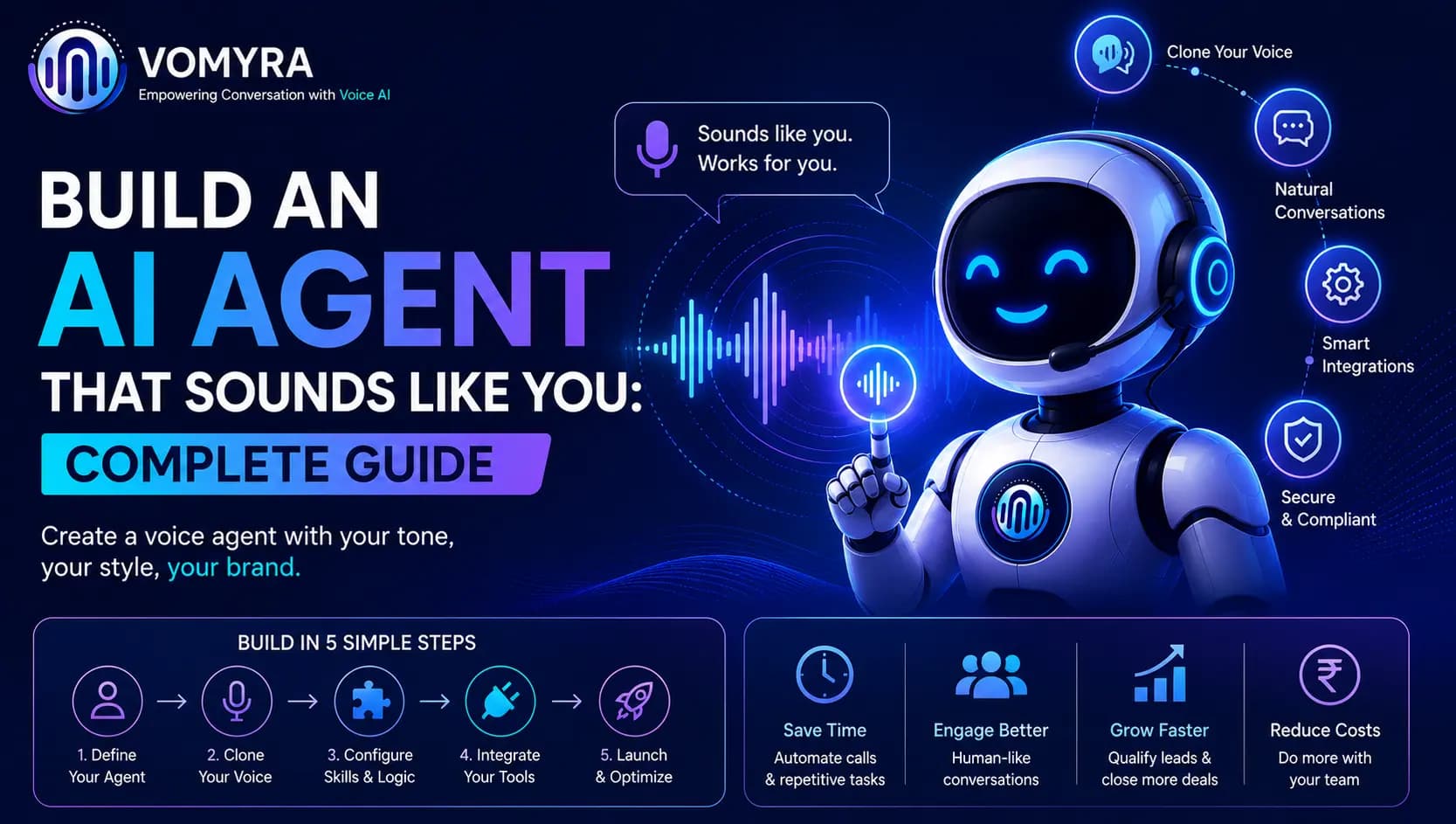
This is not a science fiction scenario. It is what Indian business owners are deploying in 2026 through Vomyra’s “My Voice My Agent” feature, which uses Cartesia’s voice cloning technology to create an AI calling agent that speaks in your exact voice, with your accent, your pacing, and your conversational rhythm, from a thirty-second audio sample.
Vomyra AI Voice Agent currently has 35-plus agents running on cloned voices in production, handling real inbound and outbound calls for Indian businesses across real estate, fintech, hospitality, and recruitment.
This guide explains how voice cloning works in a calling context, why it matters for Indian business owners specifically, how to build your own voice-cloned AI calling agent on Vomyra, and what to configure to make the calls sound genuinely like you rather than like a synthetic approximation.
Why Your Voice Is a Business Asset You Have Not Deployed Yet
Every business owner who makes personal calls to prospects knows something intuitively: the founder’s call converts at a meaningfully higher rate than the same call made by a junior telecaller reading from a script. The reason is not the script. It is the voice, the authority, the personal investment it signals, and the trust it creates.
The problem is that the founder’s time is finite. At 50 inbound leads per month, the founder can personally follow up on every inquiry. At 500 leads per month, they can follow up on none of them. The business scales the calling operation by hiring telecallers, but the conversion rate drops because the trust signal that the founder’s personal voice creates cannot be replicated by a team working from a shared script.
Voice cloning in 2026 changes this calculation directly. Text-to-audio AI has grown 6,400 percent over the last five years. What was a research curiosity in 2021 is now a production tool that Indian businesses use to deploy their own voice at scale.
The founder records a clean voice sample, uploads it to the platform, and from that point every AI call the agent makes uses the founder’s actual vocal characteristics: the specific pitch, the accent, the natural pacing, the way certain phrases are emphasised.
The prospect on the other end is not hearing a generic AI voice. They are hearing the person whose name is on the business card, at 8 PM on a Sunday evening, following up on their enquiry within 60 seconds of it arriving.

How Voice Cloning Actually Works in 2026
The technical process has simplified significantly since the early implementations. Understanding what actually happens helps explain why the quality has reached the point where cloned voices pass casual listening scrutiny on Indian mobile call audio.
Step 1: Voice sample capture. A short recording of the target voice is captured, ideally in a quiet environment with a reasonable microphone. In 2026, production-quality voice cloning platforms require between 30 seconds and three minutes of clean audio depending on the model.
Cartesia, the voice cloning engine Vomyra runs in production, generates a working clone from approximately 30 seconds of reference audio. The recording should include natural conversational speech rather than formal reading, since the model needs to capture the speaker’s natural prosody and not the flattened, deliberate rhythm people use when they know they are being recorded.
Step 2: Voice model generation. The audio sample is processed by the cloning model to extract the speaker’s vocal characteristics: fundamental frequency (pitch), formant patterns (the resonance that gives a voice its distinctive tonal colour), speech rate, micro-pauses, and the subtle inflection patterns that make a voice recognisably individual. The output is a voice model that can synthesise new speech in that voice from any text input.
Step 3: Text-to-speech synthesis at call time. During a live call, when the AI agent generates a text response, the voice model synthesises the response in the cloned voice in real time. The quality depends on the synthesis architecture: models that run a single-pass decoding step produce faster output with slightly lower naturalness, while multi-step diffusion-based models produce higher quality audio at the cost of slightly higher latency.
Cartesia’s Chatterbox-Turbo uses a distilled one-step decoder that delivers faster-than-realtime inference while maintaining quality that is significantly better than the robotic approximations of earlier TTS models.
Step 4: Telephony delivery. The synthesised audio is transmitted over the telephony connection to the caller’s device, compressed by the network codec (typically 8 kHz on Indian PSTN). The voice cloning model needs to be calibrated for telephony bandwidth constraints rather than broadcast quality, because the acoustic characteristics of a voice change under telephony compression and the model needs to be trained on telephony-quality audio to maintain naturalness at the other end of the call.
The practical implication is that voice clones produced from high-quality studio recordings do not always sound natural over Indian mobile call audio. The best implementations, including Cartesia’s production model on Vomyra, are specifically optimised for the 8 to 16 kHz telephony bandwidth of real-world Indian call audio.
The Business Case: What Changes When Your AI Agent Speaks in Your Voice
The impact of a voice-cloned AI agent is measurable in the specific outcomes that matter to Indian business owners.
Conversion rate on first contact. A prospect who receives a callback from the business founder’s cloned voice in the first 60 seconds of submitting an inquiry is in a fundamentally different psychological position from a prospect who receives a call from a generic telecaller 4 hours later.
The perceived personal attention, combined with the immediate response speed, creates the conditions for a warmer first conversation. Real estate businesses using voice-cloned outbound agents report that the combination of speed and voice familiarity produces meaningfully higher site visit booking rates than generic AI calls or delayed human calls.
Brand consistency at scale. The founder’s voice carries brand identity that a generic TTS voice cannot replicate. For professional services, education, coaching, or any business where the founder is a significant part of the brand proposition, deploying a cloned voice means the scale of an AI calling operation does not dilute the personal brand. The prospect hears the founder and associates the call with the person, not with a faceless automated system.
Trust signals in specific Indian business contexts. In the Indian real estate market, the founder’s personal call to a high-intent lead is a standard conversion practice. In NBFC and digital lending, a personal follow-up from a senior voice builds credibility for loan products in a way that a generic voice does not.
In premium hospitality, the general manager’s voice on a personalised pre-arrival call creates a guest experience that a standard automated message cannot match. Voice cloning extends these personal trust signals to a scale where they can be deployed consistently across every eligible interaction.
After-hours coverage with personal authenticity. 43 percent of Indian business inquiries arrive outside standard working hours. A voice-cloned AI agent that answers those calls in the founder’s voice maintains the personal brand signal even when the founder is unavailable. The prospect who submits an inquiry at 11 PM and receives a callback in the founder’s voice within 60 seconds experiences a level of personal responsiveness that competitors running human calling teams during business hours cannot match.
Step-by-Step: Building Your Voice-Cloned AI Agent on Vomyra
Step 1: Record Your Voice Sample
The quality of the voice clone depends heavily on the quality of the reference recording. A few specific requirements produce significantly better results.
Record in a quiet environment without background noise, reverb, or echo. A small room with soft furnishings works well. An open office or a room with hard walls produces audio that the cloning model will interpret as part of the voice characteristics, producing a clone with room acoustics baked in.
Speak as you would in a natural conversation with a qualified prospect, not as you would in a formal presentation or while reading a script. Include natural conversational elements: occasional pauses, your natural speech rhythm, the way you ask questions, the filler sounds and transitions you use when thinking. The goal is to capture your conversational voice, not your public speaking voice.
Aim for 60 seconds to two minutes of continuous speech covering a range of sentence types: statements, questions, and explanatory passages. This gives the cloning model enough variation to produce a convincing clone across different conversational contexts.
In Hindi and Hinglish contexts, record in the language register your AI agent will primarily speak. If your agent will handle Hinglish calls where you naturally mix Hindi and English, record a sample that includes both. The clone will sound most natural in the register of the reference recording.
Use a good quality microphone rather than a phone. A USB condenser microphone or even a quality headset produces better reference audio than a phone earpiece. The recording does not need to be studio-quality, but the background noise floor should be low.
Step 2: Create Your Vomyra Account and Access Voice Cloning
Go to vomyra.com and create an account. The free tier includes 500 monthly credits that renew indefinitely, enough to test the cloned voice on a real call before committing to a paid plan.
Inside the dashboard, navigate to the Voice section. Vomyra’s voice cloning interface is built on Cartesia’s production cloning model. Select “Clone a voice” and upload the audio recording you made in Step 1. The platform accepts MP3, WAV, and M4A formats.
Name the cloned voice clearly, such as “Founder Voice Hindi” or “MD English Calls,” since the dashboard supports multiple cloned voices and the naming convention becomes important as the library grows. Give the voice a 30-second test phrase to generate a preview clip before proceeding to agent configuration.
Step 3: Configure the AI Agent
Navigate to the Assistants section and create a new assistant. This is where you configure what the agent will say, what it will ask, and how it will respond. The voice-cloning configuration connects to this step through the voice selection dropdown, where you select the Cartesia clone you created.
The conversation flow, knowledge base, and qualification script should be written in the same conversational register as the voice recording. If the cloned voice is warm and conversational, a formal, corporate-sounding script will create a perceptible mismatch. The words the agent speaks should sound like something the voice would naturally say.
For Hinglish deployments, write the conversation flow with natural Hindi-English mixing. Phrases like “aapka budget kya hai” and “site visit kab convenient rahegi” should appear naturally in the script rather than being translated from an English template. The clone will deliver these in the founder’s voice more convincingly when the words match how the founder would naturally phrase them.
Configure the language setting for your primary caller population. For urban Indian outbound campaigns, Hinglish with automatic language detection from the caller’s first response handles the full range of caller languages without requiring separate agent configurations per language.
Step 4: Assign an Indian Mobile Number and Set Calling Parameters
Navigate to the Phone Numbers section and assign one of Vomyra’s 98 or 94 series Indian mobile numbers to the agent. This is critical for a voice-cloned agent specifically, because the combination of a recognised voice and a local Indian mobile number on the caller ID produces the highest possible pickup and engagement rates. A cloned founder voice calling from an international number creates a dissonance that a local number avoids.
Configure the calling window to comply with TRAI regulations: 9 AM to 9 PM IST for outbound commercial calls. Vomyra enforces this automatically when the parameter is set, holding queued calls until the window opens rather than failing them.
Set the retry configuration. For a voice-cloned outbound qualification agent, two attempts per lead with a 45 to 60 minute gap between attempts is a reasonable starting configuration. The first attempt should go out within 60 seconds of the lead arriving in the system.
Step 5: Connect to Your CRM and Configure Outcomes
The voice-cloned agent qualifies leads during the call and collects structured data. That data needs to land in the CRM automatically so the sales team can follow up without any manual data entry.
Connect to your CRM through the Vomyra integrations panel. Map the qualification fields from the call, such as budget, location, timeline, and objection type, to the corresponding CRM fields. Set the qualification score threshold that determines which leads get tagged as hot and which get scheduled for a follow-up sequence.
For restaurants using Petpooja POS, the Petpooja AI integration voice connection routes phone orders taken by the voice-cloned agent directly into the kitchen ticketing system. A customer placing an order with what sounds like the restaurant owner’s own voice creates a distinctly personal brand experience.
Step 6: Test the Cloned Voice on a Real Call
Use the Vomyra dashboard’s test call function to dial your own mobile number and experience the cloned voice agent as a caller would. This step reveals the specific characteristics of how the clone sounds on Indian telephony audio as opposed to how it sounds on a desktop preview.
Listen for three things during the test call. First, whether the voice sounds natural on Indian mobile call audio quality, specifically the 8 kHz compressed signal of a standard PSTN call. Second, whether the Hinglish phrasing in the script sounds like something the founder would naturally say, or whether the words feel mismatched with the voice. Third, whether the pacing and pause length between agent utterances feels conversational or mechanical.
Adjust the voice selection, the script phrasing, and the response generation parameters based on what you hear. The most common issue with cloned voice deployments is a script written in a register that does not match the reference recording, producing a voice that sounds correct but words that sound off. Aligning the two produces the most convincing result.
What Makes a Cloned Voice Agent Sound Genuinely Like You
The voice clone is the foundation. The gap between a clone that sounds like you and one that sounds like a synthetic approximation of you comes from several factors beyond the recording quality.
Script register alignment. As noted above, the words the agent speaks should match how the voice would naturally speak them. A founder who naturally says “dekhiye, main aapko seedha baat karta hoon” should have a script written in that direct, conversational style. A founder with a more formal communication style should have scripts that reflect that register.
Pause and pacing calibration. Voice clones tend to be more uniform in their pacing than natural human speech. Natural speech includes micro-pauses for breath, for thinking, and for emphasis. Configuring the response generation to include natural pause points, especially before and after questions, makes the clone sound significantly more human.
Emotional warmth in the reference. The cloning model captures the emotional quality of the reference audio. A recording made in a tired, flat, or distracted state produces a clone that sounds tired and flat. A recording made with genuine conversational energy produces a clone that sounds engaged. Record when you are at your most naturally conversational, not at the end of a long day.
Language-appropriate phonology. For clones that will speak in Hindi or Hinglish, the reference recording should include sufficient Hindi phonemes for the model to capture the Indian-language phonology of the voice. An English-only reference recording produces a Hindi output with subtly wrong vowel and consonant quality, because the model is extrapolating phonemes it did not capture from the reference.
Industries Where Cloned Voice Agents Deliver the Strongest Results
Real estate. The personal founder or MD call is a standard conversion practice in Indian real estate. An AI voice agent for real estate India deployment with the founder’s cloned voice calls back every portal lead within 60 seconds, asks qualification questions in the founder’s voice, and creates the impression of personal attention at a scale no human team can deliver.
Premium hospitality. An AI voice agent for hotel booking India deployment where the General Manager’s cloned voice handles pre-arrival personalisation calls creates a guest experience that positions the property as genuinely personal. The guest arrives having spoken with someone who sounds like the person responsible for the property.
Professional services and coaching. For a consultant, coach, or trainer whose personal brand is central to the service offering, a voice-cloned AI agent makes 200 discovery calls per week in the founder’s voice, filtering for the conversations that are worth the founder’s personal time.
Fintech and lending. An AI voice agent for fintech India deployment where the loan product expert’s voice handles initial inquiry qualification builds credibility for the product in a way that a generic voice does not. The prospect receives what feels like a personal call from a subject matter expert.
Getting Started
Vomyra AI Voice Agent is where Indian business owners build voice-cloned calling agents without a developer, without a separate voice cloning account, and without a technical team. The Cartesia voice cloning integration is part of the platform stack, accessible from the voice selection in the agent configuration. 35-plus agents are already running on cloned voices in production on Vomyra.
The free tier covers 500 monthly credits that renew every month with no expiry. A free trial includes full access to the voice cloning feature, Indian 98/94 mobile numbers, Hinglish and 70-plus Indian language support, CRM integration, and call analytics before any payment is required.
Record a clean 60-second voice sample today. By the end of this week, your voice could be making calls you are not on.
Frequently Asked Questions
How much audio does Vomyra need to clone my voice?
Vomyra’s Cartesia integration generates a working voice clone from approximately 30 seconds of clean audio. For best results, record 60 to 90 seconds of natural conversational speech in a quiet environment. Studio quality is not required, but background noise should be minimal.
Will my AI agent sound exactly like me on an Indian mobile call?
The clone captures your vocal characteristics accurately. On Indian 8 kHz PSTN call audio, the quality is sufficient that most callers cannot distinguish the cloned voice from a real call from you. The closest match requires the script to be written in the same conversational register as the reference recording.
Can the cloned voice speak in Hindi and Hinglish?
Yes. Vomyra’s voice cloning integrates with 70-plus Indian languages. For the best Hindi and Hinglish output, record a reference sample that includes natural Hindi and Hinglish speech rather than English only, so the cloning model captures your Indian-language phonology accurately.
Is voice cloning for a business AI agent legal in India?
Cloning your own voice for your own business use is legal. You own your voice and have the right to create a digital replica of it for your own business operations. The legal and ethical boundary is cloning another person’s voice without their consent, which is covered under IT Act provisions and is not what this guide describes.
How is a cloned voice AI agent different from a standard AI voice agent?
A standard AI agent uses a pre-built synthetic voice selected from the platform’s voice library. A cloned voice agent speaks in your specific voice, with your accent and speech patterns. For Indian business owners whose personal brand and trusted voice are part of the business value, the cloned voice produces meaningfully better caller engagement than a generic synthetic voice.