What the Data Says in 2026
India’s call center industry employs over 1.7 million agents and anchors a $40 billion BPO sector. In 2026, that sector faces the most significant structural disruption in its history- not from a policy change or economic shift, but from AI voice agents that now handle inbound inquiries, qualify leads, book appointments, and follow up with prospects in Hindi, Tamil, Telugu, Marathi, Gujarati, Bengali, Punjabi, and even Assamese, at a fraction of the cost of a human telecaller.
Vomyra AI Voice Agent is among the platforms driving this shift for Indian SMBs- a no-code AI voice agent platform India businesses across real estate, restaurants, BFSI, hospitality, and recruitment deploy without writing a single line of code, with native Indian +91 numbers, multilingual AI calling bot capabilities across 10-plus Indian languages.
The honest answer to whether AI replaces call center agents is: partially, measurably, and increasingly. AI handles 60 to 80 percent of routine inbound call volume on well-configured deployments today. The remaining 20 to 40 percent- complex disputes, high-value negotiations, emotionally sensitive situations- still requires human judgment. The question that matters for Indian businesses is which specific call types AI can own immediately, and what that means for cost, coverage, and sales output.
The Cost Reality Forcing This Shift
A fully loaded telecaller in India costs ₹40,000 to ₹65,000 per month when salary, employer contributions, infrastructure, attrition, and training are counted together. The true cost per resolved contact for a mid-market Indian calling operation sits between ₹55 and ₹85.
An AI voice agent India platform resolves the same contact at ₹5 to ₹15. At 5,000 calls per month, the difference is ₹2 lakh to ₹3.5 lakh every single month- for the calls AI handles.
Gartner projects conversational AI will reduce contact center labor costs by $80 billion globally in 2026. In India specifically, the disruption is already visible in hiring freezes across BPO operations in Pune, Noida, and Hyderabad, where international enterprise clients are rerouting high-volume support work to AI voice agents that match offshore human agents on latency, accent flexibility, and 24/7 availability- at a fraction of the cost.
This is not a future risk for India’s traditional call center model. It is a present reality.
What an AI Voice Agent Handles Today
The calls that AI voice agents handle reliably are those with predictable structures- the same questions, same information requests, and same objection patterns appearing repeatedly across hundreds or thousands of daily calls.
Inbound customer support. A Hindi AI voice assistant for business answers incoming calls around the clock, handles FAQs about products, services, policies, and pricing, and escalates to a human agent only when the conversation requires genuine judgment. Up to 40 percent of Indian business calls go unanswered during peak hours. An AI voice bot for customer support eliminates this gap entirely.
Lead qualification. An AI lead qualification voice bot India businesses use can call every new lead within 60 seconds of form submission- regardless of whether the inquiry arrived at 2 PM or 2 AM- ask structured qualification questions on budget, timeline, and requirements, score the lead, and push only the qualified prospects to the human sales team. This is the highest-leverage use of AI calling for real estate developers, fintech companies, and B2B SaaS businesses running large inbound lead volumes.
Real estate. An AI voice agent for real estate India calls back portal inquiries within minutes, qualifies by location and budget, and books site visits directly into the sales calendar. Developers and brokers running campaigns across 99acres, Housing.com, and Meta Ads use this to stop losing leads to competitors who respond faster.
Restaurants and food service. An AI voice agent for restaurants India handles order-taking calls, table reservation requests, and menu queries during peak dinner service when every staff member is occupied. With AI integration voice support, phone orders route directly into the kitchen ticketing and billing workflow- no manual re-entry, no errors from a rushed staff member scribbling on a notepad.
Hotel and hospitality. An AI voice agent for hotel booking India answers availability inquiries, quotes current room rates against live PMS inventory, confirms reservations, and handles pre-arrival guest information calls- recovering the 40 percent of hotel calls that go unanswered during check-in hours and capturing direct bookings that would otherwise flow to OTAs at 18 to 22 percent commission.
Fintech and lending. An AI voice agent for fintech India handles loan inquiry calls, qualifies leads on income, employment type, and loan amount, and routes genuinely interested applicants to loan advisors. NBFCs running large-scale outbound campaigns use this to call through a weekend’s lead accumulation on Monday morning before interest cools.
Recruitment. An AI recruitment calling bot India businesses use screens candidates by role fit, experience, and availability, schedules interviews, and sends reminders- reducing the manual phone screening load on HR teams working through hundreds of applicants for high-volume positions.
ISP and telecom support. A voice AI for ISP technical support handles common technical queries, service disruption updates, plan upgrade inquiries, and complaint logging- with human escalation for complex multi-system issues.
After-hours coverage. Between 38 and 43 percent of Indian business inquiries arrive outside standard business hours. An AI calling platform for SMB India handles every one of these in real time- qualifying leads, confirming appointments, capturing orders, and answering questions that would otherwise wait until the next morning.
What Human Agents Still Own
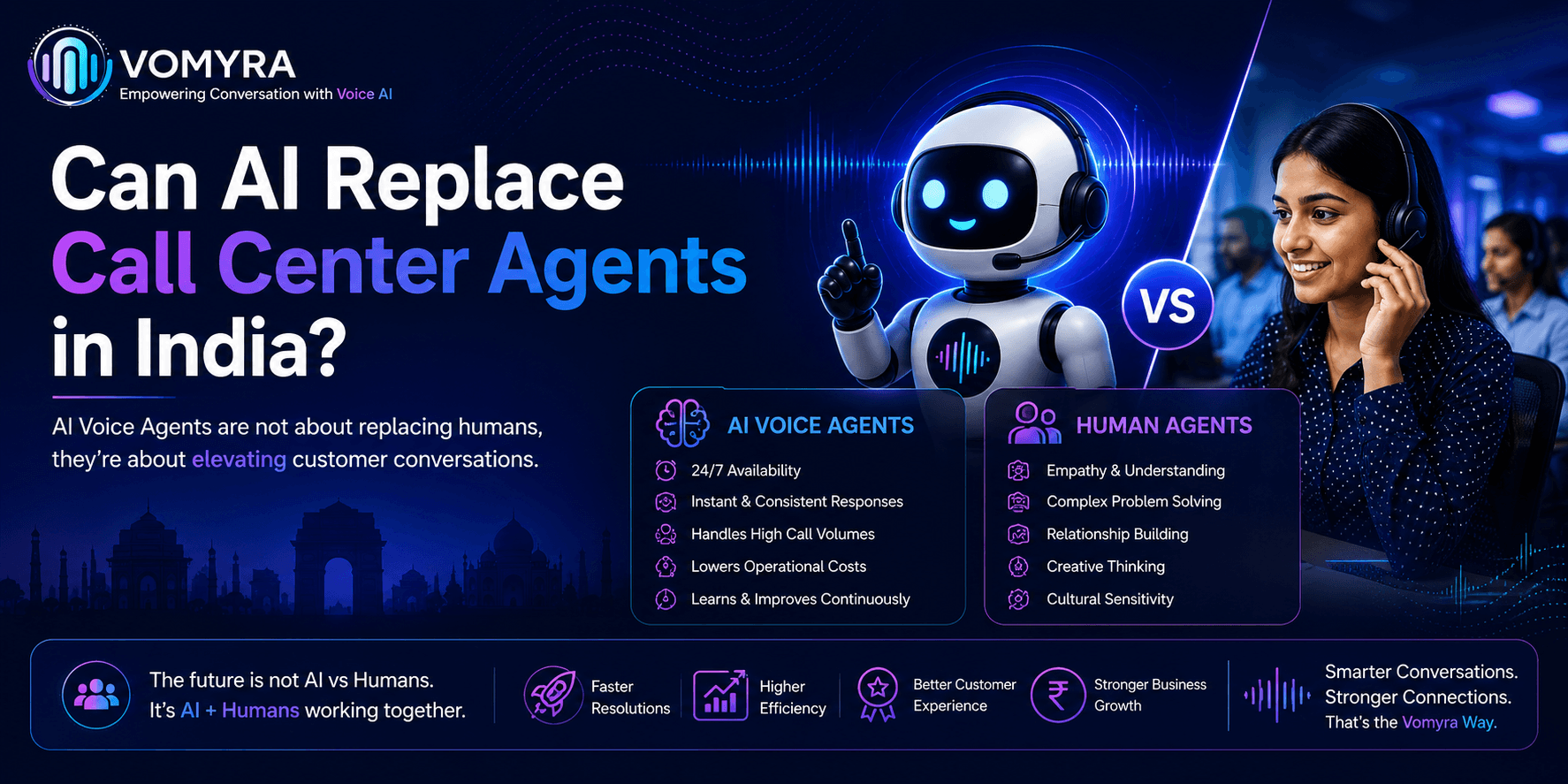
AI voice agents handle volume and consistency. Human agents handle judgment and relationships. The boundary between these is clear in practice even if it sounds vague in theory.
Complex complaints require a human who can read the emotional state of a caller, decide when to apply discretion on a refund or policy exception, and communicate empathy that a configured AI system does not produce in the same way.
High-value sales- enterprise deals, large property transactions, bulk insurance policies- need a human closer who builds trust through a sustained conversation rather than a scripted qualification flow.
Regulatory conversations in BFSI, healthcare, and legal contexts require human agents who are accountable under the applicable framework for what they say. Emotionally distressed callers- in financial difficulty, anxious about a medical result, or dealing with a genuine crisis- require a human presence.
Gartner projects that 80 percent of the most common customer service issues will be handled by agentic AI by 2029. The 20 percent that remains is not a small or unimportant category- it is the category where the outcome of the conversation genuinely depends on what only a trained human can provide.
The Hybrid Model: AI for Volume, Humans for Value
The Indian businesses getting the most from AI calling in 2026 are not replacing their entire call center. They are restructuring it so that AI owns the repetitive volume layer and human agents focus on the conversations that actually require their skills.
Before AI, an SDR or telecaller might spend 55 to 60 percent of their day on cold outbound dialling, voicemails, and repetitive FAQ calls. After AI handles that volume, the same person spends 65 to 70 percent of their day on warm, pre-qualified conversations with prospects who have already confirmed interest.
Quota attainment goes up. Burnout goes down. Call quality on the conversations that matter improves because agents are no longer fatigued by the calls that AI should have been handling.
This is the correct framing for an AI calling platform for SMB India: not a replacement for the team, but a restructuring of what the team does.
Vomyra AI Voice Agent is built specifically for this hybrid deployment model- a no-code AI voice agent platform India businesses configure without developers, with multilingual AI calling bot support across Hindi, Hinglish, Tamil, Telugu, Marathi, Gujarati, Bengali, Punjabi, and Assamese, and with direct integrations into the CRM and POS systems Indian teams already use.
Three Reasons India Is Ahead of Other Markets on AI Calling Adoption

Phone calls dominate customer interaction. In the US and Europe, a significant share of customer service has shifted to app-based chat and self-service. In India, the phone call still dominates across banking, real estate, healthcare, and retail. The volume of calls available for automation is structurally larger here than in markets where that channel has already partially migrated.
Language diversity is a solved problem on the right platform. A business serving customers across multiple Indian states faces language diversity that staffing cannot solve economically. A multilingual AI calling bot that detects language automatically- handling Hinglish code-switching, regional dialects, and formal versus informal registers- addresses this at the same per-call cost regardless of which language the caller uses.
This is why Vapi AI alternative India searches and Bolna AI alternative searches are growing- Indian SMBs want India-native platforms, not adapted global tools.
The cost differential is decisive at Indian call volumes. AI voice agent pricing India platforms offer is typically INR-based and inclusive- no stacked Twilio costs, no separate LLM fees billed on top. For businesses comparing a best voice AI platform for startups India option against the cost of their current human team, the payback calculation is often measured in weeks rather than quarters.
Getting Started: The Right First Workflow
The practical starting point is not replacing the entire call center. It is identifying the single highest-volume, most repetitive call type- the one where the same five questions appear on 80 percent of calls- and automating that workflow first. For most Indian businesses, this is either immediate inbound response or AI voice agent for outbound calls on a fresh lead list.
For teams that want to test before committing, a free AI voice agent India trial- or an AI voice agent free trial India businesses can access through Vomyra- is the lowest-risk way to measure contact rate, qualification quality, and CRM integration against real call volume before any payment. Start a free trial of Vomyra AI Voice Agent and test it against your actual leads in Hindi or any regional language before committing to a plan.
Frequently Asked Questions
Will AI fully replace all call center jobs in India?
No. AI automates 60 to 80 percent of routine, repetitive call types. Complex complaints, negotiations, and emotionally sensitive conversations stay with human agents. Roles are evolving toward higher-value work, not disappearing.
Which industries benefit most from AI call center automation in India?
Real estate, BFSI, restaurants, healthcare, hospitality, ecommerce, telecom, and recruitment- any sector with high inbound call volume built around predictable, repeating question patterns.
How much can AI reduce call center costs for Indian businesses?
Cost per resolved contact typically falls from ₹55–₹85 for a human agent to ₹5–₹15 for AI- a 60 to 75 percent reduction on the automated segment of the call mix.
Does AI call center automation comply with TRAI and DPDP requirements?
On platforms built with Indian compliance in mind, calling-hour enforcement, DND scrubbing, identity disclosure, and consent logging are built into the platform- not configured separately by the business.
How quickly can an Indian SMB go live with AI call automation?
On a no-code platform like Vomyra AI Voice Agent, a single workflow can be live within three to five working days- no engineering resources required.