Overview
An Indian B2B SaaS company selling HR compliance and payroll software to mid-market businesses deployed Vomyra AI calling to address a persistent top-of-funnel problem: a large monthly lead volume that the existing sales team could not contact fast enough or consistently enough to prevent significant pipeline leakage.
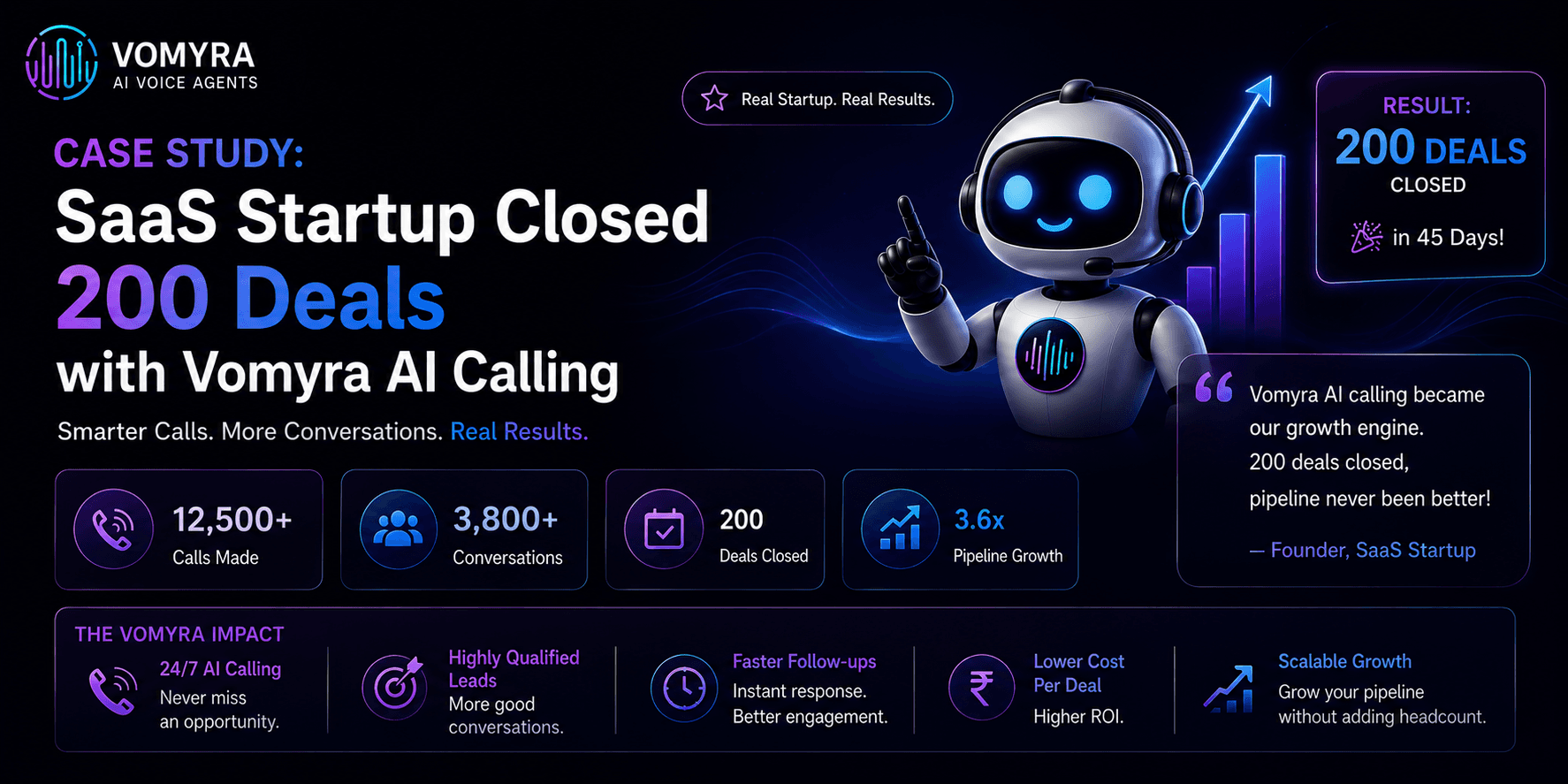
Over a 90-day deployment period, the company closed 200 deals — more than double its previous quarterly output — with the same three-person SDR team and no increase in headcount. Cost per closed deal dropped from ₹24,600 to ₹7,900. Lead contact rate within 60 seconds rose from 11 percent to 96 percent.
This case study documents the business context, the deployment structure, the results by metric, and the three operational factors that determined the outcome.
Business Context
Industry: B2B SaaS — HR compliance and payroll automation Market: Indian mid-market businesses, 50 to 500 employees Annual contract value: ₹52,000 Monthly lead volume: 540 to 580 Sales team: 3 SDRs, 2 AEs, 1 team lead Pre-deployment monthly closed deals: 26 to 31 Pre-deployment cost per closed deal: ₹24,600
The company generated leads from Google Search campaigns, LinkedIn outbound, inbound demo requests, and partner referrals. Demo-to-close conversion was healthy at 36 percent. The problem existed upstream of the demo.
The Problem: Three Structural Gaps
1. Speed-to-Contact Failure
The SDR team’s average first-contact time on inbound leads was 4.6 hours. Industry research across B2B sales data consistently shows that the likelihood of qualifying a lead drops by more than 80 percent when first contact is delayed beyond five minutes. At 4.6 hours, the company was operating well inside the lowest-conversion window for every lead it generated.
The core cause was not effort — SDRs were dialling actively. The cause was structural: three people covering standard business hours could not physically respond to 540-plus leads per month within minutes of submission, particularly when those leads arrived throughout the day and night.
2. After-Hours and Weekend Lead Abandonment
Analysis of six months of inbound lead data showed that 43 percent of all form submissions arrived outside standard business hours — evenings, nights, and weekends. These leads waited hours or days for a callback. By the time a call was placed, a meaningful share had already engaged with a competing product or lost active interest.
Leads contacted within the first five minutes converted to qualified demo at 3.4 times the rate of leads contacted after 24 hours. The company was effectively discarding nearly half of every month’s leads at the point of acquisition.
3. Dormant Lead Accumulation
Over the two quarters preceding the Vomyra deployment, the company accumulated 1,300 leads classified as uncontacted or cold — prospects who had submitted inquiries, received no call or a single unanswered attempt, and been left in the CRM. These leads represented paid acquisition spend that had produced no return.
Vomyra Deployment: Three Workflows
Vomyra AI calling was configured and live within five working days. No engineering resources were required. The SDR team lead handled setup using Vomyra’s no-code configuration interface.
Workflow 1: Inbound Lead Response
Every new lead entering the CRM triggered a Vomyra outbound call within 55 seconds of submission, operating 24 hours a day, seven days a week. The AI conducted a structured qualification conversation covering company size, current payroll process, pain point description, decision authority, budget range, and purchase timeline.
Qualified leads were booked directly into the AE calendar. Leads requiring nurture received a qualification score, a full call transcript, and a follow-up date — all logged automatically into the CRM. SDRs received no raw leads; they received only pre-qualified, pre-annotated leads ready for human follow-up.
Workflow 2: Dormant Lead Reactivation
The 1,300 cold leads were loaded into a Vomyra outbound reactivation sequence, run over four weeks in parallel with inbound response. Each call used a fresh value angle — a recent product development relevant to the prospect’s business type — rather than a generic follow-up script. Leads showing renewed engagement were flagged and transferred to the SDR queue with full context notes.
Workflow 3: Demo No-Show Recovery
Prospects who booked a demo and did not attend received an automatic Vomyra callback 22 minutes after the missed slot. The call offered two immediate alternative time slots and confirmed intent. Before this workflow, no-show follow-up occurred by email, typically one to two days after the missed slot — too late to retain meaningful intent in most cases.
All three workflows operated in Hindi and English. Language was detected automatically from the prospect’s first response and maintained throughout the call without manual configuration for each language separately.
Results: 90-Day Data
All results are measured against the same 90-day period in the preceding year.
| Metric | Before Vomyra | After Vomyra | Change |
| Lead contact rate (within 60 sec) | 11% | 96% | +85 pts |
| Monthly demos booked | 43 | 97 | +126% |
| Demo no-show rate | 29% | 8% | −21 pts |
| Deals closed (quarter) | 86 | 200 | +133% |
| Cost per closed deal | ₹24,600 | ₹7,900 | −68% |
| Monthly Vomyra platform cost | — | ₹92,000 | — |
Dormant lead recovery: From 1,300 cold leads, Vomyra’s reactivation sequence surfaced 168 qualified prospects. The SDR team converted 44 of those into closed deals — generating ₹22.88 lakh in ARR from leads previously classified as unrecoverable.
Headcount change: Zero. The same three SDRs and two AEs operated throughout the deployment. Total monthly sales team cost increased by less than 6 percent. Deal output increased by 133 percent.
SDR Productivity Shift
Before deployment, SDR time distribution was approximately: cold outbound dialling and admin at 58 percent, voicemails and unreturned attempts at 18 percent, and live qualification conversations at 24 percent.
After deployment, the distribution shifted to: live qualification and warm follow-up at 72 percent, reviewing Vomyra transcripts and preparing handoff notes at 17 percent, and administrative tasks at 11 percent.
Cold dialling was eliminated from the SDR workflow entirely. Every call the team made was to a prospect already pre-qualified by Vomyra, with a full transcript in the CRM. AEs entered every demo knowing the prospect’s stated pain point, current software, decision timeline, and likely objection — before the call began.
Factors That Determined the Outcome
Three implementation decisions were directly responsible for the deployment producing measurable results rather than a partial pilot.
Qualification script built from actual sales data. Before configuring the Vomyra workflow, the team reviewed six months of call recordings from their highest-converting SDR and extracted the specific questions that appeared consistently on calls that ended in demo bookings. The Vomyra qualification script was built from those questions, not from a standard BANT template. This ensured the AI was running the exact qualification logic that had historically produced pipeline for this product in this market.
CRM integration configured before the first live call. The team spent one full day mapping every Vomyra call outcome — qualification score, key prospect details, objection flags, follow-up date, transcript — to specific CRM fields before going live. Every outcome landed in the right place from the first call. SDRs never operated from disconnected data, and reporting was accurate from day one.
Dormant list treated as a new campaign, not a follow-up task. The reactivation sequence was built on a separate script from the inbound workflow, with a different opening, a different value frame, and a different call cadence. Running it as an independent campaign — rather than a generic “just checking in” sequence — produced a qualification rate from the cold list that justified the full quarter’s Vomyra cost within the first three weeks of the reactivation alone.
Getting Started with Vomyra

Vomyra AI calling is available for a free trial that allows a sales team to test qualification logic, language accuracy, and CRM integration against actual lead volume before making a payment commitment.
For most B2B SaaS teams, the practical starting point is the inbound response workflow — Vomyra calling every new lead within 60 seconds, 24 hours a day. Running this single workflow for 30 days against the previous period’s contact rate and demo-booking rate produces a clear data set for deciding whether to expand to backlog reactivation and no-show recovery.
The deployment in this case study took five working days from first configuration to first live call. All three workflows were handled by one non-technical team member using Vomyra’s no-code setup.
Frequently Asked Questions
How long does a Vomyra deployment take for a SaaS sales team?
Most Vomyra deployments are completed within 5 business days, including CRM integration and workflow setup. For simpler use cases, a single-workflow deployment can often go live in just 2–3 days without requiring engineering support.
Does Vomyra support Hindi and regional Indian languages?
Yes. Vomyra supports Hindi, Hinglish, Tamil, Telugu, Marathi, Gujarati, Bengali, and Punjabi. The AI automatically detects the language a prospect uses and responds accordingly, eliminating the need for separate workflows.
What happens to leads that Vomyra cannot fully qualify?
When a lead cannot be fully qualified, Vomyra records the conversation, assigns a qualification score, and recommends the next best action. If a prospect requests human assistance, the conversation can be seamlessly handed over with full context.
Does Vomyra require replacing existing CRM or sales tools?
No. Vomyra is designed to integrate with existing CRM and sales platforms. It automatically syncs call data, lead information, and conversation outcomes without disrupting your current workflow.
What results can businesses typically expect during the first month?
Many businesses see a significant increase in lead contact rates within the first few weeks. As qualification models improve with real call data, teams often experience higher engagement, better lead quality, and increased demo bookings.