Why No-Code Changes the Deployment Equation
Building an AI voice agent used to mean hiring a developer to stitch together a speech recognition API, a language model, a text-to-speech engine, and a telephony provider- then spending weeks testing whether the pieces worked together reliably under real call conditions.
For most Indian small and mid-sized businesses, that process was effectively inaccessible. The cost was prohibitive, the timeline was too long, and maintaining the system after deployment required ongoing technical support that most businesses could not sustain.
No-code AI voice agent platforms collapse that complexity into a visual configuration process. The underlying technology- speech recognition, language understanding, voice synthesis, telephony integration- is already assembled and maintained by the platform.
A business operator’s job is to define what the agent should say, what it should ask, which language it should speak, and where the data from each call should go. That configuration work requires product knowledge and business judgment, not programming skills.
For Indian businesses specifically, the distinction between a genuinely no-code platform and a developer-first platform with a visual interface on top matters more than in most markets. TRAI compliance controls, +91 number provisioning, Hinglish language support, and integrations with India-specific systems like Petpooja- these are either built into the platform or they are not. A platform that handles all of these natively saves weeks of integration work that a global tool adapted for India requires.
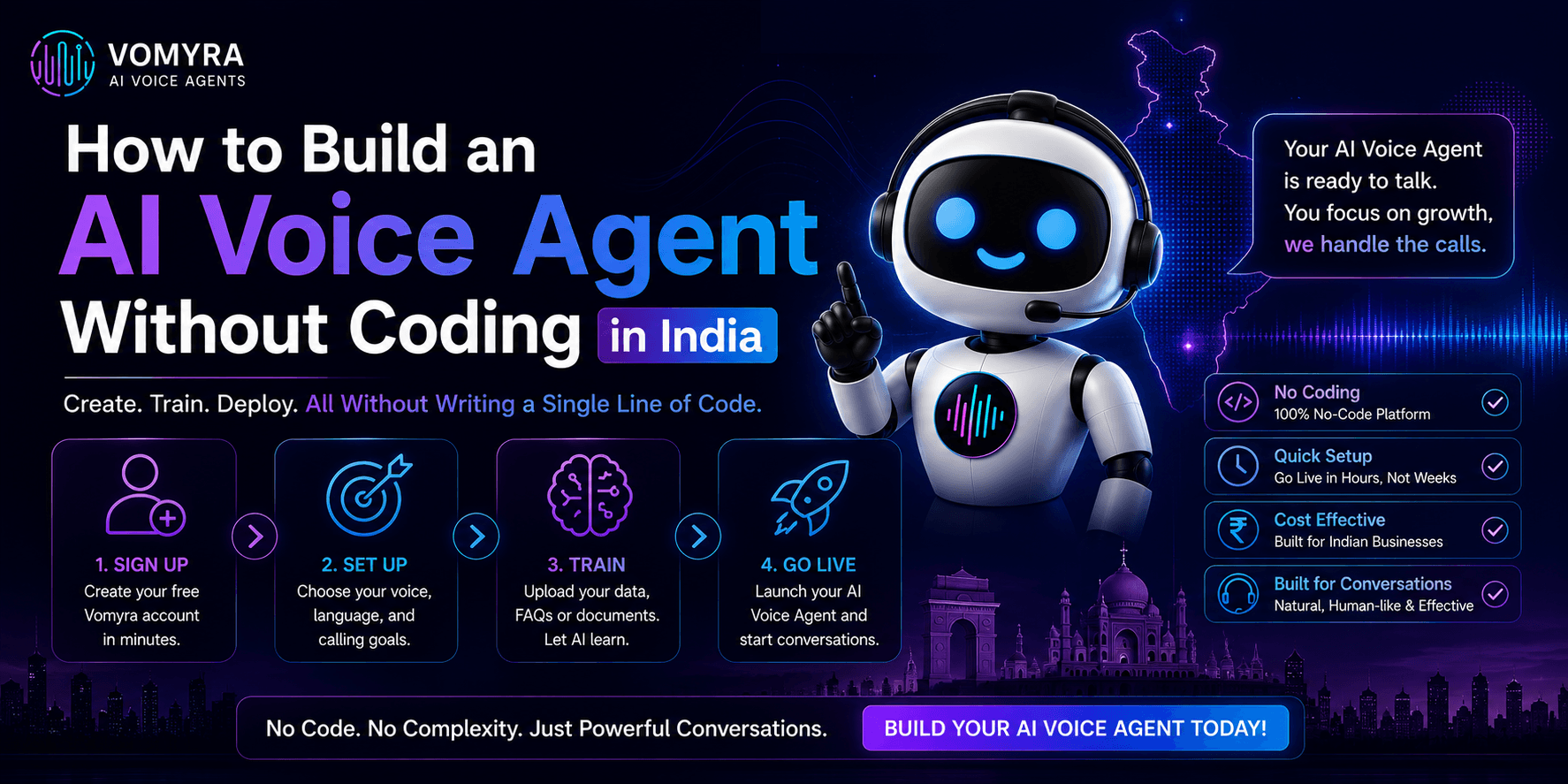
This guide covers the complete process of building and deploying an AI voice agent without coding in India- from defining the use case through live deployment, with the India-specific configuration steps called out at each stage.
Step 1- Define a Single Use Case Before Opening Any Platform
The most common reason no-code AI voice agent deployments underperform is not technical. It is scope. Businesses that try to configure an agent that handles inbound reservation calls, outbound lead follow-up, multilingual support across five states, and customer complaint routing simultaneously- all in the first week- end up with an agent that handles nothing reliably.
The correct starting point is a single, well-defined use case with a clear outcome.
Good first use cases share three characteristics. They involve calls that follow a predictable structure- the same questions, the same information requests, the same objection patterns appearing repeatedly.
They have a measurable outcome that can be tracked- a booking confirmed, a lead qualified, a demo scheduled. And they represent the highest volume of repetitive call activity in the current workflow- the task that consumes the most human hours for the least complex work.
For an Indian real estate broker, this is typically the inbound inquiry callback: a lead arrives from a portal, the agent calls back within 60 seconds, asks about budget and location preference, and books a site visit if the criteria match.
For a restaurant, it is order-taking and reservation management during peak hours. For an NBFC, it is the initial loan inquiry qualification call. For a clinic, it is appointment reminders and rescheduling.
Write down the single use case, the outcome it should produce, and the five to eight questions or pieces of information the agent needs to handle to reach that outcome. This document is the foundation for every configuration decision that follows.
Step 2- Choose a Platform That Is Genuinely No-Code for Indian Conditions
Not all platforms described as no-code deliver equally on that description. Some require separate telephony provider setup- Twilio or Exotel accounts connected via API- before a single call can be placed. Some require JSON configuration files for conversation branching logic.
Some offer Indian language support only as an add-on that requires additional model selection and testing.
Evaluating a platform against India-specific requirements before committing to setup time produces better outcomes than discovering these gaps mid-deployment.
The criteria worth checking before starting:
Indian phone number included natively. A platform that requires a separate Twilio or Plivo account and separate number provisioning before calls can be placed adds setup complexity and ongoing cost that a genuinely India-first platform absorbs. The agent should be able to call from and receive calls to a +91 number configured within the platform itself.
Outbound call answer rates in India are meaningfully higher from Indian numbers than from international or unrecognised numbers- this is a revenue-affecting distinction, not a minor convenience.
Hindi, Hinglish, and regional language support built in. Many platforms list Indian language support but test it only on clean, studio-recorded audio in standard Hindi. The practical test is Hinglish mid-sentence code-switching: a caller who says “haan, budget toh hai, but delivery timeline thoda jaldi chahiye” should be understood without the agent breaking or defaulting to English.
Run this test before committing. Platforms built on Indian call data perform measurably better on real Indian caller audio than global platforms adapted for the market.
Compliance controls pre-configured. TRAI’s TCCCPR framework requires outbound commercial calls to operate between 9 AM and 9 PM, to scrub lists against the DND registry, and for the calling business to be registered as a telemarketer through the DLT platform.
A no-code platform built for the Indian market should have calling-hour enforcement configurable within the campaign settings, not require the business to manage DND scrubbing externally. The DPDP Act’s consent and data-handling requirements should similarly be addressed in the platform’s data logging architecture.
Integration with systems the business already uses. An agent that qualifies a lead into a separate dashboard the sales team never checks adds work rather than removing it. Verify that the platform connects directly to the CRM, the POS system, or the spreadsheet the team already operates from- without requiring API development on the business’s side.
Vomyra AI Voice Agent is built around all four of these requirements for the Indian market. Indian +91 numbers are included in the platform. Hindi, Hinglish, Tamil, Telugu, Marathi, Gujarati, Bengali, and Punjabi are supported natively with models trained on Indian call audio.
TRAI calling-hour enforcement and DND compliance controls are configurable within the campaign settings. And integrations with Petpooja for restaurant and hospitality POS workflows, as well as standard CRM platforms, are available without developer involvement.
Step 3- Configure the Agent’s Knowledge Base
The knowledge base is everything the agent needs to answer questions accurately: product details, pricing, availability, policies, FAQs, location information, and any other information that callers regularly ask about.
The format that works best for a no-code knowledge base is plain language- the same way a business would explain these things to a new employee on their first day. Avoid marketing copy, which is optimised for reading rather than for being stated aloud in a conversation.
Avoid bullet-point lists, which do not translate naturally into spoken responses. Write in simple, direct sentences that answer the most common caller questions.
The knowledge base should include answers to the five to ten questions that appear on almost every call. For a real estate agent, these include the project’s RERA registration status, possession timeline, parking availability, home loan support, and the process for booking a site visit.
For a restaurant, these include delivery availability, current timings, the most commonly ordered dishes, and whether advance table bookings are required. For a loan company, these include eligible loan amounts, income requirements, processing time, and required documents.
Load the knowledge base before the conversation flow is built. The quality of the agent’s responses in real calls is largely determined by the accuracy and completeness of this information- more so than the sophistication of the conversation branching logic.
Step 4- Build the Conversation Flow
The conversation flow defines the structure of what the agent says and when- the opening, the qualification questions, the responses to common objections, the escalation logic, and the closing.
Most no-code platforms present this as a visual flow editor: a sequence of nodes where each node represents a step in the conversation, connected by branching paths that change based on what the caller says.
The opening should state the agent’s name and purpose clearly within the first two sentences. For outbound calls, it should also disclose that the call is AI-assisted- both as a matter of transparency and because Indian regulatory guidance is moving toward mandatory disclosure for automated commercial calls. “Namaste, I’m Meera calling from [Company] to help with your recent inquiry” is a cleaner opening than a lengthy introduction that delays the qualification conversation.
The qualification questions should be drawn directly from the document created in Step 1- the five to eight questions the agent needs to answer to reach the defined outcome. Each question node in the flow should have response branches for the most common answer types, and each branch should lead either to the next question or to a conditional outcome (booking confirmed, escalation to human, lead flagged for follow-up).
Objection handling should be built as branch nodes connected to the main qualification path- not as separate scripts. When a caller raises a price concern or says “abhi sochna hai,” the agent should move to the relevant objection branch, address it with the response validated from real sales call recordings, and then return to the main qualification flow rather than losing the thread of the conversation.
The escalation node- the point at which the call transfers to a human agent- should be configured with clear triggers: an explicit request to speak with a person, a second or third repeated objection in the same category, or a question that falls outside the agent’s knowledge base.
Escalation should transfer the call with full conversation context so the human agent does not need to re-establish what has already been discussed.
Step 5- Select Voice, Language, and Calling Number

Voice selection affects how the agent is perceived. Most platforms offer multiple voice options- different tones, cadences, and registers.
For a professional services or financial services context, a measured, clear voice builds more trust than a highly animated one. For a restaurant or hospitality context, warmth and energy in the voice register better with callers. Listen to the available options on a full sample sentence that includes both Hindi and English phrasing before selecting.
Language configuration should be set to match the primary language of the target customer base, with Hinglish as the default for most urban Indian business contexts where callers mix languages freely.
For businesses serving predominantly regional-language markets- a logistics company in Tamil Nadu, a clinic in Telangana- configure the primary language accordingly.
Calling number should be an Indian +91 number provisioned within the platform. For outbound campaigns, this number appears on the caller’s screen. In India, caller ID recognition significantly affects answer rates- numbers that appear local and domestic are answered at substantially higher rates than numbers without identifiable origin.
Step 6- Connect Integrations Before Going Live
Integration setup should happen before the first test call, not as an afterthought after deployment. Attempting to add CRM connectivity or POS integration after the agent is live creates a period where call data is being captured without reaching the systems where it needs to go- and that data is difficult to retroactively import.
The most important integration for most sales and service workflows is CRM connectivity. Every qualified lead, qualification score, objection raised, and follow-up date should land in the CRM automatically at the end of each call.
If the current workflow runs on a spreadsheet rather than a CRM, configure the agent to post call summaries to a Google Sheet or send a structured WhatsApp notification to the relevant team member- the key requirement is that call outcomes reach the right person automatically, not through a manual export step.
For restaurants and hospitality businesses, Petpooja POS integration means phone orders taken by the agent route directly into the kitchen ticketing and billing workflow- without a staff member re-entering the order from a paper note or a separate system.
Step 7- Test Thoroughly Before Any Live Calls
Testing should include at minimum three call scenarios: a call that follows the ideal path from opening to qualified outcome, a call that introduces an objection mid-qualification, and a call where the caller asks a question outside the knowledge base.
Each scenario should verify that the agent identifies the situation correctly, delivers the appropriate response without unnatural pacing or repetition, returns to the main flow cleanly, and escalates or logs correctly.
After internal testing, a limited pilot on a small subset of real leads- not the full call list- surfaces issues that controlled testing does not. Real callers produce phrasing and conversation paths that even careful internal testing does not anticipate.
The pilot period should be reviewed call-by-call, with specific attention to drop-off points and instances where the agent’s response did not match the caller’s intent.
Step 8- Launch, Monitor, and Iterate
A no-code AI voice agent is not a one-time configuration. The first week of live calls will reveal gaps in the knowledge base, phrasing that sounds unnatural in spoken audio, and qualification questions that callers interpret differently than expected. Each gap identified and addressed in the first 30 days produces a meaningfully better-performing agent by day 60.
The weekly review process should focus on three outputs: calls where the agent addressed an objection but the caller dropped off immediately after (indicating the response did not resolve the concern), calls where the agent escalated but probably should not have (indicating the escalation triggers are too broad), and calls where a question was asked that the knowledge base did not cover (indicating a gap that should be filled).
Vomyra AI Voice Agent provides full call transcripts and conversation analytics from the first live call, giving the business the data needed to run this review process from day one. The no-code configuration interface allows knowledge base updates, conversation flow adjustments, and escalation rule changes to be made immediately when the review identifies an improvement- without queuing a developer request or waiting for a platform update cycle.
A free trial is available for Indian businesses that want to complete Steps 1 through 7 and test against real call volume before making a payment commitment.
Frequently Asked Questions
Do I need technical knowledge to build an AI voice agent on Vomyra?
No. Vomyra is built for no-code deployment. You can configure conversations, choose languages, connect your phone number, and manage workflows through a simple interface without coding or developer assistance.
How long does it take to make the first live call?
Most businesses can go live within 3–5 business days. The setup time mainly depends on preparing your conversation script, knowledge base, and testing the call flow before launching.
Can the same agent handle inbound and outbound calls?
Yes. Vomyra supports both inbound and outbound calls from the same setup. You can use one knowledge base while customizing the opening flow based on whether the call is incoming or outgoing.
What happens if a caller speaks an unsupported language?
Vomyra automatically detects supported languages. If a caller uses an unsupported language, the agent can switch to a fallback language or transfer the conversation to a human representative.
Do I need a separate telephony account?
No. Vomyra includes integrated telephony, allowing you to set up and manage business calling without creating or maintaining a separate telephony account.