A busy restaurant on a Friday night typically receives around fifty phone calls during the dinner rush alone — most asking for a table, some placing a takeaway order, the rest with general questions about timing or the menu.
On a night like that, kitchen and floor staff stretched thin often answer only a fraction of those calls. The rest ring out, and the caller moves on, usually to another restaurant that did pick up.
This is one of the more overlooked sources of lost revenue in the Indian food and beverage industry. Restaurant owners spend heavily on decor, menu design, delivery platform visibility, and marketing, while the phone line itself, often the first point of contact for a paying customer, gets the least attention.
An AI voice agent for restaurants in India is built specifically to close this gap, answering every call instantly so interest doesn’t quietly disappear into a missed-call log.
Why Missed Calls Cost More Than Most Owners Realize
Every call to a restaurant represents a customer who has already decided to engage. They aren’t browsing; they’re calling to reserve a table, order dinner, ask about catering, or confirm today’s specials, which is a different kind of intent than someone scrolling a delivery app, and losing that call is closer to losing a sale than losing a lead.
Indian businesses lose a substantial amount of revenue every month specifically to missed calls, and the pattern is consistent across restaurants, clinics, and service businesses alike: a large share of inbound calls, often 40 to 60 percent, arrive outside standard operating hours or during the exact peak windows when staff are least available. A restaurant’s phone tends to ring hardest precisely when the floor and kitchen are busiest, meaning the calls most likely to go unanswered are often the ones representing the highest order value of the day.
What Actually Causes Restaurants to Miss Calls
It is rarely a staffing failure in the way owners assume. Peak-hour timing is the biggest factor — lunch and dinner rushes create a sudden spike in call volume at the exact moment every available staff member is occupied with a table, a billing queue, or a kitchen ticket.
Lean staffing compounds this, since many small and mid-sized restaurants run with one or two people covering billing, service, and phone duty simultaneously, and the phone is usually the first thing deprioritized.
Channel fragmentation adds another layer, since customers now reach restaurants through phone calls, WhatsApp, Instagram, and delivery app chat, and keeping pace with all of them at once is difficult even for well-staffed teams.
After-hours timing is the final piece — customers place orders late at night or call early morning to book a table for that evening, and a restaurant with no one on the line simply lets those calls go unanswered.
How AI Voice Agents Actually Help
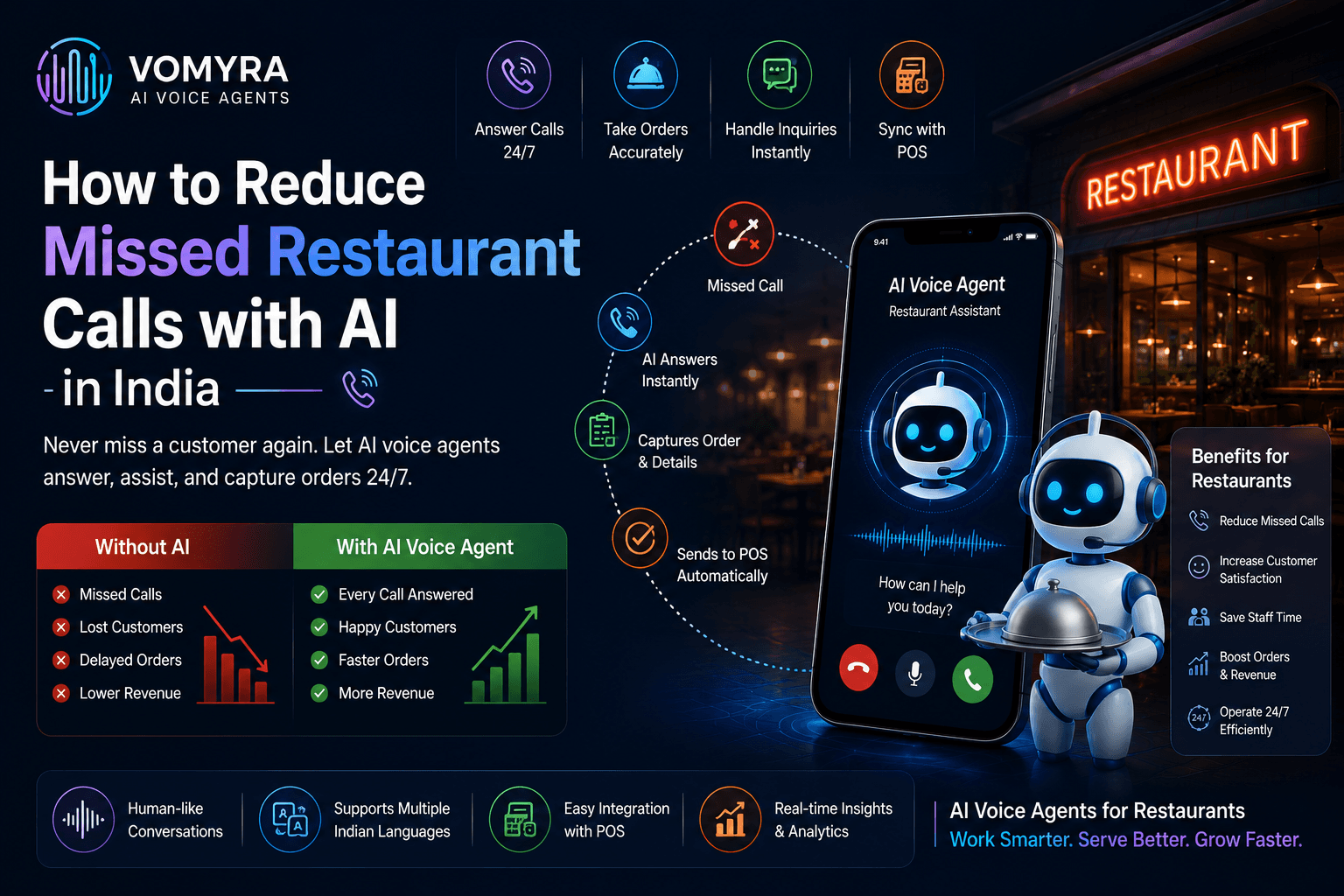
An AI voice system answers every incoming call immediately, regardless of how busy the floor is or what time it is. The caller doesn’t sit through unanswered rings; they get a response right away, in a conversational tone rather than a rigid phone-menu structure.
A modern AI voice agent for restaurants can take a food order directly over the phone, confirming items and quantities before forwarding it into the kitchen workflow. It can collect reservation details such as name, contact number, date, time, and party size, recording them automatically rather than relying on a notebook near the billing counter.
It can also answer repetitive questions like closing time, today’s specials, or allergen information, and transfer the call to staff when a situation genuinely needs a person, such as a complaint.
What separates this from the IVR systems many businesses already associate with frustration is that customers can speak naturally — asking “do you have a table for four tonight” in plain language, without navigating numbered options first.
The Order-Taking and Reservation Problem, Specifically
Phone ordering is error-prone precisely because it depends on a busy staff member writing things down accurately while doing several other things at once. A misheard quantity, a missed item, or an incomplete address are common, not rare.
An AI ordering system that confirms each detail back to the caller before finalizing the order reduces this kind of error, since the same consistent process runs every time regardless of how busy the restaurant is.
Reservation handling carries a similar pattern for restaurants where bookings matter, including fine dining venues, rooftop spaces, and banquet halls. An AI voice agent for hotel and restaurant bookings can capture the customer’s name, contact number, date, time, and guest count, logging it directly without relying on a staff member remembering to write it into a register during a busy shift.
For restaurants already using point-of-sale systems like Petpooja for billing and inventory, the more useful AI deployments sync directly with that POS rather than running as a disconnected tool. Vomyra’s AI voice agent is built around exactly this kind of native Petpooja integration, so a phone order taken by the AI lands in the same kitchen ticketing and billing workflow as an order taken at the counter.
Why This Is Gaining Traction Specifically in India
India has a particular relationship with the phone call that makes this technology land differently than it might elsewhere. The “missed call” itself is already a familiar cultural signal here, used deliberately to register interest without a full conversation.
Customers calling a restaurant and getting no answer don’t necessarily think the business is closed; they simply move to the next option, because waiting is no longer something people expect to do. Food delivery apps respond within seconds and cab bookings confirm instantly, so a restaurant phone that rings out repeatedly feels out of step.
Language is the other major factor. A restaurant in Mumbai may field calls in Hindi, Marathi, and English over a single evening, while one in Chennai deals with Tamil callers who may prefer not to switch to English at all.
A multilingual AI calling bot that holds a natural conversation in the caller’s preferred language removes a real friction point, particularly for customers in Tier 2 and Tier 3 cities more comfortable in their regional language.
What to Look For Before Choosing a Platform
Not every AI voice tool on the market is built with Indian restaurants in mind. Conversation quality matters more than feature lists, since a system that sounds robotic or forces customers through rigid prompts defeats the purpose.
POS integration matters for any restaurant that wants phone orders flowing into existing kitchen and billing systems rather than a second, disconnected queue. Language coverage should be checked against the languages your actual customers speak, not a generic “multilingual” label. And a clear human-handoff path is non-negotiable, since complaints and unusual requests still need a person on the line.
Given how many restaurant owners are testing this category for the first time, a free AI voice agent trial in India is worth prioritizing so a deployment can be tested against real call volume before any payment commitment, an option Vomyra offers for restaurants wanting to evaluate fit before scaling up.
Is This Only for Large Chains, and Will It Replace Staff?
Neither assumption holds up. A neighborhood café fielding thirty calls a day with two staff members on shift often feels the impact of missed calls more acutely than a large chain with a dedicated call center, since every missed order represents a larger share of that day’s total revenue. And on replacing staff: it isn’t designed to.
Hospitality still depends on human service for the parts of the experience that matter most, like greeting guests, handling a complaint with empathy, and building the rapport that brings a customer back. What AI handles well is the repetitive, time-sensitive layer underneath that, like taking down a straightforward order or logging a reservation, freeing staff to focus on the people actually sitting at the tables.
The Bigger Question Worth Asking
Most restaurant owners already sense that missed calls cost them something. Few have actually quantified how much. A phone that goes unanswered fifteen or twenty times a week, multiplied across a year, represents a meaningful and entirely avoidable loss, especially when the fix doesn’t require hiring additional staff.
As customer expectations around instant response keep rising across every other channel, a restaurant’s phone line is one of the last places still running on hold music and missed rings, and that gap is exactly where the opportunity sits.
Frequently Asked Questions
How can restaurants reduce missed calls without hiring more staff?
By deploying an AI voice agent that answers every incoming call instantly, takes orders, logs reservations, and escalates to a human only when a situation genuinely requires one.
Can an AI voice agent handle phone orders accurately during a busy rush?
Yes. It follows the same process on every call, confirming items and quantities back to the customer, which reduces errors common when a rushed staff member takes an order by hand.
Is this worth it for a small restaurant with low call volume?
Often more so than for a large chain, since a single missed order represents a larger share of a small restaurant’s daily revenue and staff have less spare capacity to absorb phone duty.
Does an AI voice agent support Hindi and regional Indian languages?
Most platforms built for the Indian market support Hindi, Tamil, Telugu, Marathi, Gujarati, Bengali, and Punjabi, alongside English, so callers can speak in whichever language they’re most comfortable with.
Can it integrate with the POS system a restaurant already uses, like Petpooja?
Yes, where the integration is built properly. Orders taken by the AI sync directly into the existing kitchen ticketing and billing workflow instead of creating a separate manual process for staff to reconcile.