Why Objection Handling Is the Most Important Training Task
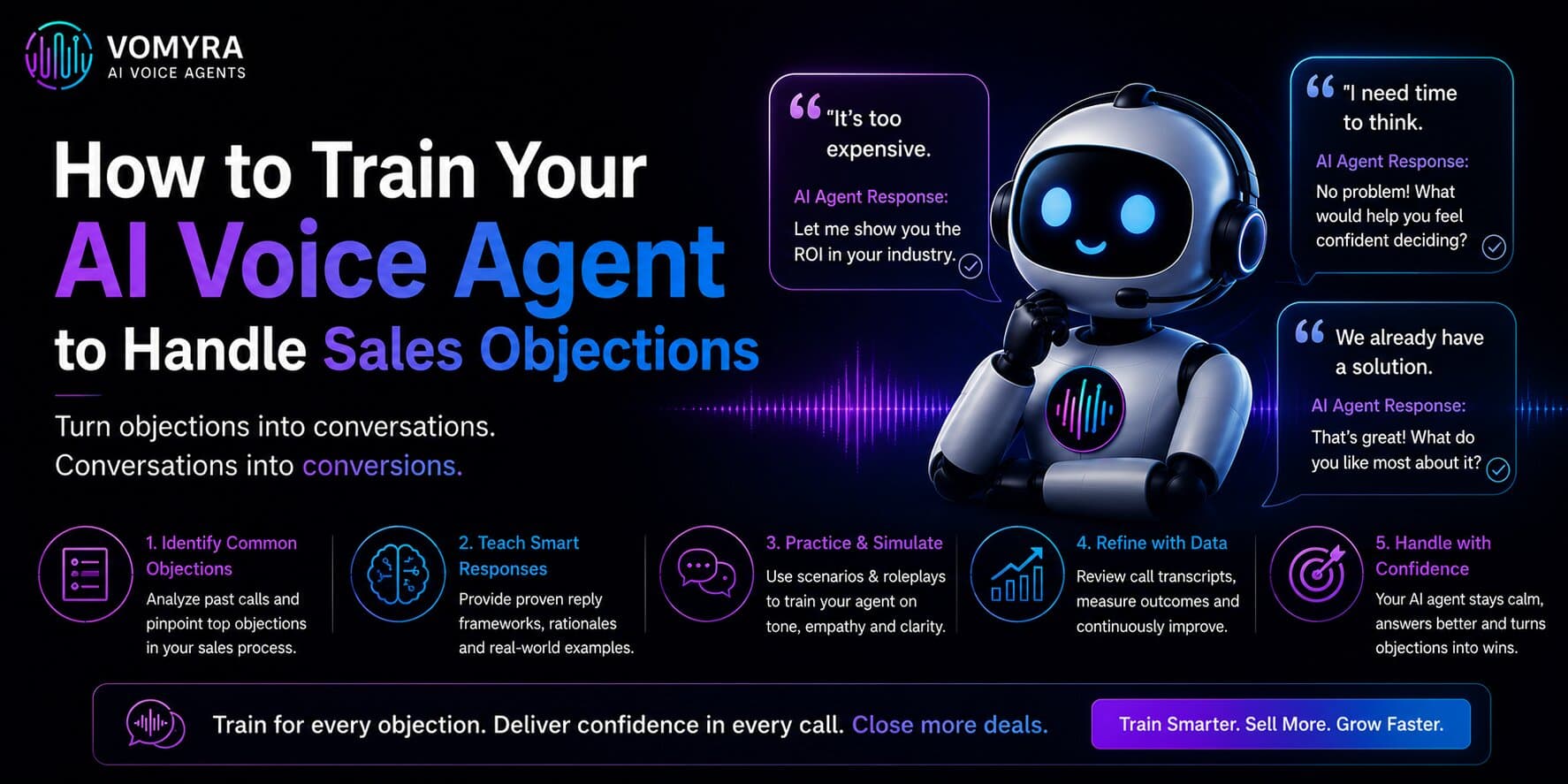
An AI voice agent that can answer basic questions and collect lead information is straightforward to configure. An AI voice agent that can handle a prospect who says “it’s too expensive,” “I need to think about it,” or “we already have a solution” – and keep the conversation moving toward a qualified outcome – requires deliberate training work that most teams skip or underestimate.
The gap matters commercially. AI voice agents with properly mapped objection handling convert 40 to 60 percent more calls than agents running static qualification scripts that collapse the moment a prospect pushes back.
An agent that falls silent, repeats itself, or circles back to the previous question when confronted with an objection does not just lose that conversation. It damages the prospect’s perception of the business and makes re-engagement harder.
The good news is that objections in most sales contexts are not random. Analysis of real call recordings across industries consistently shows that 90 to 95 percent of all prospect pushback falls into 8 to 12 repeating categories.
Training an AI voice agent to handle objections is primarily a process of identifying those categories from real data and building accurate, validated responses for each – not a process of trying to anticipate every possible variation of every objection that could theoretically occur.
This guide covers the complete training process: extracting objection data from existing calls, building a branching response structure, writing responses that work in the agent’s voice, configuring escalation logic, and maintaining the training over time as real call data accumulates.
Step 1: Extract Objection Data from Existing Calls Before Building Anything
The most common mistake in AI objection training is writing response scripts before reviewing real call recordings. Generic objection responses rarely match the specific language or context in which prospects push back in a given industry or market.
The correct starting point is a review of 50 to 100 recorded calls from the existing sales team. The goal is to extract every instance where a prospect raised resistance – formal objections, hesitation, deflections, and expressions of doubt.
From this review, recurring objection phrases cluster into a small number of underlying concerns even when the surface language varies. “I need to think about it,” “let me get back to you,” and “I want to discuss with my partner” are all versions of the same timing or commitment objection.
For most B2B sales contexts in India, the repeating categories are: price or budget concerns, timing or priority, authority or decision-maker access, product fit doubt, trust or skepticism, existing solution objections, and requests to receive information by email rather than continue the conversation.
The output of this step is a documented list of 8 to 12 objection categories, each with 3 to 5 real phrasing examples pulled from actual call recordings. This list becomes the foundation for everything built in subsequent steps.
Step 2: Build a Branching Response Structure, Not a Linear Script
A linear script assumes the conversation follows a predetermined sequence. An objection-ready agent needs a branching structure – a decision tree where each objection triggers a specific response pathway that loops back to the main qualification flow once addressed.
Each branch contains five components:
Detection trigger – the words or intent patterns signalling this objection type. For a price objection, triggers include “too expensive,” “out of our budget,” “can you reduce the price,” and variants in Hindi or the relevant regional language.
Acknowledgment response – a single sentence confirming the agent has understood the concern. Jumping directly to a rebuttal without acknowledgment produces resistance rather than reducing it.
Reframe or evidence response – the substantive handling of the objection, rooted in specific data or proof points loaded into the agent’s knowledge base, not generic assertions.
Return-to-qualification prompt – a question bringing the conversation back to the main qualification flow after the objection has been addressed. This step is often omitted in poorly designed agents.
Escalation trigger – a rule identifying when this objection, combined with other call signals, indicates a human agent should take over.
The branching structure should be built in the platform’s conversation flow editor, with each of the 8 to 12 objection categories mapped as a separate branch connecting to and from the main qualification trunk.
Step 3: Write Response Scripts in the Validated Voice of the Sales Team
Response content matters as much as structure. Scripts that sound generic or inconsistent with how the business actually communicates underperform even when the logic is correct.
The practical approach is to take the actual responses the best-performing human sales representative uses on calls and adapt them for the AI agent – removing filler language, tightening phrasing to fit spoken audio, and ensuring all product and pricing information is accurate.
For each objection category, the response should follow a consistent logic:
Price objection: Shift from defending the price to quantifying the cost of the problem the product solves. If the product saves a business ₹3 lakh per year, the conversation moves from “is ₹48,000 expensive?” to “what does not solving this cost today?” Use a specific data point or customer outcome wherever possible.
Timing objection: Acknowledge the priority concern, then surface the cost of delay. Ask what would need to change for now to be the right time – this reveals whether the timing concern is genuine or a deflection requiring different handling.
Authority objection: Facilitate the decision-making process rather than trying to continue without the relevant person. Offer to schedule a call when the decision-maker is available, or ask what information would help the prospect present the option internally.
Fit doubt: Ask a clarifying question before responding. “I’m not sure this is right for us” can reflect a misconception, a past bad experience, or a specific unmet requirement. The response should be diagnostic first.
Existing vendor objection: Ask what is working well with the current solution and what could be better. The goal is to identify a specific gap – not to argue against the competitor.
Email deflection: Confirm that information will be sent and immediately propose a specific follow-up call time – converting an apparent exit into a scheduled next step.
Step 4: Configure Escalation Logic for the 5 to 10 Percent the AI Should Not Handle
A correctly trained AI voice agent handles 90 to 95 percent of objections through mapped branches. The remaining 5 to 10 percent – novel, emotionally charged, legally sensitive, or deal-specific objections – should trigger escalation to a human agent, not AI improvisation.
Escalation rules should be configured for specific conditions: repeated objections in the same category within a single call, significant frustration signals, questions about contract terms or data compliance, high-value deal indicators, and explicit requests to speak with a human.
Escalation must transfer full call context to the human agent – transcript, qualification data, objections raised, and how they were addressed – so the conversation does not restart from the beginning.
Vomyra AI Voice Agent includes configurable escalation triggers per objection type, per conversation signal, and per deal size indicator. A Vomyra-deployed agent transfers to a human with a full call summary, qualification score, and objection history – ensuring complete context before the human agent’s first word.
Step 5: Test Against Real Calls Before Going Live
No objection training configuration should be deployed to live calls without structured testing. Testing exposes gaps in branching logic, reveals phrasing that sounds unnatural in spoken audio, and identifies objection variants missed in the initial data extraction.
Internal call simulations where team members role-play as prospects and deliberately raise each mapped objection category should evaluate whether the agent correctly identifies the objection type, delivers the response without unnatural pauses or repetition, returns to the qualification flow cleanly, and escalates correctly when escalation conditions are met.
Following internal testing, a limited pilot with a defined subset of real calls provides real-world data before full deployment. Each objection-handling instance should be reviewed for resolution quality and post-objection conversion outcome.
Step 6: Establish a Weekly Review Cycle
Objection training is not a one-time configuration task. New objections surface, market conditions change, and product updates require response revisions.
A weekly review of 30 to 60 minutes covers: calls where escalation triggered to evaluate whether the escalation was appropriate or indicates a gap in mapped coverage; calls where the agent addressed an objection but the prospect dropped off immediately after; and any new objection phrases not matching existing branch triggers.
Updates should be made immediately when real call data shows a clear improvement opportunity, rather than batched into monthly revision cycles.
Vomyra’s free trial provides access to full call transcripts and conversation analytics from the first live call, giving sales teams the data foundation for this review process from day one of deployment.
Objection Types Worth Mapping Specifically for Indian Markets

Sales teams deploying AI voice agents in Indian B2B and B2C contexts should map two objection categories specific to the Indian market alongside the universal types above.
The “abhi sochna hai” objection – a Hindi expression meaning “I need to think about it” that functions as a polite deflection rather than a genuine timing concern. A response treating this as a literal timing objection misses the underlying hesitation. The correct response acknowledges the concern, asks a specific question about what would help clarify the decision, and proposes a concrete next step rather than leaving the conversation open-ended.
The family or partner consultation objection – particularly common in B2C and SMB contexts where business and personal finances overlap. Offering to schedule a follow-up when the relevant party is available, and providing information that makes the internal conversation easier, produces better outcomes than trying to close without the relevant decision-maker.
Frequently Asked Questions
How many objection categories does an AI voice agent typically need to handle?
For most B2B sales contexts in India, 8 to 12 objection categories cover 90 to 95 percent of all prospect pushback. Building beyond this range with dozens of categories adds configuration complexity without meaningfully improving coverage, since the additional categories rarely appear in practice.
Should the AI agent disclose that it is AI before handling objections?
Disclosure of AI identity at the start of the call is the recommended practice and reduces the risk of a trust-damaging mid-conversation revelation. Most prospects whose primary objection would be “I don’t want to talk to an AI” will raise that objection at the beginning – where it can be handled cleanly – rather than part-way through a qualification conversation.
What happens when a prospect raises an objection not covered in any mapped branch?
A well-configured fallback branch handles unmapped objections by acknowledging the concern, indicating that a team member with more specific information will follow up, and either escalating to a human or scheduling a callback. The unmapped objection is logged for review in the next weekly cycle and added to the training if it represents a recurring pattern.
How long does it take to build and test a complete objection-handling configuration?
For a team with existing call recordings to draw from, the full process – data extraction, branching structure design, response scripting, testing, and pilot – typically takes two to three weeks. Teams without existing recordings who are building from first principles take longer, typically four to six weeks to accumulate enough pilot call data to validate the configuration.
How often should objection responses be updated after the initial deployment?
Responses to core objection categories – price, timing, authority – should be reviewed monthly and updated when real call data shows a pattern of post-response drop-off. Trigger phrases and branch detection logic should be reviewed weekly as new phrasing variants appear in live calls.