Most Indian businesses know that running a telecalling team is expensive. Very few have calculated exactly how expensive. The salary line is visible. Everything beneath it — training costs, attrition replacement, idle time, infrastructure, supervision, and the revenue lost to missed calls during peak hours — rarely appears in a single number anywhere. When it does, the total is consistently higher than most business owners expect.
This post builds that number from the ground up, compares it against what an AI voice agent actually costs to run in India in 2026, and shows where Vomyra AI Voice Agent fits for businesses that want to make this switch without an engineering team or a lengthy deployment project.
What a Human Telecalling Team Actually Costs in India
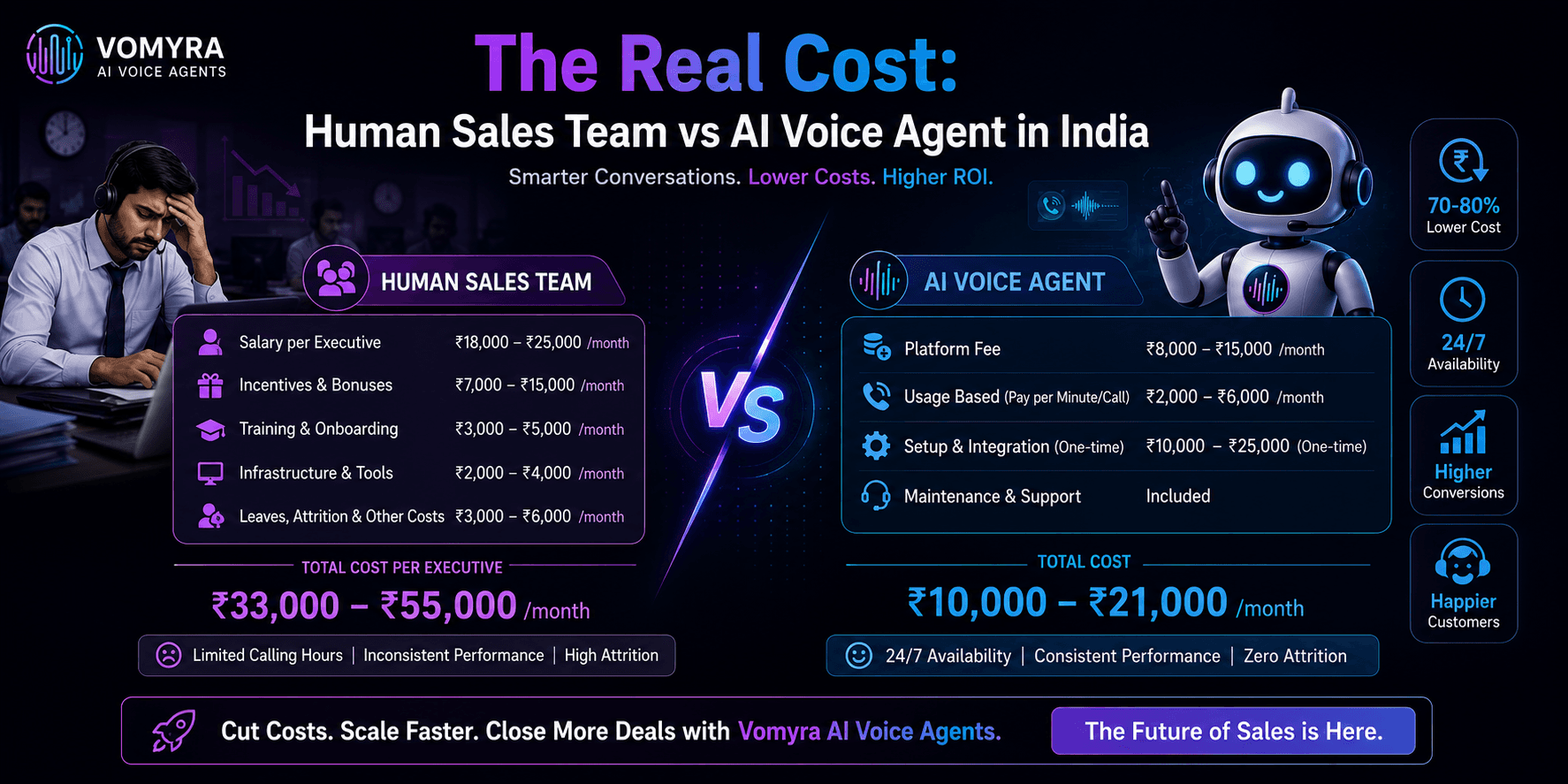
The starting point is salary. A fresher telecaller in India earns ₹10,000 to ₹18,000 per month in hand, with experienced callers in Tier 1 cities earning ₹20,000 to ₹28,000. Add performance incentives and the typical total cash compensation for an active caller sits between ₹15,000 and ₹30,000 per month. That is the number most businesses quote when they estimate their calling costs. It is also the least complete number in the entire calculation.
Employer contributions. PF and ESI add approximately 13 to 15 percent on top of gross salary. A caller earning ₹18,000 per month carries ₹2,340 to ₹2,700 in employer contributions, bringing the monthly cost before any overheads to ₹20,340 to ₹20,700.
Training and onboarding. A new telecaller takes two to four weeks to reach productive performance. During that period they are drawing a salary, occupying a supervisor’s time, and consuming training materials. Industry estimates put the direct cost of training and onboarding a single telecaller at ₹8,000 to ₹15,000. This cost recurs every time someone leaves.
Attrition. This is where the real cost lives, and where most business owners underestimate the situation significantly. Telecalling floors in India see annual attrition rates of 80 to 120 percent. At 100 percent attrition, a team of five callers turns over completely within twelve months. Every departure triggers a fresh round of recruitment, onboarding, and training costs. A five-person team at 100 percent attrition means five full replacement cycles per year, each costing ₹8,000 to ₹15,000 in training alone, before accounting for recruiter time or any agency fees.
Infrastructure. Each caller requires a workstation, headset, CRM licensing, telephony access, and internet connectivity. In an office setting, this runs ₹8,000 to ₹15,000 per agent per month when all components are counted.
Idle time. Agents are paid for shifts, not calls. During low-volume windows, between-call wrap-up time, team briefings, and unplanned breaks, the cost clock continues running. A 25 percent idle rate, which is conservative for most calling operations, inflates the effective cost of every productive call by 30 to 40 percent.
Supervision overhead. A team of four to six callers typically requires one team lead who does not dial themselves but manages quality, handles escalations, and monitors performance. At ₹35,000 to ₹50,000 per month for a team lead, their cost distributes across every call the team makes.
The honest total. When all these components are added up, the true cost of a human telecaller in India sits between ₹40,000 and ₹65,000 per month per head in fully loaded terms. Divided across the calls they realistically make and resolve, the cost per resolved contact falls between ₹55 and ₹85 for a typical mid-market Indian calling operation. Operations running lean on supervision and infrastructure at the low end, and those in Tier 1 cities with higher overheads at the high end.
That is the real baseline. Not the salary line.
What the Human Model Costs Beyond Money
There are costs to a human telecalling operation that do not appear on any monthly bill but affect business performance directly.
Coverage gaps. A team working standard shifts covers 45 to 50 hours per week. Inquiries arriving outside those hours — which for most Indian businesses running digital campaigns represent 40 to 60 percent of total lead volume — are either missed or receive a next-day callback when the prospect’s interest has cooled. In real estate, fintech, and insurance, the difference between a five-minute callback and a next-day callback can be the difference between conversion and a lost lead.
Inconsistency. Call quality varies by agent, by shift, and by hour of the day. A caller in hour five of a Friday evening shift performs differently from one who is fresh. The script deviates, qualifying questions get rushed, and an incorrect fee gets quoted that later becomes a complaint. Human variability is not a failure of individual agents — it is an inherent structural feature of the model.
Language limitations. A team hired for Hindi calling cannot serve Tamil-speaking prospects equally well. For businesses running campaigns across multiple Indian states, full language coverage through a human team is expensive to build and expensive to maintain.
Missed calls during peaks. During a Friday dinner rush or the hour immediately after a digital ad goes live, phone volume spikes at the exact moment every team member is occupied. These are the highest-intent calls, and they are the ones most likely to go unanswered in a human-only model.
What an AI Voice Agent Actually Costs
The cost structure of an AI voice agent is fundamentally different from a human team because most of the cost categories that make human teams expensive simply do not exist.
There is no attrition. The AI does not resign, take leave, or require replacement. The entire attrition and onboarding cost cycle, which in a five-person calling team can run ₹40,000 to ₹75,000 per year in training costs alone, disappears entirely.
There is no idle time. The AI is billed only for connected call time. During low-volume periods, the cost is zero. There is no salary running through a quiet afternoon.
There is no shift premium. A call at 11 PM costs the same as a call at 11 AM. The AI covers the 40 to 60 percent of inquiries that arrive outside standard hours at the same unit cost as daytime calls.
There is no training cycle. When a script changes because a new product launches or a campaign updates, the change is made once and applies instantly to every subsequent call. There is no retraining period, no inconsistency during the transition, and no productivity dip.
Infrastructure cost is fixed and shared. Platform cost, telephony access, and CRM integration spread across every call made, and the per-unit cost falls as call volume increases.
The honest all-in cost for an AI voice agent in India in 2026 runs between ₹12 and ₹25 per resolved contact for most mid-market Indian deployments. Routine, high-volume, single-language flows sit at the lower end. Complex multilingual flows with deep CRM integration and human escalation sit at the higher end.
Against the human baseline of ₹55 to ₹85 per resolved contact, the cost difference is consistent and significant.
Where Vomyra AI Voice Agent Fits This Calculation

The cost comparison above works in practice only when the AI platform actually does the job. A platform that handles 60 percent of calls and fails on the rest, transferring them to a human team for a second full handling cost, produces a blended number that narrows the gap considerably.
Vomyra AI Voice Agent is built for the Indian businesses described throughout this post — not for enterprise contact centres with engineering teams, but for mid-market and SMB operations in real estate, restaurants, healthcare, fintech, hospitality, and recruitment that need a working AI voice agent without writing code or hiring a developer to maintain it.
The platform handles Hinglish code-switching and regional languages including Hindi, Tamil, Telugu, Marathi, Gujarati, Bengali, and Punjabi natively, which addresses the language coverage gap that limits most human calling operations. It operates 24/7 on Indian +91 numbers, which closes the after-hours lead coverage gap that costs businesses conversion every single day.
It connects directly to Petpooja for restaurant order routing and to standard CRM platforms for lead management, so the data from every AI-handled call lands in the right system without manual reconciliation.
Pricing is in INR with transparent, inclusive rates rather than stacking platform fees, language model costs, speech costs, and telephony costs into separate monthly bills.
The free trial is structured specifically for this evaluation: a business can run the platform against its actual call volume and measure whether the language handling, qualification logic, and system integration actually work before committing to a paid plan. That test is the only honest way to validate the cost comparison for a specific business’s workflow.
Building the Business Case for Your Operation
The numbers in this post are ranges because cost varies by city, industry, call complexity, and team structure. The calculation a business should build follows this structure.
Start with the current fully loaded cost per head: salary plus employer contributions, plus infrastructure, plus a monthly share of annualised training and attrition costs.
Divide by the number of resolved contacts that caller handles per month, accounting for idle time. That produces the true cost per resolved contact for the human model.
Then model the AI cost at current call volume: platform cost plus telephony, divided by calls handled. Add an escalation rate — the share of calls that still need a human — and calculate the blended cost.
For most Indian businesses running a calling operation at meaningful volume, the gap between those two numbers is large enough that the question is not whether the switch makes sense financially, but which segment of the call mix to automate first.
The standard starting point is the highest-volume, most repetitive calls: lead qualification callbacks in real estate and fintech, order-taking and reservation handling in restaurants and hospitality, appointment reminders in healthcare. These use cases have the clearest cost-per-contact calculation and the most predictable AI handling rate.
Frequently Asked Questions
Is a human sales team still needed after deploying an AI voice agent?
Yes. AI handles the repetitive, high-volume layer — lead qualification, follow-ups, FAQs, appointment reminders — while human agents focus on complex negotiations, objection handling, and relationship-based selling where judgment and empathy matter. The correct model is AI for volume, humans for value.
What is the real monthly cost of one telecaller in India?
The salary line is ₹15,000 to ₹25,000 per month, but the fully loaded cost including employer contributions, infrastructure, training, and an annualised share of attrition costs typically runs ₹40,000 to ₹65,000 per head per month for a mid-market Indian operation.
How does AI voice agent pricing work in India?
INR-based platforms charge per minute of connected call time. At typical Indian call durations of two to three minutes, a resolved contact costs ₹2 to ₹6 in direct call costs, plus a share of the monthly platform fee. The all-in cost per resolved contact for most Indian deployments sits between ₹12 and ₹25.
Does Vomyra AI Voice Agent support Hindi, Hinglish, and regional Indian languages?
Yes. The platform supports Hindi, Hinglish, Tamil, Telugu, Marathi, Gujarati, Bengali, and Punjabi natively, including mid-sentence language switching, which is essential for Indian customer conversations.
How quickly can a business switch from a human team to an AI voice agent?
On a no-code platform like Vomyra, a basic agent for lead qualification or FAQ handling can go live within a few days. Most businesses run a parallel period — AI handling inbound volume while the human team focuses on warm leads — before transitioning fully on the repetitive call segments.