AI voice calling sounds simple until you actually try building it for the Indian market. The moment you factor in TRAI regulations, DLT registration, consent rules, and number provisioning, what looked like a quick automation project turns into a compliance puzzle. Most businesses either get the technology right and the compliance wrong, or the other way around.
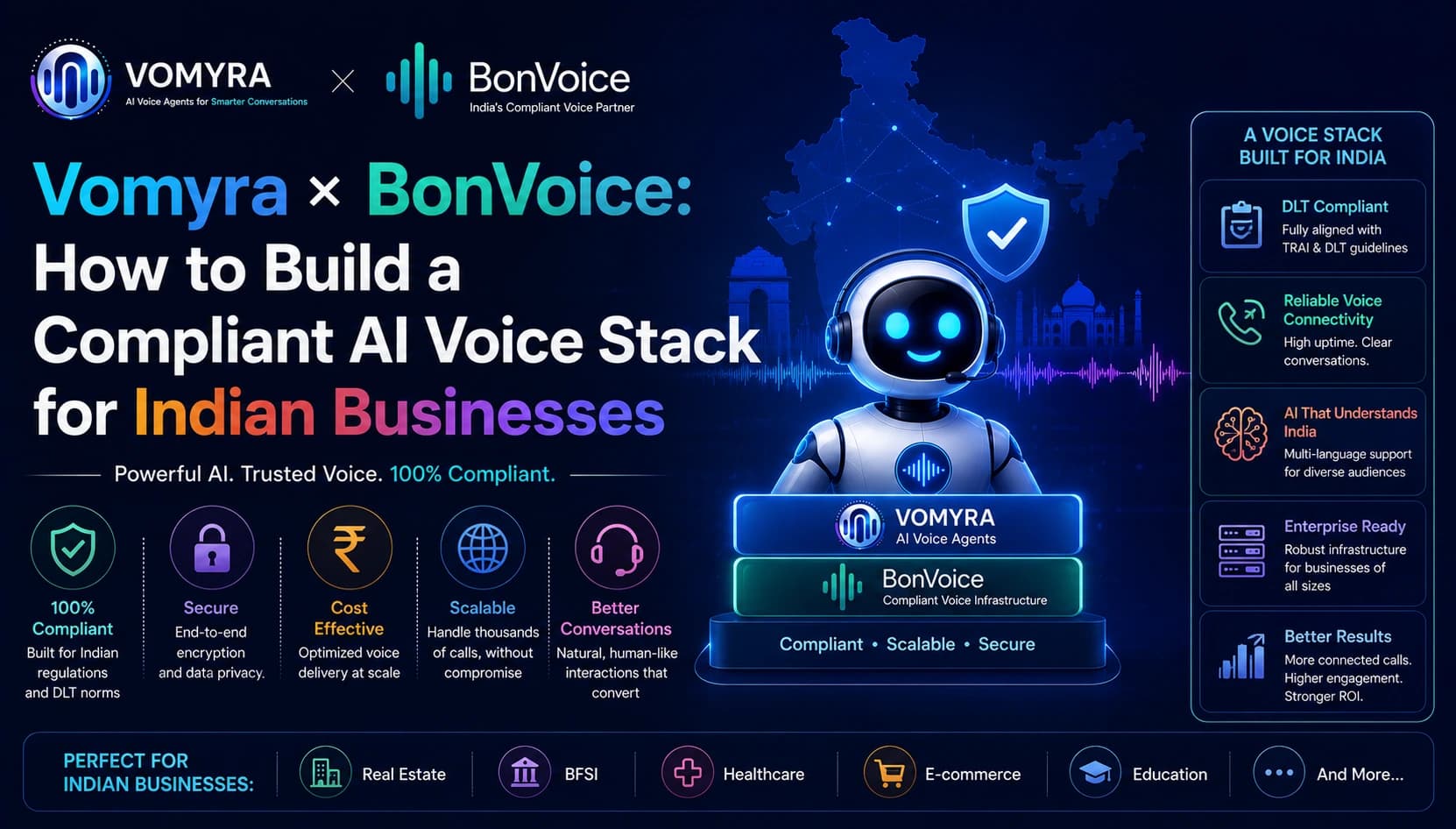
This is exactly the gap that pairing Vomyra with Bonvoice Solutions is designed to close. Instead of stitching together telephony, consent management, and AI logic from separate vendors, this integration handles the entire stack, voice, compliance, and configuration, in one connected setup built specifically for Indian businesses.
Why Compliance Can’t Be an Afterthought in India
Unlike many global markets, India has a fairly strict regulatory framework around calling and messaging, largely enforced through TRAI (Telecom Regulatory Authority of India) and TCCCPR (Telecom Commercial Communications Customer Preference Regulations).
These rules exist to protect consumers from spam calls and unauthorized outreach, but they also mean businesses can’t just plug in an AI voice bot and start dialing.
Getting this wrong isn’t a small risk. Non-compliant calling can lead to blocked numbers, regulatory penalties, and damaged sender reputation, which defeats the entire purpose of building an automated calling system in the first place.
That’s why a proper AI voice stack for Indian businesses needs to be built around compliance first, technology second.
Telephony and Number Provisioning
The foundation of any compliant voice system starts with how numbers are provisioned and routed.
Native Indian Mobile Formats
Using Bonvoice Solutions’ cloud telephony under a UL-VNO (Unified License – Virtual Network Operator) framework, businesses can provision genuine +91 mobile-format virtual numbers, including common prefixes like 98XXX and 94XXX. This matters because customers are far more likely to answer a call from a familiar-looking mobile number than an unfamiliar landline or shortcode.
Simplified Call Routing
Numbers can be assigned directly per agent through Vomyra, without needing to maintain a completely separate standalone Bonvoice account. This keeps the setup lean instead of forcing teams to manage multiple disconnected systems.
Inbound and Outbound Logic
The system handles both inbound call routing and outbound calling campaigns, while strictly respecting TRAI’s designated calling windows. This ensures outbound calls only happen during permitted hours, an easy detail to miss but a critical one for staying compliant.
The Regulatory Compliance Framework
This is where most DIY AI calling setups fall apart. Here’s what a properly compliant system actually needs to handle.
TRAI and TCCCPR Enforcement
Do-Not-Call (DNC) registrations and TCCCPR consent rules need to be enforced automatically, not manually checked before every campaign. The system should recognize which numbers have opted out and prevent outreach accordingly.
Sender Series Separation
Promotional calls and transactional calls can’t share the same number series. Promotional calling needs to go through the designated 140 series, while transactional communication, like appointment confirmations or order updates, runs through the 1600 series. Mixing these up is one of the most common compliance mistakes businesses make.
DLT Registration for Templates
Every SMS and communication template linked to voice campaigns needs Distributed Ledger Technology (DLT) registration. This step is non-negotiable in India and applies even when the primary channel is voice rather than SMS.
Together, these three layers form the regulatory backbone that keeps an AI calling system operating legally and reliably, something covered in more depth in this walkthrough on building a Bonvoice AI voice bot with Vomyra.

Agent Workflow and Language Configuration
Once telephony and compliance are sorted, the next layer is actually building the AI agent’s behavior, how it talks, what it says, and in which language.
No-Code Flow Configuration
Conversation logic, scripts, and voice characteristics can all be configured through a visual builder interface, without needing developers to write custom code. This makes it realistic for smaller teams to launch and adjust their voice agents without depending on technical staff for every small change.
Multilingual and Code-Switching Support
India isn’t a single-language market, and a voice agent that only speaks formal English will lose a large portion of callers. Support for 32+ regional Indian languages, including Hindi, Tamil, and natural Hinglish code-switching, allows the agent to maintain context and sound natural regardless of how a caller chooses to speak.
Audit Trails and Call Logs
Transcripts, call recordings, and analytical logs can be exported directly from the platform, giving businesses verifiable records for compliance audits. This isn’t just useful for regulatory purposes, it also helps teams review call quality and refine scripts over time.
If you’re comparing this setup against other voice AI options before committing, this breakdown on choosing the right voice AI platform for Indian businesses is worth reviewing before finalizing your stack.
Why This Combination Works Better Than Building It Separately
Businesses often try to assemble their own voice AI stack by combining a telephony provider, a consent management tool, and a separate AI platform. On paper, this seems flexible, but in practice, it creates fragmented systems that are harder to maintain, audit, and troubleshoot when something breaks.
By building on a connected framework where telephony, compliance enforcement, and AI configuration all work together natively, businesses avoid the operational overhead of managing multiple disconnected vendors. Instead of hoping all the pieces stay in sync, compliance becomes a built-in part of the infrastructure rather than a separate checklist running alongside it.
Who This Setup Is Built For
This kind of compliant AI voice stack makes the most sense for:
- Businesses running outbound calling campaigns at scale
- Companies handling appointment reminders or transactional updates via voice
- Organizations that need verifiable compliance records for audits
- Teams operating across multiple Indian states and language regions
- Businesses that want to avoid the legal risk of non-compliant calling
Whether it’s a healthcare provider sending appointment confirmations or a financial services company managing outbound campaigns, the same compliance principles apply regardless of industry.
Final Thoughts
Building an AI voice stack for Indian businesses isn’t just about picking a good AI model or a reliable telephony provider, it’s about making sure every layer, from number provisioning to consent enforcement, works together correctly from day one. Getting this right protects businesses from regulatory risk while still delivering the efficiency and scale that automated voice calling promises.
For any business planning to scale outbound or inbound voice automation in India, treating compliance as a foundation rather than an afterthought is what separates a system that works long-term from one that gets shut down after a few complaints.
FAQs
1. What is a UL-VNO framework?
It’s a licensing structure that allows virtual network operators to legally provision and manage telecom numbers in India.
2. Why does sender series separation matter?
Promotional and transactional calls must use different number series (140 vs 1600) to comply with TRAI regulations.
3. Is DLT registration required for voice-only campaigns?
Yes, if any linked SMS templates are involved, DLT registration is mandatory even for primarily voice-based campaigns.
4. Can this system support regional Indian languages?
Yes, it supports 32+ regional languages, including natural code-switching like Hinglish, for more authentic conversations.
5. Do I need coding skills to configure the AI agent?
No, conversation flows, scripts, and voice settings can be configured through a no-code visual builder.