Phone conversations rarely happen in perfect conditions. A customer may call from a busy road, speak while travelling, interrupt a question, or give an answer that is difficult to understand. If an AI voice agent cannot handle these situations properly, even a simple conversation can become frustrating.
AI Voice Agents for Noisy Environments need more than basic speech recognition. They must identify what the caller is saying, recognise when someone wants to speak, and respond carefully when information is unclear. These capabilities help businesses provide smoother customer support, qualify leads, and manage calls without making callers repeat themselves unnecessarily.
Why Real-World Calls Are Difficult for AI Voice Agents
A voice agent may perform well during a quiet demonstration but struggle when it starts handling actual customer calls. Real conversations include traffic sounds, people talking nearby, poor mobile connections, different accents, and incomplete sentences.
These conditions affect how the system hears and interprets a caller. For example, a customer confirming an appointment might say a date that sounds similar to another date. If the agent misunderstands the answer and continues without checking, the booking could be recorded incorrectly.
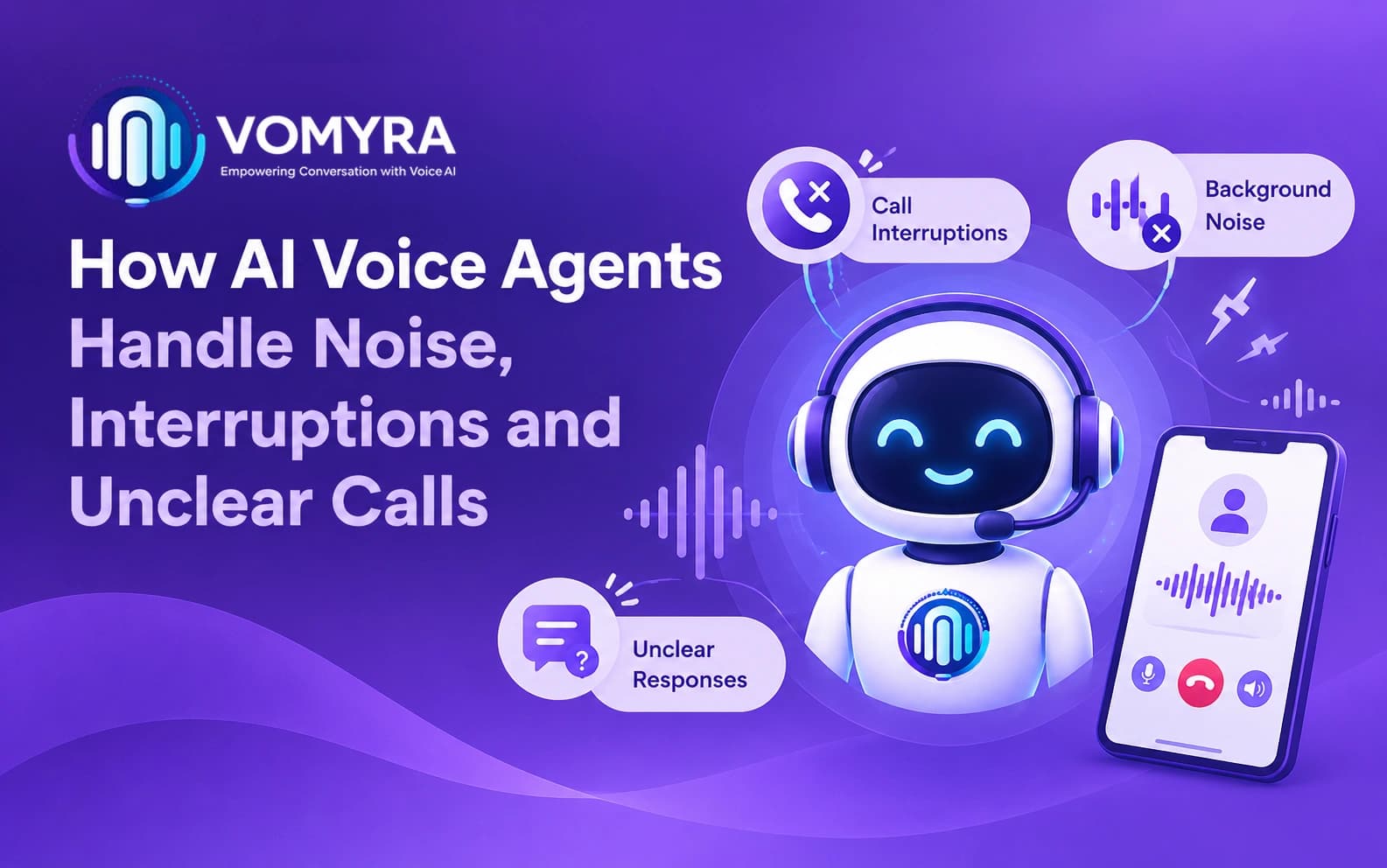
AI Voice Agents for Noisy Environments must therefore handle three important tasks: recognising speech accurately, managing conversation interruptions, and recovering from misunderstandings.
1. Handling Background Noise Without Losing Important Words
Background noise is one of the most common problems during phone conversations. Customers may call from offices, shops, homes, vehicles, or crowded public places. Sounds such as engines, fans, music, and nearby conversations can make spoken words harder to recognise.
How Voice AI Background Noise Handling Works
Voice AI background noise handling can involve audio filtering, noise reduction, and speech detection before the system converts speech into text. These processes help reduce unwanted sounds while keeping the caller’s voice clear enough for recognition.
However, noise reduction is not a complete solution. When background sounds overlap with a person’s voice, some words may remain difficult to identify. The system should avoid treating every generated transcript as completely reliable.
Businesses can improve results by testing calls in environments similar to those their customers use. If most callers speak from mobile phones, testing should include ordinary mobile audio rather than relying only on studio-quality recordings.
2. Managing AI Voice Agent Call Interruptions
People do not always wait for another speaker to finish. A caller may interrupt to correct a detail, ask a question, or provide information before the agent finishes its sentence. A useful voice agent should recognise these moments and adjust its response.
AI voice agent call interruptions require careful turn-taking. The system needs to distinguish a genuine interruption from a short acknowledgement such as “okay,” “haan,” or “right.” Otherwise, it may stop speaking too often or continue talking when the customer needs to respond.
A natural conversation should allow the agent to:
- Stop speaking when the caller clearly takes the conversational turn.
- Listen to the new information before preparing its next response.
- Retain the relevant context from earlier in the conversation.
- Avoid treating every short acknowledgement as a request to interrupt.
AI voice agent call interruptions become especially important when callers use mixed languages or speak quickly. Testing these situations helps businesses identify whether an agent is genuinely responsive or simply following a fixed script.
3. Improving AI Voice Recognition Accuracy
AI voice recognition accuracy depends on several factors, including audio quality, pronunciation, accent, speaking speed, and the recognition model being used. A system may understand a clearly spoken sentence but struggle with a name, address, technical term, or number.
For example, a caller might provide a phone number, mention a product code, or spell out an email address. A small transcription error can create problems later if the agent saves that information without verification.
To improve recognition quality, businesses should:
- Select speech recognition models suited to their callers’ languages and accents.
- Test common words, names, numbers, and industry-specific terms.
- Review transcripts from real calls to identify recurring mistakes.
- Ask callers to repeat important details when confidence is low.
AI Voice Agents for Noisy Environments should also treat critical information differently from ordinary conversation. A slightly unclear general statement may not affect the outcome, but a misunderstood appointment date or customer identifier can have practical consequences.
4. What Happens When a Caller Gives an Unclear Response?
Not every caller gives a complete answer. Someone may respond with “maybe tomorrow,” change their mind halfway through a sentence, or answer a question with information that does not match what the agent asked.
A well-designed agent should recognise when it lacks enough information to proceed. Instead of guessing, it can ask a short follow-up question that helps clarify the caller’s meaning.
For example, if a customer says, “Call me in the afternoon,” the agent may ask, “Would 2 PM or 4 PM work better?” This makes the next step clear without forcing the customer to repeat the entire conversation.
Practical AI Voice Agent Error Handling
AI voice agent error handling determines how the system responds when speech recognition, interpretation, or a connected action fails. It should be designed as part of the conversation rather than treated as an afterthought.
Useful recovery methods include:
- Clarification: Ask the caller to repeat or explain the unclear part.
- Confirmation: Repeat important details before saving or acting on them.
- Fallback responses: Offer another way to proceed when the system cannot understand.
- Human handoff: Transfer the conversation when repeated attempts fail or the issue requires human judgement.
For sensitive or high-impact actions, the agent should not make decisions based on uncertain information. A clear confirmation step is safer than confidently acting on a possible misunderstanding.
5. Keeping Real-Time Voice Conversations Natural
A real-time voice agent conversation depends on more than correct words. Timing matters too. Long pauses can make callers wonder whether the call has disconnected, while responses that arrive too early may interrupt the person who is still speaking.
Streaming audio processing, efficient speech recognition, and well-designed turn detection can help the system respond at an appropriate time. Short, direct answers also make conversations easier to follow and give callers more opportunities to respond.
Vomyra provides voice-agent infrastructure designed for live conversations, including speech processing and interruption handling. Businesses should still test their particular use case, language requirements, call quality, and recovery behaviour before deploying an agent widely.
Read More: Multilingual Voice Agents for AI Voice Agents: Practical Guide for Production Calling

6. How Businesses Can Test Voice Agents Before Launch
Testing should reflect the situations the agent will encounter after deployment. A quiet call with a clear speaker is useful, but it cannot show how the system performs across different real-world conditions.
A practical testing checklist should include:
- Calls with traffic, office noise, and other background sounds.
- Customers who interrupt, pause, or change their answers.
- Different accents and mixed-language conversations.
- Unclear names, dates, phone numbers, and other important details.
- Temporary connection problems and failed system integrations.
- Situations where the agent should request clarification or transfer the call.
Businesses should review transcripts, incorrect responses, unnecessary interruptions, and successful recovery attempts. These observations help teams identify specific problems instead of relying on a general impression that the agent sounds natural.
Vomyra can be considered when evaluating a voice AI setup, but the right choice depends on how well the complete system performs under the business’s actual calling conditions.
Conclusion
Reliable AI Voice Agents for Noisy Environments must do more than recognise speech in ideal conditions. They need to manage interruptions, filter unwanted noise, identify unclear responses, and recover without guessing when information is missing. The most effective approach combines suitable speech recognition, careful conversation design, realistic testing, and clear escalation rules.
With these elements in place, businesses can make automated calls easier to follow and reduce avoidable communication errors. Vomyra offers a platform businesses can evaluate for these requirements, with testing based on their own callers and workflows remaining essential.
FAQs
1. Can AI voice agents understand callers in noisy environments?
They can handle many noisy situations using audio filtering and speech recognition, but performance depends on noise levels, audio quality, accents, and the model used. Testing with realistic calls is essential.
2. How do AI voice agents handle interruptions?
They use turn detection and interruption-handling logic to identify when a caller wants to speak. The agent can then stop its response, listen, and continue based on the new information.
3. What affects AI voice recognition accuracy?
Background noise, poor connections, unfamiliar accents, fast speech, and specialised terms can all affect recognition. Testing real calls and confirming important details can help reduce errors.
4. What should an AI voice agent do when it cannot understand a caller?
It should ask a clear follow-up question, request repetition, or offer another way to continue. If it still cannot resolve the issue, transferring the call to a human may be appropriate.
5. How can businesses test an AI voice agent before launch?
Businesses should test noisy calls, interruptions, mixed-language speech, unclear answers, and failed integrations. Reviewing transcripts and recovery behaviour helps identify issues before wider deployment.