Voice automation has moved past simple call-and-response scripts. Businesses now expect their AI callers to check a booking calendar, pull customer history, update a spreadsheet, and confirm a payment, all inside one phone call. None of that is possible if the voice agent can only talk.
It needs a way to reach outside tools and act on real data. This is where the Model Context Protocol, or MCP, comes in, and it is quickly becoming the backbone of every serious MCP server voice agent India businesses are starting to adopt.
This article breaks down what an MCP server does, why it matters for voice AI, and how it changes what a phone-based assistant can accomplish for a business operating in India.
Understanding MCP in Plain Terms
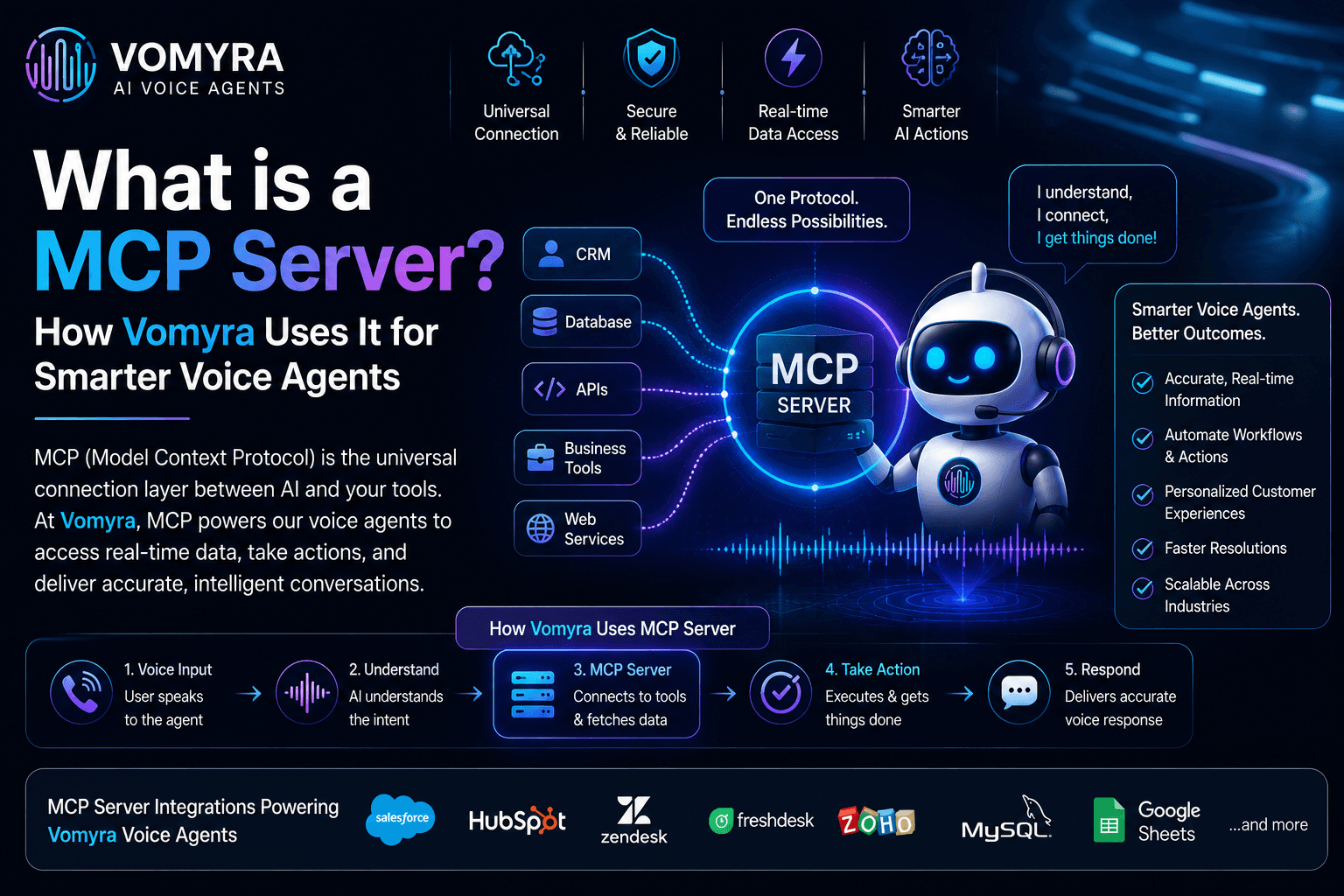
MCP stands for Model Context Protocol, an open standard that lets an AI model connect to outside tools, databases, and services in a structured, predictable way. Before MCP, every integration between a voice assistant and, say, a CRM or a booking system had to be custom built. A developer would write separate code for each connection, test it, maintain it, and repeat the process every time a new tool needed to be added.
An MCP server removes that repetitive work. It acts as a translator sitting between the AI model and a specific system, such as a payment gateway, a Google Sheet, a hotel booking calendar, or a restaurant POS. The AI does not need to know how that system works internally.
It only needs to ask the MCP server for what it wants, and the server handles the technical exchange. One common comparison is a universal connector port: instead of wiring a different cable for every device, one standard port handles all of them.
For a voice agent, this distinction is significant. A phone call is a real-time, fast-moving interaction. A caller will not wait thirty seconds while a backend integration figures out how to fetch their order status. MCP keeps that exchange quick and structured, so the agent can speak naturally while quietly pulling or updating information in the background.
Why Voice Agents Specifically Need This
Text-based chatbots have had years to mature their integrations. Voice is a newer and harder problem because everything happens live, with no room for lag or visible loading screens. A caller expects an answer the moment they finish a sentence.
Without a protocol like MCP, voice platforms either limit themselves to a small set of pre-built integrations or rely on engineers writing brittle, one-off connections for every client request. Both approaches slow down how fast a business can deploy a useful agent.
MCP solves this by giving any voice platform a standard way to plug into new tools without rebuilding the core system each time.
This matters for companies scaling a voice agent across industries. A restaurant agent needs a POS system. A real estate agent needs listings and scheduling tools. A clinic needs an appointment calendar. With MCP, the same voice engine connects to all of these through different MCP servers, instead of needing a separate build for each use case.
How an MCP Server Works During an Actual Call
It helps to walk through what happens on a real phone call once MCP is involved.
A customer calls in and says they want to check the status of their last order. The voice agent transcribes the speech, understands the intent, and recognizes it needs order data it does not already have. Instead of guessing or asking the caller to hold while a human steps in, the agent sends a structured request to the MCP server connected to the business’s order system.
The server queries the database, returns the relevant order details, and the agent converts that into a spoken response, all within a couple of seconds.
If the caller then asks to reschedule a delivery, the same flow repeats with a different tool, perhaps updating a calendar or sending a confirmation message. The agent is not following a fixed script; it is deciding, in the moment, which tool to call based on what the caller actually needs. That flexibility is the core advantage MCP brings to voice automation.
The Difference Between Scripted Bots and MCP-Connected Agents

Older IVR systems and basic voice bots run on rigid decision trees: press 1 for billing, press 2 for support. Even AI-driven bots without proper tool access tend to fall back on canned answers once a question falls outside their training data.
An MCP-connected voice agent behaves differently because it can reach for live information instead of relying only on what it was trained on. Ask it about today’s room availability, and it checks the actual booking system. That is the gap between an agent that sounds smart and one that is actually useful for running a business.
Why This Matters for Businesses in India
Indian businesses, particularly in hospitality, real estate, and retail, deal with a unique mix of demands: multilingual callers, regional POS systems, WhatsApp-driven workflows, and a strong reliance on tools like Google Sheets for day-to-day operations. A voice agent built without flexible tool access struggles to fit into this environment because it cannot adapt to the specific systems a business already uses.
This is exactly the gap an MCP server voice agent India companies are evaluating needs to close. The agent should not force a business to change its existing software stack. Instead, it should connect to what is already in place, whether that is a regional POS, a spreadsheet, or a CRM built for the Indian market, and do so while speaking fluently in Hindi or other Indian languages.
How Vomyra Uses MCP to Build Smarter Agents
Vomyra is a no-code voice AI platform designed for businesses across hospitality, real estate, recruitment, and financial services in India. Rather than locking customers into a fixed set of features, the platform is built around the same idea that makes MCP useful: agents should be able to connect to the tools a business already runs on.
A Vomyra Ai Voice Agent deployed for a restaurant can sync directly with Petpooja, India’s widely used POS system, to take orders and update inventory in real time without manual entry. For other use cases, the same underlying architecture connects to Google Sheets for lead capture, scheduling tools for hotel and dental bookings, and CRM systems for sales and recruitment follow-ups.
Each of these connections works the way an MCP server is meant to work: the voice agent asks for what it needs, the connected tool handles the task, and the conversation continues without interruption.
This approach is also what allows the platform to support multiple Indian languages alongside live tool access. A guest can book a hotel room in Hindi, ask about pricing, and get a confirmation, while the same conversation triggers updates inside the hotel’s actual booking system. None of this requires the business to learn new software or hire a developer to wire up each integration manually.
Security and Reliability Considerations
Connecting an AI model directly to business systems naturally raises questions about data safety. MCP addresses this through standardized authentication, including OAuth-based access control, so a voice agent only gets the access it is explicitly granted. A booking tool should not be able to touch financial records, and a support agent should not have admin-level access to a database just to look up an order.
It is worth asking any voice AI provider how access permissions are scoped per integration and whether logs are kept for every tool call made during a conversation. A well-implemented MCP setup should make these answers straightforward, since structured logging and permission boundaries are part of the protocol’s design.
What’s Next for AI Voice Automation
Voice AI is shifting away from one-off automations toward connected systems that can reason about which tool to use and when. MCP is becoming the shared language that makes this possible, the same way standard APIs once made web integrations easier across unrelated platforms.
As more Indian businesses move customer interactions to phone-based AI, the ones with flexible, MCP-style architecture will adapt faster and connect to more of the systems business owners already depend on.
For a deeper look at how this works in practice, or to see how a Vomyra Ai Voice Agent can be set up for a specific industry, it helps to start with a free trial and test how the agent handles a real call using existing business tools.
Final Thoughts
An MCP server is not complicated once broken down: it is a structured bridge that lets an AI model use outside tools without custom-coding every connection.
For voice agents, that bridge is the difference between a bot that can only talk and an assistant that can get things done on a call. As more businesses in India look for voice automation that respects their existing software and language needs, understanding MCP is a useful starting point for evaluating which platform is built to last.
FAQs
1. What is an MCP Server?
An MCP (Model Context Protocol) Server is a framework that enables AI systems to securely connect with external tools, databases, APIs, and business applications. It helps AI agents access real-time information and perform actions beyond simple conversations.
2. How does Vomyra use MCP Servers?
Vomyra uses MCP Servers to connect AI voice agents with CRM platforms, scheduling systems, databases, help desks, and other business tools. This allows voice agents to retrieve information, update records, and complete tasks during live calls.
3. What are the benefits of MCP-powered voice agents?
MCP-powered voice agents can provide accurate real-time responses, automate workflows, reduce manual work, improve customer experiences, and seamlessly integrate with existing business systems.
4. Can Vomyra’s AI voice agents work with existing business software?
Yes. Through MCP integrations, Vomyra voice agents can connect with a wide range of business applications, including CRMs, calendars, ticketing systems, payment platforms, and custom internal tools.