Introduction
The rapid adoption of AI voice technology has transformed how organizations manage customer interactions. AI voice agents are increasingly being deployed across sales, customer support, lead qualification, appointment scheduling, collections, hospitality, healthcare, and other communication-intensive business functions. While automation has significantly improved operational efficiency, scalability, and response consistency, conversion performance remains heavily dependent on the quality of customer interactions.
Among the factors influencing AI call outcomes, voice naturalness has emerged as one of the most significant. The difference between a robotic-sounding voice system and a human-sounding AI voice agent extends beyond user experience considerations. It directly affects customer engagement, trust formation, information retention, call completion rates, and conversion performance.
As voice AI adoption accelerates across industries, organizations are increasingly recognizing that automation alone does not guarantee business success. The effectiveness of an AI voice agent depends not only on what it communicates but also on how that communication is delivered. Human speech carries complex social and psychological signals that influence perception, credibility, and decision-making. AI systems capable of replicating these characteristics consistently achieve stronger business outcomes than systems relying on traditional robotic speech synthesis.
The relationship between voice quality and conversion performance has become a critical area of focus for organizations seeking to maximize the return on investment from voice AI deployments.
The Business Impact of Voice Quality
Voice communication remains one of the most influential channels for customer engagement. Unlike text-based interactions, phone conversations require immediate responses and rely heavily on auditory cues. During a call, customers continuously evaluate the speaker’s credibility, confidence, professionalism, and trustworthiness based on vocal characteristics.
Human speech naturally contains variations in pitch, rhythm, pacing, emphasis, and emotional tone. These characteristics help listeners interpret meaning beyond the words themselves. They also contribute to perceptions of authenticity and attentiveness.
When voice AI systems fail to replicate these characteristics, interactions often feel mechanical and impersonal. Customers may recognize the artificial nature of the conversation within seconds, leading to reduced engagement and increased call abandonment.
Conversely, human-sounding AI voice agents create interactions that closely resemble natural conversations. This increases the likelihood that customers remain engaged throughout the interaction, allowing organizations to achieve higher completion rates and stronger conversion outcomes.
The influence of voice quality is particularly significant in customer-facing environments where trust and relationship-building play a central role in decision-making.
Call Completion Rates and Customer Engagement
Call completion rate is one of the earliest indicators of AI voice agent performance. It measures the percentage of connected calls that progress through the intended workflow without premature disengagement.
Research and deployment data consistently demonstrate that customers form initial impressions within the first few seconds of hearing an AI voice. During this period, listeners evaluate speech quality, conversational flow, and perceived authenticity.
Several characteristics commonly associated with robotic voice systems contribute to higher abandonment rates:
- Monotonic delivery
- Repetitive intonation patterns
- Unnatural pauses
- Mechanical pronunciation
- Delayed response timing
These characteristics increase the likelihood that customers disengage before meaningful communication occurs.
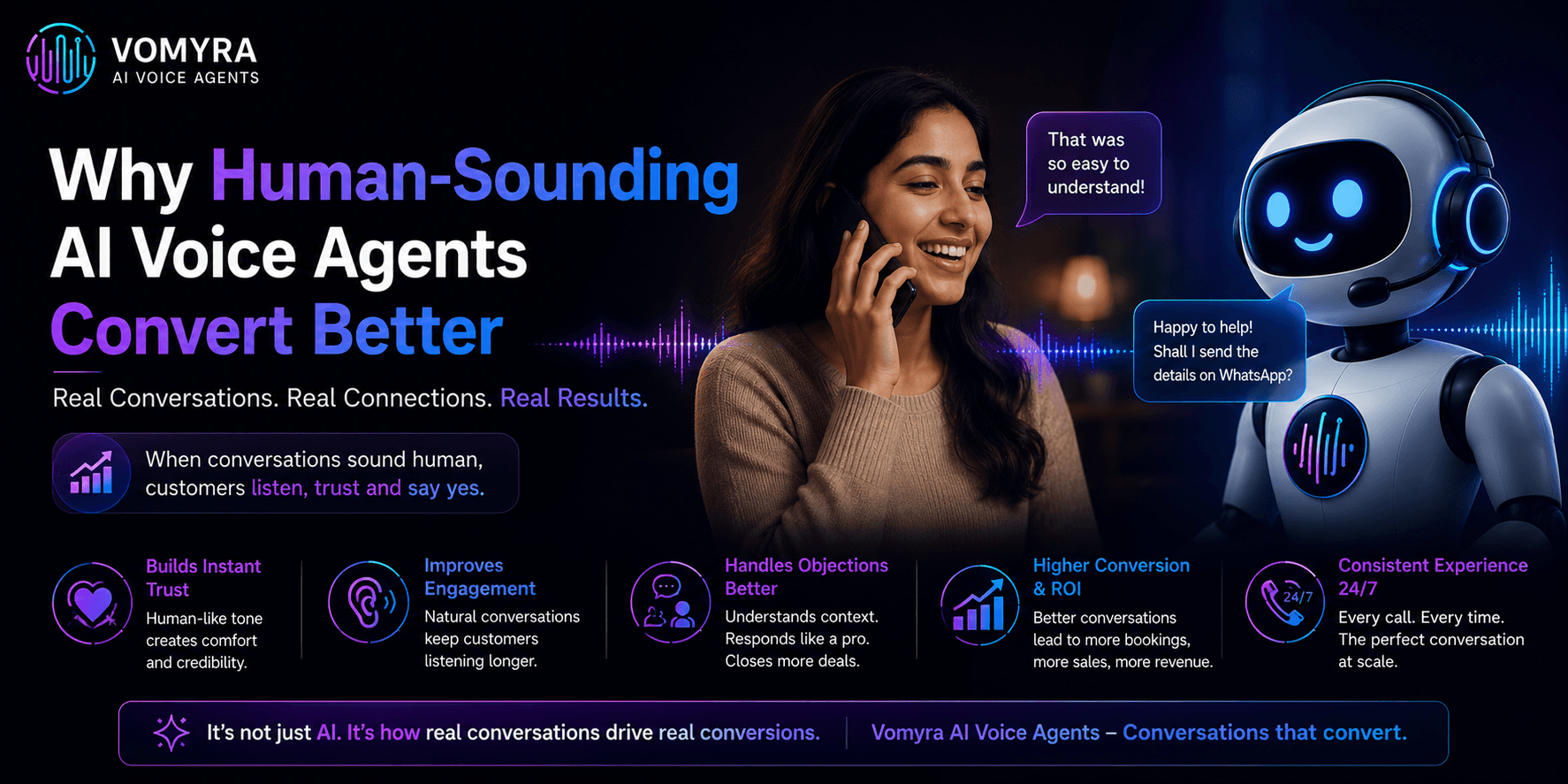
Human-sounding AI voice agents reduce these barriers by delivering speech patterns that closely align with natural human conversation. Realistic pacing, dynamic intonation, and natural response timing encourage customers to remain engaged, increasing the probability that the interaction reaches its intended objective.
Higher call completion rates create a direct positive impact on downstream performance metrics, including lead qualification, appointment booking, and sales conversion.
The Relationship Between Trust and Conversion
Trust plays a central role in virtually every customer interaction. Whether a customer is considering a financial product, scheduling a healthcare appointment, booking a service, or responding to a sales inquiry, trust significantly influences decision-making behavior.
Human beings rely on vocal cues as an important mechanism for assessing trustworthiness. Research in communication psychology and psychoacoustics has shown that listeners often form judgments about credibility before fully evaluating the content of a conversation.
Natural human speech contains numerous trust-building signals, including:
- Subtle pitch variation
- Contextual emphasis
- Emotional responsiveness
- Conversational pacing
- Tonal warmth
These characteristics help listeners perceive the speaker as attentive, competent, and authentic.
Robotic voice systems frequently lack these signals, resulting in interactions that feel impersonal or artificial. Even when identical information is delivered, customers may perceive robotic voices as less trustworthy than natural-sounding alternatives.
This distinction has significant implications for conversion performance. Increased trust improves customer willingness to share information, continue conversations, accept recommendations, and commit to next-step actions.
As a result, trust serves as one of the primary mechanisms through which human-sounding AI voice agents achieve higher conversion rates.
Psychological Factors Influencing Human Response to Voice AI
Social Presence and Human Connection
Social Presence Theory suggests that communication becomes more effective when individuals perceive a stronger sense of interpersonal connection.
Natural-sounding voice interactions create a greater sense of presence than robotic alternatives. Customers are more likely to perceive the interaction as attentive and responsive, even when they understand that they are speaking with an AI system.
Higher levels of perceived presence contribute to increased engagement, stronger information retention, and greater willingness to participate in the conversation.
These factors collectively support improved conversion outcomes across a wide range of business applications.
Cognitive Processing Fluency
Cognitive processing fluency refers to the ease with which information is processed and understood.
Human brains are optimized to interpret natural speech patterns. When speech follows familiar rhythms and conversational structures, listeners expend less mental effort on comprehension.
Robotic speech often introduces unnecessary cognitive friction through unusual pacing, unnatural emphasis, or inconsistent intonation. This additional effort can reduce attention and negatively affect persuasion.
Human-sounding AI voice agents improve processing fluency by presenting information in a format that closely resembles natural conversation. Reduced cognitive load enables customers to focus on the content of the interaction rather than the mechanics of speech delivery.
The Uncanny Valley Effect
The Uncanny Valley describes a phenomenon in which artificial representations become increasingly realistic until subtle imperfections create discomfort.
This principle applies to voice technology as well.
Voices that sound obviously robotic are easily identified as machine-generated. Highly realistic voices are generally perceived positively. However, voices that sound almost human while retaining noticeable artificial characteristics can create unease and reduce trust.
Advanced AI voice systems seek to overcome this challenge by achieving a level of realism that supports natural conversational experiences without triggering negative psychological responses.
Technical Characteristics of Human-Sounding AI Voice Agents

The effectiveness of a voice AI system depends heavily on the technologies used to generate and manage speech.
Natural Prosody
Prosody refers to the rhythm, stress, and intonation of speech. It is one of the most important factors determining whether a voice sounds human.
Advanced neural voice systems dynamically adjust speech patterns based on sentence structure, conversational context, and communication objectives. This creates interactions that feel significantly more natural than traditional text-to-speech systems.
Conversational Timing
Human conversations operate within predictable timing patterns. Responses that occur too quickly may appear artificial, while delayed responses can disrupt conversational flow.
Low-latency AI systems maintain natural response timing, helping preserve engagement and improve the overall customer experience.
Emotional Variation
Human communication involves emotional nuance. Even professional conversations contain subtle changes in tone that communicate attentiveness, empathy, confidence, or urgency.
Modern AI voice systems increasingly incorporate emotional context modeling to improve realism and create more engaging interactions.
Speech Consistency
While natural variation is important, consistency remains equally critical. Human-sounding AI voice agents must maintain clarity, pronunciation accuracy, and conversational coherence across thousands of interactions.
Achieving the appropriate balance between consistency and natural variation is a defining characteristic of high-performance voice AI systems.
Industry Applications with Significant Conversion Impact
Real Estate
Real estate sales depend heavily on trust and relationship-building. Prospective buyers frequently require multiple interactions before scheduling property visits or consultations.
Human-sounding AI voice agents improve engagement during lead nurturing and appointment scheduling activities, supporting stronger conversion performance throughout the sales process.
Financial Services
Financial products often involve significant customer commitment and risk assessment. Trust and credibility are therefore essential components of successful customer communication.
Natural voice AI enhances customer confidence during lead qualification, onboarding, and follow-up interactions, contributing to improved conversion outcomes.
Healthcare
Healthcare communication requires clarity, empathy, and attentiveness. Appointment scheduling, patient follow-ups, and care coordination activities benefit significantly from natural conversational experiences.
Human-like AI voice agents help improve patient engagement while maintaining operational efficiency.
Hospitality and Reservations
Customer experience begins long before service delivery. Reservation management, booking confirmations, and guest communication influence brand perception and purchasing decisions.
Natural-sounding voice interactions contribute to a more professional and customer-centric experience, improving both engagement and conversion metrics.
Vomyra AI Voice Agent and Voice Naturalness
As organizations increasingly prioritize conversational quality, platforms capable of delivering realistic voice experiences are becoming strategically important.
Vomyra AI Voice Agent is designed to support human-like communication through advanced voice synthesis, natural conversational timing, and intelligent interaction management.
The platform focuses on creating voice experiences that align with established principles of human communication while maintaining the scalability and efficiency advantages of AI automation.
By emphasizing voice naturalness as a core performance factor, organizations can improve customer engagement, strengthen trust formation, and optimize conversion outcomes across a variety of business applications.
Conclusion
The relationship between voice quality and conversion performance has become increasingly evident as AI voice adoption expands across industries. Human-sounding AI voice agents consistently outperform robotic systems in key performance areas, including call completion rates, customer engagement, trust formation, lead qualification, and conversion outcomes.
The advantages associated with natural voice AI are supported by established research in communication psychology, social cognition, and human perception. Natural speech patterns reduce cognitive friction, strengthen interpersonal trust, and create conversational experiences that more closely resemble human interactions.
As organizations continue investing in AI-driven customer communication, voice quality is emerging as a critical competitive differentiator. Automation alone is no longer sufficient to maximize performance. The ability to deliver realistic, engaging, and trustworthy voice experiences increasingly determines whether AI interactions achieve their intended business objectives.
For businesses seeking higher conversion rates, stronger customer engagement, and improved AI voice agent ROI, human-sounding voice technology represents a foundational component of effective AI communication strategy.
FAQs
1. What is a human-sounding AI voice agent?
A human-sounding AI voice agent uses advanced speech synthesis, natural language processing (NLP), and conversational AI to create realistic interactions that closely resemble human conversations. Vomyra’s AI voice agents are designed to engage customers naturally, helping businesses automate calls without sacrificing the human touch.
2. Why do Vomyra’s human-sounding AI voice agents convert better than robotic voice systems?
Vomyra’s AI voice agents create a more natural and trustworthy customer experience. Their realistic tone, pacing, and conversational flow reduce friction during calls, resulting in higher engagement, improved lead qualification, increased appointment bookings, and better conversion rates.
3. How do Vomyra AI voice agents improve customer engagement?
Vomyra’s natural voice AI makes conversations feel personal and authentic. Customers are more likely to stay on the line, ask questions, and share information when interacting with a human-like voice, leading to stronger engagement and better customer experiences.
4. Can Vomyra AI voice agents effectively qualify leads?
Yes. Vomyra AI voice agents can automatically ask qualifying questions, analyze responses in real time, and identify high-intent prospects based on your business criteria. This enables sales teams to focus on the most promising leads while reducing manual workload.
5. Which industries benefit most from Vomyra’s human-like AI voice agents?
Vomyra AI voice agents are ideal for industries that rely on phone conversations for lead generation, customer support, and appointment scheduling. Common use cases include healthcare, real estate, insurance, financial services, education, automotive, home services, and professional services, where natural conversations can significantly improve conversion rates and customer satisfaction.