The End of “Press 1 for Hindi, Press 2 for English”
Every Indian who has ever called a bank, an insurance company, a telecom provider, or a delivery helpline knows exactly what an IVR system sounds like. A flat, robotic voice reads through a list of options. The caller presses a number. Another list appears.
The caller presses another number. Eventually, after navigating three to five menus, they either reach a human agent who puts them on hold, or they hang up in frustration and try WhatsApp instead.
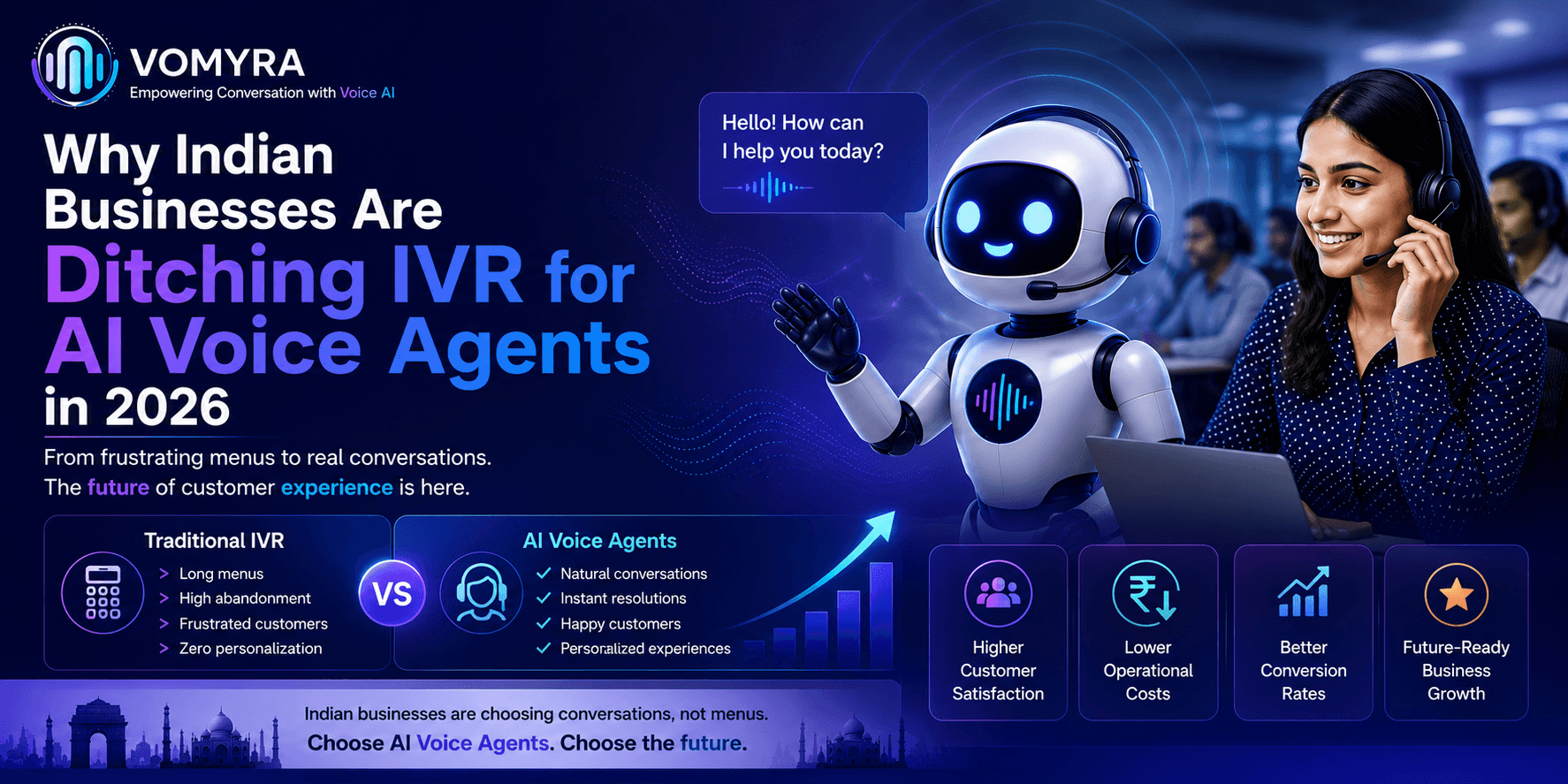
India’s IVR era is not ending because the technology stopped working. It is ending because Indian businesses now have access to something that works dramatically better-AI voice agents that understand what a caller is actually saying, respond in their language within milliseconds, and complete the task without routing anyone through a menu at all.
Vomyra AI Voice Agent is one of the platforms leading this migration for Indian SMBs-a no-code AI voice agent platform India businesses across real estate, restaurants, BFSI, hospitality, fintech, and recruitment deploy to replace outdated IVR systems with intelligent, multilingual AI calling agents that operate 24 hours a day on Indian +91 numbers.
This is the most significant shift in how Indian businesses handle customer communication in a decade. Here is why it is happening now, what is driving it, and what businesses across different sectors are gaining from making the switch.
What Made IVR Good Enough for So Long
IVR-Interactive Voice Response-was never a great customer experience. It was a cost control mechanism. Before IVR, every inbound call required a human agent to pick up the phone. At scale, that meant large calling teams, high staffing costs, and significant coverage gaps during peak hours and nights. IVR automated the routing layer, reducing the number of calls that needed a human to answer them.
For that narrow purpose, IVR worked. A caller wanting to check their bank balance could press 1, enter their account number, and get the information without tying up an agent. A caller wanting to know a restaurant’s hours could hear a recording without a staff member having to answer.
The problem was everything else. Three years ago, voice AI in India meant an IVR with a slightly better speech recogniser. In 2026, it means a system that can take an inbound call from a policyholder in Hinglish, retrieve their policy, explain a renewal, collect premium on UPI, log the transaction in the CRM, and send a WhatsApp confirmation-inside one call, with no human in the loop. IVR could not do any of that. It could route. It could not understand, respond, or complete.
Five Reasons the Switch Is Happening Now
1. Regional language models reached production quality.
The single biggest technical barrier to AI voice adoption in India was language. A model with 5% error on US English can easily hit 25% or higher on regional Indian languages over phone audio. For years, AI voice systems built on Western speech recognition models produced unacceptable error rates on Hindi, Tamil, Telugu, Marathi, and Bengali-particularly over mobile phone audio with background noise, regional accents, and Hinglish code-switching.
In 2026, that barrier has fallen. Indian-language voice models trained on actual telephony audio-not studio recordings-now achieve word error rates that make production deployment viable across Hindi, Hinglish, Tamil, Telugu, Marathi, Gujarati, Bengali, Punjabi, and even Assamese.
Vomyra AI Voice Agent supports all of these natively, with automatic language detection that follows mid-sentence language switches without breaking-the standard for how urban Indian customers actually speak.
2. The cost gap became impossible to ignore.
PwC estimates that AI-enabled voice systems can reduce customer service costs by as much as 70 percent, while improving first-call resolution rates. For Indian businesses, this maps to a specific number: a fully loaded human telecaller costs ₹40,000 to ₹65,000 per month, while an AI voice agent on an INR-priced no-code platform resolves the equivalent contact at ₹5 to ₹15.
At any meaningful call volume, this is not a marginal improvement. It is a structural cost reduction that changes the economics of running a sales or support operation.
3. Attrition made IVR-plus-human teams unsustainable.
India’s BPO industry faces 30 to 50 percent annual attrition, night-shift fatigue, and rising costs. The human layer behind every IVR system-the agents who handle the calls IVR could not resolve-was already stressed before AI became viable.
Constant recruitment, constant retraining, and constant quality variation from a team with 40 percent annual turnover meant the IVR-human combination was delivering inconsistent results at high and rising cost.
4. Customer expectations crossed the threshold.
Indian customers now book cab rides in 30 seconds, order food in two minutes, and transfer money without speaking to anyone. The same customer calling a real estate developer, a clinic, or a bank and being asked to press 1 for English experiences a jarring gap between their digital experience and their phone experience. The shift from IVR tolerance to IVR rejection in India accelerated sharply between 2024 and 2026 as smartphone penetration deepened and digital-native expectations spread to Tier 2 and Tier 3 cities.
5. No-code deployment removed the technical barrier for SMBs.
For large enterprises, the IVR-to-AI migration required significant technology investment and months of integration work. For small and mid-sized Indian businesses-the restaurant group, the real estate brokerage, the NBFC, the clinic network-deploying an AI voice agent on a no-code platform now takes days rather than months.
No developer required, no telephony account to configure separately, no API integration to maintain. A best voice AI platform for startups India businesses can access today is one that goes live in a week, not a quarter.
What Businesses Across Sectors Are Gaining
Real estate. An AI voice agent for real estate India calls back portal leads within 60 seconds of submission-day or night-asks qualification questions on budget, location, and timeline, and books site visits directly into the sales calendar.
The IVR alternative required a caller to select a language, navigate to an inquiry option, and leave a callback request that a human agent might call back the next morning. The AI alternative produces a qualified lead before the competitor has responded.
Restaurants and food service. An AI voice agent for restaurants India handles order-taking calls, reservation requests, and menu queries during peak service hours when every staff member is occupied. With Petpooja AI integration voice support, phone orders route directly into the kitchen ticketing workflow.
The IVR alternative-“press 1 to place an order, press 2 for reservations”-still required a human to complete the transaction. The AI alternative completes it entirely.
Hotel and hospitality. An AI voice agent for hotel booking India checks live room inventory, quotes current rates, confirms reservations, and handles pre-arrival queries without a front desk agent being available. Up to 40 percent of hotel calls go unanswered during check-in hours under the IVR-human model. The AI model answers every call within seconds.
Fintech and lending. An AI voice agent for fintech India qualifies loan inquiry calls immediately, asks about income, employment type, and loan amount, and routes genuinely interested applicants to advisors-replacing a multi-menu IVR that left callers confused about which option applied to their situation and resulted in significant call abandonment.
Healthcare. An AI receptionist India Hindi speakers and regional language speakers can talk to naturally replaces the IVR appointment booking flow that required callers to enter dates and times using a phone keypad-a process that produced high abandonment rates, particularly among older patients.
Recruitment. An AI recruitment calling bot India HR teams use screens candidates by availability, experience, and role fit over a natural conversation-replacing IVR pre-screening that candidates routinely abandoned or gamed by pressing whatever option seemed most likely to get them to a human.
What “No-Code” Actually Means in Practice

The phrase no-code appears on most AI voice platform marketing pages. The practical difference between a genuinely no-code platform and a developer-first platform with a visual wrapper is significant.
A genuinely no-code AI voice agent platform India businesses can use without a developer provides: an Indian +91 phone number included in the platform without a separate telephony account a visual conversation flow editor where questions, branches, and escalation logic are configured by clicking rather than coding a knowledge base where product information, pricing, and FAQs are entered in plain language CRM and POS integration through pre-built connectors rather than API development and TRAI compliance controls including calling-hour enforcement and DND scrubbing built into the campaign settings.
Vomyra AI Voice Agent is built to this standard. A front office manager, a sales team lead, or a business owner can configure an agent, connect it to an Indian number, and go live without filing a developer request or waiting for an integration sprint.
The Metrics That Change When IVR Becomes AI
The difference between IVR and AI is not just qualitative-it shows up in specific numbers that Indian businesses measure every month.
Call abandonment rates on IVR systems average 35 to 60 percent across Indian industries. Callers hang up when they cannot find the right menu option or when hold times extend. AI voice agents reduce abandonment to under 10 percent on well-configured deployments because the caller reaches a response immediately and in their own language.
First-call resolution-the percentage of calls where the customer’s issue is fully resolved without a callback or transfer-averages 40 to 55 percent on IVR-human hybrid systems. AI voice agents resolve 65 to 80 percent of the call types they are configured for on the first call, because they access live data, complete transactions, and confirm outcomes in a single conversation.
Lead qualification speed-the time between a lead inquiry and a qualified lead reaching a human salesperson-goes from hours or days on an IVR-human model to minutes on an AI model. For Indian sales operations where response speed is the single largest determinant of conversion, this number determines how many deals get closed before a competitor responds.
Vomyra AI Voice Agent is built to deliver all three of these metric improvements-lower abandonment, higher first-call resolution, and faster lead qualification-on a no-code platform that goes live in days, not months.
Getting Started: Replace One IVR Flow First
The practical migration path for most Indian businesses is not replacing the entire IVR system at once. It is identifying the single highest-volume IVR flow-typically the inbound inquiry line or the appointment booking menu-and replacing that flow with a configured AI voice agent first.
This produces a clean measurement: before and after call abandonment rate, first-call resolution rate, and qualified lead volume from the same call source. If the numbers improve-and across documented deployments they consistently do-the case for expanding to additional flows is made by the data rather than by a technology pitch.
Vomyra AI Voice Agent supports this phased migration with a free AI voice agent India trial that covers a full deployment against real call volume. A free trial gives Indian businesses the data needed to validate the switch before committing to a full plan-in Hindi, Hinglish, Tamil, Telugu, or any of the other Indian languages the platform supports natively.
Frequently Asked Questions
Is an AI voice agent better than IVR for Indian businesses?
Yes, for most use cases. AI understands natural speech in Hindi, Hinglish, and regional languages, completes transactions, and resolves calls without menus. IVR routes calls through numbered options and cannot understand free-form speech.
Do I need a developer to switch from IVR to an AI voice agent?
Not on a genuinely no-code platform. Vomyra AI Voice Agent configures through a visual interface-conversation flow, knowledge base, integrations, and Indian +91 number-without any coding or developer involvement.
How long does the switch from IVR to AI voice take?
A single-workflow deployment-such as replacing an inbound inquiry IVR-typically goes live within three to five working days on a no-code platform.
Can an AI voice agent handle the same call volume as an IVR?
Yes, with no upper limit on concurrent calls. Unlike IVR systems constrained by channel capacity, an AI voice agent platform scales automatically with call volume.
What languages does Vomyra AI Voice Agent support?
Hindi, Hinglish, Tamil, Telugu, Marathi, Gujarati, Bengali, Punjabi, Assamese, and English-with automatic language detection based on how the caller opens the conversation.