Most businesses spend far more effort acquiring new customers than reactivating ones who already know the product and already trusted the brand once. Dormant customers – people who haven’t purchased, renewed, or engaged in months – are one of the most overlooked sources of revenue in most businesses, largely because reactivating them at scale is hard to do manually.
Calling through a dormant customer database is repetitive, low glamour, and easy to deprioritise compared to active sales pipeline. Most teams simply don’t have the calling capacity to run it consistently, so dormant customer lists tend to sit untouched.
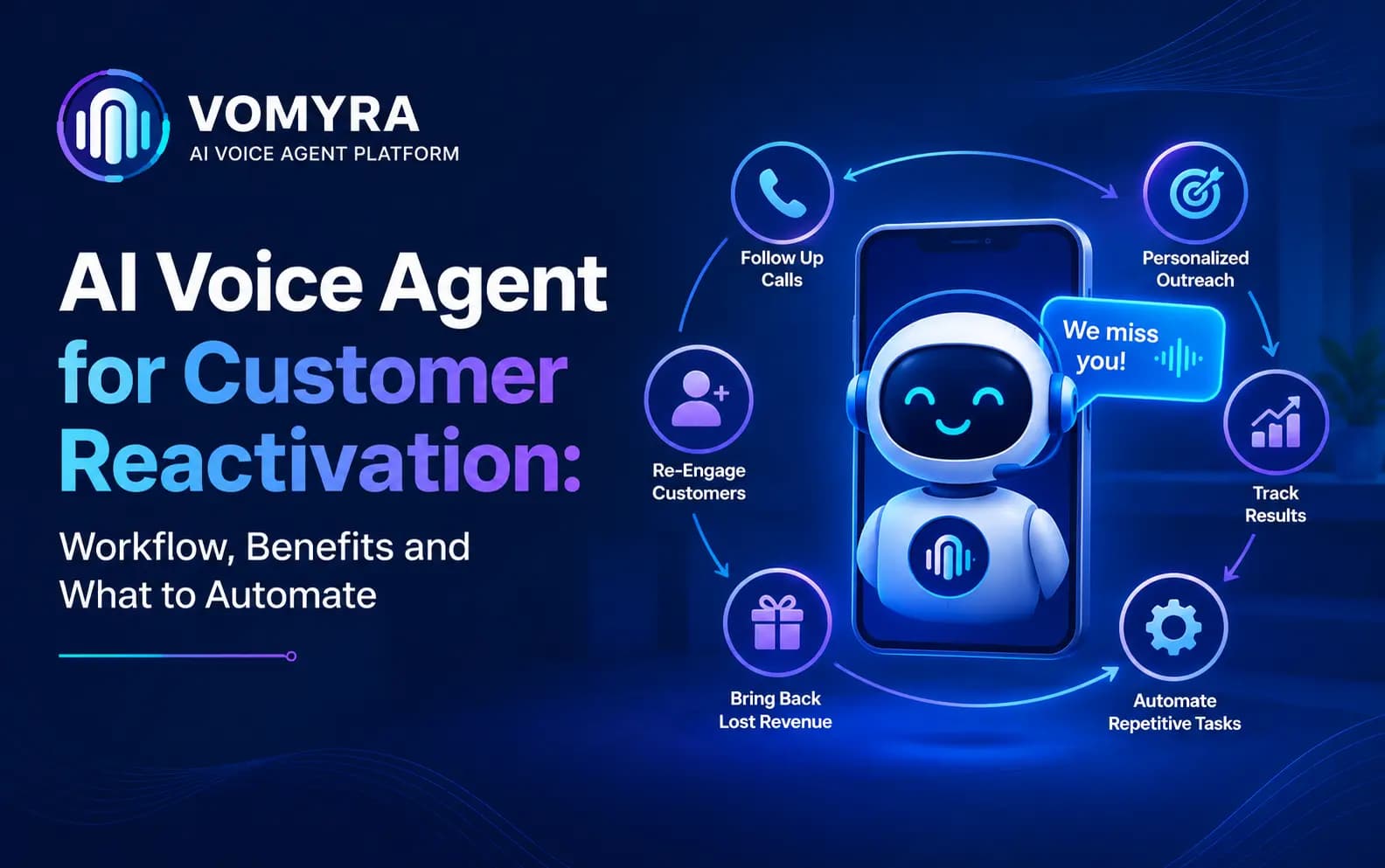
An AI voice agent for customer reactivation systematically works through this list – calling dormant customers, understanding why they went quiet, and re-engaging them with a relevant offer or reason to return.
This guide covers how AI voice agents handle customer reactivation, the workflow behind it, the benefits over manual win-back efforts, and what to automate first.
What Is Customer Reactivation, and Why It’s Usually Neglected
Customer reactivation is the process of re-engaging customers who were previously active but have gone quiet – not renewed, not purchased again, not responded to recent communication – with the goal of bringing them back.
It’s usually neglected for structural reasons, not lack of value:
- It competes with active pipeline for attention. Sales and support teams naturally prioritise live opportunities over a list of people who already went quiet.
- It requires calling volume most teams don’t have spare capacity for. A dormant customer list can run into the thousands, far beyond what a small team can call through manually.
- Timing and messaging matter, and get little iteration. A single generic win-back email sent once rarely performs as well as a well-timed, personalised call.
- There’s no clear owner. Reactivation often falls between sales, support and marketing, and ends up owned by no one.
None of this reflects the actual value of the opportunity – reactivating an existing customer is typically far cheaper than acquiring a new one, since trust and product familiarity already exist.
What Is an AI Voice Agent for Customer Reactivation?
An AI voice agent for customer reactivation is a voice AI system that systematically calls dormant customers, understands their reason for going quiet through natural conversation, addresses it where possible, and re-engages them with a relevant offer, update, or reason to return.
Because it can call an entire dormant list without competing with active pipeline for attention, it turns reactivation from an occasionally-attempted initiative into a consistent, ongoing part of the customer lifecycle.
The AI Voice Agent Customer Reactivation Workflow
A typical reactivation workflow runs through these stages:
- Segment identification – Dormant customers are identified based on defined criteria – no purchase in X months, lapsed subscription, unused account, expired policy.
- Outbound reactivation call – The AI voice agent calls the customer, referencing their prior relationship with the business rather than opening as a cold, generic call.
- Reason discovery – The agent asks why the customer went quiet – price, a bad experience, no longer needing the product, simply forgetting – gathering data that’s often never captured otherwise.
- Relevant re-engagement – Based on the conversation, the agent offers a relevant incentive, update, or reason to return – a win-back discount, a new feature, a renewal reminder.
- Outcome routing – Interested customers are booked for a follow-up, transferred to a rep, or completed directly on the call. Uninterested customers are logged with their reason, informing future strategy.
- CRM and segment update – Every call outcome, transcript and reason-for-churn is logged, updating the customer’s status and segment.
- Ongoing cadence – Customers not ready to return can be scheduled for a longer-term re-engagement touchpoint, rather than being written off after one call.
This turns a dormant customer database from a static list into an active, continuously worked channel.
Manual Win-Back vs AI Voice Agent Reactivation
| Factor | Manual Win-Back Efforts | AI Voice Agent Reactivation |
| List coverage | Small fraction of dormant customers, if any | Entire dormant database, systematically |
| Consistency | Sporadic, dependent on spare team capacity | Ongoing, defined cadence |
| Reason-for-churn data | Rarely captured | Gathered on every call |
| Cost per reactivated customer | High, given limited manual reach | Significantly lower at scale |
| Personalisation | Generic email blasts | Conversational, references prior relationship |
| Follow-through on interested customers | Inconsistent | Immediate booking or handoff |
| Language coverage | Limited to team’s languages | Multiple languages, including regional Indian languages |
| Ownership and consistency | Often falls between teams, neglected | Runs as a defined, owned process |
Key Benefits of Automating Customer Reactivation
Lower cost per recovered customer Reactivating an existing customer is typically far cheaper than acquiring a new one, and automation makes it possible to work the full dormant list, not just a small sample.
Revenue recovery from an underused asset A dormant customer database that was previously untouched becomes an active, ongoing source of recovered revenue.
Better understanding of churn reasons Systematic reactivation calls surface why customers actually leave, providing data that’s often missing entirely from manual processes.
Consistent, ongoing coverage Reactivation runs as a defined, continuous process rather than an occasional, under-resourced initiative.
Personalised outreach at scale Every reactivation call can reference the customer’s specific history and prior relationship, rather than sending the same generic message to everyone.
Frees the team to focus on active pipeline Reactivation no longer competes with live sales or support priorities for the same limited team attention.
Read Also: AI Voice Agent for Customer Support: Workflow, Benefits and What to Automate
What to Automate First
A staged approach works well for customer reactivation:
- Recently lapsed customers first – start with customers who went dormant most recently, since re-engagement typically works better the sooner it happens.
- Simple reactivation offers – a straightforward incentive or reminder, rather than complex, negotiated win-back terms.
- Reason-for-churn capture – even for customers who don’t return, capturing why they left is valuable data worth automating from the start.
- CRM segment updates – ensure every call outcome updates customer status automatically, so the database stays accurate over time.
- Handoff for interested customers – route re-engaged customers to a human rep quickly once real interest is shown.
More advanced steps – dynamic offer personalisation based on customer history, multi-touch reactivation sequences, or reactivation combined with product update announcements – can be layered in once the core process is running reliably.
Best Practices for AI Voice Agent Customer Reactivation
Reference the prior relationship explicitly Opening with “we noticed it’s been a while since your last order” performs very differently from a cold, generic pitch – the agent should acknowledge the existing relationship from the first sentence.
Prioritise by recency and value Not all dormant customers are equal. Segmenting by how recently they lapsed and their prior value helps focus effort where reactivation is most likely and most worthwhile.
Capture churn reasons even on “no” outcomes A reactivation call that doesn’t convert still has value if it captures why – this data should feed back into product, pricing or service decisions.
Keep the offer relevant, not generic A win-back incentive tied to the customer’s specific prior usage or product performs better than a blanket discount applied to everyone.
Don’t treat reactivation as one-and-done Some customers need more than one touchpoint to return. A defined longer-term cadence for non-responders keeps the door open without demanding constant call volume.

Build an AI Team for Customer Reactivation
Most businesses have a dormant customer list sitting untouched, representing recoverable revenue that manual calling capacity simply can’t reach at scale.
Vomyra is India’s Agentic Voice AI Platform, built to run complete AI sales and retention workflows – with agents that qualify, follow up, and re-engage customers as part of one connected system, not a single standalone calling tool. Vomyra AI voice agents systematically work through dormant customer segments, using real Indian mobile numbers and human-like conversations in multiple languages.
If you’re evaluating how to recover revenue from an existing customer base without adding headcount, Vomyra is built specifically for this – with unlimited calling plans and no coding required to get started.
FAQs
How is customer reactivation different from lead follow-up?
Lead follow-up re-engages people who haven’t yet become customers. Reactivation re-engages people who already were customers and went dormant – the relationship, trust and product familiarity already exist, which typically makes reactivation calls convert differently than cold lead follow-up.
Is it worth calling customers who lapsed a long time ago?
It depends on the business and reason for lapse, but many businesses find value in at least attempting contact with older dormant segments, since the cost of an automated call is low relative to even a modest reactivation rate.
Can an AI voice agent handle reactivation calls in regional Indian languages?
Yes. Platforms built for Indian businesses support multiple languages, so reactivation calls can happen in the language the customer is most comfortable with.
Does this replace customer success or retention teams?
No. It handles the systematic, high-volume outreach to dormant customers so retention and success teams can focus on active accounts and the customers who show renewed interest.