Restaurants receive calls throughout the day for table reservations, takeaway orders, menu questions, opening hours, and delivery updates. During busy hours, staff may not be able to answer every call. Missed calls can mean lost bookings, delayed orders, and customers choosing another restaurant.
An AI voice agent for restaurants helps manage these conversations automatically. It can answer incoming calls, understand customer requests, collect booking details, and share relevant information. With Vomyra, restaurants can explore voice automation to handle routine phone conversations while allowing staff to focus on food preparation and in-person service.
What Is an AI Voice Agent for Restaurants?
An AI voice agent is a voice-based system that speaks with customers over the phone. Unlike a basic recorded message, it can understand spoken questions, respond conversationally, and follow a defined workflow.
For example, a customer may call to ask whether a table is available for four people at 8 PM. The agent can collect the date, time, and party size, check the connected reservation system when available, and confirm the booking only after receiving a successful response.
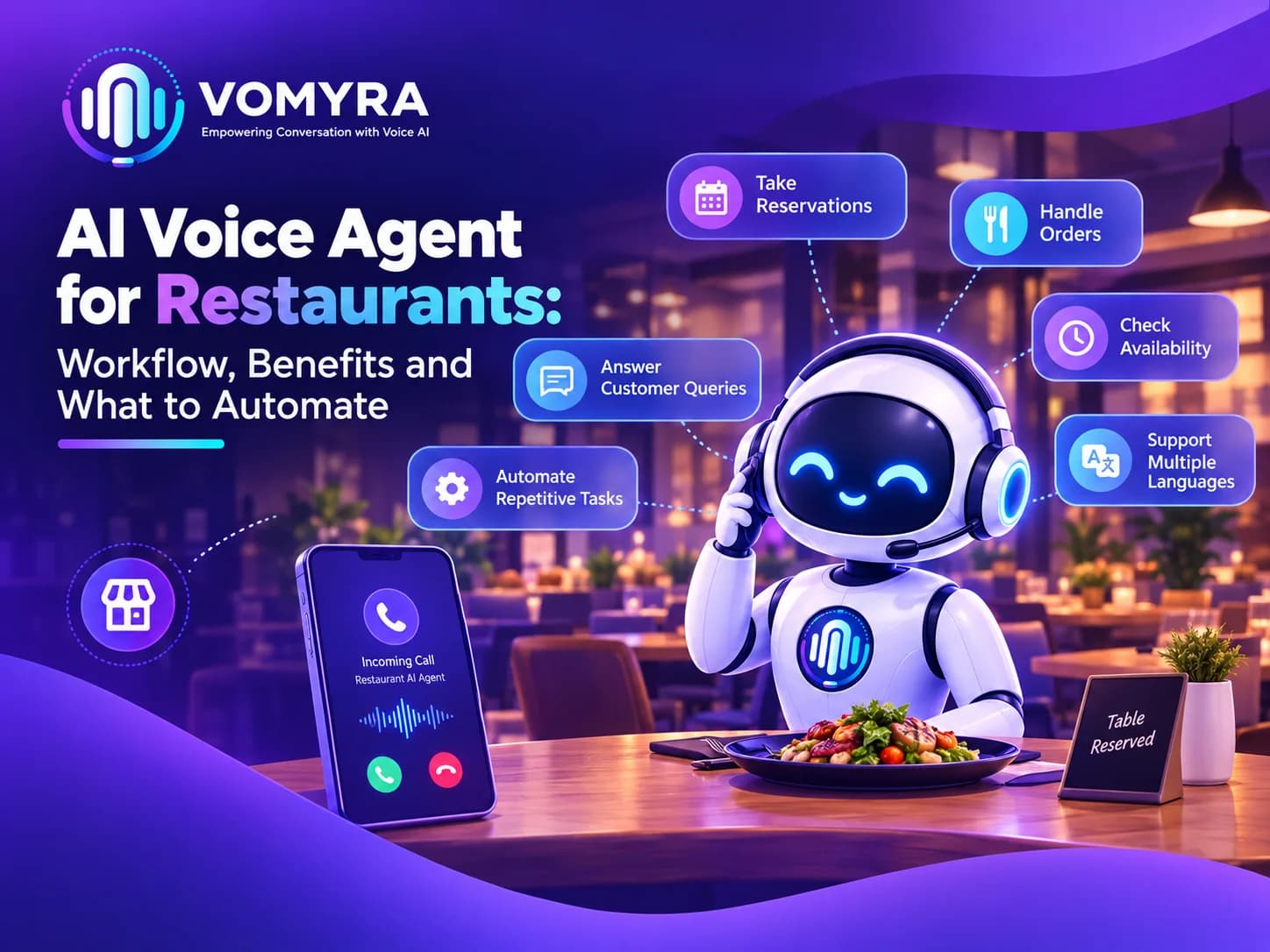
Modern AI voice agents for restaurant calls can support several tasks, including reservations, frequently asked questions, order enquiries, and call routing. Their actual capabilities depend on the integrations, business rules, and information available to the system.
How Restaurant Call Automation Works
Effective restaurant call automation follows a clear process. The goal is not simply to answer calls but to resolve customer requests accurately.
1. Answer Incoming Calls
When a customer calls, the AI agent answers using a natural conversational voice. It identifies the reason for the call and guides the customer towards the appropriate next step.
This is useful during lunch and dinner rushes, when employees are occupied with serving customers and managing orders.
2. Understand the Customer’s Request
The agent identifies whether the caller wants to book a table, place an order, ask about the menu, or speak with a staff member. It then asks relevant follow-up questions to collect missing information.
A well-designed system should also recognise when it does not understand a request and offer clarification or transfer the call to a human.
3. Connect with Business Systems
The agent can connect with supported reservation platforms, ordering software, customer databases, or other business tools. These integrations allow it to retrieve information and perform permitted actions instead of relying entirely on static answers.
4. Complete the Task and Record Details
After handling the request, the system can save relevant information, trigger an approved workflow, or send a confirmation through a supported channel. Vomyra can be considered for building these connected voice workflows, depending on the restaurant’s requirements and integration options.
What Can Restaurants Automate with Voice AI?
Not every phone conversation requires a staff member. Restaurants can start with repetitive enquiries and gradually automate more complex tasks.
Table Reservations
AI agents for restaurant reservations can collect the customer’s name, preferred date, time, party size, and contact details. When connected to a reservation system, they can check availability and complete bookings according to the restaurant’s rules.
If the requested slot is unavailable, the agent can offer alternative times supported by the booking system.
Phone Orders and Takeaway Requests
Restaurant order taking automation can help collect items, quantities, customisation requests, and pickup preferences. Before submitting an order, the agent should repeat the details and confirm the total where pricing information is available.
Integration with the restaurant’s ordering system is essential. Without it, the agent should not claim that an order has been placed successfully.
Menu and Business Information
Customers often call to ask about opening hours, menu prices, ingredients, dietary options, parking, and delivery areas. AI phone answering for restaurants can handle these common questions using approved and regularly updated information.
For allergen enquiries, the agent should rely on verified ingredient information and transfer uncertain questions to staff rather than guessing.
Order Status and Call Routing
Customers may call to check whether their takeaway is ready or ask about a delayed delivery. If order tracking is connected, the system can provide an available status update.
For complaints, unusual requests, or sensitive situations, the agent can route the call to the appropriate employee.
Key Benefits of Restaurant Voice AI
A well-planned restaurant voice AI system can improve how a restaurant manages calls without requiring staff to abandon their primary responsibilities.
- Fewer missed calls: Customers can receive an answer even when the team is busy, subject to system availability.
- Better customer experience: Callers can obtain routine information without waiting for an employee.
- More efficient operations: Staff spend less time answering the same questions repeatedly.
- Consistent information: Approved responses help keep details about opening hours, menus, and policies consistent.
- Better lead and booking records: Captured information can help restaurants understand enquiries and reservation demand.
- Support during peak hours: Automation can manage routine conversations while staff handle exceptions and complex requests.
The results depend on call volume, system accuracy, integration quality, and how well the workflows are designed.
Read More: How to Reduce Missed Restaurant Calls with AI in India
AI Phone Answering for Restaurants vs Traditional Call Handling
The following table explains the main differences between manual call handling and an automated approach.
| Feature | Traditional Call Handling | AI-Powered Call Handling |
| Answering calls | Depends on staff availability | Can answer automatically when operational |
| Reservation requests | Staff collect and enter details | Agent collects details and may book through an integration |
| Common questions | Employees answer individually | Agent responds using approved information |
| Order enquiries | Staff check order systems | Agent can retrieve updates when connected |
| Complex complaints | Staff handle directly | Agent transfers or escalates the call |
| Call records | May require manual entry | Can record structured details through supported workflows |
Automation works best when it supports employees rather than attempting to replace human judgement in every situation.

How to Choose an AI Voice Assistant for Restaurants
Before implementing an AI voice assistant for restaurants, assess the problems your team needs to solve. A restaurant receiving frequent reservation calls may need different workflows from a takeaway business handling many order-status enquiries.
Consider these factors:
- Voice quality and language support: The agent should communicate clearly with your customers.
- Integration options: Check compatibility with your existing booking, ordering, and customer management systems.
- Accuracy: Test how it handles accents, background noise, menu names, and follow-up questions.
- Human handover: Make sure customers can reach staff when the request is outside the agent’s capabilities.
- Data protection: Review call recording, customer data storage, access controls, and consent requirements.
- Reporting: Look for useful records of answered calls, completed tasks, transfers, and unresolved enquiries.
Start with one workflow, such as answering frequently asked questions or collecting reservation requests. Review actual call outcomes before expanding automation to orders and other business processes.
Vomyra can be evaluated for restaurant voice automation based on the required calling workflows, integrations, and reporting needs. A practical implementation should define exactly what the agent can do and when it must involve a person.
Conclusion
An AI voice agent for restaurants can help businesses answer routine enquiries, manage reservation requests, support takeaway orders, and reduce the pressure on front-of-house teams. The most effective setup combines conversational AI with reliable business information, connected systems, and clear escalation rules.
Restaurants should begin with high-volume, repetitive calls and measure whether automation improves response times and task completion. With the right workflow, Vomyra can be explored as part of a voice automation strategy that helps restaurants manage calls more consistently while keeping staff focused on customer service.
Frequently Asked Questions
1. What is an AI voice agent for restaurants?
It is an AI-powered phone system that speaks with customers, answers common questions, collects information, and can perform supported tasks such as reservations through connected systems.
2. Can AI voice agents handle restaurant reservations?
Yes. They can collect booking details and check available slots when integrated with a reservation platform. Successful bookings should be confirmed only after the system verifies them.
3. Can restaurant voice AI take food orders?
It can collect food items, quantities, and preferences. Submitting orders accurately requires an appropriate integration with the restaurant’s ordering system.
4. What are the main benefits of restaurant call automation?
The main benefits include fewer missed calls, faster responses, reduced repetitive work, consistent information, and better handling of routine enquiries during busy periods.
5. How can a restaurant start using AI voice automation?
Start by identifying frequent call types, preparing accurate business information, choosing a suitable voice platform, and connecting the systems needed for the selected workflow. Test the process before deploying it to all incoming calls.