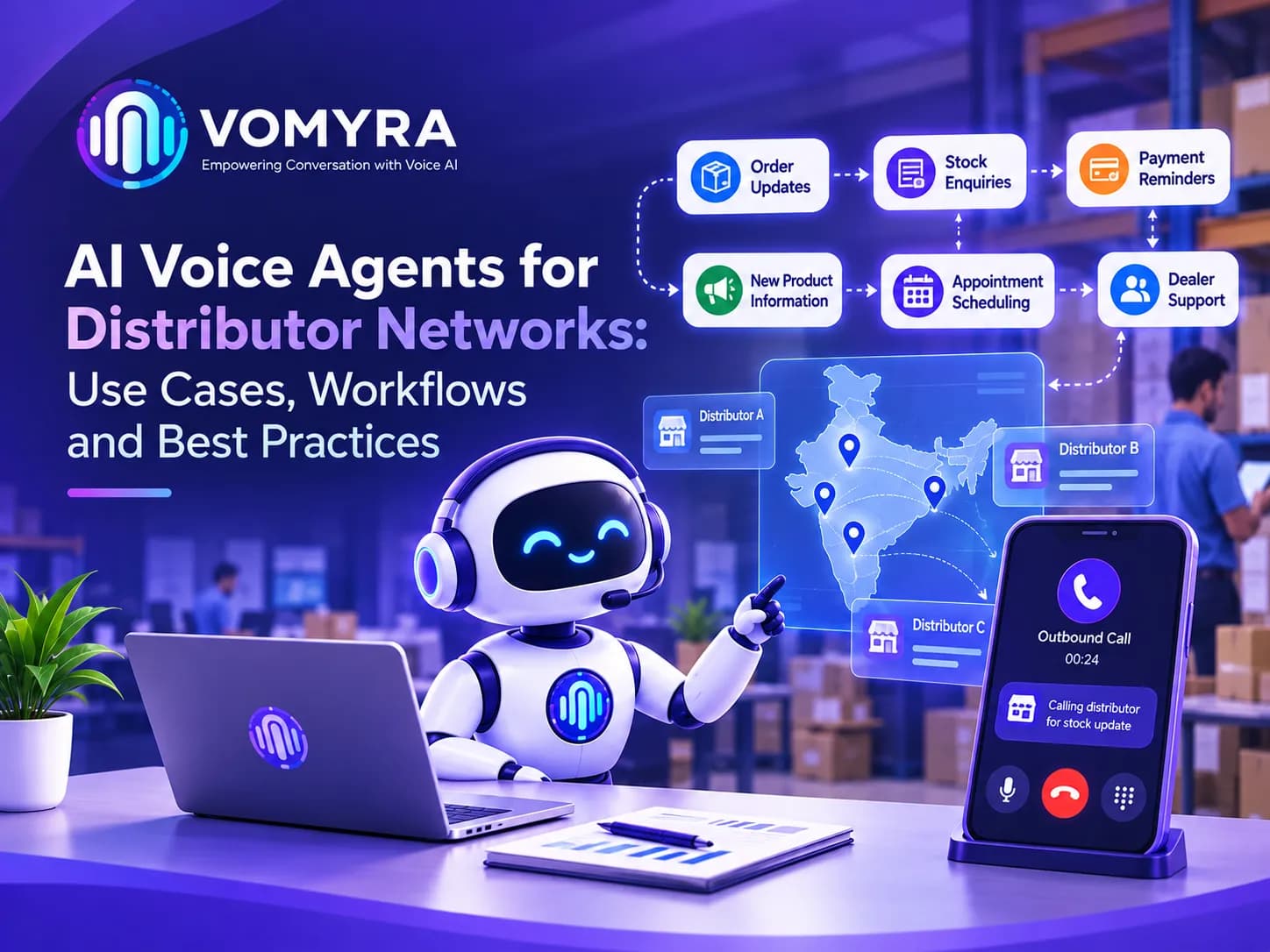
Distributor networks connect manufacturers, wholesalers, retailers, and customers. Managing these relationships requires regular communication about orders, stock availability, delivery schedules, payments, and product updates. When these tasks depend entirely on manual calls, teams may struggle to respond on time, especially as the network grows.
AI voice agents for distributor networks help businesses manage routine conversations, collect information, and coordinate daily operations through automated voice calls. They can support sales teams, improve order communication, and reduce repetitive work while allowing employees to focus on more complex customer needs.
What Are AI Voice Agents for Distributor Networks?
AI voice agents are software systems that use speech recognition and natural language processing to communicate with people over phone calls. Unlike basic automated phone menus, conversational agents can understand spoken responses and follow a conversation based on the caller’s answers.
For distributors, these systems can handle tasks such as confirming orders, checking product requirements, sharing delivery updates, and reminding customers about pending payments. Businesses can configure workflows according to their processes and connect them with relevant business systems where supported.
Platforms such as Vomyra can be evaluated by businesses exploring automated voice communication for routine distributor operations.
Why Do Distributor Networks Need Voice Automation?
Distributor operations often involve hundreds of retailers, multiple product categories, and different delivery schedules. Sales representatives may spend hours making calls, checking order requirements, and following up on deliveries instead of building new business relationships.
Common challenges include:
- Missed calls and delayed responses during busy periods.
- Inconsistent follow-ups with retailers.
- Errors when employees record orders manually.
- Limited visibility into retailer demand.
- Delays in communicating stock or delivery changes.
Voice automation for distributors helps manage repetitive calls through predefined workflows. It also allows teams to maintain consistent communication across a growing network without depending entirely on manual follow-ups.
Key Use Cases of AI Voice Agents for Distributors
1. Automated Order Collection
Retailers frequently contact distributors to place orders or ask about product availability. AI agents can also make outbound calls to collect replenishment requirements from retailers who order regularly.
During a call, the agent can ask which products are needed, collect quantities, and repeat the details for confirmation. The information can then be sent to the relevant system or team for validation and processing.
These capabilities make AI voice agents for distributors useful for businesses handling a high volume of repeat orders.
2. Stock Availability and Product Enquiries
Retailers often need quick answers about available products, new arrivals, and expected restocking dates. When connected to a suitable inventory system, a voice agent can share available information during a conversation.
If the required details are unavailable or a product needs special approval, the agent can transfer the enquiry to a human representative. This reduces unnecessary back-and-forth communication and helps employees focus on enquiries that need personal attention.
3. Delivery Updates and Order Confirmation
After placing an order, retailers may call to confirm whether it has been accepted or when it will arrive. Automated calls can communicate order status, expected delivery windows, and relevant changes when reliable information is available.
This is a practical application of AI voice agents for wholesale distribution, particularly for businesses managing frequent deliveries across different locations.
4. Payment Reminders and Outstanding Dues
Distributors often manage payment cycles across many retailers. Voice agents can make polite reminder calls before or after due dates, communicate approved payment details, and record responses for the accounts team.
Sensitive disputes, payment disagreements, or requests for revised credit terms should be transferred to an authorised employee rather than handled through an unrestricted automated conversation.
5. Retailer Feedback and Sales Follow-Ups
Regular feedback helps distributors understand product demand, delivery issues, and retailer satisfaction. A voice agent can ask short questions after a delivery or contact retailers who have not placed orders recently.
The collected responses can help sales teams identify retailers who need assistance, discover recurring service problems, and prioritise follow-ups.
How AI Voice Agents Fit Into Distributor Workflows
Effective AI voice agents for wholesale distribution need more than a calling feature. They should fit into existing order, inventory, sales, and customer support processes.
A typical workflow follows these steps:
- Trigger: A scheduled task or business event identifies a retailer who needs a call.
- Prepare: The system retrieves permitted customer details and relevant order information.
- Call: The agent contacts the retailer and explains the purpose of the call.
- Collect: It captures the retailer’s response, such as order quantities or delivery preferences.
- Validate: Business rules check the information before it is submitted.
- Update: The result is recorded in the connected system or shared with the responsible team.
- Escalate: Unclear responses, complaints, or exceptions are passed to a human employee.
This structured approach supports distributor network automation by making communication more consistent and helping teams track call outcomes.
Manual Calling vs AI Voice Agents
| Business activity | Manual calling | AI voice agent approach |
| Order collection | Representatives contact retailers individually | Scheduled calls collect order requirements |
| Delivery updates | Staff communicate status manually | Automated calls share available updates |
| Payment reminders | Employees track and make follow-up calls | Reminders follow configured schedules |
| Retailer feedback | Collection depends on staff availability | Standardised questions collect responses |
| Complex complaints | Employees handle the conversation | Calls are transferred to the appropriate employee |
The right approach depends on call volume, system integration, data quality, and conversation complexity. Human calling remains valuable for negotiations, relationship management, and sensitive issues.
Best Practices for Implementing Distributor Network Automation
Start With One Clear Business Goal
Avoid automating every process at once. Begin with a repetitive task, such as order confirmation or delivery updates, and define what a successful outcome looks like.
Measure completed calls, information accuracy, successful transfers, and time saved by the team. These results will help determine whether the workflow should be expanded.
Integrate With Existing Business Systems
Distributor network automation works best when call workflows use accurate customer and order information. Connect the agent to relevant CRM, inventory, or order management systems where integrations are available.
Set permissions carefully and avoid sharing confidential information with unauthorised callers.
Keep Conversations Simple
Use short questions and clear language that retailers can easily understand. Support relevant regional languages where available, and make it easy for callers to repeat information or speak to an employee.
Test conversations with real-world examples, including background noise, unclear answers, and changes in order requirements.
Protect Customer Data
Distributor databases may contain phone numbers, order histories, payment information, and business details. Establish access controls, follow applicable privacy requirements, and define how call recordings and transcripts are stored and retained.
Inform callers about automated interactions where required and provide a clear way to reach human support.
Monitor Performance and Improve Workflows
Review call outcomes regularly instead of measuring success only by the number of calls made. Track unanswered calls, incorrect data, escalation rates, retailer feedback, and the percentage of orders successfully processed.
Businesses evaluating AI calling solutions for distributors should also review integration options, language support, reporting features, security controls, and exception handling. Vomyra can be considered during this evaluation, depending on the organisation’s needs and the platform’s supported capabilities.

How to Measure the Results
A pilot should establish baseline performance before automation begins. Compare the results after implementation to determine whether the workflow is delivering measurable value.
Useful metrics include:
- Average time spent on routine calls.
- Percentage of calls answered and completed.
- Order information accuracy.
- Time required to resolve retailer enquiries.
- Successful delivery of reminders and updates.
- Employee time saved per week.
Distributor order management automation should be evaluated on accuracy and business outcomes, not simply the number of calls made. Collecting an order is not the same as validating and entering it successfully into the order management system.
Businesses should also review AI voice agents for distributors based on their ability to handle common questions, record accurate information, and escalate exceptions appropriately. Vomyra is one option to evaluate when exploring voice automation for distributor operations.
Conclusion
Managing a growing distributor network requires timely communication, accurate order information, and reliable follow-ups. AI voice agents can support these needs by automating routine calls, collecting retailer requirements, and sharing updates through structured workflows.
Businesses should start with a clear use case, connect reliable data sources, protect customer information, and keep human support available for complex situations. When implemented carefully, AI voice agents for distributor networks can help teams manage communication more consistently while giving employees more time for sales and relationship building.
Read More: AI Voice Agents for Automation Builders: Use Cases, Workflows and Best Practices
Frequently Asked Questions
1. What are AI voice agents for distributor networks?
They are conversational voice systems that help distributors automate calls for order collection, delivery updates, payment reminders, and retailer follow-ups.
2. Can AI voice agents collect retailer orders?
Yes. They can collect product requirements and quantities through calls. The information should be validated before an order is confirmed or submitted to an order management system.
3. How does voice automation help distributors save time?
It reduces the need for employees to make repetitive calls individually, allowing them to focus on sales, negotiations, and complex customer requests.
4. Can AI voice agents integrate with distributor management software?
Integration may be possible through supported APIs or connectors. Businesses should confirm compatibility with their existing CRM, inventory, and order management systems before implementation.
5. What should distributors consider before adopting AI calling solutions?
They should evaluate call accuracy, language support, integration options, data security, reporting, scalability, and the availability of human handoffs.