Every business with a phone number deals with the same basic math problem: call volume is unpredictable, but staffing is fixed. A quiet Tuesday afternoon and a post-campaign Monday morning generate wildly different call volumes, but most teams staff somewhere in the middle – meaning they’re either overstaffed during quiet periods or, far more often, understaffed during peak ones.
An AI voice agent for inbound calls answers every call instantly, regardless of volume, time of day, or how many calls are coming in simultaneously. It doesn’t eliminate the need for a team – it removes the ceiling on how many calls can be answered well at once.
This guide covers how AI voice agents handle inbound calls, the workflow behind it, the benefits over manual call answering, and what to automate first.
What Is an AI Voice Agent for Inbound Calls?
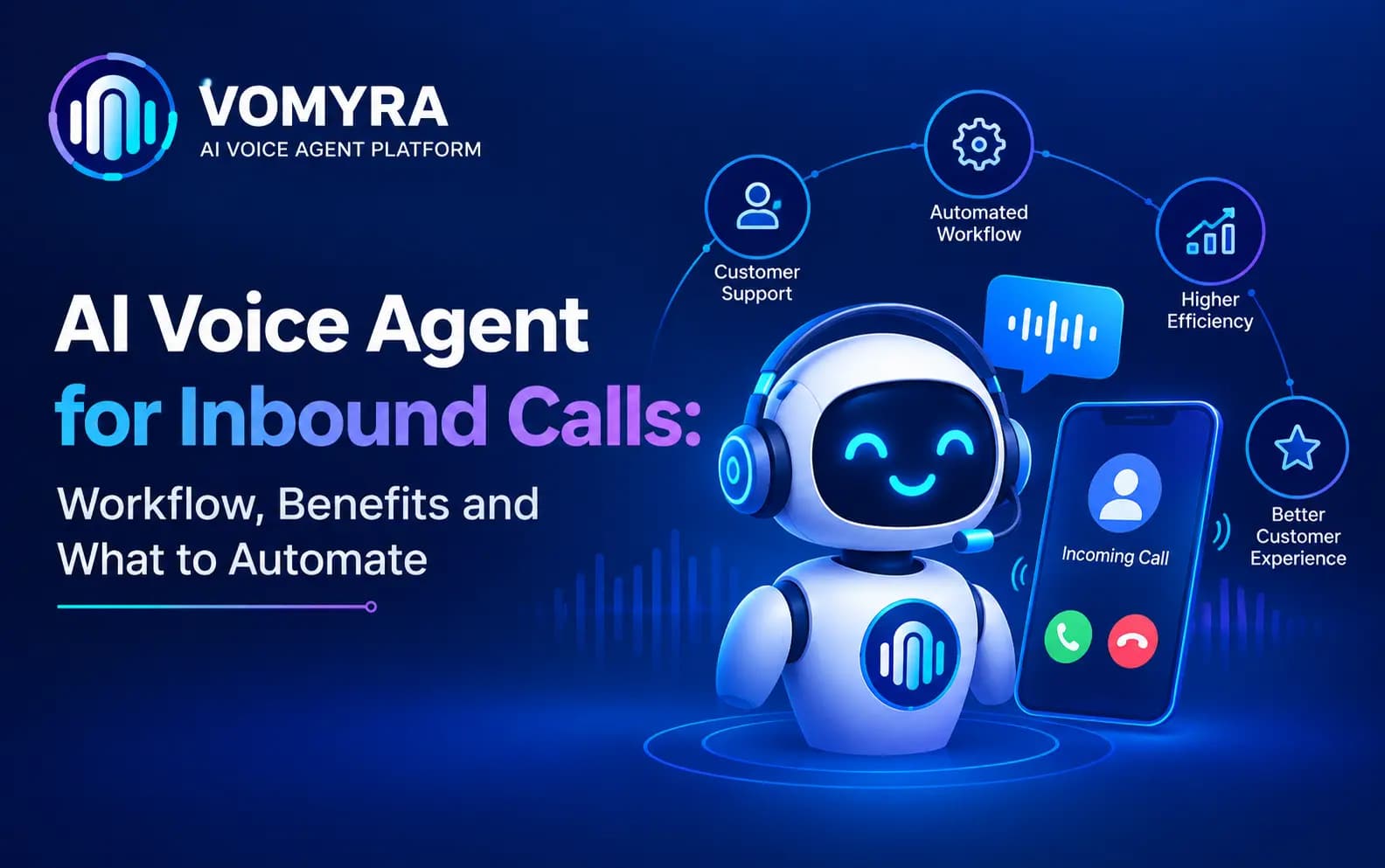
An AI voice agent for inbound calls is a voice AI system that answers calls coming into a business – from customers, prospects, or existing accounts – and handles the conversation directly: answering questions, resolving requests, booking appointments, or routing the caller to the right person when needed.
Unlike a traditional IVR that forces callers through a rigid menu of options, an AI voice agent listens to what the caller actually says and responds conversationally, understanding intent rather than requiring the caller to navigate a phone tree to get there.
Why Inbound Calls Are Hard to Staff Well
Inbound call volume creates structural problems that fixed staffing struggles to solve:
- Volume is unpredictable. Marketing campaigns, seasonal demand, news events, or even weather can cause sudden spikes that overwhelm normal staffing.
- Peak hours cluster. Most businesses see call volume concentrated in specific windows – lunch hours, evenings, Mondays – that don’t match a flat 9-to-5 staffing model well.
- Off-hours calls go unanswered. Calls outside business hours are either missed entirely or pushed to voicemail, where response rates are notoriously low.
- Every missed call is a missed opportunity. Whether it’s a new customer trying to book, or an existing customer needing support, an unanswered call often means they simply go elsewhere or grow frustrated.
An AI voice agent removes the ceiling entirely – every call gets answered, whether it’s the first of the day or the fiftieth happening at the exact same moment.
The AI Voice Agent Inbound Call Workflow
A typical inbound workflow runs through these stages:
- Instant call answer – The AI voice agent picks up the call immediately, with no hold time or queue.
- Intent understanding – Through natural conversation, the agent identifies what the caller needs – a booking, a status update, a support query, general information.
- Context lookup – If the caller is an existing customer or lead, the agent pulls relevant account or history data from connected systems.
- Direct resolution – For queries within its scope, the agent resolves the request directly – answering a question, booking an appointment, updating an account detail.
- Escalation when needed – For anything complex, sensitive, or outside defined scope, the call is routed to the right human team, with a summary passed along so the caller doesn’t repeat themselves.
- Outcome logging – Every call is transcribed and logged, with structured outcome data synced to the relevant CRM or business system.
- Follow-up where relevant – For unresolved queries or requests needing further action, the agent can schedule or handle a follow-up call automatically.
The core principle: every call gets answered and progressed immediately, with clean handoff to a human whenever the conversation genuinely needs one.
Manual Inbound Answering vs AI Voice Agent Answering
| Factor | Manual Call Answering | AI Voice Agent |
| Call answer rate | Missed calls during peak volume or off-hours | Every call answered instantly |
| Availability | Limited to staffed hours | 24/7 |
| Simultaneous call handling | Limited by number of available staff | Unlimited concurrent calls |
| Consistency of information given | Varies by staff knowledge and training | Same accurate response every time |
| Cost during high-volume periods | Requires overtime or temporary staff | Scales instantly, no extra hiring |
| Caller wait time | Hold queues during busy periods | No hold time |
| Documentation | Manual notes, often incomplete | Full transcripts and structured records |
| Language coverage | Limited to staff’s languages | Multiple languages, including regional Indian languages |
Key Benefits of Automating Inbound Calls
No missed calls, regardless of volume Every call is answered, whether it’s a quiet afternoon or the busiest moment of the year – nothing goes to voicemail or a full queue.
No hold times Callers get an immediate response instead of waiting in a queue, which is consistently one of the biggest drivers of caller frustration.
Round-the-clock coverage Calls outside business hours are answered and handled in real time, rather than deferred to the next business day.
Lower cost of handling volume spikes Sudden increases in call volume – from a campaign, a product launch, or seasonal demand – are absorbed without temporary staffing.
Consistent, accurate information Every caller gets the same correct answer to a routine question, regardless of which “agent” picks up or how busy the day has been.
Staff focus on complex, high-value conversations Human team members spend their time on calls that genuinely need judgement, empathy, or specialised knowledge.
What to Automate First
A staged rollout works well for inbound call automation:
- Off-hours and overflow coverage – start by automating calls outside business hours or during volume spikes your team can’t currently absorb.
- High-frequency, routine queries – FAQs, hours, location, basic account or order status questions.
- Appointment or callback booking – letting callers schedule directly on the call, without waiting for a callback.
- Call routing and triage – ensuring every call reaches the right destination quickly, whether resolved directly or escalated.
- Outcome logging – automatic CRM or system updates so no call’s context is lost after it ends.
More advanced steps – complex multi-step troubleshooting, full account management over the phone, or handling emotionally sensitive calls – can be layered in once the core inbound flow is proven and reliable.
Best Practices for AI Voice Agent Inbound Calling
Design clear escalation paths Define exactly which query types route to a human, and make that handoff fast and seamless – callers should never feel stuck with an agent that can’t help and won’t hand off.
Keep the caller informed Let callers know they’re speaking with an AI voice agent, and make it easy to reach a human at any point in the call.
Prioritise accuracy over trying to handle everything An agent that confidently resolves what it can and escalates the rest cleanly performs better than one that attempts every query and occasionally gets it wrong.
Monitor call transcripts regularly Review a sample of calls regularly to catch misunderstandings, gaps in scope, or recurring queries the agent isn’t yet handling well.
Match language to your caller base Businesses with a diverse customer base benefit from an agent that can converse in the languages callers actually use, not just English.

Build an AI Team for Inbound Calls
Every missed call is a customer, prospect, or opportunity that had to go elsewhere. Fixed staffing simply can’t match unpredictable call volume – but an AI voice agent can.
Vomyra is India’s Agentic Voice AI Platform, built to help businesses answer every inbound call instantly, resolve routine queries directly, and escalate complex calls to the right human team with full context – using real Indian mobile numbers and human-like conversations in multiple languages.
If you’re evaluating how to stop losing calls to hold queues, off-hours gaps, or volume spikes, Vomyra is built specifically for this – with unlimited calling plans and no coding required to get started.
FAQs
Does an AI voice agent replace the need for a support or reception team?
No. It absorbs the volume that a fixed team can’t handle consistently – off-hours calls, peak spikes, and routine repetitive queries – so the human team can focus on complex or sensitive conversations.
Can an AI voice agent handle multiple calls at the exact same time?
Yes, this is one of its core advantages over a human team – call volume that would create a queue for a limited staff is answered simultaneously and instantly.
Will callers know they’re speaking to an AI?
Best practice is to be transparent about this at the start of the call, with an easy, clearly stated path to reach a human agent whenever the caller wants one.
Can inbound AI voice agents work in regional Indian languages?
Yes. Platforms built for Indian businesses support multiple languages, so callers can be served in the language they’re most comfortable with.