Most leads aren’t lost because they weren’t interested. They’re lost because nobody followed up enough times, at the right intervals, before they moved on. Studies and sales data consistently point to the same pattern: it typically takes several attempts to reach and convert a lead, yet most sales teams stop trying after one or two calls.
Follow-up is repetitive, easy to deprioritise under pipeline pressure, and hard to track consistently across a growing lead list. It’s also one of the highest-leverage activities in sales — and one of the easiest to automate well.
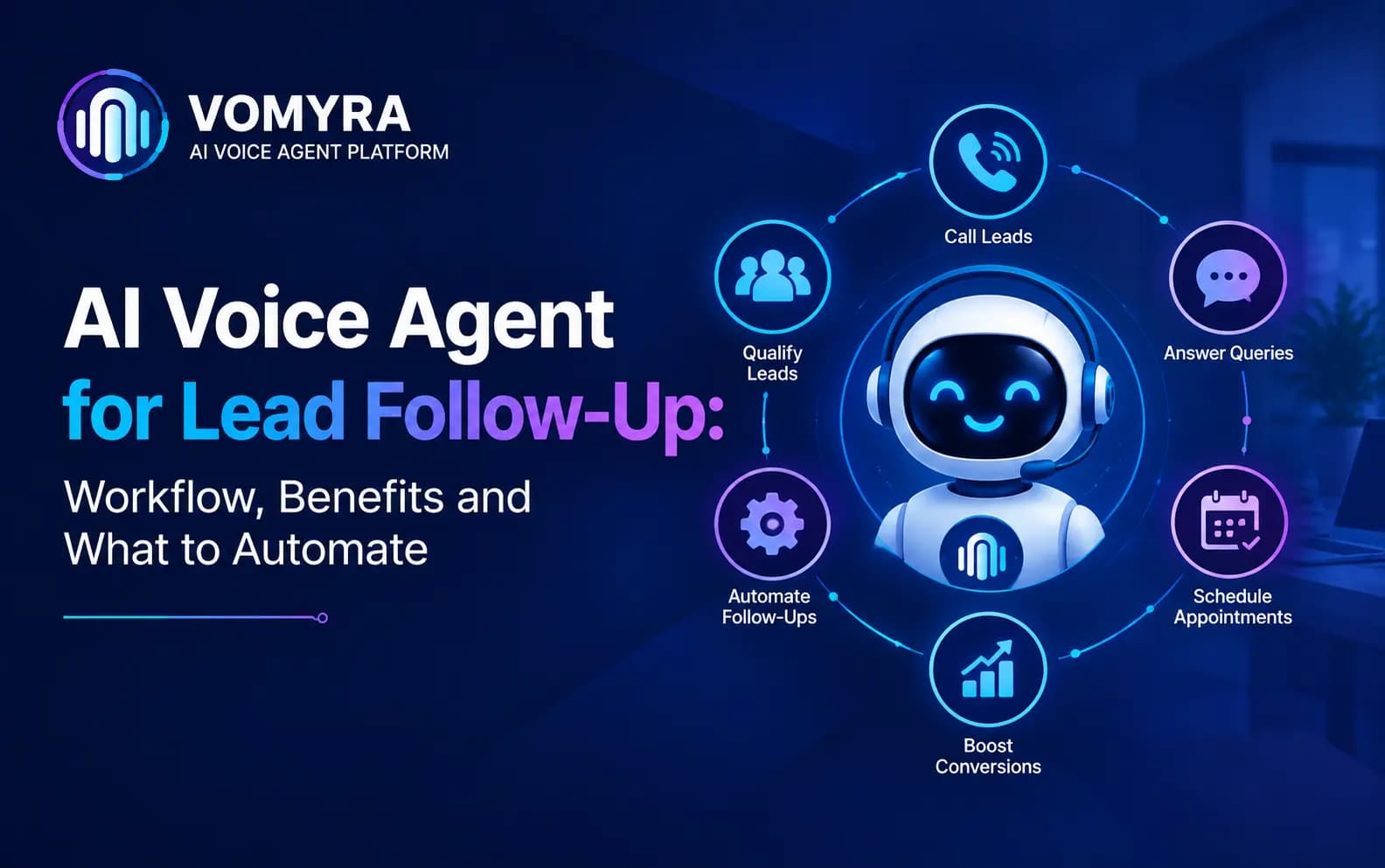
An AI voice agent for lead follow-up calls every lead at the right cadence, every time, without depending on a rep remembering to pick up the phone again.
This guide covers how AI voice agents handle lead follow-up, the workflow behind it, the benefits over manual follow-up, and what to automate first.
What Is an AI Voice Agent for Lead Follow-Up?
An AI voice agent for lead follow-up is a voice AI system that automatically calls leads at defined intervals after an initial enquiry, demo, or missed contact attempt — re-engaging them in natural conversation, answering questions, and moving them toward a decision or a booked call with a human rep.
Unlike a one-off outreach call, follow-up is a sequence. It requires tracking who’s been contacted, when, what was said, and what should happen next — the kind of coordination that breaks down easily in a manual process but is exactly what a well-built AI voice agent is designed to sustain.
Why Lead Follow-Up Breaks Down Manually
Follow-up fails in predictable ways when left to manual processes:
- No consistent cadence. Reps follow up when they remember to, not on a defined schedule, so timing varies lead to lead.
- Leads fall through the cracks. Without a strict system, leads that don’t respond to the first attempt often never get a second one.
- Follow-up gets deprioritised. When pipeline gets busy, follow-up calls are the first thing reps skip in favour of active deals.
- No memory of prior conversations. Reps juggling many leads often don’t recall exactly what was discussed last time, leading to repetitive or disjointed follow-up calls.
- Manual tracking is error-prone. Spreadsheets and reminders are easy to lose track of, especially as lead volume grows.
None of these are failures of effort — they’re structural limits of asking humans to run a disciplined, high-volume, well-timed process by hand.
The AI Voice Agent Lead Follow-Up Workflow
A typical follow-up workflow runs through these stages:
- Trigger event — A lead doesn’t answer the first call, requests to be contacted later, goes quiet after initial interest, or reaches a defined stage without moving forward.
- Cadence scheduling — The AI voice agent schedules the next follow-up attempt based on predefined rules — for example, a second attempt the next day, a third a few days later.
- Context-aware calling — Each follow-up call references what was discussed previously, rather than starting the conversation from zero.
- Objection handling and re-engagement — The agent responds to hesitations, answers new questions, and gauges current interest level.
- Outcome routing — Re-engaged, ready leads are booked for a call or handed to a sales rep. Leads still not ready are scheduled for the next follow-up in the sequence. Leads that opt out are removed from the sequence entirely.
- CRM update — Every follow-up call outcome, transcript and next step is logged automatically.
- Sequence completion or escalation — After a defined number of attempts, unresponsive leads are moved to a longer-term nurture cycle or flagged for review, rather than being followed up indefinitely.
This structure keeps every lead moving through a defined process, without depending on a rep’s memory or bandwidth.
Manual Follow-Up vs AI Voice Agent Follow-Up
| Factor | Manual Follow-Up | AI Voice Agent Follow-Up |
| Follow-up consistency | Depends on rep discipline and workload | Same defined cadence for every lead |
| Leads missed entirely | Common, especially under pipeline pressure | Rare — every lead stays in the sequence |
| Context continuity | Relies on rep memory or notes | Full transcript history referenced automatically |
| Follow-up attempts per lead | Often one or two before drop-off | Consistent multi-touch sequence |
| Cost per follow-up call | High (rep time across a growing list) | Significantly lower at scale |
| Scalability with lead volume | Requires more reps as volume grows | Scales instantly without added headcount |
| Reporting on follow-up outcomes | Manual, inconsistent | Structured data across every touchpoint |
| Language coverage | Limited to rep’s languages | Multiple languages, including regional Indian languages |
Key Benefits of Automating Lead Follow-Up
Higher conversion from existing pipeline Since most conversions happen after multiple touchpoints, consistent follow-up alone often lifts conversion without needing more top-of-funnel leads at all.
No lead falls through the cracks Every lead stays in a defined sequence until it converts, opts out, or reaches a defined end point — nothing depends on a rep remembering to call back.
Reps spend time on ready leads Instead of splitting attention between chasing cold leads and closing warm ones, reps only step in once a lead is re-engaged and ready.
Consistent, context-aware conversations Every follow-up call references prior context, so leads don’t get asked the same questions repeatedly or feel like they’re starting over each time.
Lower cost of pipeline recovery Re-engaging existing leads through automated follow-up is typically far cheaper than generating new leads to replace the ones that went cold.
Clear visibility into what’s working Structured data across every follow-up attempt shows which cadences, messages and timing windows actually move leads forward.
What to Automate First
A staged rollout works well for lead follow-up automation:
- No-answer follow-up calls — automate the second and third attempt after an unanswered first call.
- “Call me later” re-engagement — automatically schedule and execute follow-up at the time the lead requested.
- Post-demo or post-enquiry check-ins — automate follow-up after a demo or initial enquiry where the lead went quiet.
- Cold lead re-engagement — systematically work through leads that stalled weeks or months ago and were never followed up again.
- CRM logging and next-step tracking — ensure every follow-up outcome updates the record automatically, so reps always see accurate lead status.
More advanced steps — dynamic cadence adjustment based on engagement signals, multi-channel follow-up combining calls with messages, or fully automated booking within the follow-up call — can be layered in once the core sequence is running reliably.
Best Practices for AI Voice Agent Lead Follow-Up
Define a clear cadence upfront Decide how many attempts, at what intervals, before a lead moves to long-term nurture — this structure is what prevents both under-following-up and over-contacting.
Always reference prior context A follow-up call that ignores what was already discussed feels disjointed. Referencing the last conversation makes the sequence feel coherent, not repetitive.
Respect opt-outs immediately Leads who ask not to be contacted again should be removed from the sequence instantly — this is both good practice and often a compliance requirement.
Balance persistence with restraint There’s a meaningful difference between consistent, well-timed follow-up and contacting someone too often. Cadence design should reflect this.
Hand off warm leads quickly Once a lead re-engages and shows real interest, minimise the delay before a human rep steps in — the follow-up sequence’s job is to find the right moment, not to close the deal itself.

Build an AI Team for Lead Follow-Up
Most sales teams don’t have a lead quality problem — they have a follow-up consistency problem. Fixing it doesn’t require more leads; it requires making sure every existing lead actually gets the follow-up it needs.
Vomyra is India’s Agentic Voice AI Platform, built to run complete AI sales workflows — with a dedicated Follow-Up Agent working alongside Research, Outreach, Qualification and Closing agents. Vomyra AI voice agents follow up with every lead on a consistent, context-aware cadence, using real Indian mobile numbers and human-like conversations in multiple languages.
If you’re evaluating how to recover more value from your existing pipeline before spending more on new leads, Vomyra is built specifically for this — with unlimited calling plans and no coding required to get started.
FAQs
How many follow-up attempts are ideal before giving up on a lead?
This varies by industry and lead source, but the key principle is having a defined, consistent number of attempts rather than an inconsistent one or two calls — a structured sequence outperforms ad hoc follow-up regardless of the exact count chosen.
Will leads find repeated AI follow-up calls annoying?
This depends heavily on cadence and relevance. Well-timed, context-aware follow-up that respects opt-outs tends to perform better than either under-following-up or generic, repetitive outreach — the design of the sequence matters more than the fact that it’s automated.
Can an AI voice agent follow up with leads in regional Indian languages?
Yes. Platforms built for Indian businesses support multiple languages, so follow-up calls can happen in the language the lead is most comfortable with.
Does this replace the sales team’s follow-up responsibility?
No. It handles the repetitive, high-volume cadence work so reps can focus their time on leads that are actually re-engaged and ready for a real sales conversation.