Every AI voice agent will eventually meet a call it should not finish alone. The customer is angry. The question is outside the script. The deal is large, or the topic is sensitive. What happens next decides whether the customer stays or leaves.
That moment is the handoff. A good one feels like a relay: the agent hands the call to a person who already knows the story. A bad one feels like a dropped call, a repeated explanation, or a loop of “I did not understand that”.
This guide explains human handoff for AI voice agents: when to escalate, how to transfer, what context to pass on and how to test it before launch.
What Is Human Handoff in an AI Voice Agent?
Any serious AI voice agent platform should treat handoff as a core feature, not an add-on.
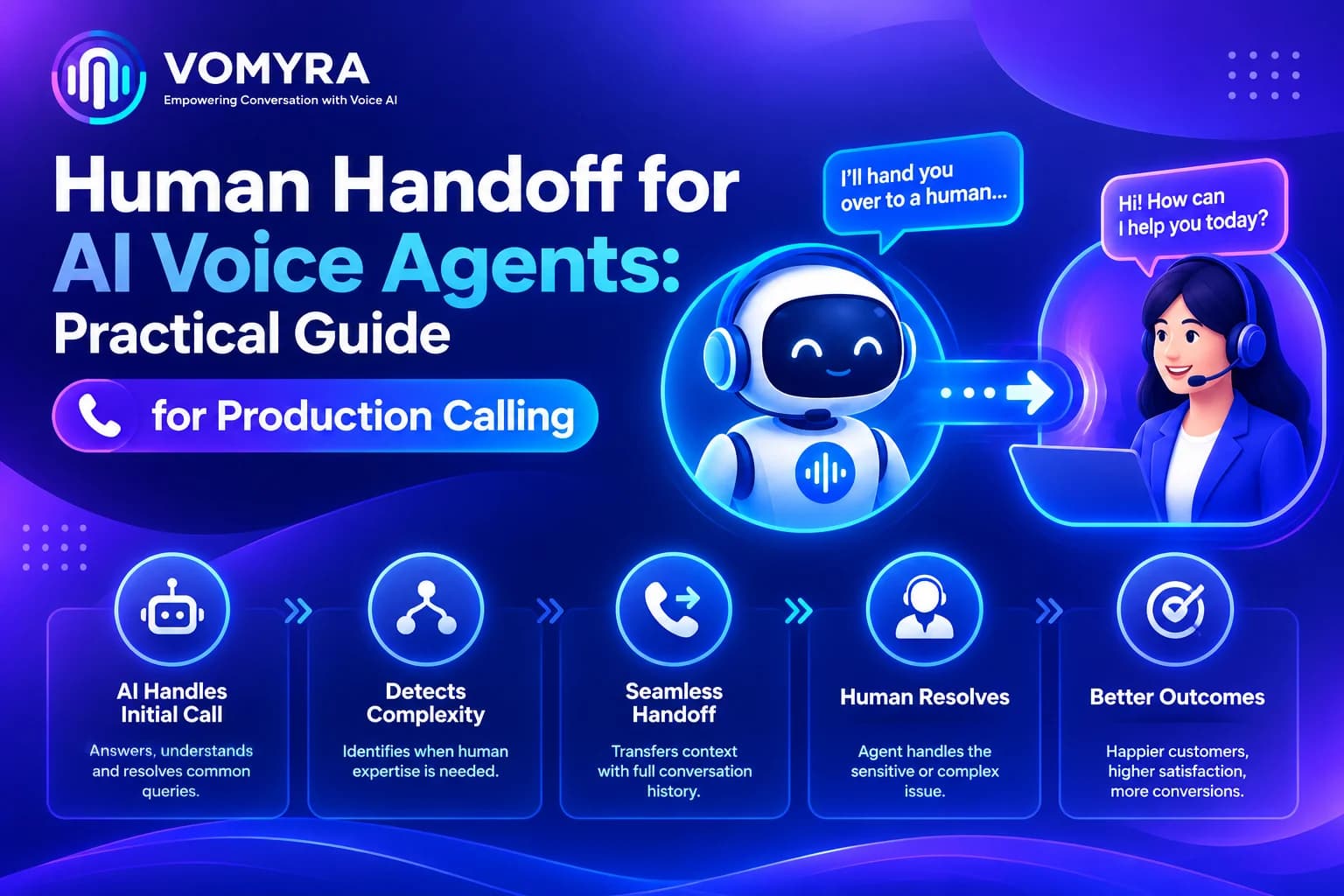
Human handoff is the point where an AI voice agent passes a live call, or the next step of a conversation, to a person. It can happen in the middle of a call, at the end of one, or after the call as a callback.
It is not a sign of failure. In production calling, human handoff for AI voice agents is part of the design. The agent handles the repetitive majority, and people handle the cases that need judgement, empathy or authority.
Why Handoff Design Matters
An AI customer service agent is only as trusted as its exit route.
It protects the customer. Good AI voice agent escalation means people tolerate automation when they know a human is reachable. They do not tolerate being trapped.
It protects revenue. High-intent leads, large orders and renewals often need a person to close. A fast, informed handoff keeps that momentum.
It builds trust. Clear rules about when the agent steps back make the whole system feel more reliable.
It is increasingly expected. For AI voice agents in India and elsewhere, callers and regulators expect transparency and a route to a human for many types of automated calls.
When an AI Voice Agent Should Escalate
AI voice agent escalation works best when the triggers are written down, not left to chance. Common triggers include:
- The caller asks for a human. Always honour this quickly.
- Strong emotion. Anger, distress or repeated frustration.
- Low confidence. The agent has misunderstood the caller more than once.
- Out-of-scope questions. Legal, medical, security or contractual topics outside the approved script.
- High value. Large deals, premium customers or key accounts.
- Complaints and disputes. Cases where the company’s response needs authority.
- Sensitive situations. Bereavement, financial hardship or safety concerns.
- Failed actions. A payment, booking or system action that did not go through.
- Compliance triggers. Requests such as opt-out, data access or formal complaints.
Types of Handoff
Choosing the right transfer type is a core part of AI voice agent escalation design.
| Type | How it works | Best for |
| Warm transfer | The agent stays on, briefs the human and then connects the caller | Sales closing, complaints, high-value calls |
| Cold transfer | The call is connected to a human without a briefing | Simple routing where context is not needed |
| Scheduled callback | The agent books a time and passes the details to a person | Out-of-hours calls, busy teams, non-urgent cases |
| Message or ticket handoff | The agent logs the issue with a summary for later action | Issues that need research or follow-up |
| Supervisor escalation | The call moves to a senior person | Complaints, disputes, sensitive cases |
A warm transfer usually gives the best experience, because the caller does not need to start again. A scheduled callback is better than a long wait on hold.
What Context to Pass to the Human
The person taking over should not need to ask “How can I help?”. A good handoff includes:
- Who the caller is: name, number, account or lead ID.
- Why they called or why the agent called them.
- What has been said and decided so far, in a short summary.
- The reason for escalation.
- Key details: amounts, dates, product, location, language preference.
- The caller’s mood, if it matters.
- The full transcript and recording, available on request.
- A suggested next step.
When this arrives on the agent’s screen before the call connects, the human can start with “Hi Priya, I understand you wanted to change your booking to Friday”, not with a blank page.
Common Handoff Problems and Fixes
| Problem | Likely cause | What to do |
| Caller has to repeat everything | No context passed | Send summary and transcript with every transfer |
| Long wait after “transferring you” | No available humans, poor routing | Check staffing hours, offer callback, add queue rules |
| Agent refuses to transfer | Rule too strict, caller intent missed | Always allow a direct request for a human |
| Transfer drops the call | Telephony or routing issue | Test on real lines and monitor transfer success |
| Wrong team receives the call | Weak routing logic | Route by reason, language and customer type |
| Handoff happens too late | Escalation triggers too narrow | Add sentiment and repeated-failure triggers |
| Handoff happens too often | Scope too tight or knowledge gaps | Review transcripts and expand what the agent can safely handle |
| Humans ignore AI summaries | Summaries are long or unclear | Keep them short, structured and consistent |
Best Practices for Handoff in Production
Decide the triggers before launch. This matters even more for AI voice agents in India handling high call volumes. Write a list of what the agent handles, what it escalates and what it never touches.
Make “talk to a person” easy. Do not hide it behind several questions.
Use warm transfers for high-stakes calls. The briefing saves time and shows respect for the caller.
Plan for out-of-hours. If no human is available, book a callback and say when it will happen.
Match language. In India, where customers mix Hindi, English and regional languages, AI voice agents in India need handoffs that respect this. Route to a person who speaks the caller’s language, including Hindi-English mixes.
Be honest. Whether it is a sales caller or an AI customer service agent, tell callers when they are being transferred and what will happen next.
Test with real calls. Whichever AI voice agent platform you choose, check transfers across phone networks, time zones and busy periods.
Review handoffs weekly. Treat AI voice agent escalation as a metric. Look at why calls escalated, how long transfers took and what customers said afterwards. Use the findings to improve scripts and knowledge.
Measure the right things. Track transfer success rate, time to human, repeat-explanation complaints and the outcome of handed-off calls.
Handoff Across Use Cases
- Sales and lead qualification: pass hot leads to a closer with budget, timeline and objections noted.
- Customer support: an AI customer service agent should escalate complaints and complex issues with a ticket and summary.
- Collections: hand off disputes, hardship cases and negotiation to trained staff.
- Healthcare and appointments: route clinical or urgent questions to qualified people.
- E-commerce: many AI voice agents in India handle COD confirmation; escalate payment failures, damaged-item claims and address disputes.
- BFSI: transfer regulated or sensitive requests to authorised staff.

Build Voice Agents That Know When to Step Back
A reliable AI voice agent platform is judged as much by its handoffs as by its conversations.
The best AI voice agents are not the ones that never escalate. They are the ones that escalate at the right moment, with the right context.
Vomyra is India’s Agentic Voice AI Platform. It gives businesses a complete AI voice team (Research, Outreach, Qualification, Closing and Follow-Up agents), real Indian mobile numbers, human-like conversations in multiple languages and no-code setup, with unlimited calling plans.
If you are planning how your calls should move between AI and your team, test Vomyra on a real use case and review how the handoff works end to end.
FAQs
What is human handoff for AI voice agents?
It is the process of passing a live call, or the next step of a conversation, from an AI voice agent to a person. It can be a live transfer, a scheduled callback or a ticket with a call summary.
When should an AI voice agent hand over to a human?
When the caller asks for one, when emotion runs high, when the agent is unsure after repeated attempts, when the topic is outside its approved scope, or when the call involves high value or sensitive matters.
What is the difference between a warm transfer and a cold transfer?
In a warm transfer, the agent briefs the person before connecting the caller, so the caller does not need to repeat anything. In a cold transfer, the call is connected without a briefing. Warm transfers suit complex or high-value calls.
What information should the human receive?
The caller’s identity, the reason for the call, a short summary, the reason for escalation, key details such as amounts and dates, language preference and access to the full transcript.
What should I look for in an AI voice agent platform for handoff?
Look for live transfer and callback options, context passing with summaries and transcripts, clear escalation rules, language-aware routing and reporting on transfer outcomes.
What happens if no human is available?
The agent should say so, offer a callback at a specific time or log the issue with a summary, and make sure the request is not lost.
Does handoff work in Hindi and regional languages?
It should. Route the call to a person who speaks the caller’s language, and pass a summary that matches. Vomyra supports multiple languages, including natural Hindi-English code-switching, so the conversation before the handoff can match the caller’s way of speaking.
How do I know if my handoff is working?
Track transfer success, time to reach a human, repeat-explanation complaints and the outcome of escalated calls. Listen to a sample of handoffs every week.
Does having a handoff mean the AI voice agent is not good enough?
No. Even a strong AI customer service agent needs one. Good production systems are designed with handoff from the start. The agent handles repetitive work, and people handle judgement, empathy and authority.