Meta Ads can generate a steady flow of leads through Facebook and Instagram campaigns. However, getting a lead is only the first step. Businesses still need to contact potential customers, understand their requirements, answer basic questions and move interested prospects towards a purchase or appointment.
This process becomes difficult when a business receives dozens or hundreds of enquiries every day. Delayed responses, missed calls and inconsistent follow-ups can result in lost opportunities. An AI voice agent for Meta Ads leads helps businesses manage these conversations through automated calls, lead qualification and follow-up workflows.
Instead of depending entirely on sales representatives for the first interaction, businesses can use AI to handle routine conversations and pass interested prospects to the right team.
What Is an AI Voice Agent for Meta Ads Leads?
An AI voice agent is a conversational system that can make or receive phone calls and communicate with people using natural speech. It understands spoken responses, processes information and replies according to the business’s requirements.
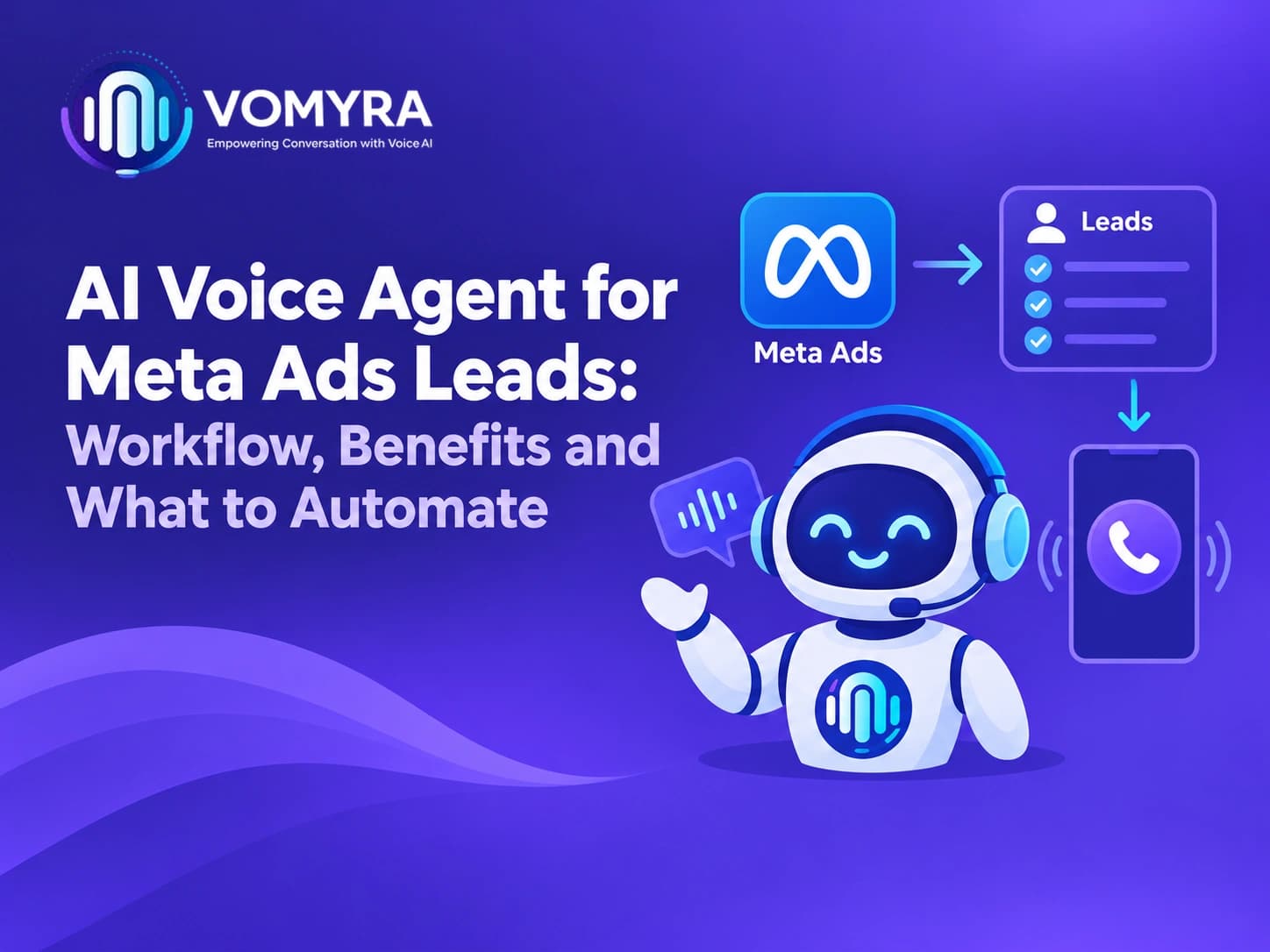
When connected to Meta lead generation campaigns, it can contact people who submit their details through Facebook or Instagram Instant Forms.
For example, someone fills out a form to enquire about a property, insurance service or product. The submitted information enters the business’s lead management system, which triggers an AI-powered call.
During the conversation, the agent can:
- Introduce the business and explain the reason for calling.
- Confirm the customer’s interest.
- Ask questions about their requirements.
- Share basic information about products or services.
- Identify qualified prospects.
- Schedule appointments or request a callback.
This makes an AI voice agent for Facebook leads useful for businesses that need to respond to enquiries quickly and manage large volumes of incoming prospects.
How Does Meta Ads Lead Automation Work?
A successful automation setup connects advertising platforms, lead management tools and an AI calling system. Each part has a specific responsibility.
Here is how the workflow typically operates.
1. Capture Leads Through Facebook and Instagram Ads
The process starts when a person clicks an advertisement and submits their details through a Meta Instant Form. These forms usually collect information such as name, phone number, email address and answers to business-specific questions.
For example, a real estate company may ask about the preferred property location, budget and buying timeline.
2. Connect Meta Leads to Your CRM
Once a person submits the form, their information needs to reach the business’s CRM or lead management system.
This connection can be established using supported integrations, webhooks or automation platforms such as Zapier and Make. The CRM stores the lead details and helps trigger the next action.
Businesses should also check that the integration is working correctly so that enquiries are not missed or duplicated.
3. Trigger an AI Voice Call
After receiving the lead information, the connected workflow can initiate an automated call.
The AI agent uses the available customer details to personalise its opening conversation. It can mention the enquiry and ask whether the person is available to discuss their requirements.
With an AI voice agent for leads, businesses can reduce the time between form submission and the first conversation.
4. Qualify Leads Through Conversation
Not every person submitting a form is ready to purchase. Some are researching options, while others may have specific requirements or limited budgets.
AI calling for Facebook leads helps businesses understand these differences through structured questions.
For instance, an education company may ask:
- Which course are you interested in?
- When are you planning to enroll?
- Do you prefer online or offline classes?
Based on the responses, leads can be categorised according to their interest and readiness.
5. Update the CRM and Schedule Follow-Ups
After the conversation, the system can save relevant details, such as call status, customer responses, qualification results and callback requests.
Interested prospects can be assigned to sales representatives, while people who request more information can enter an appropriate follow-up process.
This creates a connected workflow instead of keeping call information scattered across different tools.
Meta Ads Lead Automation: Manual vs AI-Powered Process
| Lead Management Activity | Manual Process | AI-Powered Process |
| Lead response | Sales team calls leads manually | Automated calls can start after form submission |
| Initial conversation | Representative asks basic questions | AI agent follows a predefined conversation flow |
| Lead qualification | Team checks customer requirements | AI collects and categorises responses |
| Follow-ups | Representatives track pending calls | Automated workflows schedule follow-ups |
| Appointment booking | Team coordinates available slots | AI can assist with appointment scheduling |
| CRM updates | Details are entered manually | Connected systems can update lead records |
| Performance tracking | Team reviews individual records | Call outcomes can be tracked through connected systems |
An AI-powered process can reduce repetitive tasks and make lead management more organised. However, human representatives remain important for complex enquiries, negotiations and final sales discussions. The right balance between automation and personal communication helps businesses manage leads more effectively.
What Should Businesses Automate After Receiving Meta Ads Leads?
Automation works best when it handles repetitive tasks without removing the human involvement needed for important sales conversations.
Here are some areas businesses can automate.
Instant Lead Response
A quick response can help businesses connect with prospects while their enquiry is still fresh. An automated calling workflow can initiate contact shortly after a valid form submission, depending on system availability and customer preferences.
Initial Lead Qualification
AI can ask predefined questions to understand customer needs, budget, location and purchase timeline. Sales teams can then focus on prospects who match their target customer profile.
Missed Call Follow-Ups
Some people may not answer the first call. Instead of treating these enquiries as lost, businesses can schedule another attempt at an appropriate time.
The system can also record unsuccessful attempts so that sales teams know which leads still need attention.
Appointment Scheduling
For businesses that depend on consultations, demonstrations or property visits, an AI agent can help customers select suitable appointment slots.
Once confirmed, the appointment details can be shared with the relevant team and updated in the CRM.
Post-Call Information Sharing
After a conversation, the workflow can trigger a relevant follow-up through supported channels such as SMS or WhatsApp.
For example, a customer who enquires about a service may receive its details or an appointment confirmation. Such communication should follow the customer’s consent and applicable messaging rules.
Key Benefits of AI Lead Follow-Up Automation
Using AI lead follow-up automation can improve how businesses handle advertising enquiries.
Faster communication: Automated calls reduce dependence on manual calling schedules and help businesses respond sooner.
Better lead management: Customer information and call outcomes can be recorded in one place, making it easier to track enquiries.
Reduced repetitive work: Sales representatives spend less time asking the same initial questions and updating basic lead information.
Consistent conversations: An AI agent follows an approved conversation flow, helping businesses maintain consistency across routine interactions.
Scalable operations: Businesses can manage higher enquiry volumes without increasing their manual calling workload at the same rate.
However, automation does not guarantee higher sales. Results still depend on lead quality, conversation design, product pricing, customer interest and the effectiveness of the sales team.
Best Practices for Setting Up an Automated Lead Calling System
A poorly configured system can create a negative impression even if the technology works correctly. Businesses should plan the calling process before activating automation.
- Use a clear calling script: Keep the opening introduction short and explain why the customer is receiving the call.
- Personalise conversations: Use the information collected through Meta forms instead of asking customers to repeat everything.
- Provide a human handover: Transfer complex enquiries or interested prospects to a sales representative when required.
- Set appropriate calling times: Respect customer preferences, consent and applicable telemarketing regulations.
- Monitor call performance: Review unanswered calls, qualification rates, appointment bookings and customer feedback.
- Test integrations: Check whether lead details, call results and CRM updates are being recorded correctly.
Businesses should also disclose that customers are speaking with an AI assistant where appropriate and provide a clear way to request human assistance.

How Vomyra Helps Businesses Manage Meta Ads Leads
Managing advertising enquiries requires more than simply making automated calls. Businesses need a voice system that can understand customer responses, maintain natural conversations and support their lead management process.
Vomyra, India’s Agentic Voice AI Platform, helps businesses use AI-powered voice agents for customer conversations and automated calling workflows.
Depending on the integration and configuration, businesses can use voice agents to:
- Contact new advertising leads.
- Ask questions and qualify prospects.
- Handle common customer enquiries.
- Support appointment scheduling.
- Trigger relevant post-call workflows.
- Share conversation outcomes with connected systems.
This approach helps businesses organise their initial lead communication while allowing sales representatives to focus on conversations that need personal attention.
Conclusion
An AI voice agent for Meta Ads leads can help businesses turn advertising enquiries into organised sales opportunities. From instant calling and lead qualification to appointment scheduling and CRM updates, automation can reduce repetitive work and improve the speed of customer communication.
The most effective setup is not one that automates every interaction. It is one that handles routine conversations efficiently and brings human sales representatives into the process whenever their involvement matters.
With the right workflow, Vomyra can help businesses build a more structured approach to Meta Ads lead management and customer follow-ups.
Frequently Asked Questions
1. What is an AI voice agent for Meta Ads leads?
It is an AI-powered calling system that contacts people who submit enquiries through Facebook and Instagram advertisements. It can ask questions, qualify prospects and support follow-up activities.
2. How does AI voice calling work with Facebook lead forms?
When someone submits a Facebook lead form, their information is transferred to a connected CRM or automation platform. This can trigger an AI voice call using the customer’s submitted details.
3. Can AI voice agents qualify leads automatically?
Yes. They can ask predefined questions about customer requirements, budget, location and buying timelines. The responses can help businesses categorise leads for further sales follow-up.
4. Can an automated lead calling system schedule appointments?
Yes. When connected to a suitable scheduling system, an AI agent can check available slots, collect the customer’s preferred time and help confirm appointments.
5. Is AI lead follow-up automation suitable for small businesses?
Yes. Small businesses can use it to manage enquiries without depending entirely on manual calling. The workflow can be adjusted according to lead volume, business requirements and available resources.