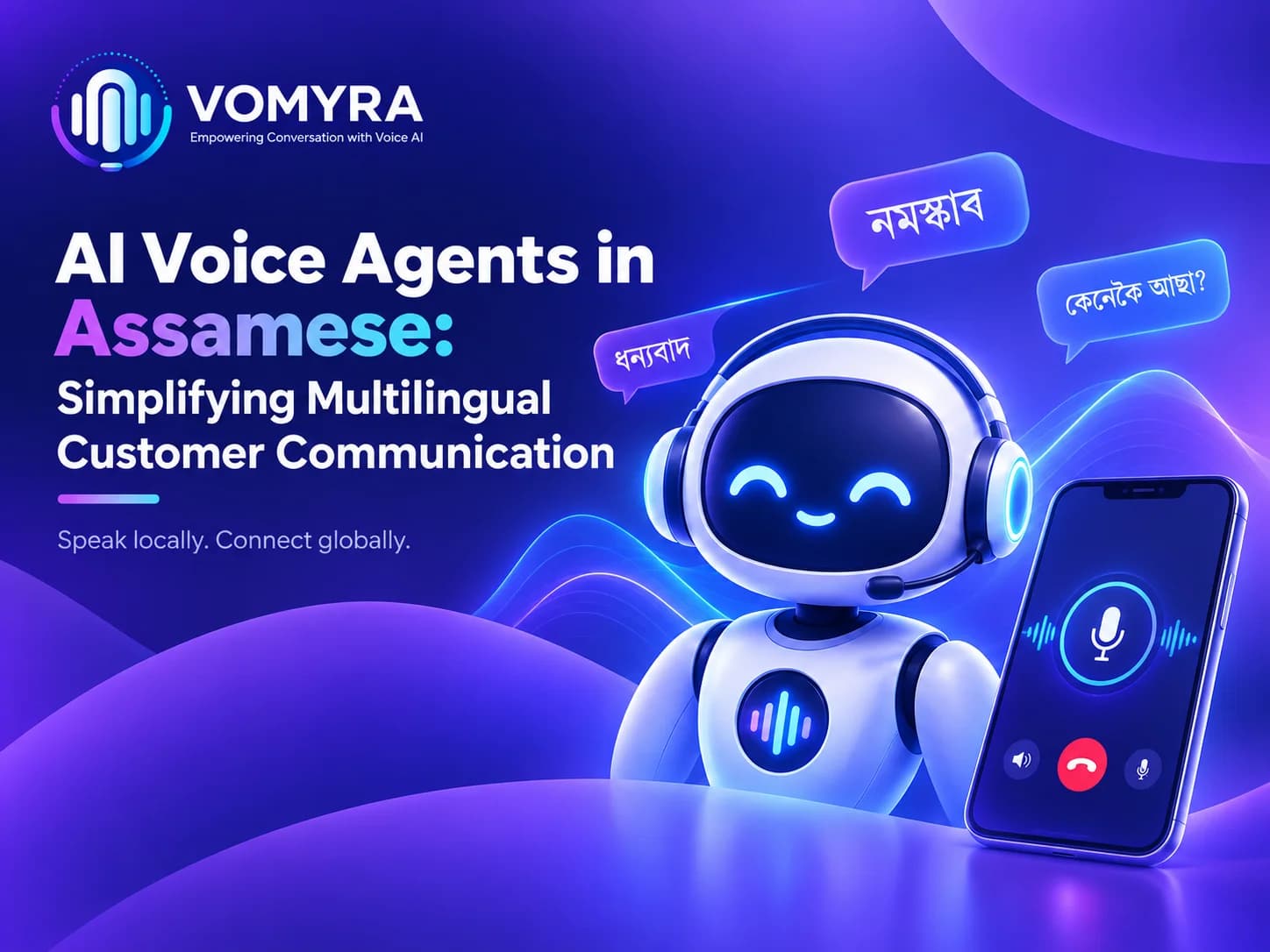
Think about a single day of customer calls for a business in Guwahati. One customer speaks Assamese. The next prefers Hindi. A third switches between Assamese and English halfway through a sentence.
In Barak Valley, many callers speak Bengali. In other districts, Bodo or another local language may be the natural choice. Handling this with a human team means hiring for every language and every shift. Handling it with a single-language bot means leaving many customers behind.
AI voice agents in Assamese are one part of the answer, but the real goal is bigger: multilingual customer communication that works smoothly, whatever language the customer starts with. This guide looks at how that works in practice, what to design, what to test and where to start.
The Real Problem: Many Languages, One Business
An AI calling agent has to meet customers where they are, not where the script was written.
For businesses serving Assam and the North East, language is not a feature. It is the main condition of every call.
- Customers choose their own language. Forcing a menu choice (“press 1 for Assamese”) adds friction and loses callers.
- Languages mix in one sentence. Assamese with English product names, Hindi phrases or Bengali words is normal speech.
- Teams cannot cover everything. A small support team rarely has speakers for every language at every hour.
- Quality varies. Staff, scripts and answers differ between languages, so customers get different experiences.
- Records get messy. Notes written in different languages are hard to search and report on.
Doing this well solves these together: one process, many languages, a consistent result.
What a Multilingual Voice Agent Needs
Any AI voice agent platform serving Assam should cover each of these. For AI voice agents in Assamese to work alongside other languages, several parts must work together.
Language Detection
The agent has to recognise which language the caller is speaking, ideally within the first sentence, and follow if the caller changes mid-call. Language detection should be tested on short, noisy phone audio, not only on clean samples.
Speech Recognition That Handles Mixed Speech
Recognition must cope with accents, dialects and mixed-language sentences, including English brand names, numbers and addresses inside Assamese or Hindi speech.
Understanding Across Languages
The same intent, such as “reschedule my appointment”, must be understood whether it is said in Assamese, Hindi or English.
A Knowledge Base That Works in Every Language
Answers on prices, timings, policies and offers must be accurate in each language, not only in the one the content was first written in.
Natural Spoken Replies
Replies should be short and conversational, in the register people use on the phone. Textbook language sounds artificial.
Voices That Pronounce Correctly
Names, places and numbers must be spoken correctly in each language, or trust drops quickly.
A Clear Human Handoff
When the agent is unsure, it should say so and hand it over to a person who speaks the caller’s language, with a summary.
Read More: Assamese Language AI Voice Agents: Automating Customer Calls with Vomyra
How the Call Flows
- Call connects from a number the customer recognises.
- Opening line in a likely language, kept short and friendly.
- Language identification from the caller’s first response, with a graceful switch if needed.
- Conversation in that language, following mid-call changes without asking the caller to choose.
- Read-back of names, numbers, dates and addresses.
- Action: book, confirm, send a link or create a ticket.
- Record outcome and summary in one consistent format, whatever language the call used.
- Handoff or follow-up as required.
Where Multilingual Calling Helps Most
| Use case | Languages typically involved | Benefit |
| Payment and renewal reminders | Assamese, Hindi, English | Clear understanding of amounts and dates |
| Appointment reminders | Assamese, Hindi, English, Bengali | Fewer no-shows |
| COD and delivery confirmation | Assamese, Hindi, English | Fewer failed deliveries |
| Lead follow-up | Assamese, Hindi, English | Higher response and trust |
| Admission and enrolment calls | Assamese, English, Hindi | Parents engage more readily |
| Customer service first response | Mixed | Wider coverage without extra shifts |
| Feedback and survey calls | Mixed | More honest answers in a familiar language |
Challenges to Plan For
Assamese data is smaller. Speech recognition for Assamese is generally less mature than for widely used languages, so it needs careful testing.
Dialects vary. Speech differs across regions and communities.
Mixed speech is hard. Hindi-English code-switching is the best-known case, and Assamese mixes are no easier. Switching between Assamese, Hindi and English inside a sentence is one of the hardest cases for any voice agent.
Uneven quality across languages. A strong result in Hindi does not guarantee the same in Assamese or Bengali.
Script and pronunciation. Assamese has its own script, and Roman-letter text can be mispronounced by voice output.
Over-promising. A long language list is less useful than a short list that works well.
How to Test Multilingual Customer Communication
- Use native speakers from different parts of Assam and the North East, and across age groups.
- Test language switching: calls that begin in one language and move to another.
- Test on real phone lines with background noise and interruptions.
- Include mixed sentences with English words, numbers and addresses.
- Score each language separately, and compare results side by side.
- Review transcripts weekly after launch and track errors per language.
- Add languages gradually, once the previous one is stable.
Best Practices
Start from data. Pick an AI voice agent platform that lets you add languages gradually. Check which languages your customers actually use before choosing the order.
Begin with one use case. Treat your first AI calling agent as a pilot. Reminders, confirmations or lead follow-up are good starting points.
Write for speech. Use short, natural sentences.
Confirm key details. Read back anything that affects money, time or place.
Keep content consistent. Check key facts in every language.
Respect consent and calling rules. Call only people who have reason to expect it, follow calling-hour rules and honour opt-outs.
Measure by language. Track pickup, completion, escalations and business outcomes for each language.

One Process, Many Languages
Choose an AI voice agent platform on how it performs in your languages, not on how long its list is. Customers do not want to adapt to your systems. They want to be understood the first time, in the language they use. The businesses that manage this well tend to keep customers longer and spend less on repeat calls.
Vomyra gives businesses a complete AI voice team (Research, Outreach, Qualification, Closing and Follow-Up agents) with real Indian mobile numbers, human-like conversations in multiple languages and no-code setup, with unlimited calling plans.
If you serve customers in Assam and the North East, book a demo, bring your own call scenarios and judge the results by what you hear.
FAQs
What are AI voice agents in Assamese?
They are AI voice agents that can understand and speak Assamese on phone calls, so businesses can automate routine customer conversations in the language customers use at home.
What is multilingual customer communication?
It is the ability to serve customers in the language they prefer, across calls and other channels, with consistent information and a consistent experience whatever language they use.
How does an AI calling agent know which language the caller speaks?
Through language detection, which identifies the language from the caller’s speech. A good setup also follows the caller if they switch languages during the call. Test this on short, noisy phone audio.
Can one voice agent handle Assamese, Hindi and English together?
That is the goal of multilingual voice AI. In practice, quality differs by language and by how much mixing there is, so each language and each mix should be tested on real calls.
Does Hindi-English code-switching work for Assamese callers too?
Not automatically. Hindi-English code-switching support does not guarantee the same quality for Assamese-English or Assamese-Hindi mixes. Each combination needs its own testing.
How do I choose an AI voice agent platform for regional languages?
Look for natural conversation in your customers’ languages, honest testing support, language detection, CRM integration, call transcripts, clear handoff rules and simple setup. Judge it on your own calls.
Can an AI calling agent replace my support team?
No. It handles routine calls, reminders and first responses. People still handle complaints, negotiation and sensitive cases.
Which businesses benefit most?
Businesses with many routine customer calls in Assam and the North East, such as lenders, clinics, retailers, schools, real estate firms, utilities and logistics companies.
Does Vomyra support Assamese?
Vomyra is India’s Agentic Voice AI Platform, with human-like conversations in multiple languages, including natural Hindi-English code-switching. For Assamese, ask the Vomyra team about current language support and test it on your own scenarios in a demo.