Indian real estate developers spend ₹5,000 to ₹50,000 to generate a single qualified lead through Google Ads, property portals, and Meta campaigns. Much of that spend is wasted the moment the lead arrives, because a telecaller is busy, the inquiry comes in after office hours, or the callback happens a day later when the buyer has already spoken to three other agents. This gap between lead generation and lead response is the single biggest reason industry-wide conversion from inquiry to site visit sits at just 2 to 8 percent.
An AI voice agent for real estate in India closes that gap by picking up every call, in the buyer’s own language, within seconds of the inquiry. This guide explains what these systems do, how Indian developers and brokers are using them in 2026, and how to evaluate one for your portfolio.
What an AI Voice Agent Actually Does in Real Estate
An AI voice agent is software that holds a real, two-way phone conversation with a property buyer without a human on the other end. It combines speech recognition, language understanding, a response engine, and natural-sounding voice synthesis, working together fast enough that the exchange feels like talking to a person rather than navigating a phone tree.
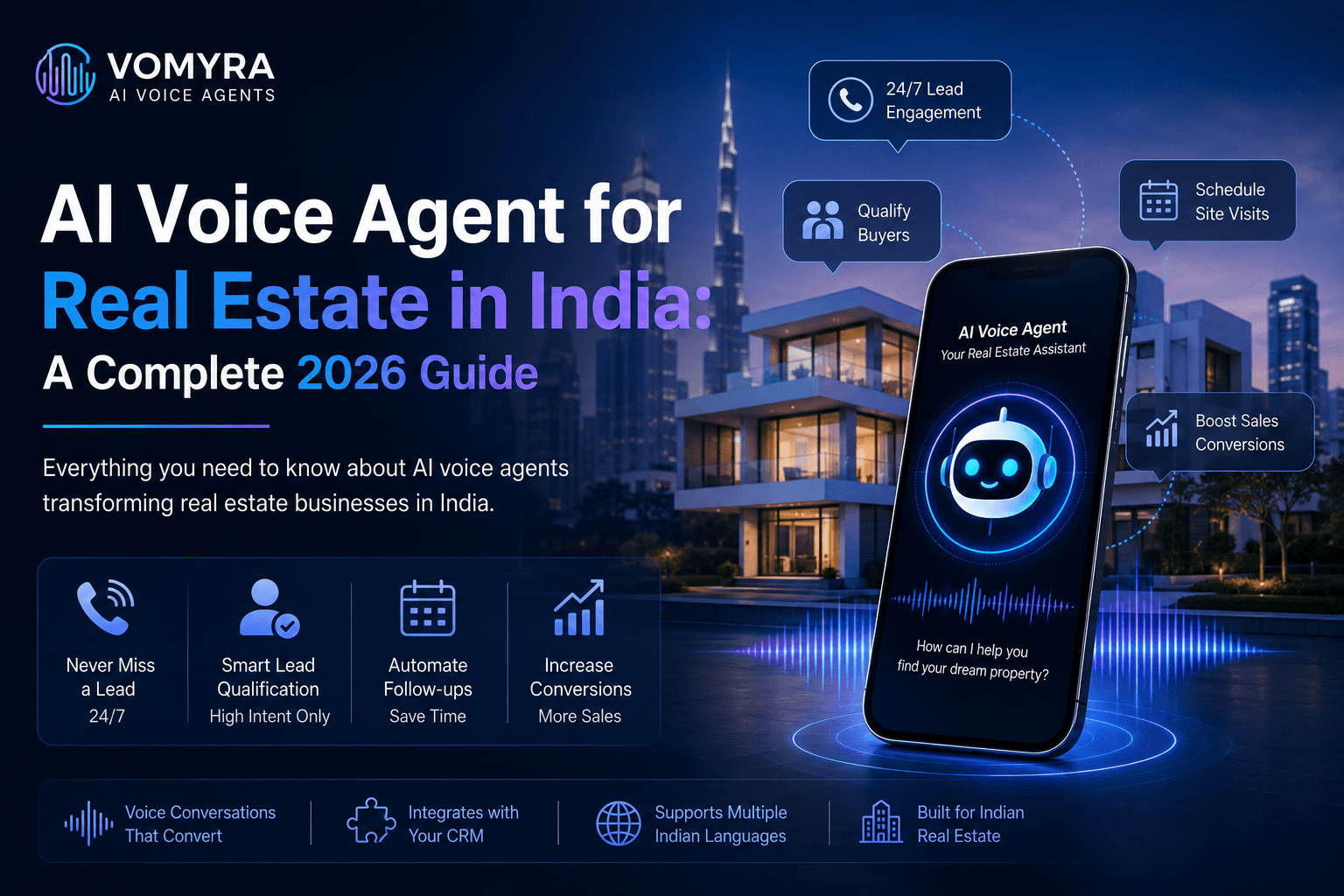
In practice, this covers a handful of concrete jobs. The agent answers every inbound call to a project helpline, regardless of the hour. It calls fresh leads the moment they fill a form on 99acres, Housing.com, or a Meta lead ad, often within sixty seconds. It asks the qualifying questions a junior telecaller would ask — budget, preferred location, configuration, timeline to purchase — and records the answers automatically.
It shares pricing, floor plans, RERA status, and possession dates on request, books site visits into the sales calendar, and sends reminders. When a caller sounds genuinely ready to buy, it transfers the conversation to a human closer instead of trying to finish the sale itself.
Unlike the IVR systems Indian real estate companies have used for years, the conversation isn’t scripted into rigid menus. A buyer can ask an open-ended question, interrupt, or switch to Hinglish mid-sentence, and the agent still follows along.
Why Indian Developers Are Adopting This Now
Three forces are pushing adoption faster in India than in most markets. First, sheer inquiry volume — portals, paid ads, WhatsApp campaigns, and referrals all funnel leads into the same sales desk simultaneously, and most mid-sized developers don’t have the telecalling bandwidth to respond inside the golden first few minutes that decide whether a lead converts.
Second, the language reality of Indian buyers. A project in Pune might get inquiries in Marathi, Hindi, and English the same day. A multilingual AI calling bot that holds a fluent conversation in a buyer’s preferred language removes a real barrier to qualification, particularly for Tier 2 and Tier 3 city buyers more comfortable in their regional language.
Third, the proof points are now public. Gnani.ai’s deployment for Brigade Group, one of India’s larger developers, used multilingual voice AI to qualify leads by intent and budget immediately after capture and route hot prospects to sales — a project credited with generating over ₹5 crore in revenue, the kind of result moving voice AI from experimental to standard in real estate sales tech budgets.
Where Voice AI Fits Across the Sales Funnel
Instant lead response. The moment a buyer submits an inquiry, the AI calls back, typically inside a minute, while interest is still fresh — the single variable that correlates most strongly with qualification rates.
Lead qualification at scale. Instead of a telecaller manually dialing through hundreds of raw portal leads, the AI works through the list automatically, scoring each lead by intent, budget fit, and timeline, so sales teams spend time only on prospects actually ready to talk numbers.
Site visit scheduling and project information. The agent checks availability, books a slot, confirms it, and sends a reminder. It also answers questions buyers ask repeatedly — price, unit sizes, RERA registration, possession timeline, amenities — consistently every time.
Re-engaging old leads and post-visit follow-up. Outbound calling campaigns can revisit cold databases at scale, and after a site visit, the same agent can gather feedback and nudge the buyer toward the next step — useful for the long, multi-touch buying cycles typical of Indian residential real estate.
How This Differs From Hiring More Telecallers
The honest comparison isn’t “AI versus a human salesperson,” since closing a property deal still requires human relationship-building and trust. The real comparison is between AI and the layer of telecalling work that exists purely to filter, qualify, and route — repetitive work that doesn’t need a human’s judgment until a lead is already warm.
A telecalling team has fixed hours, takes leave, and can’t realistically dial out to a hundred leads the same hour a campaign goes live. An AI voice agent for outbound calls works around the clock and runs hundreds of calls simultaneously — while still deferring to humans for negotiation and the final close, with AI handling volume and the human team handling value.
What to Actually Look for in a Platform
A few concrete criteria matter more than marketing claims when comparing platforms.
Language coverage matters more in Indian real estate than almost any other vertical, since buyer pools are regionally diverse even within a single city. Check whether the platform genuinely supports Hindi, Hinglish, and the regional languages relevant to your markets, rather than just English with a “multilingual” label attached.
CRM integration determines whether the tool plugs into your existing workflow or becomes a parallel system to manage separately. A platform pushing call outcomes, lead scores, and appointment data directly into your CRM saves far more time than one needing manual exports.
Setup complexity is also worth scrutinizing. Some platforms require API integration and conversation-flow coding before anything goes live — fine for a developer with a tech team, but a poor fit for a brokerage wanting something running this week. A genuinely no-code AI voice agent platform built for the Indian market lets a non-technical team configure scripts and launch without writing a line of code.
Pricing transparency varies too. Some platforms charge a base subscription plus per-minute usage plus separate telephony costs that only become clear once you’re using the tool. Always ask for the all-in cost per minute, not just the headline number.
Vomyra is built around this last point — a no-code AI voice agent platform where Indian developers and brokers can launch a multilingual agent on their own +91 number without engineering work, with native support for Hindi and regional languages and direct integration into existing lead workflows.
Common Concerns Worth Addressing Honestly
Will buyers know they’re talking to AI? Often not immediately, and disclosure practices vary by platform. Indian regulations around automated calling and consent are evolving, so any platform you choose should have clear consent and recording-disclosure mechanisms built in.
Does this replace my sales team? No. The deployments that perform well escalate to a human the moment a conversation moves from information-gathering to negotiation, or when the AI detects frustration or repeated misunderstanding. Voice AI handles top-of-funnel volume; it doesn’t replace the relationship-building that closes a property sale.
Is this only for large developers? Not anymore. Brokers and channel partners managing inquiries across multiple projects are often better candidates than large developers, since they deal with higher lead variety and tighter margins on time spent per lead. A free AI voice agent trial is usually enough to test whether qualification logic and language accuracy hold up on your actual lead list before committing to a paid plan.
The Direction This Is Heading
Voice AI in Indian real estate is moving from a pure lead-qualification tool toward a continuous buyer-engagement layer — handling follow-ups across the months a typical property decision takes, project recommendations, and post-visit nurturing. As lead volume keeps climbing and cost per lead keeps rising, businesses that respond fastest and most consistently will keep converting at a higher rate than those relying on manual callbacks.
For developers, brokers, and channel partners evaluating this category in 2026, the practical starting point is narrow: pick one lead source, one language pair, and one clear outcome — usually site-visit bookings — and measure whether response time and conversion actually improve before expanding further.
Frequently Asked Questions
Is an AI voice agent the same as an IVR system?
No. IVR systems route callers through fixed touch-tone menus and can’t hold an open conversation. An AI voice agent understands natural speech and adapts mid-call, which is why it can qualify a lead the way a trained telecaller would.
How quickly can a real estate business deploy one?
With a no-code platform, a basic agent handling FAQs and lead qualification can usually go live within a few days, since there’s no custom development involved. Complex multi-project setups with deep CRM syncing take longer.
Does it work for resale and rental inquiries, not just new projects?
Yes. Brokers and channel partners use the same qualification logic for resale listings and rentals — confirming budget, configuration, and timeline before a human agent spends time on a property visit.
What happens if the AI can’t answer a buyer’s question?
A properly configured agent recognizes when a query falls outside its script and either takes a message for the sales team or transfers the call to a human in real time, rather than guessing.
Is there a low-cost way to test this before a full rollout?
Most platforms built for the Indian market offer a free trial specifically so a business can test call quality and language accuracy on its own leads before paying for a larger deployment.