The Number Indian Hospitals Do Not Talk About at Conferences
Between 26 and 32 percent of scheduled OPD appointments at mid-to-large Indian hospitals never happen. The patient booked. The slot was held. The consultant arrived. The chair stayed empty.
At a 200-bed hospital running 400 OPD consultations daily, a 20 percent no-show rate is 80 missed appointments. That is Rs 64,000 to Rs 2,40,000 in foregone revenue every single day, depending on the speciality mix. Multiply across a month and the annual number crosses several crore for any hospital running meaningful outpatient volume.
The causes are addressable. The reminder did not arrive or arrived at the wrong time. The patient tried to reschedule and could not reach the front desk. The discharge instructions were clear in the room but forgotten by the time the follow-up date arrived. The medication adherence call that was supposed to happen at day 7 did not happen because the ward coordinator had 200 other tasks.
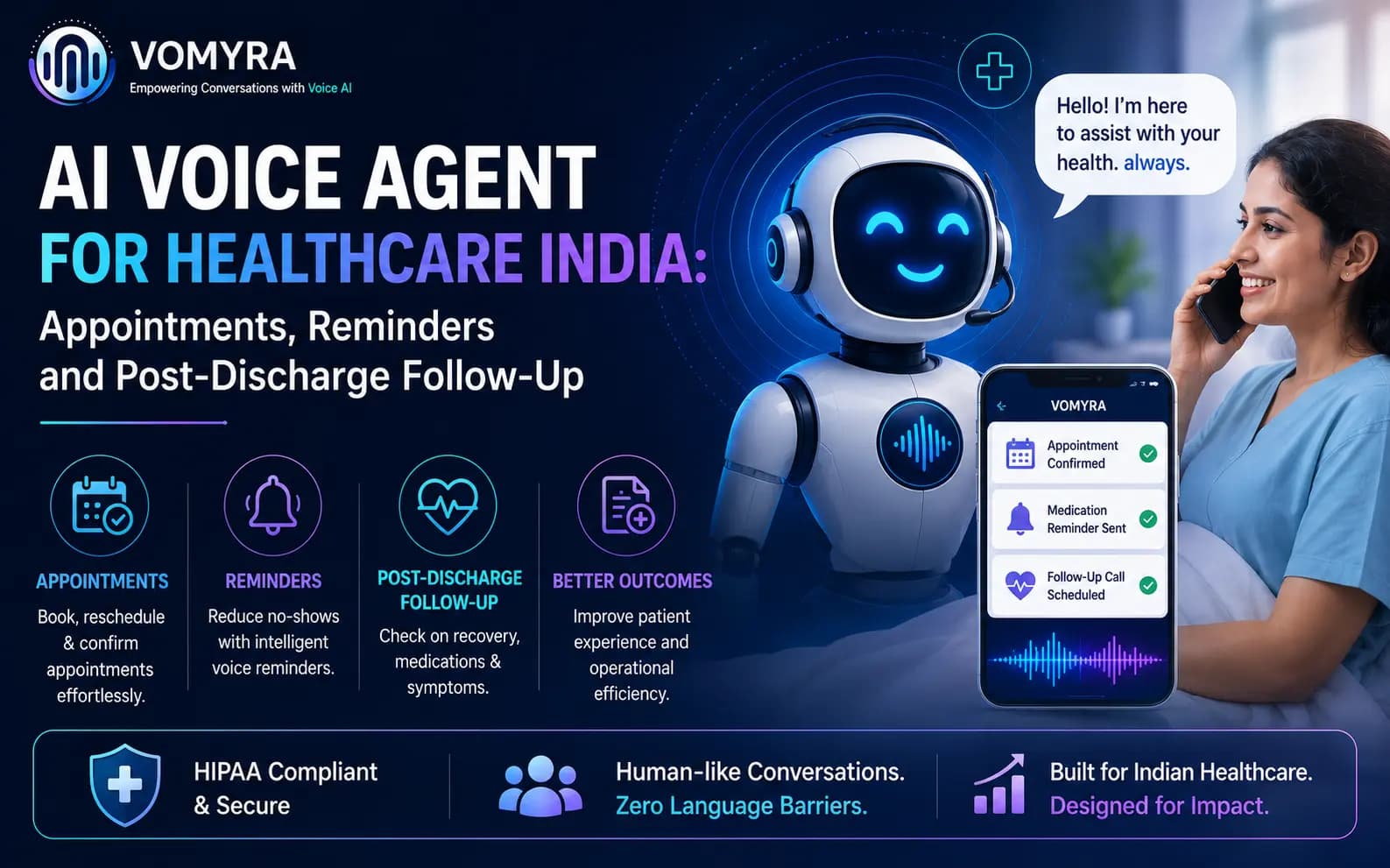
These are operational failures, not clinical ones. And they have an operational solution. Vomyra AI Voice Agent is the platform Indian hospitals, clinic chains, and diagnostic centres are deploying in 2026 to run appointment reminders, confirmations, post-discharge follow-up, and medication adherence calls in the patient’s language, automatically, without adding front desk headcount.
Why the Indian Healthcare Context Is Different
Most AI voice solutions for healthcare are built for Western markets where patients speak one language, hospitals have well-integrated EMR systems, and the regulatory environment is HIPAA-first. The Indian healthcare context has different characteristics that matter for deployment decisions.
Linguistic diversity is the first operational reality. A multi-city hospital chain with facilities in Mumbai, Chennai, Hyderabad, and Bhopal serves patients who speak Marathi, Tamil, Telugu, and Hindi respectively. A reminder call in English reaches some of these patients adequately.
A reminder call in their own language reaches all of them and produces meaningfully better confirmation rates. Research consistently shows that Hindi-language calls produce 15 to 20 percent better confirmation rates than English calls on the same patient population in Hindi-speaking regions.
Mobile phone penetration exceeds hospital digital infrastructure. India has over 120 crore mobile subscribers. A significant proportion of Indian patients, particularly in Tier 2 and Tier 3 cities and among older patient populations, do not have digital patient portals, email addresses linked to their hospital record, or app notifications from a hospital’s digital platform.
But they have a mobile phone that receives calls. AI voice calling reaches patients that no other automated channel reliably reaches.
Front desk capacity is the binding constraint. Indian hospital front desks routinely manage simultaneous walk-ins, phone queues, insurance documentation, and doctor schedule changes. The confirmation call that was supposed to go out at 10 AM for tomorrow’s 9 AM appointments gets pushed to 3 PM, or missed entirely, because a senior consultant changed their schedule and the desk is managing the rebooking cascade.
AI voice removes the front desk from the reminder and confirmation workflow entirely, running every call at exactly the configured time regardless of what else is happening in the hospital.
The Evidence-Based Reminder Sequence: T-48, T-24, T-2
The intervention with the strongest evidence base for no-show reduction in Indian hospital settings is a structured reminder cadence with three specific touchpoints before each appointment.
T-48: The preparation call. 48 hours before the appointment, the AI voice agent calls the patient to confirm they are still planning to attend, provide any preparation instructions specific to their appointment type (fasting for surgery, stopping certain medications, what to bring), and offer an easy rescheduling option if their plans have changed. This call catches the significant proportion of no-shows who would have willingly rescheduled if they had been contacted in time but defaulted to simply not showing up because rescheduling felt like friction.
T-24: The confirmation call. 24 hours before the appointment, the agent calls to confirm the patient is still coming and, critically, offers a final rescheduling option. For the patients who did not pick up at T-48, this is a second opportunity. For the patients who confirmed at T-48 but have had a change of circumstances, this call gives them a dignified way to reschedule without leaving a slot empty without notice.
T-2: The day-before logistics call. Two hours before an appointment, a brief call confirms the appointment is still on and provides logistical information: parking, which entrance to use, whether to go directly to the consultation room or check in at reception first. This call dramatically reduces the late arrivals and missed appointments that happen when a patient is present in the building but cannot navigate to the right department quickly enough.
Hospitals that implement all three touchpoints consistently report no-show rates falling from the 26 to 32 percent baseline to 10 to 15 percent within 60 days of deployment. The T-2 call alone, even without T-48 and T-24, produces measurable no-show reduction because it addresses the navigation and logistics failures that account for a meaningful share of same-day no-shows.
The Five Healthcare Workflows AI Voice Handles
Appointment Booking and Confirmation
For hospitals and clinics where a significant proportion of appointment bookings still arrive by phone rather than through an app or portal, an AI receptionist India Hindi fluent handles inbound booking calls in the patient’s language, checks availability against the configured schedule, books the appointment, and sends the confirmation details.
The same agent handles rescheduling calls, which are typically higher-stress interactions because they involve a patient who has a specific reason for wanting to change their slot and may be anxious about losing their place in the consultant’s schedule.
An AI agent that handles the rescheduling call immediately, in the patient’s language, without a hold queue, produces better patient experience than a front desk call where the patient waits on hold and then negotiates with a coordinator under time pressure.
Pre-Procedure Instructions
For surgical procedures, diagnostic tests with specific preparation requirements, and consultations requiring the patient to bring specific documents or maintain specific conditions beforehand, the preparation call is not just a reminder. It is a compliance intervention.
An AI voice agent calling three to five days before a procedure, in the patient’s language, delivers the preparation instructions in conversational terms, asks the patient to confirm they have understood each step, and escalates to a human coordinator if the patient raises a concern about their ability to follow the preparation.
Pre-procedure instruction calls that use this interactive confirmation approach produce better preparation compliance than written discharge instructions or SMS-delivered instruction lists.
Post-Discharge Follow-Up
Post-discharge follow-up is where the gap between what Indian hospitals plan to do and what they actually do is widest. A discharge summary specifies that a cardiac patient should receive a follow-up call at day 3, day 7, and day 30.
In practice, the ward coordinator who was responsible for that patient is managing the current census, and the day 3 call for a patient who left five days ago does not get made.
AI voice handles this automatically. The discharge event triggers a scheduled call series. The day 3 call asks standard post-discharge questions: whether the patient has been able to take their medication as prescribed, whether they have experienced any symptoms that warrant a callback from a clinical team member, and whether they have booked their next appointment.
Answers that fall outside normal parameters trigger an immediate escalation to a nurse or doctor through the platform’s call transfer function. Answers within normal parameters are logged to the patient record and the next scheduled call is confirmed.
Medication Adherence and Chronic Care
For patients managing chronic conditions, medication adherence is the single most significant factor in whether they return for follow-up with deteriorating or stable health status. Adherence rates in Indian outpatient chronic care are lower than clinical teams would prefer, partly because the monitoring mechanism between visits depends on the patient’s own motivation rather than any systematic follow-up.
A weekly AI voice check-in call, in the patient’s language, asking whether they have been able to take their medication, whether they have noticed any side effects, and whether they have questions for the doctor before the next visit, maintains the care relationship between appointments.
Patients who receive these calls report higher adherence and show up to follow-up appointments with better-prepared questions than patients who go through the inter-visit period without any contact from the healthcare provider.
Lab Results Notification and Follow-Up Booking
Diagnostic labs and hospital pathology departments face a specific operational gap: results are ready before the ordering physician has reviewed them, and the patient does not know this.
AI voice calling the patient when results are ready, in their language, to let them know the results are available and to ask whether they would like to book a follow-up appointment to discuss them with the doctor, closes this gap without requiring the lab team to make outgoing calls alongside their primary workload.
Compliance: DPDP and Healthcare Data in AI Voice Calls
Healthcare voice AI deployments in India in 2026 must meet the requirements of the Digital Personal Data Protection Act 2023 as they apply to health data, which is classified as sensitive personal data under the Act. The DPDP requirements that apply to AI voice calls in healthcare include documented consent for data collection and processing, a defined purpose limitation for how voice interaction data is used, a specified retention period, and an accessible grievance mechanism for patients who want to exercise their data rights.
Vomyra AI Voice Agent handles consent logging at the platform level. Every call captures a consent signal at the opening of the interaction, stores it with the call record, and makes it available for audit through the platform’s compliance reporting.
The call data is subject to the data retention and deletion parameters configured by the hospital, enabling compliance with DPDP retention requirements without custom data infrastructure development.
For hospitals operating in regulated specialities under specific MCI, IRDAI, or NABH requirements, the call transcript and outcome log produced by Vomyra’s cascaded pipeline architecture provides the documented interaction record that audit processes require.
The ROI Table: What AI Voice Delivers for Indian Healthcare
| Use Case | Without AI Voice | With AI Voice | Monthly Benefit |
| No-show rate (400 OPD/day hospital) | 28% (112 missed/day) | 14% (56 missed/day) | 56 slots recovered daily |
| Revenue recovered (at Rs 800 avg) | , | Rs 44,800/day | Rs 13.4 lakh/month |
| Front desk call hours for reminders | 4 hours/day manual | 0 hours/day | 88 staff hours/month freed |
| Post-discharge follow-up compliance | 35% contacted | 95% contacted | 60% more patients followed up |
| Medication adherence calls | 0 systematic | Weekly automated | Chronic care improvement |
| Pre-procedure preparation rate | 65% arrived prepared | 88% arrived prepared | Fewer OT cancellations |
| AI voice agent monthly cost (3,000 calls at Rs 5/min, 2 min avg) | , | Rs 30,000 | , |
| Net monthly benefit (conservative) | , | , | Rs 13.1 lakh+ net |
These numbers are based on a 200-bed hospital running 400 OPD consultations daily. Smaller clinics see proportionally smaller absolute numbers but similar percentage improvements. The Rs 30,000 monthly cost is a fraction of a single receptionist’s loaded monthly cost, and it covers call volume that no human team could match at consistent quality.
Language Configuration for Multilingual Patient Populations

The configuration decision that most directly determines whether a healthcare AI voice deployment produces good patient outcomes is the language setup. A reminder call that the patient does not understand does not reduce no-shows. It generates a missed connection that the front desk team then has to follow up manually.
Vomyra AI Voice Agent supports 70-plus Indian languages with automatic detection from the patient’s first response. For a hospital in Chennai, the default language is Tamil. For a hospital in Hyderabad, it is Telugu.
For a multi-city chain, the patient’s preferred language can be stored in the patient record and passed to the AI agent as a parameter at call time, ensuring every patient receives their reminder in the language associated with their file.
Hinglish handling is particularly important for urban Indian hospitals where patients routinely mix Hindi and English mid-sentence. A patient who says “mera appointment change karna tha, kya Thursday hai available?” needs an agent that understands the full Hinglish sentence as a single coherent request rather than treating the English and Hindi portions as separate inputs. Vomyra’s Hinglish mode handles this natively without additional configuration.
Vomyra AI Voice Agent is deployed across 20-plus Indian hospitals and clinics running appointment reminders, discharge follow-up, and chronic care calls in production. The 98 and 94 series Indian mobile numbers that Vomyra provisions natively produce pickup rates above 80 percent on Indian mobile networks, which is the operational foundation that makes every other healthcare AI voice workflow function correctly.
Getting Started: The First Workflow to Deploy
The fastest-ROI entry point for a hospital or clinic starting with AI voice is the T-24 appointment reminder. This single workflow, deployed for 30 days on all booked appointments, produces a measurable reduction in the no-show rate that makes the business case for expanding to T-48, T-2, post-discharge follow-up, and chronic care calls.
The configuration requires the appointment schedule from the HMS (exported as CSV or connected via API webhook), the patient phone numbers and preferred languages from the patient record system, and the standard reminder script in the relevant language or languages.
The full setup, from signed contract to first live calls, typically completes within three to five working days on Vomyra’s no-code platform.
A free trial of Vomyra AI Voice Agent covers 500 monthly credits that renew every month, full access to Hindi, Hinglish, Tamil, Telugu, Kannada, Marathi, and all supported Indian languages, Indian 98/94 mobile numbers, HMS integration via webhook, DPDP-compliant consent logging, and call transcripts before any payment commitment.
Frequently Asked Questions
How much can AI voice reminders reduce no-shows at Indian hospitals?
Hospitals running structured T-48, T-24, and T-2 reminder sequences with AI voice consistently reduce no-show rates from 26-32 percent to 10-15 percent within 60 days. At a 400-OPD hospital, this recovers 50-plus…
What Indian languages does Vomyra AI Voice Agent support for healthcare calls?
70-plus Indian languages including Hindi, Hinglish, Tamil, Telugu, Kannada, Marathi, Bengali, Gujarati, Punjabi, Assamese, and Malayalam. Language is auto-detected from the patient’s first response or can be…
Is AI voice calling for healthcare compliant with DPDP in India?
Yes. Vomyra AI Voice Agent captures consent at the opening of every call, stores consent records with full audit trails, and applies data retention and deletion parameters configured by the hospital.