Introduction
Outbound sales is an important part of business growth, but reaching potential customers consistently can be difficult. Sales teams spend considerable time making calls, explaining products, qualifying leads, scheduling meetings and following up with prospects. As the number of leads increases, managing these activities manually becomes more challenging.
An AI voice agent for outbound sales helps businesses automate repetitive calling tasks while maintaining natural conversations with prospects. It can contact leads, introduce products or services, ask qualifying questions, understand customer responses and schedule the next sales interaction.
Unlike traditional automated diallers that simply connect calls or play recorded messages, conversational AI voice agents can respond to different answers and adjust the conversation based on the prospect’s requirements.
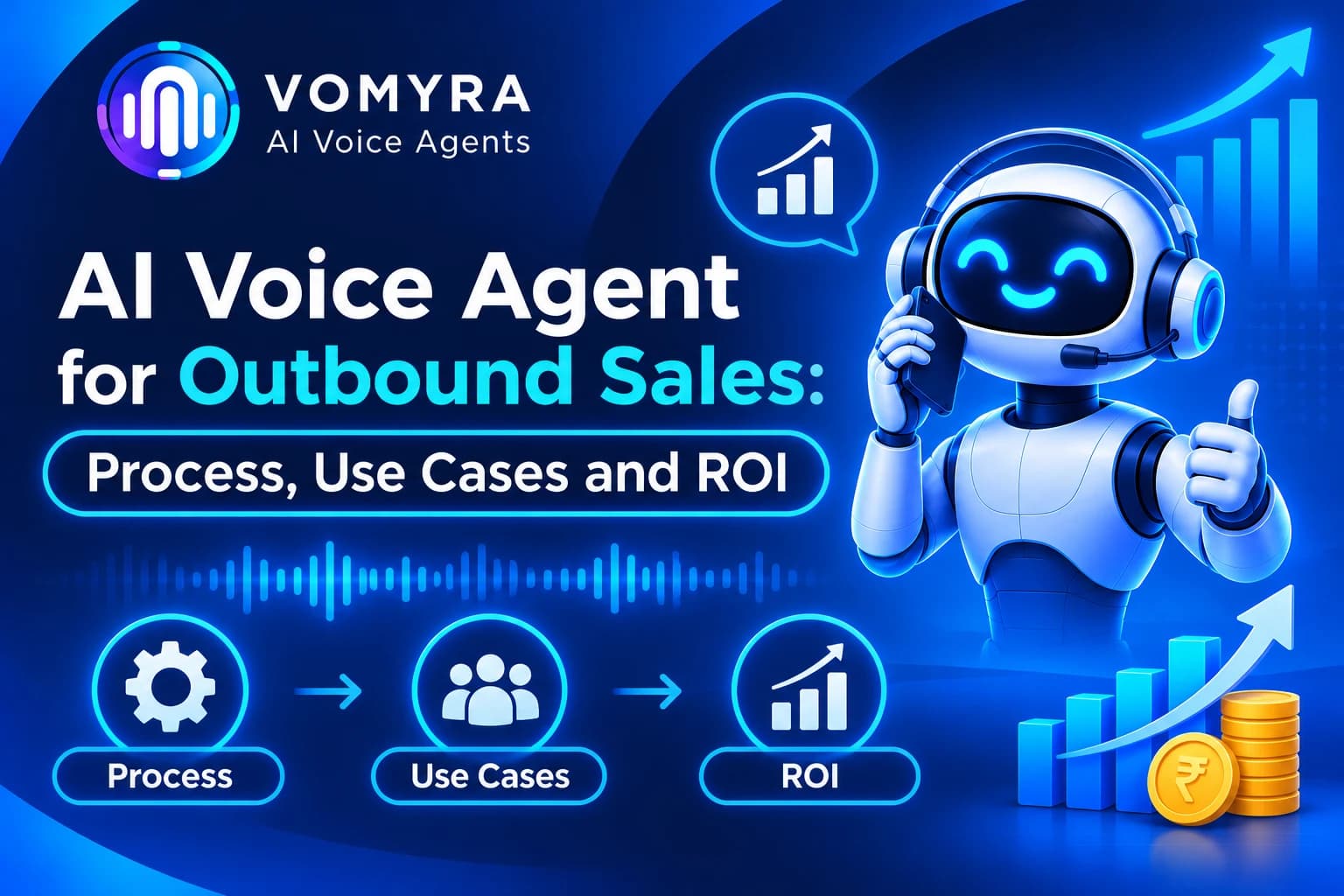
This guide explains how AI voice agents support outbound sales, the complete calling process, practical business use cases and how to calculate their return on investment (ROI).
What Is an AI Voice Agent for Outbound Sales?
An AI voice agent for outbound sales is an automated calling system that proactively contacts potential customers and manages sales conversations using artificial intelligence.
It can communicate with prospects, identify their requirements, answer predefined questions, collect information and determine whether a lead is ready for the next sales step.
For example, when someone submits an enquiry form on a company’s website, an AI voice agent can automatically call that person, understand their requirements and check their interest in the product or service.
Depending on the conversation, it can:
- Introduce the business and explain the purpose of the call.
- Ask questions about customer needs and preferences.
- Qualify prospects based on budget, interest and purchase timeline.
- Schedule product demonstrations or sales meetings.
- Update lead information in the CRM.
- Transfer interested prospects to human sales representatives.
- Arrange follow-up calls when customers are unavailable.
This allows sales teams to spend less time on repetitive outreach and more time handling qualified opportunities and closing deals.
How the AI Voice Agent Outbound Sales Process Works
A successful outbound sales workflow involves more than automatically dialling phone numbers. The agent needs relevant lead information, clear conversation instructions and access to the business systems required to complete sales tasks.
Here is how a typical workflow operates.
1. Lead Collection and Segmentation
The process starts by collecting prospect information from different sources, such as website enquiry forms, Google Ads, Meta Ads, CRM platforms, landing pages and authorised contact lists.
The leads are then organised into relevant groups based on factors such as:
- Product or service interest
- Lead source and campaign
- Customer location
- Industry or business category
- Previous interactions
- Purchase intent and lead status
Segmentation helps the AI agent use relevant information during each conversation instead of delivering the same generic sales pitch to everyone.
2. Automated Outbound Calling
Once the leads are ready, the system initiates outbound calls according to the configured campaign rules.
The AI agent introduces itself, identifies the business and explains why it is calling. It can use available lead information to make the opening more relevant.
For example, if a prospect recently requested information about a software product, the agent can refer to that enquiry and ask whether the prospect is available to discuss their requirements.
Calling schedules, retry limits and campaign pacing should be configured according to customer preferences and applicable calling regulations.
3. Product Introduction and Discovery Questions
After the opening, the agent begins the discovery process. Instead of delivering a long promotional message, it asks short questions to understand what the prospect needs.
For a B2B software company, these questions might include:
- Which business process are you looking to automate?
- How many employees will use the software?
- Are you currently using another solution?
- When are you planning to implement a new system?
The agent uses the responses to understand the prospect’s requirements and decide what should happen next.
4. Lead Qualification
The next step is determining whether a prospect is a suitable sales opportunity.
Businesses can define qualification rules based on budget, requirements, purchase timeline, company size or other relevant criteria.
For example, a real estate company may classify leads based on property type, preferred location, budget and buying timeline.
The agent can then assign a lead status such as interested, qualified, not interested, callback requested or unable to connect.
5. Human Handover and Appointment Scheduling
Not every sales conversation should be completed by AI.
When a prospect shows strong interest or asks for detailed assistance, the agent can transfer the call to an available sales representative or schedule a meeting.
The sales team can receive the prospect’s details, qualification responses and conversation summary before taking over.
This reduces the need to repeat basic discovery questions and helps representatives focus on the actual sales discussion.
6. CRM Updates and Follow-Ups
After the call, the system updates the relevant CRM fields with the conversation outcome.
Depending on the integration, it can record call status, customer interest, qualification details, follow-up requirements and scheduled meetings.
Leads that are not ready to purchase can enter an appropriate follow-up workflow. The agent can contact them again at the requested time, subject to consent and campaign rules.
Read Also: How to Connect xAI with AI Voice Agents for Real-Time Conversations
Practical Use Cases of AI Voice Agents in Outbound Sales
AI voice agents can support outbound sales across industries where businesses regularly contact prospects and customers.
1. B2B Lead Generation
B2B companies often receive enquiries from websites, advertising campaigns and business directories. Sales representatives need to contact these prospects, understand their requirements and identify potential opportunities.
An AI voice agent can make the initial call, ask discovery questions, identify business needs and schedule meetings with the sales team.
This helps companies manage larger lead volumes without requiring representatives to manually call every enquiry.
2. Real Estate Sales and Property Enquiries
Real estate businesses receive enquiries from property portals, advertising campaigns and website forms.
An AI voice agent can contact interested buyers, ask about their preferred location, property type, budget and purchase timeline.
Based on the responses, it can identify suitable prospects and schedule site visits with the sales team.
3. Education and Course Enrolments
Educational institutions and training companies receive enquiries from students interested in courses, admissions and certification programmes.
AI voice agents can explain basic course information, ask about educational interests, share relevant details and schedule counselling sessions.
They can also contact registered students with admission-related follow-ups and reminders.
4. SaaS Product Sales
Software companies often need to demonstrate product features and understand customer requirements before converting a prospect.
An AI voice agent can introduce the product, identify the prospect’s business challenges, ask about team size and arrange a product demonstration.
Qualified prospects can then be transferred to account executives for detailed discussions.
5. E-commerce and D2C Sales
E-commerce businesses can use outbound voice agents to follow up with customers who have abandoned their shopping carts or shown interest in a product.
The agent can ask whether the customer needs assistance, answer approved product questions and guide them towards completing the purchase.
Any order confirmation or payment-related action should be completed through verified business systems rather than relying only on a spoken confirmation.
6. Distributor and Channel Partner Outreach
Manufacturers and distributors often need to contact retailers, dealers and channel partners across multiple locations.
AI voice agents can communicate product updates, collect stock requirements, identify interested partners and schedule discussions with regional sales representatives.
Multilingual voice capabilities can make these campaigns more accessible to different customer groups.
How to Measure the ROI of an AI Voice Agent for Outbound Sales

ROI is one of the most important factors when evaluating an AI voice agent. Businesses should measure whether automation reduces operational costs, improves sales productivity and generates additional revenue.
Instead of looking only at the number of calls made, companies should track the impact of those calls on actual sales outcomes.
Important Metrics to Track
1. Cost Per Contact
This measures the average amount spent to reach one prospect.
Cost per contact = Total outbound campaign cost ÷ Number of prospects successfully contacted.
2. Lead Qualification Rate
This measures the percentage of contacted prospects who meet the business’s qualification criteria.
Lead qualification rate = Qualified leads ÷ Connected prospects × 100.
3. Appointment Booking Rate
This shows how effectively outbound conversations generate sales meetings or demonstrations.
Appointment booking rate = Appointments booked ÷ Connected prospects × 100.
4. Lead-to-Sale Conversion Rate
This measures how many qualified leads eventually become customers.
Lead-to-sale conversion rate = Customers acquired ÷ Qualified leads × 100.
5. Cost Per Acquisition
Cost per acquisition (CPA) measures the total sales and marketing cost required to acquire one customer.
CPA = Total campaign cost ÷ Number of customers acquired.
Read Also: I Created My Own AI Sales Agent in 10 Seconds Heres What Happened
Example of Outbound Sales ROI Calculation
Consider a business running an outbound campaign with the following monthly figures:
| Metric | Manual Calling | AI Voice Agent |
| Monthly campaign cost | ₹1,00,000 | ₹60,000 |
| Qualified leads | 100 | 140 |
| Customers acquired | 10 | 14 |
| Cost per acquired customer | ₹10,000 | ₹4,286 |
In this illustrative example, the AI voice agent campaign costs ₹40,000 less and generates four additional customers.
If each customer generates ₹20,000 in revenue, the additional revenue is ₹80,000. However, actual profit depends on delivery costs, gross margins and other operating expenses.
A more complete ROI calculation is:
ROI (%) = (Incremental profit − Additional investment) ÷ Additional investment × 100
Businesses should compare campaigns using the same measurement period and include platform charges, telephony costs, human handover expenses and other relevant operating costs.
These figures are illustrative, not guaranteed performance results. Actual ROI depends on lead quality, customer demand, conversion rates and campaign execution.
Best Practices for Implementing AI Voice Agents in Outbound Sales
A well-designed outbound sales agent should focus on useful conversations rather than simply increasing call volume.
Use Relevant Lead Information
Connect the agent with your CRM or lead management system so it can access relevant prospect information. Personalised openings and questions can make conversations more useful.
Keep Sales Conversations Natural
Avoid long scripts and repetitive promotional messages. Use short questions, clear explanations and natural pauses. Allow prospects to explain their requirements instead of forcing every conversation into a fixed sequence.
Define Clear Qualification Rules
Decide what makes a lead suitable for your sales team. Configure the agent to collect the required information and follow consistent qualification criteria.
Provide Human Handover Options
Make it easy for interested prospects to speak with a sales representative. Complex objections, pricing negotiations and sensitive discussions may require human involvement.
Integrate Your CRM and Sales Tools
Connect the agent with your CRM, calendar and other business applications. This helps keep lead records updated and reduces manual work for sales representatives.
Follow Calling and Consent Requirements
Outbound sales campaigns must follow applicable telecom, privacy and customer preference requirements. In India, businesses should pay particular attention to TRAI’s commercial communication framework, including applicable consent, registered sender and calling preference requirements.
Businesses should use authorised calling routes, respect DND preferences where applicable, identify the calling entity and provide an effective opt-out process. AI automation does not remove these responsibilities.
How Vomyra Helps Businesses Automate Outbound Sales
Vomyra provides an AI voice agent platform designed to manage business conversations and outbound calling workflows.
Its AI sales agent suite supports different stages of the sales process, including research, outreach, lead qualification, closing, follow-ups and quotation-related workflows.
Businesses can connect lead sources and CRM systems, configure calling campaigns and deploy agents that communicate in Hindi, English, Hinglish and other supported languages.
Vomyra’s AI Outreach Agent can contact new enquiries from sources such as Meta Ads, website forms and CRM platforms. During conversations, agents can collect prospect information, qualify leads, schedule meetings and update connected business systems.
The platform also supports integrations through REST APIs, webhooks, MCP and SIP trunking, allowing businesses to connect their existing tools and telephony infrastructure.
This makes Vomyra useful for businesses that want to manage repetitive sales outreach while keeping human representatives involved in important customer conversations.
Conclusion
AI voice agents are changing how businesses manage outbound sales by automating repetitive calling activities and maintaining consistent follow-ups. From lead generation and qualification to appointment scheduling and CRM updates, they can support several stages of the sales process.
However, the real value of automation should be measured through qualified leads, customer conversions, acquisition costs and overall profitability rather than call volume alone.
By combining relevant lead data, clear conversation workflows, CRM integrations and human handover, businesses can build an outbound sales process that is easier to manage and scale. Platforms such as Vomyra help bring these capabilities together through AI-powered calling and sales automation.
Read Also: Chatgpt + Mcp for AI Voice Agents: Practical Guide for Production Calling
Frequently Asked Questions
1. What is an AI voice agent for outbound sales?
An AI voice agent for outbound sales is an automated system that calls prospects, holds conversations, asks qualifying questions and manages follow-ups. It helps businesses automate repetitive sales outreach and identify interested customers.
2. Can AI voice agents qualify sales leads automatically?
Yes. AI voice agents can ask questions about customer requirements, budget, purchase timeline and product interest. Based on predefined qualification rules, they can classify leads and share suitable prospects with the sales team.
3. Can an AI voice agent schedule sales meetings?
Yes. When connected to a calendar or scheduling system, an AI voice agent can check available time slots, collect customer preferences and schedule meetings or product demonstrations.
4. How do AI voice agents improve outbound sales ROI?
They can reduce repetitive calling work, improve follow-up consistency and help sales representatives focus on qualified opportunities. ROI should be measured through campaign costs, lead quality, conversion rates and customer acquisition costs.
5. Can AI voice agents integrate with CRM software?
Yes. Through supported native integrations, APIs or webhooks, AI voice agents can retrieve lead information, update customer records, add call outcomes and trigger follow-up workflows in connected CRM systems.
6. Are AI outbound sales calls allowed in India?
Commercial calling in India is subject to applicable TRAI regulations and customer preferences. Businesses must use authorised calling arrangements, meet relevant consent and registration requirements, respect applicable DND preferences and provide appropriate opt-out options.