E-commerce generates an enormous volume of customer touchpoints that don’t need a human on every single one – order confirmations, delivery updates, abandoned cart follow-ups, return queries, COD confirmation calls. Individually, each is quick and repetitive. Collectively, they’re too much volume for most support and retention teams to handle by phone consistently.
Most of this communication happens over chat, SMS or email today, largely because phone calls at this scale have historically required more staff than e-commerce businesses can justify. AI voice agents change that equation – making phone-based communication viable again at e-commerce volume, without a call centre’s worth of headcount.
This guide covers where AI voice agents fit into e-commerce, key use cases, a practical workflow, and best practices for using voice effectively alongside your existing channels.
Why E-Commerce Is a Strong Fit for AI Voice Agents
A few characteristics of e-commerce operations make voice AI particularly useful here:
- High transaction volume, repetitive communication needs. Order confirmations, delivery updates and return queries follow largely predictable patterns.
- Revenue directly tied to response speed. A cart abandonment call made promptly converts differently than a generic email sent hours later.
- COD-heavy markets need verification. In markets where cash-on-delivery is common, confirming orders by phone before dispatch meaningfully reduces failed deliveries and return-to-origin costs.
- Support volume scales with sales volume. Every spike in orders – a sale, a festival season – creates a proportional spike in support and logistics queries.
These conditions make e-commerce a strong, high-volume use case for AI voice agents, particularly where phone-based touchpoints demonstrably outperform chat or SMS – such as COD confirmation and cart recovery calls.
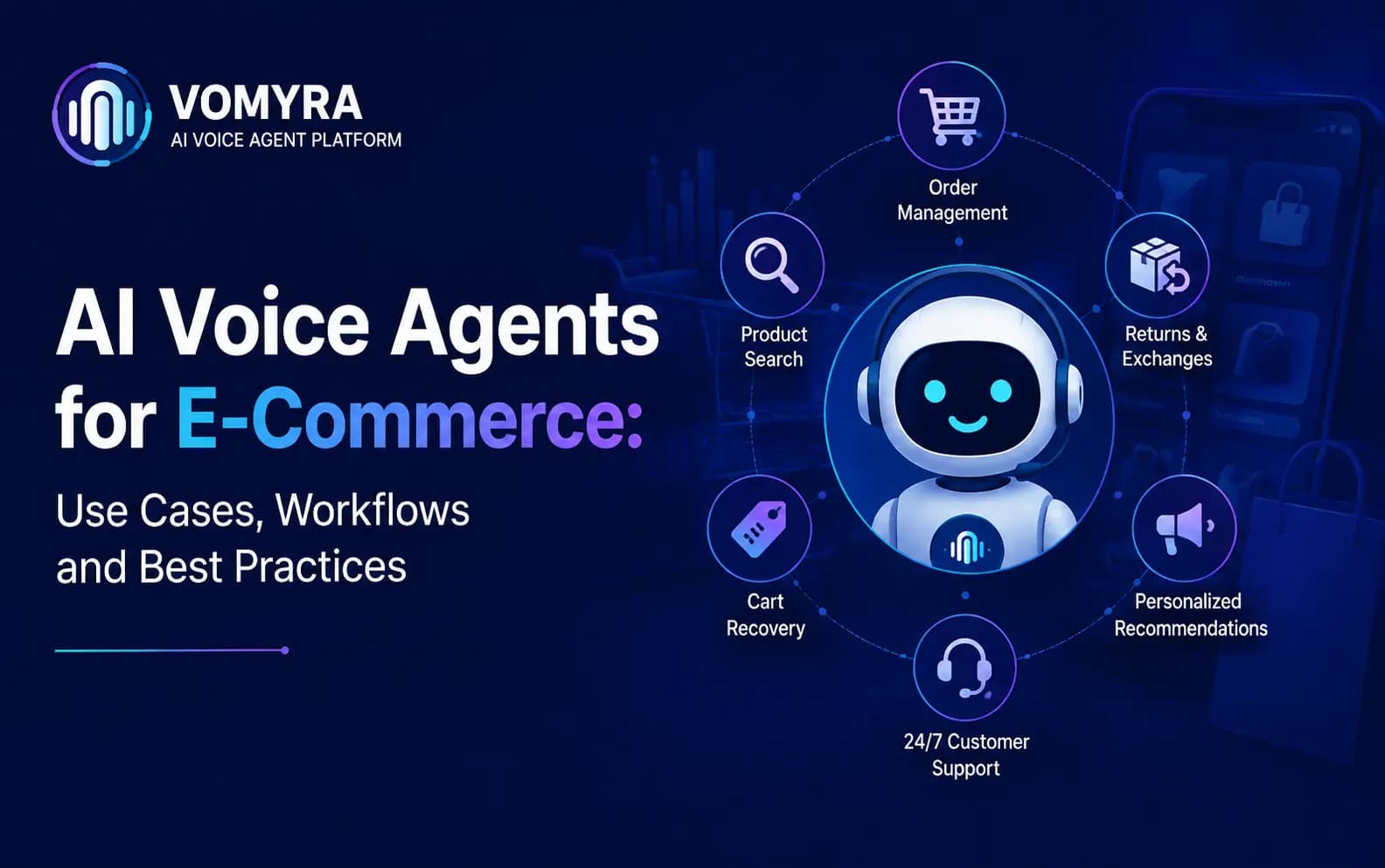
Key Use Cases for AI Voice Agents in E-Commerce
1. Cash-on-Delivery (COD) Order Confirmation
Before dispatching a COD order, an AI voice agent can call to confirm the order details and delivery address, reducing fake or mistaken orders and cutting return-to-origin costs – a significant expense for e-commerce businesses in COD-heavy markets.
2. Abandoned Cart Recovery
Rather than relying solely on email or SMS reminders, an AI voice agent can call customers who abandoned a cart, address common hesitations (shipping cost, delivery time, sizing) and help complete the purchase directly on the call.
3. Order and Delivery Status Updates
Customers calling to ask “where is my order” can get an instant, accurate answer by connecting the AI voice agent directly to order and logistics systems, without waiting in a support queue.
4. Delivery Failure and Rescheduling Calls
When a delivery attempt fails, an AI voice agent can call the customer to confirm a new delivery window, reducing the number of orders that end up returned to the warehouse.
5. Return and Refund Query Handling
Common, repetitive questions about return eligibility, refund timelines and exchange processes can be answered directly by the agent, freeing support staff for more complex cases.
6. Post-Purchase Follow-Up and Cross-Sell
After a delivery is completed, an AI voice agent can call to check satisfaction, gather quick feedback, and mention relevant complementary products – turning a routine follow-up into a light-touch retention and cross-sell opportunity.
7. Win-Back Calls for Lapsed Customers
For customers who haven’t ordered in a while, AI voice agents can run systematic win-back campaigns with relevant offers – a task most e-commerce support or retention teams don’t have the calling capacity to run at scale.

A Practical AI Voice Agent Workflow for E-Commerce
- Trigger event – An order is placed, a cart is abandoned, a delivery attempt fails, or a customer calls in with a query.
- System lookup – The AI voice agent pulls relevant order, customer and logistics data from connected systems.
- Conversation handling – The agent confirms an order, recovers an abandoned cart, answers a status query, or reschedules a delivery, conversationally.
- Resolution or escalation – Straightforward queries are resolved directly; complex issues (damaged product disputes, payment problems) are escalated to a human agent with context.
- System update – Order status, confirmation outcomes, and customer notes are updated directly in the e-commerce platform or CRM.
- Follow-up scheduling – Where relevant, next touchpoints (delivery reminder, post-purchase check-in) are scheduled automatically.
- Call logging and reporting – Every call outcome feeds back into reporting, giving visibility into COD confirmation rates, cart recovery rates, and common query types.
Manual Support/Ops vs AI Voice Agent for E-Commerce
| Factor | Manual Calling/Support Team | AI Voice Agent |
| COD confirmation coverage | Limited by staff capacity, often skipped for low-value orders | Every order confirmed consistently |
| Cart recovery method | Email/SMS only, lower response rates | Direct call, higher engagement |
| Order status query handling | Support queue wait times | Instant, connected to live order data |
| Delivery failure follow-up | Inconsistent, often delayed | Immediate rescheduling call |
| Cost during sale/festival spikes | Requires temporary staffing | Scales instantly, no extra hiring |
| Win-back campaign capacity | Rarely run at meaningful scale | Systematic, ongoing outreach |
| Language coverage | Limited to team’s languages | Multiple languages, including regional Indian languages |
| Data capture | Manual notes, inconsistent | Full transcripts and structured data |
Key Benefits of AI Voice Agents for E-Commerce
Lower return-to-origin costs Confirming COD orders by phone before dispatch reduces the number of orders that come back undelivered or refused.
Higher cart recovery rates A phone call addressing specific hesitations often recovers carts that a generic email reminder wouldn’t.
Reduced support queue volume Routine order and delivery status queries are resolved directly, without adding to human support queue times.
Better handling of demand spikes Sale periods and festival seasons generate call volume that scales instantly with an AI voice agent, without temporary hiring.
More consistent post-purchase engagement Follow-up and win-back calls run systematically, rather than only during quieter periods when staff have spare capacity.
Clear visibility into operational patterns Transcripts and structured call data reveal common delivery issues, return reasons, or product questions worth addressing upstream.
Read Also: AI Voice Agents for E-Commerce Businesses
Best Practices for AI Voice Agents in E-Commerce
Start with COD confirmation or cart recovery Both have direct, measurable financial impact, making them strong starting points for proving value quickly.
Keep confirmation calls short and specific COD confirmation calls should be quick – confirm the order, the address, and the payment method – not turn into an extended conversation.
Time cart recovery calls carefully Calling too soon after abandonment can feel intrusive; calling too late loses the moment of intent. Testing timing windows matters as much as the script itself.
Connect the agent to live systems Order, delivery and inventory data need to be live, not static, for the agent’s answers on status and availability to be accurate.
Design clear escalation paths Payment disputes, damaged product claims, and complex refund cases should route to a human quickly, with full context passed along.
Track calls against business outcomes Measure COD confirmation-to-dispatch rates, cart recovery conversion, and repeat purchase rates from win-back calls – not just call volume handled.
Build an AI Team for Your E-Commerce Operations
E-commerce generates too many repetitive customer touchpoints for phone-based communication to scale with a human team alone – which is exactly why most of it has shifted to chat and SMS. AI voice agents make voice viable again, at the volume e-commerce actually needs.
Vomyra is India’s Agentic Voice AI Platform, built to give e-commerce businesses a complete AI voice team – handling COD confirmations, cart recovery, delivery updates and post-purchase follow-ups at scale. Vomyra AI voice agents use real Indian mobile numbers and hold human-like conversations in multiple languages, so calls feel natural rather than automated, even at high volume.
If you’re evaluating how to reduce return-to-origin costs and recover more abandoned carts, Vomyra is built specifically for this – with unlimited calling plans and no coding required to get started.
FAQs
Does COD confirmation calling actually reduce return-to-origin costs?
Confirming order and address details before dispatch is a widely used approach specifically because it catches mistaken, duplicate, or fraudulent orders before shipping costs are incurred, which is where much of the return-to-origin cost comes from.
Will customers respond well to a call instead of a text reminder for abandoned carts?
Response varies by audience, but a call allows the agent to address a specific hesitation in the moment – something a static SMS or email template can’t do – which is why it can outperform text-based reminders for some customer segments.
Can an AI voice agent handle order queries in regional Indian languages?
Yes. Platforms built for Indian businesses support multiple languages, so customers can get order and delivery updates in the language they’re most comfortable with.
Does this replace the e-commerce support team?
No. It absorbs the repetitive, high-volume share of order, delivery and return queries, so support teams can focus on complex disputes and issues that need judgement.