If you run a GoHighLevel agency, you have probably built the same funnel many times. A lead fills a form, lands in the pipeline, gets an SMS, an email and a WhatsApp message, and a task is created for the client’s team to call.
That last step is where results quietly leak. The client’s team calls late, or not at all. The lead has already moved on, and the report you send at the end of the month shows leads generated but few meetings booked.
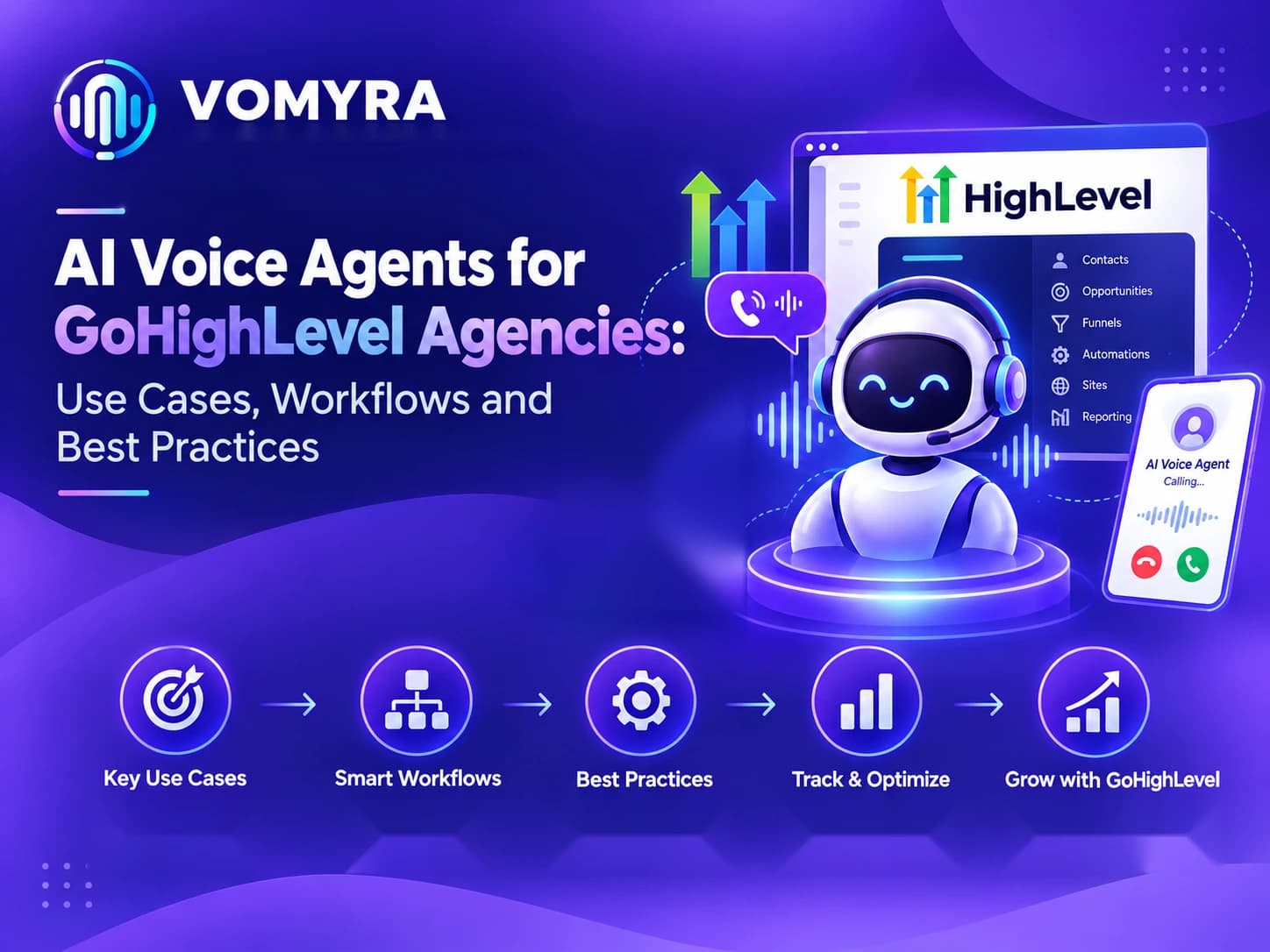
AI voice agents let agencies take ownership of that step. The call becomes part of the funnel: triggered by an event, handled by an agent, and sent back to the pipeline as a result. This guide covers where voice fits in a GoHighLevel-style agency setup, the workflows worth building first, and the practices that keep client work reliable.
Why Voice Matters for CRM-Led Agencies
- Messages do not always get replies. For high-intent leads, a phone call often gets a response when SMS and email do not.
- Speed to lead decides conversion. The first few minutes after an enquiry matter most, and agencies rarely control how fast the client calls.
- Clients judge on outcomes. Booked appointments matter more than lead counts, and voice qualification moves that number.
- Your pipeline already has the triggers. New lead, stage change, missed call, no-show and stalled opportunity are events you already track.
- Staffing calling teams for every client does not scale. Automation lets you add clients without adding telecallers at the same rate.
Key Use Cases for Agencies
1. Instant Calls to New Leads
When a lead arrives from a form or ad, a webhook or automation step triggers the voice agent. It calls within minutes, confirms interest, asks a few qualifying questions and books a slot.
AI lead qualification helps agencies identify which enquiries match the client’s requirements. By combining it with AI follow-up automation, agencies can contact new leads quickly and maintain consistent communication without depending entirely on manual calling.
2. Appointment Booking and Confirmation
The agent offers available times, books directly into the client’s calendar and calls again before the appointment to confirm or reschedule. This helps reduce no-shows.
An AI booking assistant can manage routine scheduling conversations, while AI call automation can trigger confirmation calls and reminders based on appointment dates and pipeline events.
3. Missed-Call Follow-Up
When a client misses an inbound call, the workflow can trigger a call back, log the reason and update the contact record.
4. Stalled Opportunity Follow-Up
Opportunities that sit in one stage for days can trigger a polite check-in call. The result moves them forward or marks them lost with a reason.
5. No-Show Recovery
After a missed appointment, a call can offer a new slot while the lead still remembers why they booked.
6. Database Reactivation
Many clients have thousands of old contacts nobody has called. Agencies can sell reactivation campaigns where the agent works through the list and flags interested contacts.
AI outbound calling can help agencies reach eligible contacts at scale, while defined retry rules and opt-out handling keep campaigns organised.
7. Review and Feedback Calls
After a service or purchase, a short call can collect feedback and invite happy customers to leave a review, with the outcome recorded automatically.
8. Reporting with Evidence
Transcripts and structured outcomes show exactly what happened to each lead, which makes client reporting clearer and more credible.
A Practical Workflow Pattern for Agencies
- Trigger: a pipeline event such as a new lead, stage change, missed call or no-show.
- Pass context: name, phone number, offer, language and any form answers go to the voice agent.
- Call: the agent runs the conversation with the client’s approved script and knowledge base.
- Action: book a slot, confirm an appointment or collect a reason for not proceeding.
- Return data: outcome, summary and transcript go back to the CRM through a webhook or integration.
- Branch: qualified leads move forward, no-answers enter a retry schedule, opt-outs are suppressed.
- Report: share contacted, qualified, booked and lost-reason numbers with the client.
Webhooks for AI voice agents can pass lead details and call outcomes between the voice system and the CRM. A reliable CRM integration should also handle booking status, call summaries and contact updates so the client’s pipeline stays accurate.
Manual Follow-Up vs AI Voice Agents for Agencies
| Factor | Manual calling by client team or vendors | With AI voice agents |
| Time to first call | Hours to days | Minutes |
| Follow-up consistency | Varies by person | Same cadence every time |
| Handling campaign spikes | Needs extra staff | Scales without hiring |
| Appointment no-shows | Reminders often skipped | Confirmation calls on schedule |
| Reporting | Manual notes | Transcripts and structured outcomes |
| Language coverage | Limited to the team | Multiple Indian languages |
| Agency margin | Falls as calling volume grows | Can improve with volume |
Benefits for Agencies
Better client results. Faster response and consistent follow-up can improve booked-appointment rates on the same ad spend.
A new service line. Lead qualification, appointment setting and database reactivation can be priced as add-ons tied to outcomes.
Less dependence on the client’s team. Results no longer wait for the client to call leads back.
Clearer reporting. Transcripts show why leads are converted or dropped, which supports honest conversations about lead quality.
Healthier margins. More volume without a matching rise in calling headcount.
Best Practices for Agencies
Agree on qualification rules with the client. Write down what a qualified lead means: budget, location, timeline and decision-maker.
Set up each client separately. Each client should have its own script, knowledge base and tone, built from its own website and documents.
Define retries and fallbacks. Decide how many attempts, at what times, and what happens after no answer or an opt-out.
Keep a human path. Set rules for handoff, and make sure it includes a summary.
Respect consent and calling hours. Call only people who have reason to expect it, follow local rules and honour opt-outs automatically.
Log everything. Store status, transcripts and outcomes so you can debug quickly and show results to clients.
Test before handover. Run sample calls in the languages the client’s audience speaks, then review transcripts weekly for the first month.
Report outcomes, not activity. Show qualified leads, booked appointments and show-up rates, not only calls made.
When evaluating an AI voice agent platform, check how easily it connects with your existing tools, supports client-specific workflows and returns structured call results. An Agentic Voice AI platform can support more advanced workflows when agents are configured to qualify leads, follow up, book appointments and handle the next steps within defined rules.

Turn Funnel Leads into Booked Calls
Agencies win when leads turn into conversations quickly and consistently. AI voice agents close the gap between the form fill and the first call.
Vomyra is India’s Agentic Voice AI Platform. It gives agencies and their clients a complete AI voice team (Research, Outreach, Qualification, Closing and Follow-Up agents), real Indian mobile numbers, human-like conversations in multiple languages and no-code setup, with unlimited calling plans.
If you want to add voice to your client funnels, test Vomyra on one workflow with one client and measure the result.
FAQs
How can GoHighLevel agencies use AI voice agents?
They can add voice as a step in client funnels for instant lead calls, appointment booking and confirmation, missed-call follow-up, no-show recovery, database reactivation and feedback calls.
Do I need to code to connect a voice agent to my pipeline?
Not necessarily. On a no-code platform, agents can be set up from a website, knowledge base or documents. Connecting triggers and results to your CRM usually uses webhooks or integrations, which most agency teams already use. Check exactly what a platform can send and receive before you design the workflow.
Will AI voice agents replace our client’s calling team?
They take over repetitive first calls, reminders and confirmations. People still handle complex conversations, negotiations and sensitive cases.
Can the voice agent work in Hindi and regional languages?
Yes, some platforms built for India support multiple languages. Vomyra supports multiple languages, including natural Hindi-English code-switching, which matters for campaigns outside the metros.
How should agencies price voice services?
Many agencies price per booked appointment, per qualified lead or as a monthly retainer. The best model depends on call volume and what the client values most.
How do I keep calls compliant?
Call only people who have reason to expect it, follow calling-hour and disclosure rules, honour opt-outs and keep a route to a human. Take legal advice for your sector and region.
How do I prove the results to clients?
Use call outcomes, transcripts and pipeline movement. Report contacted, qualified, booked and lost-reason numbers, and let clients review sample calls.