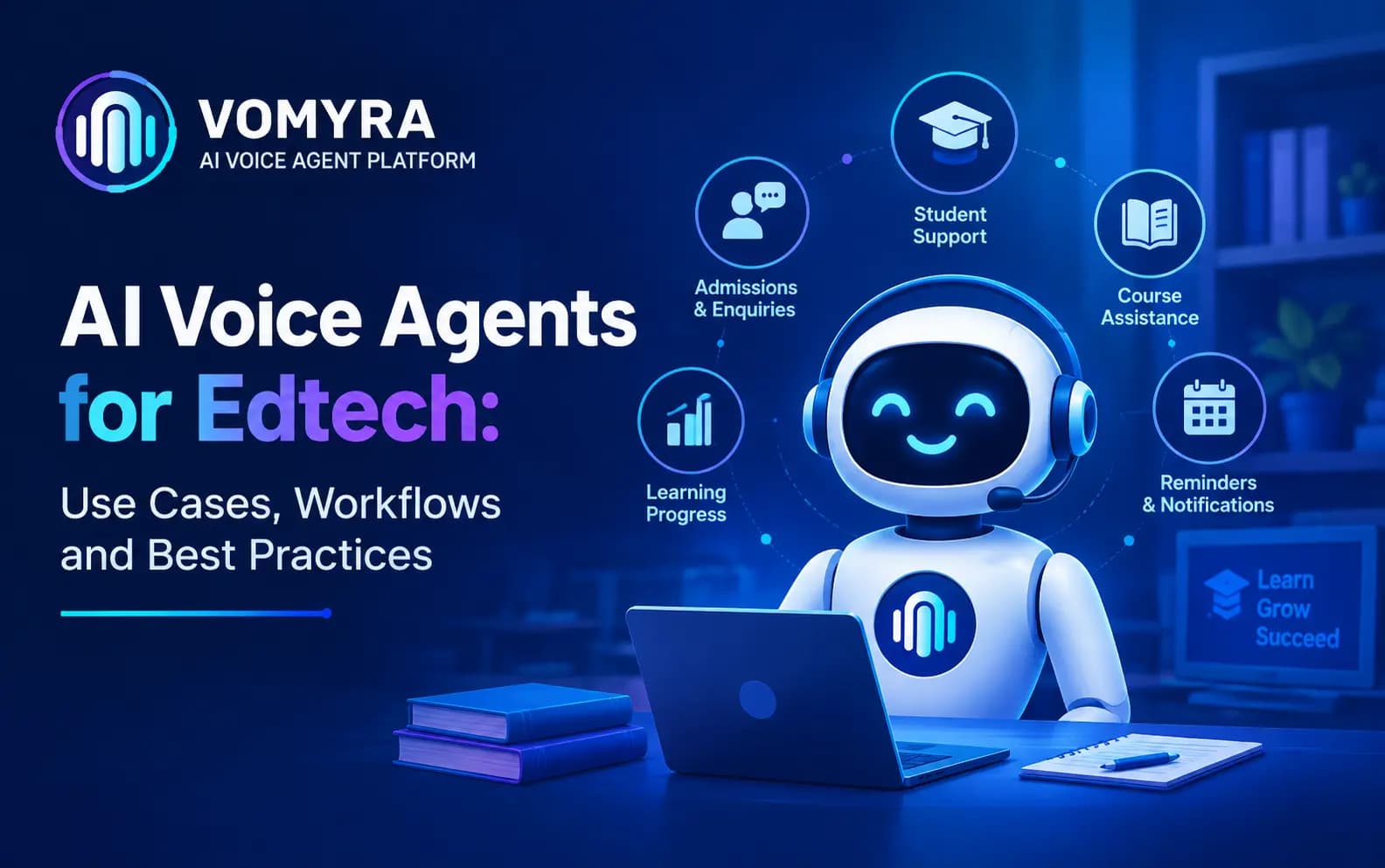
Admissions and enrolment seasons generate a surge of enquiries that most education businesses aren’t staffed to handle at the speed prospective students expect. A course enquiry, a counselling session request, an admission status question – each needs a prompt, informed response, but call volume during peak admission windows routinely outpaces counselling team capacity.
The cost of slow response in education is the same as anywhere else driven by intent and urgency: a prospective student who doesn’t get a timely answer often enquires elsewhere, or simply loses momentum and doesn’t follow through.
AI voice agents are increasingly used across edtech and education institutions to close this gap – answering enquiries instantly, qualifying genuine interest, and keeping admissions and student communication moving without counsellors drowning in repetitive calls.
This guide covers where AI voice agents fit into edtech, key use cases, a practical workflow, and best practices for deploying them well.
Why Edtech Is a Strong Fit for AI Voice Agents
A few characteristics of education communication make voice AI particularly effective here:
- Seasonal spikes in enquiry volume. Admission cycles, application deadlines, and result announcements generate call volume far beyond typical staffing levels.
- Time-sensitive decision windows. Prospective students and parents often compare multiple institutions or courses at once, and response speed influences which options stay under consideration.
- Repetitive, structured enquiries. Course details, fee structure, eligibility criteria, and application process questions follow a fairly standard pattern.
- Multi-touch follow-up needs. Moving a prospective student from initial enquiry to enrolment typically requires several touchpoints, which are easy to under-deliver on manually at volume.
These conditions make education a strong, measurable use case for AI voice agents – especially institutions and edtech platforms running large-scale admissions or enrolment campaigns.
Key Use Cases for AI Voice Agents in Edtech
1. Admissions Enquiry Handling
The moment a prospective student enquires – through a website form, ad campaign, or walk-in referral – an AI voice agent can call to answer course and eligibility questions and qualify genuine interest.
2. Counselling Session Scheduling
Once a prospective student is qualified, the agent can offer available counselling slots and book the session directly, syncing with the counselling team’s calendar.
3. Application Status Updates
Rather than students repeatedly calling to check application or admission status, an AI voice agent can proactively call with updates, or instantly answer status queries connected to live application data.
4. Fee Payment and Document Reminders
Automated reminder calls for pending fee payments or missing documents help reduce drop-off during the admissions process, where delays often lead to lost enrolments.
5. Enrolment Confirmation and Onboarding Calls
After a student confirms enrolment, an AI voice agent can handle logistical coordination – orientation details, document submission, course start information – freeing administrative staff for more involved onboarding tasks.
6. Re-Engagement of Past Enquiries
Prospective students who enquired but didn’t proceed in a previous cycle represent a valuable, often untapped pool. AI voice agents can systematically re-engage this database ahead of new admission cycles or course launches.
7. Student and Parent Support Queries
Routine, ongoing queries from enrolled students or parents – schedule questions, fee status, general information – can be handled directly by an AI voice agent, reducing load on administrative and support staff.
A Practical AI Voice Agent Workflow for Edtech
- Enquiry trigger – A prospective student enquires through a website, ad campaign, or referral, or the institution initiates outbound contact for a follow-up or reminder.
- Qualification call – The AI voice agent calls to understand course interest, eligibility, and timeline, answering common questions along the way.
- Scoring and routing – Genuinely interested, eligible prospects are routed to counselling scheduling; others are logged appropriately for future re-engagement.
- Counselling session booking – Available slots are offered and the session is confirmed directly into the counselling team’s calendar.
- Reminder call – A follow-up call confirms the counselling session or application deadline ahead of time.
- Handoff to counsellor – Full context – enquiry details, qualification answers, and transcript – travels with the prospective student to the human counsellor.
- Ongoing follow-up – Fee reminders, document requests, and application status updates are handled automatically through the admissions cycle.
- Re-engagement nurture – Prospects not ready to proceed are added to a sequence for future admission cycles or related course launches.
Manual Admissions Calling vs AI Voice Agent Calling
| Factor | Manual Admissions Team | AI Voice Agent |
| Response to new enquiry | Hours to days during peak admission periods | Seconds, 24/7 |
| Counselling session booking | Back-and-forth coordination | Booked directly on the call |
| Application status handling | Support queue or manual callback | Instant, connected to live data |
| Fee and document reminder consistency | Depends on staff bandwidth | Automated, every time |
| Cost during admission peak season | Requires temporary staffing | Scales instantly, no extra hiring |
| Past enquiry re-engagement | Rarely done systematically | Ongoing, automated outreach |
| Language coverage | Limited to team’s languages | Multiple languages, including regional Indian languages |
| Documentation | Manual notes, often incomplete | Full transcripts and structured records |
Key Benefits of AI Voice Agents for Edtech
Faster response during peak admission periods Enquiries are answered and qualified within moments, rather than students waiting days during the busiest, most competitive part of the admissions cycle.
Higher enrolment conversion Consistent follow-up on fee reminders, document requests and counselling scheduling reduces the drop-off that often happens between enquiry and confirmed enrolment.
Lower cost of handling seasonal volume Admission season spikes are absorbed without the cost of hiring and training temporary counselling or support staff.
Counsellors focus on genuine, qualified conversations Human counselling time goes toward students who are qualified and ready for a deeper conversation, not repetitive first-contact qualification.
A usable database of past enquiries Prospective students who didn’t enrol in a previous cycle become an ongoing, re-engageable resource rather than a static, unused list.
Better visibility into enquiry and conversion patterns Structured call data shows where prospective students drop off in the admissions funnel, informing process improvements.
Read Also– Best AI Voice Agent for Startups in India 2026
Best Practices for Deploying AI Voice Agents in Edtech
Keep admission decisions with humans The agent should handle enquiry qualification, scheduling and informational queries – actual admission decisions should remain with the institution’s admissions team.
Be transparent with prospective students and parents Callers should know they’re speaking with an AI voice agent, with an easy path to a human counsellor for detailed or sensitive questions.
Design for peak season scale from the start Since much of the value shows up during high-volume admission windows, the workflow should be tested and ready well ahead of peak enquiry periods, not set up reactively once volume spikes.
Keep fee and deadline reminders clear and timely These reminders directly affect enrolment completion, so timing and clarity matter – vague or late reminders lose much of their value.
Match language to your applicant base Education audiences across India span a wide range of language preferences, particularly for regional and non-metro institutions – language coverage directly affects trust and comprehension for both students and parents.
Protect student data carefully Admissions calls involve personal information about students and families. Data handling should meet appropriate standards for handling this kind of information responsibly.

Build an AI Team for Your Admissions and Enrolment Pipeline
Admission cycles compress a year’s worth of enquiry volume into a few high-pressure weeks, and most institutions can’t staff their way through it without either overspending on temporary hiring or losing prospective students to slow response.
Vomyra is India’s Agentic Voice AI Platform, built to give education businesses a complete AI voice team – handling enquiry qualification, counselling scheduling, fee and document reminders, and re-engagement of past applicants. Vomyra AI voice agents use real Indian mobile numbers and hold human-like conversations in multiple languages, so every enquiry gets a fast, informed response during the periods that matter most.
If you’re evaluating how to handle admission season volume without losing prospective students to slow response, Vomyra is built specifically for this – with unlimited calling plans and no coding required to get started.
FAQs
Can an AI voice agent handle detailed course or curriculum questions?
Yes, for questions the agent is configured with accurate information for, typically drawn from the institution’s course details, website or knowledge base – more nuanced or unusual questions should route to a human counsellor.
Will prospective students and parents respond well to an AI on admissions calls?
Response is generally positive for fast, informative first contact, especially during busy admission periods when the alternative is a long wait for a callback – transparency and an easy path to a human help maintain trust.
Can this work for smaller institutions and coaching centres, not just large edtech platforms?
Yes. Since these platforms don’t require coding to set up, smaller institutions can deploy an AI voice agent configured around their own courses, fee structure and admissions process.
Can an AI voice agent handle admissions calls in regional Indian languages?
Yes. Platforms built for Indian businesses support multiple languages, so enquiry and counselling calls can happen in the language students and parents are most comfortable with.