Logistics runs on a constant stream of phone calls that most companies don’t have the calling capacity to handle well – confirming delivery windows, rescheduling failed attempts, coordinating with drivers, updating customers on delayed shipments.
Each call is short and repetitive on its own, but the total volume across a growing delivery network quickly outpaces what a small operations team can manage manually.
When these calls don’t happen – or happen too late – the cost shows up directly in failed deliveries, return-to-origin shipments, and customers left wondering where their order is.
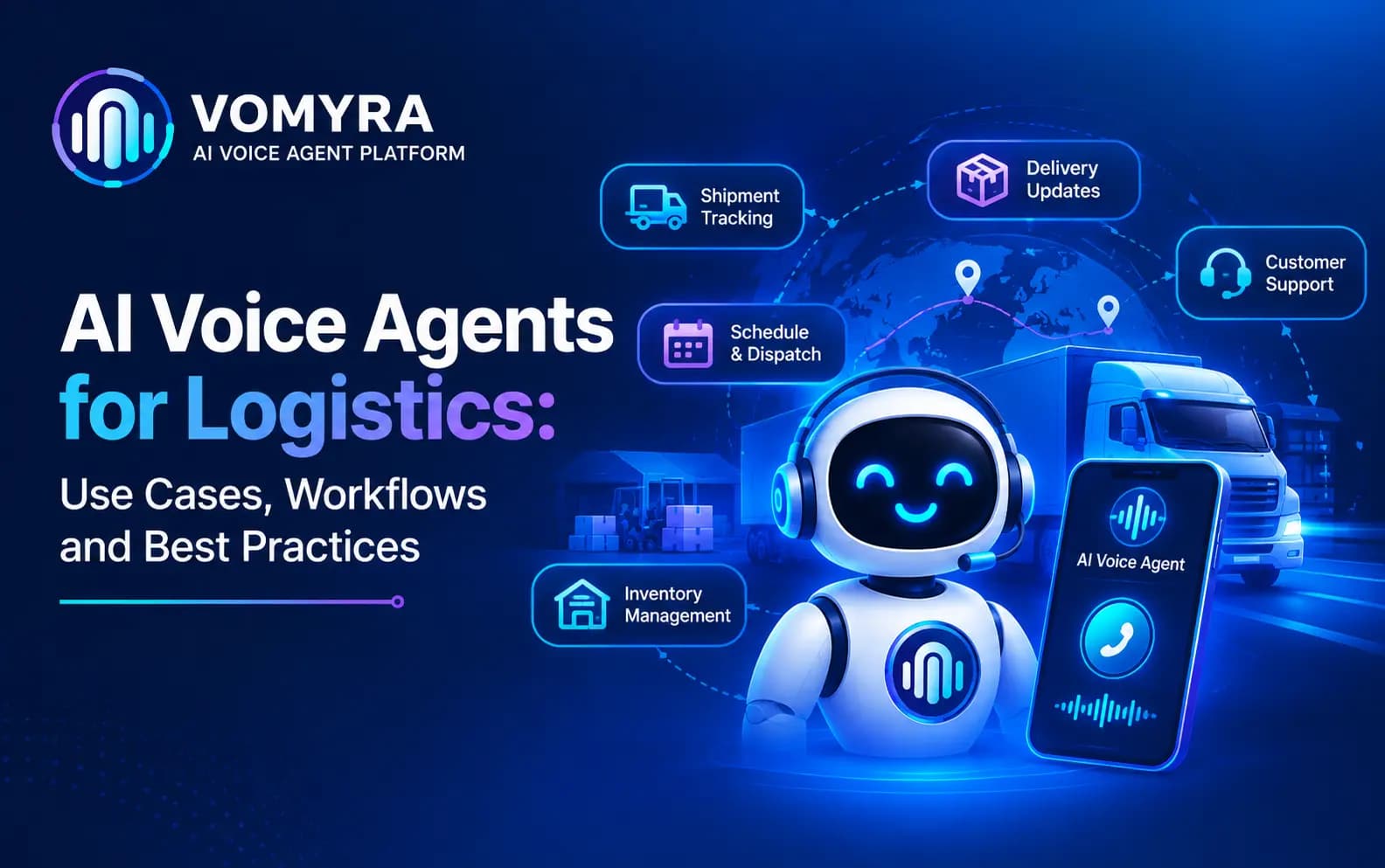
AI voice agents are increasingly used in logistics to handle this communication layer – calling customers and drivers automatically, at the volume and speed the operation actually needs.
This guide covers where AI voice agents fit into logistics, key use cases, a practical workflow, and best practices for deploying them well.
Why Logistics Is a Strong Fit for AI Voice Agents
A few characteristics of logistics communication make voice AI particularly effective here:
- High call volume tied directly to delivery volume. Every shipment potentially needs a confirmation call, a delivery update, or a rescheduling conversation.
- Time-sensitive coordination. A delivery window confirmation or a driver update loses its value if it doesn’t happen promptly.
- Repetitive, structured conversations. Confirming an address, offering a new delivery slot, or checking on a driver’s status follow largely predictable patterns.
- Real cost tied to failed deliveries. A missed delivery attempt or an incorrect address, caught late, creates return-to-origin costs and delays that compound across a network.
These conditions make logistics one of the more measurable use cases for AI voice agents – every call made or missed has a direct, trackable operational outcome.
Key Use Cases for AI Voice Agents in Logistics
1. Delivery Confirmation Calls
Before a delivery attempt, an AI voice agent can call to confirm the customer’s address and availability, reducing failed delivery attempts caused by incorrect details or the customer being unavailable.
2. Delivery Rescheduling
When a delivery attempt fails or a customer isn’t available, an AI voice agent can call immediately to offer a new delivery window and confirm it, rather than the shipment sitting idle awaiting manual follow-up.
3. Delivery Status Updates
Customers calling to ask “where is my order” can get an instant, accurate answer, with the AI voice agent connected directly to live tracking and logistics data.
4. Driver and Fleet Coordination Calls
AI voice agents can call drivers for routine coordination – confirming pickup readiness, checking on delivery progress, or relaying updated route information – reducing the dispatcher workload for routine check-ins.
5. Proof-of-Delivery and Post-Delivery Confirmation
After a delivery is marked complete, an AI voice agent can call to confirm receipt and satisfaction, flagging any discrepancies for the operations team to review.
6. Exception and Delay Notifications
When a shipment is delayed or an exception occurs, an AI voice agent can proactively call the customer with an update, rather than the customer discovering the delay only when they check themselves or call in frustrated.
7. Vendor and Warehouse Coordination
Routine coordination calls with vendors or warehouse partners – confirming pickup times, checking inventory readiness – can be handled by an AI voice agent, freeing operations staff from repetitive scheduling calls.
A Practical AI Voice Agent Workflow for Logistics
- Trigger event – A delivery is scheduled, a delivery attempt fails, a shipment is delayed, or a customer calls in with a status query.
- System lookup – The AI voice agent pulls live tracking, delivery, and customer data from connected logistics systems.
- Conversation handling – The agent confirms delivery details, offers rescheduling options, or answers status queries conversationally.
- Outcome capture – Confirmed slots, rescheduled deliveries, or flagged exceptions are recorded directly against the shipment record.
- Escalation where needed – Complex issues – damaged shipments, disputes, repeated failed deliveries – are routed to a human operations team member with context.
- System update – Every call outcome updates the logistics or CRM system in real time, keeping delivery status accurate.
- Follow-up scheduling – Where needed, the next touchpoint (a reminder ahead of a rescheduled delivery, a follow-up on an unresolved issue) is scheduled automatically.
Manual Logistics Calling vs AI Voice Agent Calling
| Factor | Manual Operations Calling | AI Voice Agent |
| Delivery confirmation coverage | Limited by staff capacity, often skipped | Every delivery confirmed consistently |
| Rescheduling speed after failed attempt | Delayed, dependent on staff availability | Immediate, same-day in most cases |
| Customer status query handling | Support queue wait times | Instant, connected to live tracking data |
| Driver coordination call volume | Consumes dispatcher time on routine check-ins | Handled directly, freeing dispatcher capacity |
| Cost during peak shipping periods | Requires temporary staffing | Scales instantly, no extra hiring |
| Delay/exception notification consistency | Often reactive, customer discovers issue themselves | Proactive, automated notification |
| Language coverage | Limited to team’s languages | Multiple languages, including regional Indian languages |
| Documentation | Manual notes, inconsistent | Full transcripts and structured records |
Key Benefits of AI Voice Agents for Logistics
Fewer failed deliveries Confirming address and availability ahead of a delivery attempt reduces the number of attempts that fail due to avoidable issues.
Lower return-to-origin costs Faster, more consistent rescheduling after a failed attempt reduces the number of shipments that end up returned rather than eventually delivered.
Reduced dispatcher workload Routine driver and vendor coordination calls no longer consume dispatcher time that could go toward exception handling and planning.
Proactive customer communication Delay and exception notifications go out automatically, rather than customers discovering issues only when they check or call in.
Better handling of peak shipping periods Seasonal or promotional spikes in delivery volume are absorbed without temporary staffing surges for the associated call volume.
Clear visibility into delivery patterns Structured call data reveals common causes of failed deliveries or delays, informing upstream process improvements.
Best Practices for AI Voice Agents in Logistics
Connect the agent to live tracking data The agent’s usefulness depends entirely on working from real-time shipment and delivery status, not static or delayed data.
Keep confirmation and rescheduling calls short These calls should confirm details and offer clear options quickly, without turning into an extended conversation.
Design clear escalation paths for exceptions Damaged shipments, disputes, or repeated failed deliveries should route to a human operations team member promptly, with full context passed along.
Prioritise proactive delay notifications Customers generally respond better to being told about a delay before they notice it themselves – building this into the workflow protects customer trust.
Match language to your delivery network Delivery and driver communication across different regions benefits from an agent that can converse in the languages customers and drivers actually use.
Track outcomes against operational metrics Measure the impact on failed delivery rates, rescheduling speed, and return-to-origin costs – not just how many calls were completed.

Build an AI Team for Your Logistics Operations
Every failed delivery and delayed notification has a real operational cost – and most of it comes down to calls that either didn’t happen or happened too late for a team stretched across a growing delivery volume.
Vomyra is India’s Agentic Voice AI Platform, built to give logistics businesses a complete AI voice team – handling delivery confirmations, rescheduling, status updates and driver coordination at scale. Vomyra AI voice agents use real Indian mobile numbers and hold human-like conversations in multiple languages, keeping deliveries and communication moving without adding headcount.
If you’re evaluating how to reduce failed deliveries and return-to-origin costs, Vomyra is built specifically for this – with unlimited calling plans and no coding required to get started.
FAQs
Can an AI voice agent handle both customer and driver calls?
Yes, though these are typically configured as distinct conversation flows – customer-facing calls focus on delivery confirmation and updates, while driver calls focus on coordination and status checks.
Does this work for both B2C last-mile delivery and B2B logistics?
Yes. The underlying workflow – confirmation, rescheduling, status updates, exception handling – applies to both, though the specific questions and escalation paths differ by context.
Can an AI voice agent handle delivery calls in regional Indian languages?
Yes. Platforms built for Indian businesses support multiple languages, so delivery and coordination calls can happen in the language the customer or driver is most comfortable with.
Does this replace the logistics operations team?
No. It absorbs the repetitive, high-volume confirmation and coordination calls, so operations teams can focus on exceptions, planning, and issues that need judgement.