Why Language Is the Most Important Infrastructure Decision in Indian Voice AI
India has 22 scheduled languages, over 19,500 dialects, and a population where the majority of customers across Tier 2 and Tier 3 cities communicate most naturally in a language other than English. Any business deploying a voice AI agent to handle inbound inquiries, qualify leads, or run outbound campaigns across India is making a language infrastructure decision whether it acknowledges it or not.
A voice agent that handles Hindi and English competently will convert callers from Delhi and Mumbai at a reasonable rate. The same agent deployed to handle loan inquiries in Vijayawada, table reservations in Coimbatore, or hospital appointment reminders in Thiruvananthapuram will fail at the point of language, regardless of how well the conversation flow is designed.
This guide covers what genuine multilingual capability looks like in a production Indian voice AI deployment, how to evaluate it before committing to a platform, what the language-specific requirements are for the major Indian languages, and how Vomyra AI Voice Agent approaches the multilingual challenge for Indian businesses across every sector.
What Most Platforms Mean by Multilingual Support (And What It Actually Requires)
The majority of platforms that claim multilingual Indian language support in 2026 fall into one of three categories. Understanding the difference saves months of post-deployment discovery.
Category one: Translate and speak. The platform takes English conversation logic, translates it into the target language at the text level, and passes the translated text to a TTS model. The output is technically in the target language but reads as a translated document rather than natural speech.
Sentence structure follows English patterns, idiomatic expressions are literal translations, and the rhythm and cadence of the spoken output does not match how native speakers of that language actually talk. Callers notice this immediately. It is the linguistic equivalent of a foreigner who has learned a language from a textbook but never heard it spoken naturally.
Category two: Language support as a configuration option. The platform supports 20 or 30 languages on its capability sheet. In practice, this means the underlying ASR model was trained on audio that included some data from those languages. Accuracy for the first two or three languages on the list is production-grade. Accuracy for languages further down the list degrades significantly, particularly for regional accents, fast speech, and low-quality mobile audio.
Category three: Natively trained multilingual models. This is genuine multilingual support. The ASR, language understanding, and TTS models were trained specifically on audio from the target language as it is actually spoken by callers on Indian mobile networks, covering regional accents, conversational patterns, and the specific backchannel vocabulary of each language.
This category is what Indian businesses need and what determines whether a voice agent actually works in production in Coimbatore versus how it performs in a demo.

Language-by-Language: What Genuine Support Actually Means
Hindi and Hinglish
Hindi is the most widely spoken Indian language and the most commonly supported in AI voice systems. The practical challenge is not Hindi by itself but the way Hindi is actually spoken in Indian business contexts, which is Hinglish.
Approximately 57 percent of urban Indian business conversations mix Hindi and English within the same sentence without signalling a language switch. A loan inquiry caller might say “budget hai, but EMI kya hoga aur documents kaunse chahiye?” in a single sentence. A property inquiry caller might ask “possession kab milegi and kya home loan facility hai?” without pausing.
An AI voice agent that treats Hindi and English as two separate language modes, requiring a deliberate switch between them, will break on most real Hinglish calls. Genuine Hinglish support means the STT model recognises code-switched audio as a single utterance and the LLM processes it without losing intent across the language boundary.
Hinglish also varies by geography. Mumbai Hinglish incorporates Marathi influences. Delhi Hinglish is closer to standard Hindi with English terms. Jaipur Hinglish uses more classical Hindi vocabulary. A system tuned only on one regional variant of Hinglish will perform inconsistently across the national Hindi-speaking market.
Tamil
Tamil is the primary language of over 80 million speakers in Tamil Nadu, Sri Lanka, Singapore, and significant diaspora communities. Tamil AI voice support is technically demanding because Tamil is an agglutinative language, meaning complex ideas are expressed through long compound words built from smaller components. A Tamil ASR model that handles only isolated words will fail on fluent Tamil speech where a single spoken word may express what requires a phrase in English.
Tamil also has significant regional dialect variation between Chennai Tamil, Madurai Tamil, and Coimbatore Tamil, each with distinct pronunciation patterns, vocabulary choices, and speech rhythm. Production-grade Tamil support requires coverage of at least these three major variants.
Business Tamil differs from conversational Tamil in register. A customer calling a bank’s Tamil-language helpline uses formal vocabulary that a system trained only on informal conversational audio will misrecognise.
Tamil number pronunciation and date formats also follow patterns distinct from English and Hindi, which matters particularly for fintech and healthcare voice AI applications where accurate capture of dates, amounts, and reference numbers is critical.
Telugu
Telugu is spoken by over 80 million people primarily in Andhra Pradesh and Telangana, two states with significant economic activity in real estate, pharmaceutical manufacturing, IT services, and agriculture. Telugu voice AI support is strategically important for any business running campaigns or customer service across these two states.
Telangana Telugu and Andhra Telugu differ enough in pronunciation and vocabulary that a system tuned only on one variant will produce noticeable inaccuracies on callers from the other. Urban Telugu in Hyderabad incorporates substantial English and Urdu borrowings, producing a code-switching pattern distinct from both standard Telugu and Hinglish.
Telugu numeral pronunciation follows a vigesimal system in parts of the vocabulary, meaning number-heavy conversations in a Telugu voice agent context, such as amount confirmations in a fintech application, require specific training on Telugu number speech rather than a simple translation of numeric values.
Kannada
Kannada is spoken by over 40 million people primarily in Karnataka. The Bangalore metropolitan area, with its concentration of tech companies, startups, and service businesses, creates a specific Kannada-English code-switching pattern often called Kanglish.
A business deploying an AI receptionist for Bangalore office use or an outbound calling agent for Karnataka-based campaigns needs a system that handles Kanglish specifically.
Kannada also has significant script complexity. Kannada has one of the largest alphabets among Indian languages, with 49 primary characters and numerous compound forms. This matters less directly for voice AI but affects the accuracy of TTS systems that generate Kannada speech from text, which will produce unnatural pronunciations if the underlying model was not trained specifically on Kannada audio.
Bengali, Marathi, and Gujarati
These three languages collectively cover over 200 million speakers across West Bengal, Maharashtra, and Gujarat, three of India’s most economically significant states.
Bengali voice AI support is complicated by the distinction between West Bengal Bengali and Bangladesh Bengali, which have different pronunciation, vocabulary, and prosodic patterns. For Indian business use cases, West Bengal Bengali is the primary target, but the training data for Bengali ASR models often mixes both variants, which can affect accuracy on native West Bengal speakers.
Marathi is distinctive for its retroflex consonants and vowel sounds that differ significantly from Hindi despite some superficial similarity. A system that treats Marathi as close to Hindi will make systematic errors on Marathi input. Maharashtra is a major economic hub and Marathi language support is strategically important for any business with significant Maharashtra exposure.
Gujarati speaker volume in business contexts is notably high for the population size. Gujarat’s business-dense economy in sectors ranging from textiles to petrochemicals to diamond trading creates strong demand for Gujarati-language AI voice support in B2B contexts, where Vomyra AI Voice Agent’s no-code deployment makes it a practical choice for Gujarati SMB businesses without dedicated technical teams.
Punjabi, Odia, Malayalam, and Assamese
These languages collectively represent a significant and often underserved portion of India’s multilingual business voice AI market.
Punjab and Haryana’s agricultural economy and the large Punjabi diaspora create specific demand for Punjabi voice AI in banking, remittance, and agricultural services contexts. Odia support matters for Odisha’s mining, steel, and industrial sector.
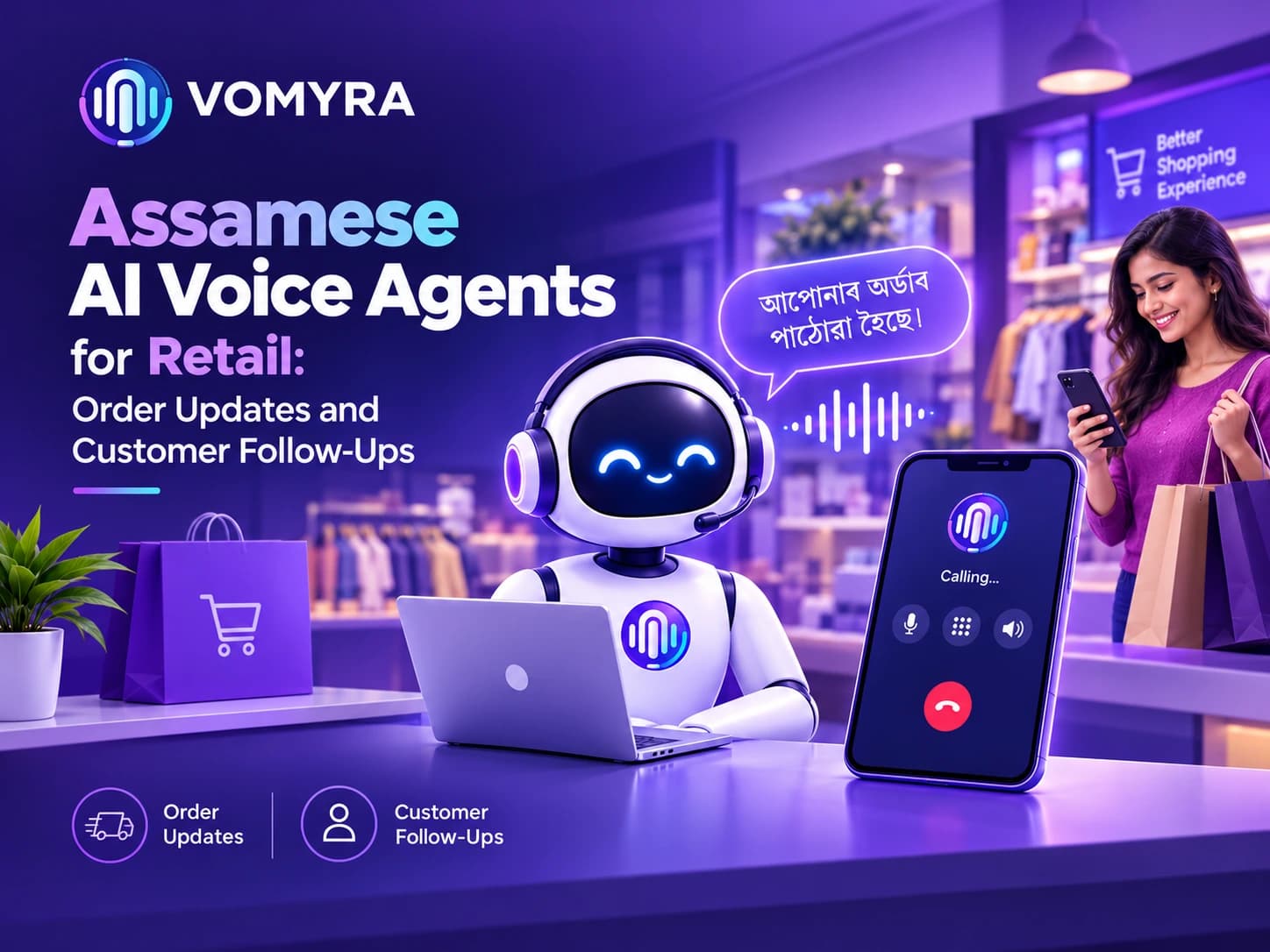
Malayalam support covers Kerala’s highly educated, service-sector-oriented economy with its specific communication patterns. Assamese support, which Vomyra AI Voice Agent provides natively, covers Northeast India, a market largely ignored by most voice AI platforms despite its growing economic activity.
For businesses serving Northeast India specifically, Assamese AI voice agent capability is not a premium feature. It is the baseline requirement for serving that market, and it distinguishes platforms that have genuinely invested in India-wide language coverage from those that have focused only on the largest-population languages.
The Three Technical Requirements for Genuine Multilingual Support
Beyond language coverage, evaluating a multilingual AI voice agent platform requires checking three specific technical capabilities.
ASR accuracy on Indian telephony audio. Benchmark accuracy numbers from platform spec sheets are typically measured on clean studio audio. Production performance on 8 kHz Indian PSTN audio with regional accents and background noise is substantially different. Require a live test on real call recordings from the specific language and geography you intend to serve before accepting accuracy claims.
Code-switching detection within a single utterance. The platform must handle a caller who switches from Hindi to English mid-sentence without the system treating the English portion as an error or requesting clarification. This requires the STT model to recognise both language patterns simultaneously within a single audio stream, not to process them sequentially as separate utterances.
Language detection at call start. Rather than requiring callers to declare their language or navigate a language selection menu, production-grade multilingual voice agents detect the caller’s language from their first spoken response and continue in that language for the entire conversation. This automatic detection needs to work reliably on first response quality audio from Indian mobile networks, which means the detection model must be trained on real Indian call data rather than controlled test samples.
How Vomyra AI Voice Agent Approaches Multilingual Support
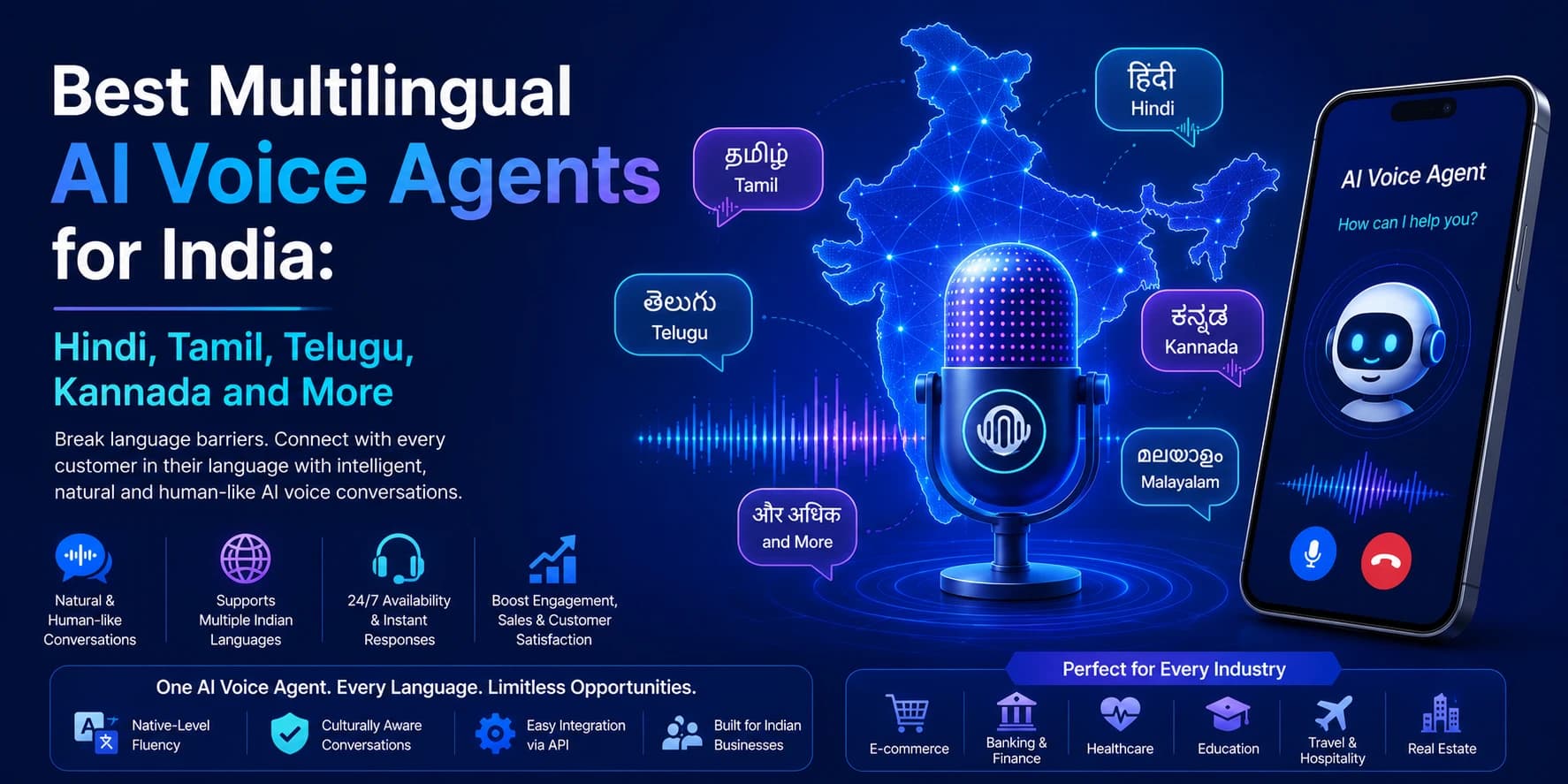
Vomyra AI Voice Agent supports over 32 Indian languages and dialects natively, including Hindi, Hinglish, Tamil, Telugu, Kannada, Bengali, Marathi, Gujarati, Punjabi, Malayalam, Odia, and Assamese. Language detection is automatic from the caller’s first response, with no menu or declaration required. Hinglish code-switching within a single sentence is handled natively without breaking conversation context.
For Indian SMBs deploying voice agents across multiple states, the practical advantage of Vomyra AI Voice Agent is operational. A real estate developer running campaigns across portal leads from Gujarat, Maharashtra, and Tamil Nadu can configure a single agent that serves all three language communities from the same campaign without separate setups per language.
An AI voice agent for restaurant booking India running a Petpooja AI integration voice setup can handle reservation calls from Tamil, Kannada, and English speakers through the same inbound number. An AI voice agent for fintech India qualifying loan inquiries handles Telugu-speaking callers from Vijayawada and Assamese-speaking callers from Guwahati on the same outbound campaign list.
The multilingual capability extends to the voice output as well. TTS models for each supported language are trained on native speaker audio, producing speech that sounds natural in the cadence and prosody of each language rather than robotic or translated.
Indian +91 numbers are provisioned directly within the platform, with no separate telephony account required. All outbound calls use Indian caller IDs, which produces significantly higher answer rates than international numbers across every Indian language market.
Vomyra AI Voice Agent is available for a free trial with 500 monthly credits that renew every month. The free tier covers full multilingual support across all 32 supported Indian languages, Indian +91 numbers, CRM integration, call transcripts, and conversation analytics before any payment is required.
Evaluating a Multilingual Voice Agent Platform: Seven Questions to Ask
Before committing to any platform for Indian multilingual voice AI, these questions separate genuine capability from marketing claims.
Can the platform demonstrate live calls in Tamil, Telugu, and Kannada on actual Indian mobile call quality audio rather than a studio recording?
Does the platform handle Hinglish code-switching within a single sentence, or does it require the caller to speak in only one language?
What is the false recognition rate for regional accents within the same language, for example Coimbatore Tamil versus Chennai Tamil?
Does language detection happen automatically from the caller’s first response, or does the caller navigate a language menu?
What is the accuracy for number recognition in each supported language, given that number pronunciation follows different patterns in Tamil, Telugu, and Kannada compared to Hindi?
Is regional language support included in the standard pricing or charged as a per-language add-on?
Can the platform show you a call from a production deployment in each language you need rather than a demo constructed specifically for evaluation?
Frequently Asked Questions
What Indian languages does a good AI voice agent support in 2026?
Production-grade platforms in 2026 support at minimum Hindi, Hinglish, Tamil, Telugu, Kannada, Bengali, Marathi, Gujarati, and Punjabi. Leading platforms extend this to Assamese, Malayalam, Odia, and other regional languages. Depth matters more than breadth: coverage of 30 languages with poor accuracy on 25 of them is less useful than strong coverage of the 10 languages most relevant to your customer base.
What is Hinglish and why does it matter for voice AI?
Hinglish is the code-switched mixing of Hindi and English within a single sentence or conversation turn. It is the natural speech pattern of the majority of urban Indian business callers. A voice agent that treats Hindi and English as separate language modes will break conversation flow every time a Hinglish-speaking caller switches languages mid-sentence, which happens in virtually every call.
How do I test whether a multilingual AI voice agent actually works for my language?
Make a test call in your target language using a real mobile phone, ideally from the geography where your customers will be calling from. Ask questions as a real customer would, including mixing languages if that is how your customers speak. Evaluate whether the agent understands correctly, responds naturally, and handles language switching without losing context.
Does Vomyra AI Voice Agent support Tamil, Telugu, and Kannada natively?
Yes. Tamil, Telugu, and Kannada are all supported natively in Vomyra AI Voice Agent with models trained on Indian telephony audio. Language detection is automatic and Hinglish code-switching is handled within the same conversation flow without separate configuration per language.
Is multilingual support included in the free tier?
Yes. The Vomyra AI Voice Agent free tier includes 500 monthly credits that renew every month and covers full multilingual support across all 32 supported Indian languages including Tamil, Telugu, Kannada, Bengali, Marathi, Gujarati, Punjabi, Assamese, and English, with no per-language charges.