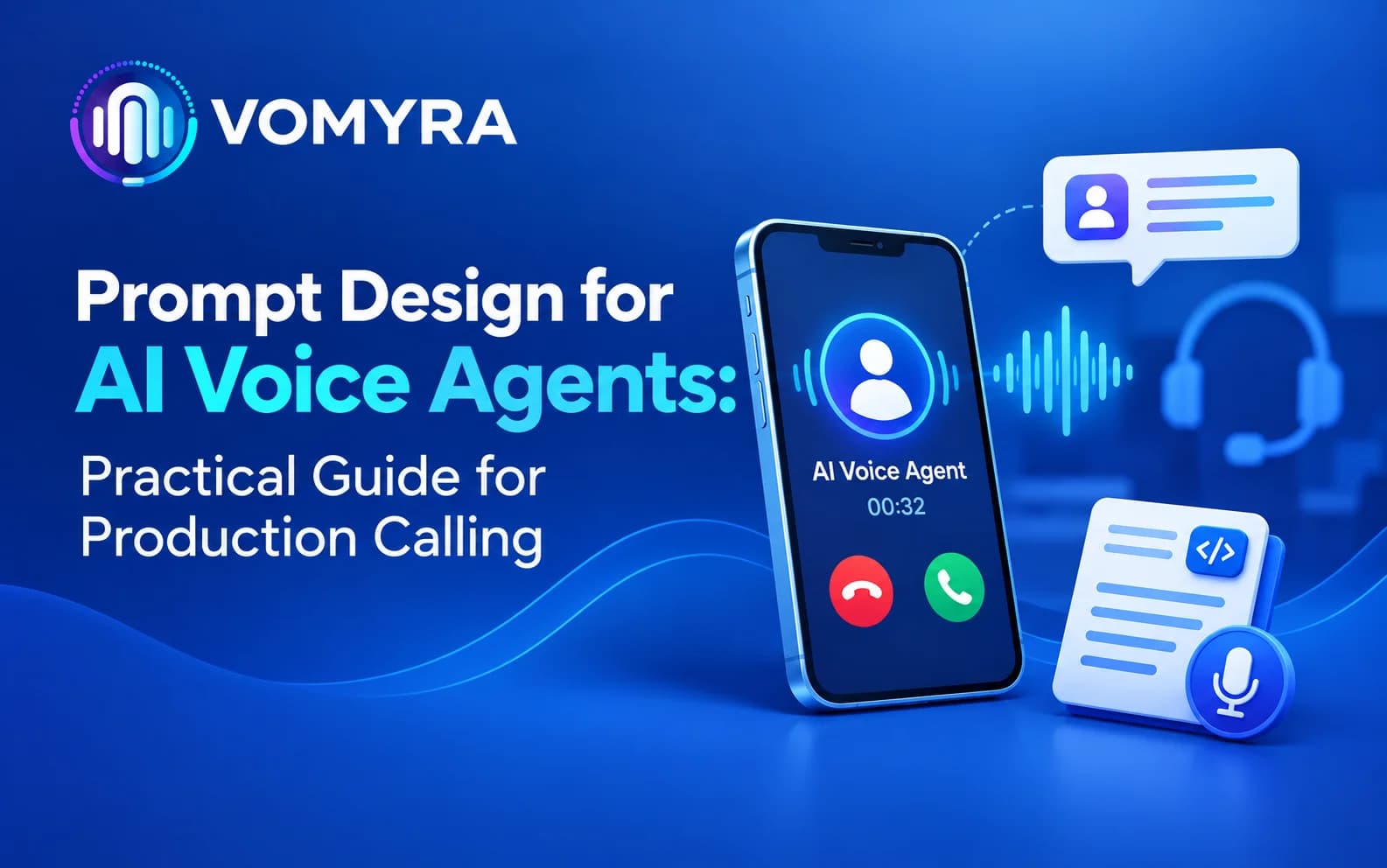
Two AI voice agents can run on the exact same underlying model, the same telephony infrastructure, and the same STT and TTS stack — and still perform completely differently on real calls. The difference is almost always the prompt: the instructions that define what the agent knows, how it should behave, what it’s allowed to do, and where it needs to stop and hand off to a human.
Prompt design for voice is a different discipline from prompt design for text. A caller can’t re-read a confusing sentence, can’t scroll back to check something, and won’t tolerate an agent that sounds like it’s reading from a script. Getting this right is one of the highest-leverage things a team can do when building or configuring a production voice agent — often more impactful than swapping to a “better” underlying model.
This guide covers what makes prompt design for voice agents distinct, the core components a production-ready prompt needs, and common mistakes that show up clearly on real calls — whether you’re configuring a single AI phone agent or an AI call agent handling volume across your business.
Why Prompting for Voice Is Different From Prompting for Text
A few characteristics of voice conversation change what good prompt design looks like compared to a text-based AI assistant — and directly affect how well any voice AI software actually performs once it’s handling real calls:
Responses need to sound spoken, not written Text-optimised responses often include bullet points, long compound sentences, or structured formatting that makes no sense read aloud. Voice prompts need to explicitly guide the model toward short, natural, conversational phrasing.
There’s no room for rereading A caller who doesn’t understand a response the first time won’t scroll back — they’ll get confused, ask again, or hang up. Prompts need to push toward clarity and brevity far more aggressively than a text-based equivalent.
The conversation is turn-based and interruptible Unlike a single text response, a voice conversation involves constant back-and-forth, interruptions, and partial information. The prompt needs to account for a caller who answers out of order, changes their mind mid-sentence, or asks a follow-up before the agent finishes.
Tone carries as much weight as content In text, tone is conveyed through word choice alone. In voice, tone is heard directly — so prompt instructions about pacing, warmth, and formality translate much more directly into how the agent actually sounds on a call.
Core Components of a Production Voice Agent Prompt
A well-structured prompt for a production voice agent typically includes several distinct layers, each doing a different job. This structure holds regardless of whether you’re building on top of an AI voice agent platform or configuring a standalone AI calling agent.
1. Role and Purpose
A clear statement of who the agent is and what it’s there to do — not just “you are a helpful assistant,” but a specific role: a qualification agent for a real estate business, a booking agent for a clinic, a support agent for an e-commerce brand. This framing shapes everything downstream.
2. Conversation Objective
What the call is actually trying to achieve — qualify a lead, book an appointment, resolve a query, confirm an order. A voice agent without a clear objective tends to meander, which is far more noticeable and frustrating on a call than in a text chat.
3. Tone and Persona Guidance
Explicit instruction on how the agent should sound — warm but professional, brief and efficient, patient and reassuring for a support context. Without this, the model defaults to a generic, often overly formal tone that doesn’t match the business or the caller’s expectations.
4. Conversation Flow and Structure
A general shape for how the conversation should progress — an opening, key questions to work through, and how to close — without being so rigid that the agent sounds like it’s reading a script when the caller doesn’t follow the expected order.
5. Knowledge and Scope Boundaries
What the agent knows and is allowed to talk about, and just as importantly, what it should not attempt to answer. This is one of the most important parts of a production prompt, since an agent confidently answering outside its actual knowledge is a common source of bad calls.
6. Escalation and Handoff Rules
Clear, specific triggers for when the agent should hand off to a human — a complex question, a frustrated caller, a request outside its defined scope. Vague escalation instructions lead to either over-escalating simple queries or under-escalating ones that genuinely need a person.
7. Tool-Use Instructions
Guidance on when and how the agent should use available tools — checking a calendar, looking up an order, updating a CRM — including how to handle a tool call that’s slow or fails, so the agent doesn’t stall or respond as if the call succeeded when it didn’t.
8. Response Length and Formatting Guidance
Explicit instruction to keep responses short, avoid lists or structured text that don’t translate to speech, and default to natural spoken phrasing rather than written-style sentences.
Common Prompt Design Mistakes in Voice Agents
Writing prompts as if for a text chatbot Reusing a prompt built for a text assistant, without adapting it for spoken conversation, is one of the most common sources of an agent that sounds unnatural — long responses, formal phrasing, and structure that doesn’t work read aloud.
Vague or missing scope boundaries Without clear limits on what the agent should and shouldn’t answer, it tends to guess or improvise when asked something outside its actual knowledge, which erodes caller trust quickly.
No guidance for handling interruptions or off-script answers A prompt that assumes callers will answer questions in order, one at a time, breaks down the moment a real caller answers three questions at once or changes the subject.
Overloading a single prompt with too much scope Trying to make one agent handle sales, support, and every possible query at once tends to produce a generalist that’s mediocre at everything, rather than a focused agent that’s genuinely good at its specific job.
No explicit fallback for uncertainty Without instruction on what to do when the agent isn’t confident in an answer, models tend to guess confidently rather than acknowledging uncertainty or offering to check — a pattern that’s particularly damaging on a call where the caller can’t easily verify what they were told.
Ignoring how instructions interact with tool calls A prompt that doesn’t clearly connect when to call a tool with what to say while waiting for the result often produces awkward silences or responses that ignore the tool’s actual output.
Read Also: AI Voice Agent for Demo Booking: Workflow, Benefits and What to Automate
Writing Prompts That Hold Up on Real Calls
Write responses to be heard, not read Draft example responses out loud, or have someone else read them aloud, to catch phrasing that looks fine on a page but sounds stilted or overly complex spoken.
Be specific about scope, not just capability. Rather than only listing what the agent can do, explicitly state what it should decline or escalate — the boundary matters as much as the capability.
Test against messy, real conversation patterns Prompts that work in a clean, linear test conversation often break down against real callers who interrupt, backtrack, or answer questions in an unexpected order — testing against this messiness matters more than testing against an ideal script.
Iterate based on transcripts, not assumptions Reviewing real call transcripts reveals where the prompt is actually failing — a misunderstood question, an over-confident wrong answer, an awkward tool-call pause — far more reliably than guessing what might go wrong.
Keep the prompt focused on one clear job A prompt built for a single, well-defined conversation type — lead qualification, appointment booking, order status — tends to perform far more reliably than one trying to handle many unrelated tasks at once.
Prompt Design Across Common Use Cases
AI lead qualification — prompts need clear qualifying questions, defined criteria for what counts as a qualified lead, and instructions for handling common early objections.
Appointment booking — prompts need to guide the agent toward offering a small number of clear time options and confirming details precisely, since scheduling errors are highly visible failures.
Customer support — prompts need explicit scope boundaries and escalation triggers, since incorrectly resolving or incorrectly escalating a support query both carry real cost.
Collections and reminders — prompts need built-in compliance language and consistent disclosure delivery, since this is one of the areas where consistency matters as much as natural conversation.

Voice Agents Built on Prompt Design That Actually Works
Getting prompt design right for voice — natural spoken phrasing, clear scope boundaries, reliable escalation, and tool-use instructions that hold up on messy real conversations — is a distinct discipline from writing prompts for text, and it’s one of the biggest factors separating a voice agent that sounds impressive in a demo from one that performs reliably in production.
Vomyra is India’s Agentic Voice AI Platform, built with prompt architecture already engineered for natural, reliable conversation across real use cases — Research, Outreach, Qualification, Closing and Follow-Up.
Businesses can launch complete AI voice agents without needing to master prompt engineering themselves, using real Indian mobile numbers and human-like conversations in multiple languages, with the AI voice automation already tuned for how Indian callers actually speak.
If you’re evaluating a voice AI platform for production calling, it’s worth testing how naturally it handles real, messy conversations — not just a clean demo script.
FAQs
Does Prompt Design Matter More Than the Underlying AI Model?
Often, yes, for practical production performance. A well-designed prompt on a solid model can frequently perform better than a poorly designed prompt on a more advanced model because the prompt directly shapes the scope, tone, instructions, and behaviour of the voice agent during real calls.
How Long Should a Voice Agent Prompt Be?
There is no fixed ideal length for a voice agent prompt. Focus and organisation matter more than word count. A detailed prompt that clearly defines the agent’s role, scope, tone, conversation flow, and escalation rules can work well, while an unnecessarily long prompt may dilute important instructions and make the agent less focused.
Should the Same Prompt Handle Multiple Types of Calls?
Generally, a focused prompt designed for a specific conversation type can perform more reliably than a single prompt covering many unrelated use cases. For businesses handling different call purposes, separate purpose-built agents or specialised prompt structures can make conversations more consistent and easier to manage.
How Often Should a Voice Agent’s Prompt Be Updated?
A voice agent’s prompt should be refined regularly based on real call transcripts, user interactions, and performance data. If the agent repeatedly misunderstands questions, gives incomplete responses, or struggles with certain situations, these patterns can indicate that the prompt needs to be adjusted.
Does Prompt Design Differ Between an AI Voice Agent Platform and a General AI Call Automation Tool?
Yes, generally. An AI voice agent platform built specifically for voice interactions may have its own prompt architecture, escalation logic, conversation controls, and language support. A general AI call automation tool may require more manual prompt engineering to achieve the same level of consistency across real-time voice conversations.