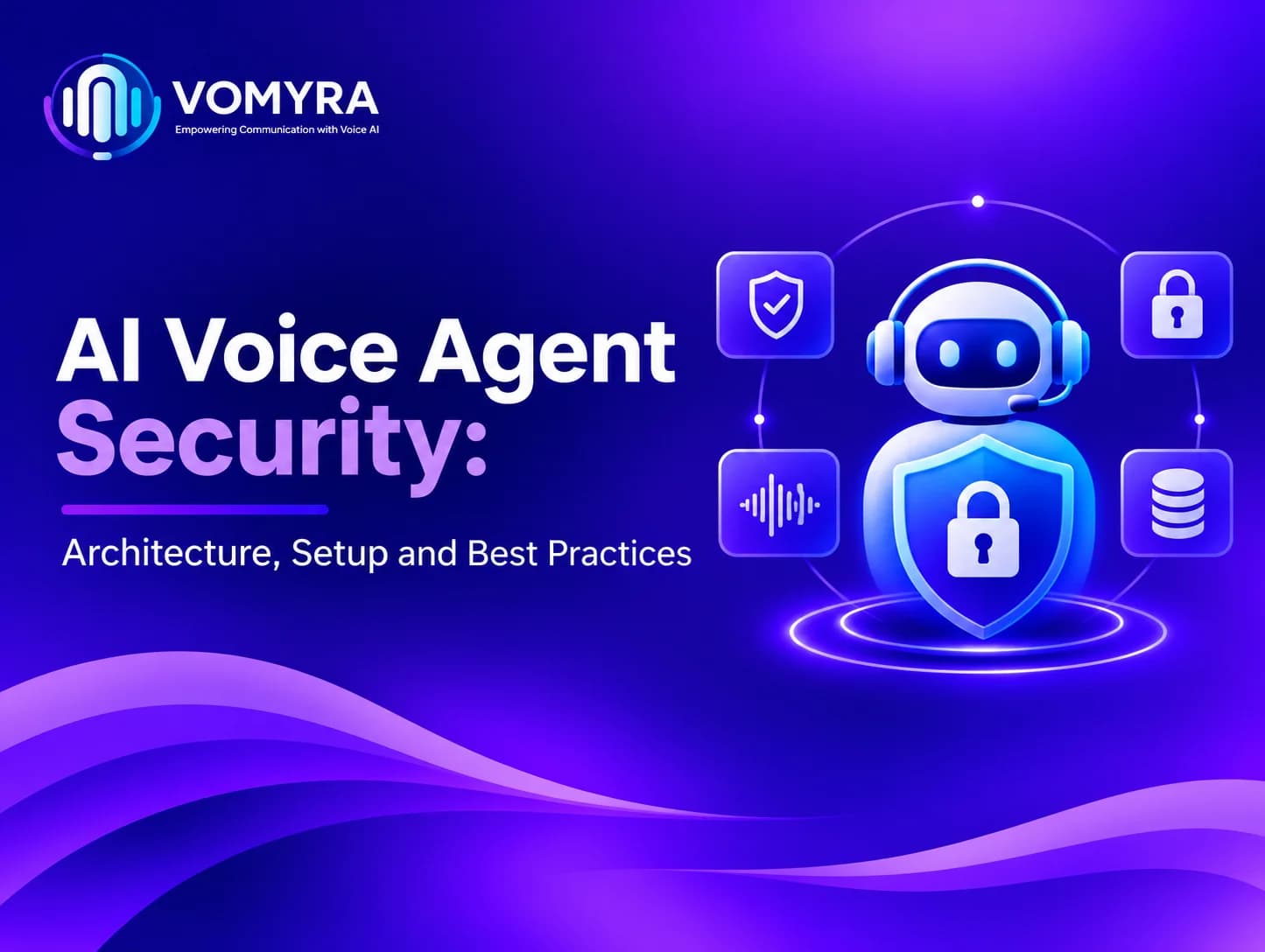
Voice is one of the most personal ways customers share information. They read out card digits, describe medical symptoms, confirm addresses and ask for account changes. When an AI voice agent handles those calls, security is not an add-on. It shapes the whole system.
Vomyra works with businesses that deploy voice agents at scale, and we see the same question come up again and again: how do you protect the data without slowing the product down? This guide walks through the threats, the architecture, the setup steps and the practices that matter most.
Why AI Voice Agent Security Needs Its Own Plan
Traditional phone systems had clear boundaries. Calls passed through a carrier and ended at a call center. Modern voice agents are different. A single call can touch speech recognition, a language model, a knowledge base, a CRM and a payment gateway. Each link is a possible point of failure.
Attackers have also adapted. Synthetic audio can imitate a real customer’s voice, and language models can be manipulated into revealing information or taking actions they should not. Good AI voice agent security treats the voice channel, the model and the connected tools as one attack surface.
Threats Worth Planning For
Most risks fall into a few groups:
- Voice spoofing: Recorded or synthetic audio used to pose as a legitimate customer.
- Weak authentication: Flows that accept a name and date of birth as proof of identity.
- Data exposure: Transcripts, recordings or logs stored without encryption or retention limits.
- Tool misuse: A manipulated conversation that causes the agent to call an API it should not reach.
- Misconfiguration: Open endpoints, expired certificates or over-permissioned service accounts.
Map these risks before you build. A simple diagram of every system a call touches often reveals a path nobody had considered.
Secure AI Voice Agent Architecture
A secure AI voice agent architecture separates duties and limits trust at every step. The core ideas are simple, even if the implementation takes care.
Least privilege for tools
The agent should only reach the tools it needs for a given task. A booking agent does not need access to billing records. Give each tool a narrow scope and review permissions regularly.
A policy layer between the model and the tools
Do not let the model call sensitive actions directly. Put a deterministic gateway between the two. The gateway checks identity, validates the request and logs the action before anything runs.
Separate storage for sensitive fields
Keep payment data, government identifiers and health details in a dedicated store with stricter access rules. Transcripts can then reference a token rather than the raw value.
Here is a quick comparison of a basic setup and a hardened one:
| Area | Basic deployment | Hardened deployment |
| Tool access | Broad, shared credentials | Narrow scope per task |
| Sensitive data | Stored in transcripts | Tokenized and stored separately |
| Authentication | Knowledge-based questions only | Step-up checks for risky actions |
| Logging | Minimal or none | Full audit trail of tool calls |
| Retention | Indefinite | Defined limits with automatic deletion |
Voice Data Encryption in Transit and at Rest
Voice data encryption protects audio and text at every stage. For data in transit, use current versions of Transport Layer Security (TLS 1.2 or 1.3) between the phone network, the speech services, the model and your backend. For data at rest, use strong encryption such as AES-256 for recordings, transcripts and backups.
Key management matters as much as the cipher. Rotate keys on a schedule, store them in a managed key service or hardware security module, and restrict who can use them. Encryption that is easy to bypass through a leaked key offers little protection.
AI Voice Agent Authentication
Authentication is where many voice systems fail. Asking a caller for their date of birth is easy to guess or find online. Voice biometrics can help, but they should not be the only factor. Synthetic speech can fool weak systems, and some government guidance for digital identity explicitly rules out voice biometric comparison for authentication in covered systems.
A stronger approach uses layers:
- A one-time code sent to a verified phone number or email for sensitive actions
- Knowledge checks for routine requests, paired with a higher bar for changes
- Step-up verification whenever a request involves money, personal data or account access
- Internal authentication for staff and admin tools, using multi-factor authentication
AI Voice Agent Data Protection and Privacy
Data protection starts with collecting less. Decide which fields the agent truly needs, and do not record more than the business purpose requires. Mask sensitive information in responses, so the agent confirms only the last four digits of a card, for example.
AI voice agent privacy also depends on clear retention rules. Define how long recordings and transcripts stay, who can access them and when they are deleted. Give customers a way to request deletion, and document how you handle those requests.
Be transparent with callers. Tell them when they are speaking with an automated agent and how their data is used. Clear disclosure reduces complaints and supports compliance with privacy laws in your market.

AI Voice Security Best Practices for Deployment
Before the first production call, work through a short checklist:
- Inventory every system, tool and data store the agent touches.
- Classify data by sensitivity, and mark which calls may include payment or health information.
- Confirm TLS is enforced on every connection, with no fallback to unencrypted channels.
- Restrict tool permissions and rotate service credentials.
- Set alerts for failed authentication attempts, unusual call volumes and repeated handoff loops.
- Run a red-team test with synthetic audio and adversarial prompts.
- Write an incident response plan that names an owner and a communication path.
Security is not a one-time task. Review logs, permissions and vendor settings each quarter, and retest after every major change to the model, prompts or integrations.
Conclusion
AI voice agent security works best when it is designed from the start. Strong architecture limits what the agent can reach, encryption protects data in motion and at rest, and layered authentication stops common impersonation attempts.
Privacy and retention rules then keep the system within the trust customers place in it. Vomyra builds voice agents with these principles in mind, and the same steps apply whether you are launching a small pilot or running calls across many locations.
FAQs
What is AI voice agent security?
It is the practice of protecting the voice channel, the language model and every connected tool from misuse, data exposure and unauthorized actions. It covers encryption, authentication, access control and monitoring.
Is voice biometrics enough to authenticate a caller?
No. Voice biometrics can add a useful signal, but they can be spoofed with synthetic audio. Combine them with a one-time code or another independent factor for sensitive requests.
How should voice data be encrypted?
Use TLS 1.2 or 1.3 for data in transit and strong encryption such as AES-256 for stored recordings and transcripts. Manage keys carefully, rotate them regularly and restrict who can use them.
How long should call recordings and transcripts be kept?
Keep them only as long as your business purpose and legal obligations require. Set automatic deletion schedules, and document the reasons for each retention period.
What is the first step in securing an AI voice agent?
Start with an inventory of the systems, data and tools the agent touches. Once you can see the full path of a call, you can apply least-privilege access, encryption and monitoring where they matter most.